Bed Bug Heat Treatments Explained: The Complete Guide to Eliminating Infestations
Introduction
When it comes to bed bug control, the pest management industry has come a long way. What once seemed like an insurmountable problem—bed bugs were so rare in the United States that they weren’t even mentioned in training manuals—has evolved into a sophisticated science with multiple treatment approaches.
But here’s the reality: chemical treatments alone aren’t cutting it anymore. Bed bugs have developed resistance. Steam treatments miss hidden populations. Freezing techniques can’t reach every harbourage. That’s where professional heat treatments come in—a method that, when executed properly, can eliminate an entire infestation in a single visit.
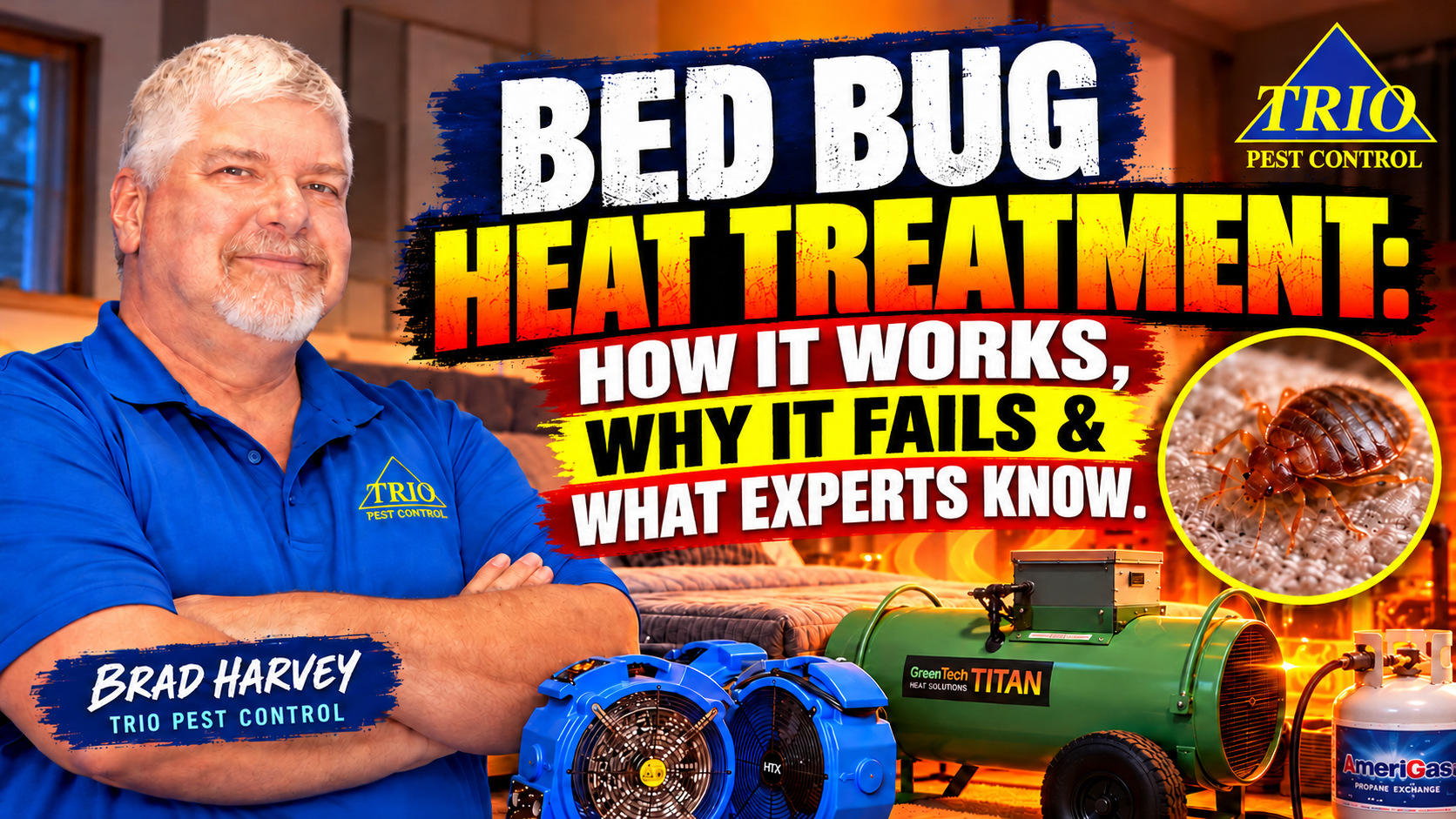
In this episode of Pest Perspectives, host Shaun Muller sits down with Brad Harvey, a 34-year veteran of the pest control industry and owner of Trio Pest Control, to explore the complete bed bug heat treatment process. Brad’s extensive experience—from his early days at Terminix through his current work and media appearances on Tales From The Crawlspace 2.0—provides invaluable insight into how this treatment method actually works and why it’s become essential in modern pest management.
The Evolution of Bed Bug Control
To understand why heat treatments are so important today, it’s worth looking back at how the bed bug crisis unfolded.
When Brad first entered the pest control industry 34 years ago, bed bugs simply weren’t a concern in America. The old nursery rhyme “good night, sleep tight, don’t let the bed bugs bite” was treated as folklore rather than a genuine pest management issue. The industry had no training protocols for bed bug control, no labeled products, and absolutely no expertise in dealing with infestations.
Then everything changed. Whether through international travel, the fall of the Berlin Wall, or the Gulf War—theories abound about how bed bugs returned to North America—suddenly the industry found itself “caught with our pants down,” as Brad puts it. The initial response was predictable: spray chemicals and kill every last one of them.
For a while, this worked. But bed bugs are remarkably adaptable creatures. They developed resistance to chemical treatments. Interestingly, modern bed frame construction itself contributes to this problem. Most beds are now pre-treated with pyrethrin-based compounds during manufacturing, which has inadvertently created an environment where bed bugs can adapt more easily to these chemicals.
As chemical resistance became an industry-wide problem, alternative methods emerged:
- Dry ice and rapid freeze treatments showed promise by causing rapid cellular disruption, but couldn’t reach every hiding spot
- Steam treatments became popular and remain useful today, but similarly struggle to access every possible harbourage
- Heat treatments emerged as the most comprehensive solution
How Bed Bug Heat Treatments Work
At its core, a professional bed bug heat treatment is elegantly simple: bring the entire structure (or specific rooms) up to a lethal temperature and maintain it for a set period. Done correctly, this approach kills all life stages of bed bugs—adults, nymphs, and eggs—simultaneously throughout the treatment area.
But the devil is in the details.
Temperature Matters—Critically
Not all heat is created equal when it comes to bed bug control. Brad explains the critical temperature thresholds:
100°F (37°C): This temperature causes damage to bed bugs but doesn’t reliably kill them. It’s not our target.
113°F (45°C): At this temperature, bed bugs will die, but it takes approximately 90 minutes of sustained exposure. This is workable but not ideal.
118°F (48°C): Here’s where we’re getting serious. Bed bugs die in about 20 minutes at this temperature.
140°F (60°C): This is the “butter zone”—the sweet spot for professional heat treatments. At this temperature, all life stages of bed bugs, including eggs, die immediately.
The practical target for most professional heat treatments is to reach and maintain 140°F throughout the structure. This isn’t just about comfort; it’s about certainty. When you hit that temperature threshold, you’re not gambling. You’re not hoping you got everything. You know you got everything.
The Challenge of Heat Penetration
Reaching 140°F in the air is one thing. Getting that temperature into every possible hiding spot is another entirely.
Bed bugs are masters of concealment. They hide in:
- Mattress seams and interior cavities
- Furniture joints and screw holes
- Wall cavities and electrical outlets
- Baseboards and crown molding
- Picture frames and headboards
This is where the technical expertise of professional heat treatment operators becomes crucial. It’s not enough to simply turn up the thermostat. Professional heat treatments require:
- Industrial heaters (electric or propane-based) designed to rapidly raise building temperatures
- Strategic air movers and fans to ensure even heat distribution
- Multiple temperature monitoring systems to verify that all areas—especially those difficult-to-reach harbourages—are reaching lethal temperatures
- Careful planning to identify cold spots where bed bugs might survive
Equipment and Treatment Execution
Professional heat treatment isn’t something you can accomplish with a space heater from a hardware store. The equipment involved is substantial and specialized:
Heating systems must be capable of raising entire structures by 40+ degrees Fahrenheit. Depending on the property size, insulation, and external temperature, this can require multiple industrial heaters working in concert.
Air movement equipment is essential for distributing heat evenly. Without proper air circulation, you’ll create hot zones and cold zones—and those cold zones are exactly where survivors will hide.
Temperature monitoring typically involves multiple sensors placed throughout the structure, with real-time readouts that operators can track. This isn’t guesswork; it’s data-driven pest management.
Duration matters too. A professional heat treatment typically takes several hours from start to finish—not including the prep work and post-treatment inspection.
Common Reasons Heat Treatments Fail
Despite heat’s theoretical effectiveness, failures do happen. Understanding why is critical for both operators and customers:
-
Insufficient temperature in harbourages: If you only measure ambient room temperature, you might miss that the interior of a mattress or furniture hasn’t reached lethal levels.
-
Inadequate treatment duration: Rushing the process or not maintaining temperature long enough allows survivors.
-
Cold spots: Structural features, exterior walls, or poorly insulated areas can create pockets where temperature doesn’t reach lethal levels.
-
Incomplete preparation: If customers don’t properly prepare the space or if operators don’t account for all harbourages, bed bugs can survive.
-
Lack of follow-up: A professional heat treatment should include inspection protocols to verify success and catch any survivors.
Heat Treatment vs. Chemical Treatment: When to Use Each
This isn’t necessarily an either/or proposition. While heat treatments are incredibly effective, they’re also resource-intensive and expensive. Chemical treatments remain valuable in many scenarios, particularly for:
- Ongoing preventative treatments
- Treating areas between heat treatment follow-ups
- Properties where heat treatment isn’t feasible
- Integrated pest management approaches combining multiple methods
The best approach often depends on the specific situation, infestation severity, and customer needs.
The Bottom Line
Professional bed bug heat treatments represent a significant evolution in pest control methodology. They address the fundamental limitations of chemical and steam treatments by simultaneously reaching every potential harbourage with lethal temperatures. When executed by knowledgeable operators with proper equipment and attention to detail, heat treatments offer the possibility of complete infestation elimination in a single visit.
However, success requires expertise, proper equipment, meticulous planning, and thorough follow-up. This isn’t a quick fix or a DIY solution—it’s a sophisticated treatment methodology that demands professional execution.
Want to Learn More?
This episode of Pest Perspectives with Brad Harvey covers far more detail about heat treatment execution, equipment selection, customer preparation, and real-world case studies from the American pest control industry. Whether you’re a pest management professional looking to expand your service offerings, a business owner considering heat treatment options, or simply curious about how modern pest control actually works, listen to the full episode for comprehensive insights from one of the industry’s most experienced practitioners.
Pest Perspectives is available on all major podcast platforms. New episodes release weekly, featuring expert guests, technical discussions, and practical insights from across the global pest management industry.