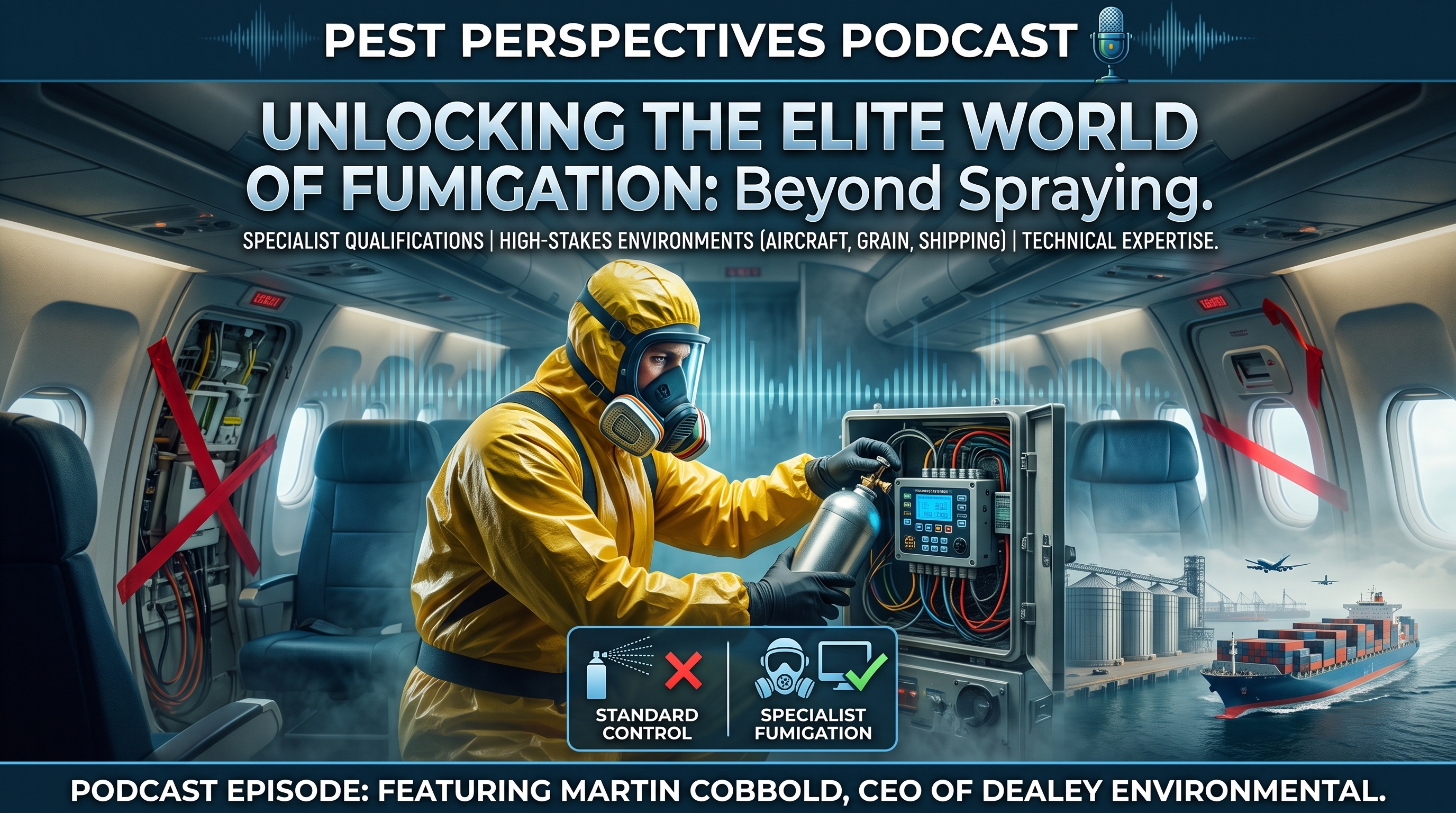
Fumigation Explained: The High-Stakes World of Pest Control's Most Specialist Discipline
When most people think of pest control, they imagine a technician with a spray bottle or a trap. But there’s an entire world of specialist pest management that operates at a completely different level—one that requires advanced qualifications, rigorous safety protocols, and deep technical expertise. That world is fumigation.
Fumigation is often confused with fogging, misunderstood by the general public, and sometimes overlooked even by pest control professionals who don’t specialize in it. Yet it’s essential work: fumigation is the only viable solution for certain infestations, particularly in high-value environments like aircraft, grain stores, and commercial shipping containers where traditional methods simply won’t cut it.
To shed light on this fascinating and complex discipline, we sat down with Martin Cobbold, CEO of Dealey Environmental, one of the UK’s leading fumigation specialists. Martin shared insights into what fumigation really is, the pathway to becoming qualified, and some compelling stories from the field that illustrate why this work matters so much.
Fumigation vs. Fogging: Understanding the Difference
One of the first things Martin emphasizes is the critical distinction between fumigation and fogging—a confusion that persists even among some industry professionals.
Fogging, or misting, is a common pest control technique where insecticidal liquid or powder is dispersed as a fine aerosol. It’s what many people picture when they think of pest control: a technician creating clouds of treatment that settle across an area to kill flying insects or surface-dwelling pests.
Fumigation, by contrast, is something far more specialized. It involves the use of gaseous pesticides—fumigants—that penetrate into spaces, structures, and materials in ways that liquid or powder treatments simply cannot. These gases can reach into the deepest crevices of a grain store, permeate the walls of an aircraft fuselage, or penetrate sealed containers. It’s a completely different methodology, requiring entirely different expertise, equipment, and certification.
This distinction isn’t academic—it’s fundamental to understanding why fumigation commands such respect (and such strict regulation) within the pest management industry.
The Qualification Pathway: Not for the Faint-Hearted
Becoming a qualified fumigator isn’t a straightforward journey. It requires serious commitment, specialized training, and a deep understanding of chemistry, safety protocols, and regulatory compliance.
The pathway typically involves obtaining specific certifications and licenses that vary by country and region. In the UK, for example, fumigators must be registered and hold appropriate qualifications that demonstrate competency in handling highly toxic substances safely. This isn’t a box-ticking exercise—it’s a rigorous process designed to protect both the fumigator and the public.
Martin points out that the investment required to become properly qualified can be substantial, and the ongoing responsibility is significant. Fumigators must stay current with regulations, understand the behavior of different fumigants, know how to calculate dosages for different scenarios, and—critically—understand the safety systems required to prevent exposure to themselves, their colleagues, and the public.
For pest control businesses considering whether to offer fumigation services, this qualification barrier is both a challenge and an opportunity. It creates a barrier to entry that protects the market for those willing to invest in proper training and infrastructure.
Real-World Fumigation: From Aircraft to Grain Stores
The true complexity of fumigation becomes apparent when you hear about the real-world applications Martin and his team handle.
Bed Bugs on Aircraft
One striking example is fumigating aircraft for bed bugs. Aircraft are particularly challenging environments for pest control. They’re high-value assets where downtime is extremely costly, and bed bugs can hide in countless locations—seat cushions, electrical systems, wall cavities, and more. Traditional treatments might miss infestations entirely, or require multiple visits and extended aircraft grounding.
Fumigation offers a solution: the aircraft can be sealed, fumigated with an appropriate gaseous pesticide, and the treatment penetrates every corner of the fuselage. It’s a decisive, comprehensive approach that minimizes downtime and ensures complete elimination.
Poultry Sheds and Red Mite
Red poultry mite presents another complex challenge. These mites hide in the structure of chicken sheds—in crevices, under roofing, and in equipment—making them nearly impossible to reach with conventional spraying. Fumigation can penetrate these hiding places, making it the only truly effective solution for severe infestations that threaten the productivity and welfare of the flock.
Grain Store Dangers
Perhaps the most hazardous fumigation work involves grain stores. These environments present multiple serious risks: the fumigants themselves are highly toxic, grain dust is explosive, and the confined spaces make rescue operations extremely difficult if something goes wrong.
Grain store fumigation requires meticulous planning, multiple safety systems, and deep expertise. It’s also critically important work—stored grain infestations can devastate food supplies, and fumigation is often the only practical solution for large-scale infestations. But the stakes are genuinely high, and the safety protocols must be absolutely rigorous.
The Growing Challenge of Insecticide Resistance
One of the most pressing issues Martin raises is the growing problem of phosphine and insecticide resistance in stored product insects. As fumigants have been used extensively around the world, particularly in grain storage, some insect populations have developed resistance to commonly used fumigants like phosphine gas.
This is a serious problem with significant implications: it reduces the effectiveness of fumigation, potentially requiring higher doses (with associated safety risks) or different fumigants entirely. It also underscores the importance of integrated pest management approaches that don’t rely solely on chemical solutions.
For the pest management industry, resistance management is becoming increasingly critical, and fumigation specialists like Martin are at the forefront of understanding and addressing these challenges.
Business Decisions and Industry Evolution
Martin also shares insights into business decisions that reflect the evolving pest management landscape. Dealey Environmental, for instance, stepped back from ship fumigation—a decision that speaks to changing risk assessments, regulatory environments, and business priorities.
The pest control industry is also grappling with broader challenges: an aging workforce, the role of private equity in consolidating the sector, and the potential impact of AI and automation. These aren’t just business issues—they affect the availability of specialist services like fumigation and the future of the industry itself.
Why Fumigation Matters
Fumigation might be a niche discipline, but it’s a critical one. There are situations where fumigation is the only viable solution—where conventional pest control simply won’t work. Understanding this specialized corner of the industry gives us a fuller picture of what modern pest management entails.
For technicians and business owners, fumigation represents both a challenge and an opportunity. It requires significant investment in training and infrastructure, but it opens doors to high-value work in specialized environments.
Want to dive deeper into the technical, high-stakes world of fumigation? Listen to the full episode with Martin Cobbold on Pest Perspectives to hear more field stories, detailed insights into safety protocols, and Martin’s perspective on the future of the pest management industry. Whether you’re a technician looking to expand your expertise or a business owner considering fumigation services, this conversation offers invaluable practical and strategic insights.
Listen to the full episode now and discover why fumigation remains one of pest control’s most fascinating and important specialisms.