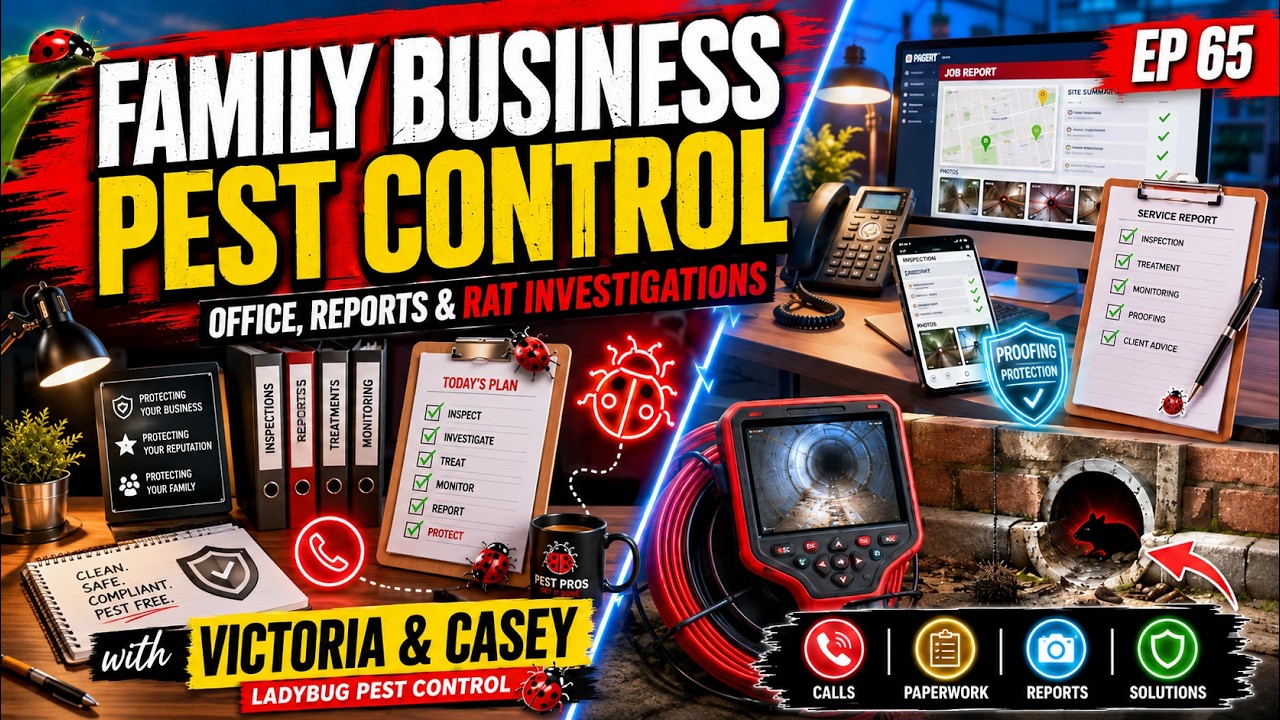
Running a Family Pest Control Business: The Reality Behind the Scenes
The Family Business Dynamic in Pest Control
There’s something uniquely challenging about mixing family and business. You’re not just managing employees and customers—you’re managing relationships that extend far beyond the office or the service vehicle. When your business partner is also your relative, the stakes feel higher, the disagreements cut deeper, and the victories feel more personal.
This is the reality that Victoria and Casey from Ladybug Pest Control know intimately. In a recent episode of Pest Perspectives, they joined Shaun Muller to have an honest, no-holds-barred conversation about what it really takes to run a family-operated pest control business in the UK.
From Roots to Growth: The Ladybug Story
Victoria’s journey with Ladybug Pest Control reflects the organic growth pattern many family businesses experience. What started as a personal venture has evolved into a multi-faceted operation handling everything from rodent control to drain surveys and wildlife management. But growth in a family business isn’t just about scaling operations—it’s about maintaining standards while navigating complex interpersonal dynamics.
Casey brings a unique perspective to the conversation, having grown up around the pest control industry and later choosing to return to the family business. Her experience represents a generational shift in family enterprises: the decision to actively participate in and shape the company’s future, rather than simply inherit a pre-built structure.
The Office Reality: Systems, Communication, and Customer Service
One of the most revealing aspects of the episode is the discussion around office operations. While technicians are out in the field managing rodents, bed bugs, and drain inspections, the office team is handling the backbone of the business: customer calls, email enquiries, invoicing, payments, and technician notes.
Casey’s role managing customer communication highlights a critical but often underestimated function. Answering phones, responding to enquiries, and handling customer expectations requires both pest control knowledge and genuine customer service skills. It’s where the customer’s first impression is formed—and where misunderstandings can quickly escalate into complaints.
The episode emphasizes the importance of clear, professional communication. When customers call about a rat problem, they don’t just want a technician booked; they want reassurance, clarity, and realistic expectations. Similarly, when explaining drain-related rat ingress or the need for proofing work, the office team needs to communicate technical concepts in accessible language.
Digital Systems and Modern Efficiency
Victoria and Casey discuss the implementation of digital reporting and paperless systems—a significant step for any pest control business. Moving away from paper-based records improves efficiency, reduces errors, and provides better documentation for compliance purposes.
However, the conversation also touches on an important cautionary note: the careful use of AI tools for pest control reports. While AI can assist with documentation and efficiency, it cannot replace professional judgment, site-specific knowledge, and the expertise that comes from years in the field. The goal is augmentation, not automation of expertise.
The Challenging Conversations: Boundaries and Responsibility
Perhaps the most candid part of the discussion involves the real challenges of working with family members. How do you maintain professional boundaries when you’re also related? How do you address performance issues or disagreements when you can’t simply “leave work at work”?
Victoria and Casey don’t shy away from these questions. They discuss:
- Communication challenges: Family dynamics can complicate straightforward business conversations
- Boundary-setting: The difficulty of separating “family mode” from “work mode”
- Responsibility and accountability: Ensuring family members are held to the same standards as other staff
- Conflict resolution: Navigating disagreements without letting them spill over into family relationships
- Flexibility vs. consistency: Balancing the flexibility family businesses can offer with the need for consistent, professional standards
These aren’t trivial issues. They’re the difference between a thriving family business and one that implodes under internal tension.
Technical Expertise: Rat Investigations and Drain Defects
The episode also delves into specific technical case studies, including detailed discussions around rat investigations and drain-related rodent ingress. This is where pest control expertise meets customer communication.
Rats entering properties through drainage defects is a common but complex problem. It requires:
- Proper investigation: CCTV drain inspections to identify the exact point of entry
- Clear explanation: Helping customers understand why their property is vulnerable
- Realistic solutions: Discussing proofing work, costs, and realistic guarantees
- Professional upselling: Recommending additional proofing work based on genuine need, not commission
The conversation around bed bug case studies and vulnerable customers also highlights the ethical dimension of pest control work. Managing customer expectations—particularly with vulnerable clients—requires professionalism, patience, and a genuine commitment to solving the problem rather than maximizing profit.
Growing Without Losing Standards
One of the underlying themes throughout the episode is the tension between growth and maintaining standards. As Ladybug Pest Control has expanded, Victoria and Casey have had to grapple with questions that many growing pest control businesses face:
- How do you scale operations without diluting service quality?
- How do you maintain the personal touch that built your reputation?
- How do you hire and train technicians who share your commitment to excellence?
- How do you document and systematize knowledge without losing the human element?
These questions don’t have easy answers. But the conversation suggests that the key lies in intentionality—being deliberate about which aspects of your business you scale, and which you protect.
Why This Episode Matters
For pest control technicians, this episode offers practical insights into the business side of the industry. For business owners, it provides validation that the challenges you’re facing—particularly around family dynamics and growth—are common and manageable with the right approach.
For anyone considering a career in family business, it’s an honest look at both the rewards and the real costs.
Ready to hear the full conversation? Listen to Episode 65 of Pest Perspectives Podcast to hear Victoria and Casey share more detailed case studies, specific systems they’ve implemented, and practical advice for managing a family pest control business. Whether you’re a technician looking to understand the business side or an owner navigating family dynamics, this episode offers field-tested insights you won’t find anywhere else.
Subscribe to Pest Perspectives for weekly episodes delivering practical pest management tactics, real case studies, and CPD-style takeaways for UK pest control professionals.