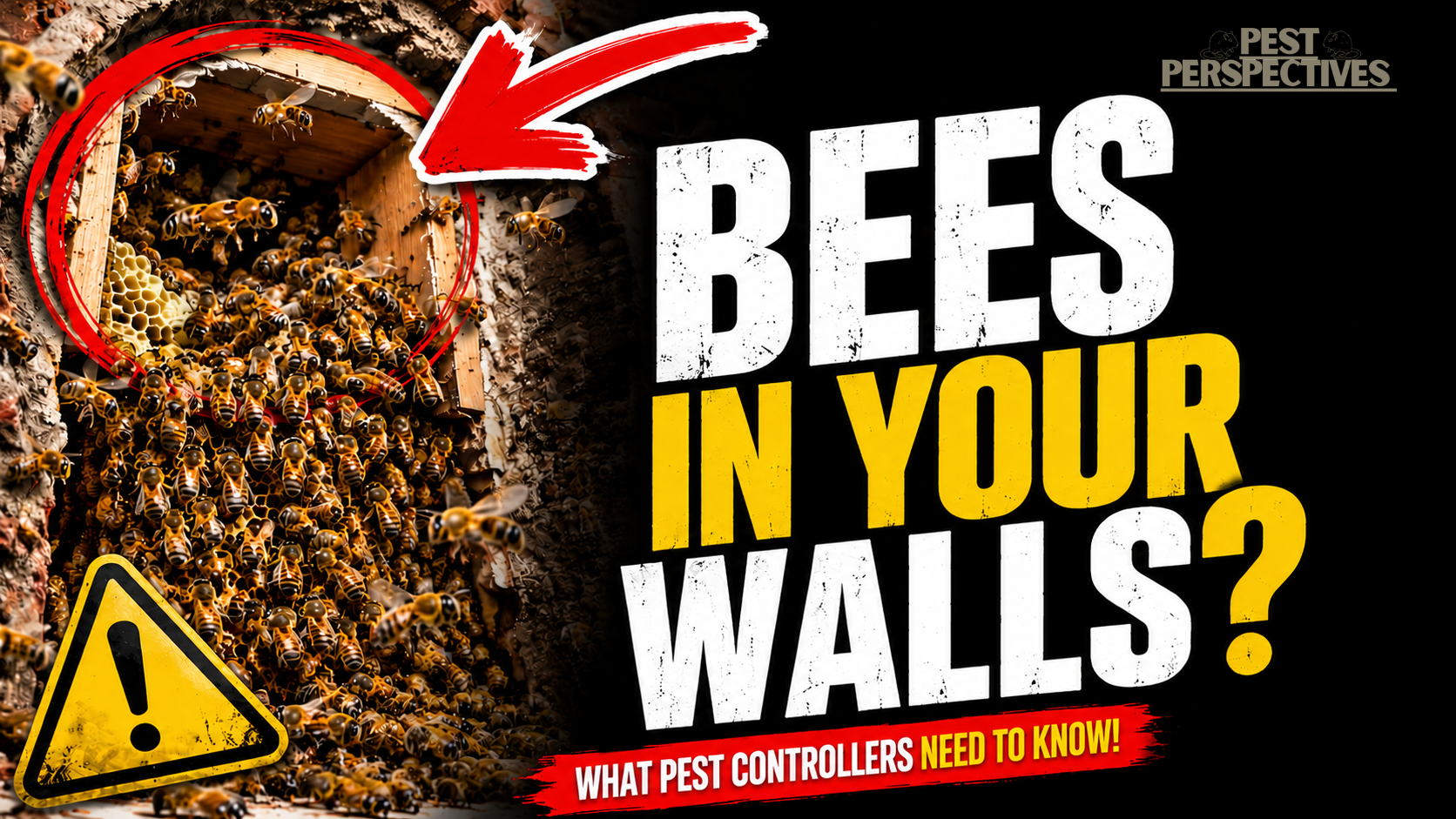
Understanding Bee Removal: A Pest Controller's Guide to Safe and Responsible Practice
Introduction
Bee-related callouts represent a unique challenge in the pest control industry. They sit at the intersection of pest management, wildlife handling, environmental responsibility, and legal obligation. Yet many technicians and business owners approach them with uncertainty, lacking the knowledge and confidence to handle these situations effectively.
In Episode 70 of Pest Perspectives, we tackle this head-on with Clive Stewart, Operations Director at Westart Apiaries Ltd. Clive brings a wealth of expertise in bee biology, safe removal practices, and professional training. His mission? To equip pest control professionals across the UK with the knowledge and skills to approach bee-related callouts with confidence and responsibility.
This episode is essential listening for anyone in pest control, facilities management, or property management. Whether you’re fielding bee calls regularly or dreading the next one that comes through, Clive’s insights will transform how you approach these situations.
Why Bee Calls Matter More Than You Think
Let’s be honest: many pest control businesses view bee callouts as an inconvenience. They’re different from standard pest control. They require specialist knowledge. They carry liability concerns. And they don’t always fit neatly into your service offering.
But here’s the reality: bee-related calls are increasingly common, and how you handle them reflects on your business, your professionalism, and your responsibility to both your clients and the environment.
The UK’s bee populations are under pressure. Honeybees, in particular, play a crucial role in our ecosystem and food production. When a colony establishes itself in a building, the situation requires careful assessment and appropriate action—not a reflexive pest control response.
This is where Clive’s perspective becomes invaluable. He’s spent years helping pest controllers understand that bee removal isn’t about eradication; it’s about relocation and responsible management.
The Critical First Step: Identification
Before any action can be taken, you need to identify what you’re actually dealing with. This sounds straightforward, but it’s where many callouts go wrong.
Honeybees are not the only bees that might establish themselves in buildings. You could be dealing with:
- Honeybees – the managed, colony-forming species that beekeepers work with
- Bumblebees – solitary or small colony nesters
- Carpenter bees – wood-boring solitary bees
- Wasp colonies – often mistaken for bees, but requiring entirely different management
The distinction matters enormously. A honeybee colony might contain 20,000 to 60,000 individual bees. They’re generally docile when defending their hive but crucial for pollination. Wasps, by contrast, are aggressive predators and scavengers. Mistaking one for the other could lead to inappropriate and potentially harmful responses.
Clive emphasizes the importance of proper identification before recommending any course of action. This is where your expertise as a pest control professional becomes critical—and where specialist training becomes essential.
When Does a Bee Colony Actually Need Removal?
Here’s a question that separates informed professionals from those simply reacting to client concerns: does this bee colony actually need to be removed?
The answer isn’t always yes.
A honeybee colony that has established itself in a building cavity, roof space, or wall void isn’t necessarily a problem that requires immediate action. If the bees aren’t causing a nuisance, if they’re not creating a genuine hazard, and if they’re not interfering with building operations, removal might not be the appropriate response.
This perspective shift is crucial. It moves the conversation from “we need to get rid of these bees” to “what’s the best outcome for everyone involved?”
In some cases, the appropriate advice to your client might be:
- Coexistence – leave the colony alone; they’re not causing harm
- Exclusion – prevent future access to the area without removing the current colony
- Relocation – safely remove and rehome the colony with a local beekeeper
Each situation is different, and each requires professional assessment.
Safe and Responsible Removal Methods
When removal is genuinely necessary, the methods matter.
Clive’s book, Safe Removal of Honey Bee Colonies from Buildings, and his specialist training courses exist because there are right ways and wrong ways to remove bees. The wrong ways can:
- Harm or kill the colony
- Create safety risks for your technicians
- Result in bees establishing themselves elsewhere in the building
- Damage your professional reputation
- Create legal and liability issues
Safe removal typically involves:
- Proper assessment – understanding the colony size, location, and access
- Appropriate equipment – bee suits, smokers, collection boxes, and specialist tools
- Correct technique – methods that safely capture and contain the bees
- Responsible rehoming – connecting with local beekeepers or apiaries for relocation
This isn’t something you can improvise. It requires training, practice, and ongoing professional development.
Building Your Bee Removal Capability
So how do you develop this capability within your business?
Clive’s courses at Westart Apiaries provide specialist training tailored to pest control professionals. These aren’t beekeeping courses; they’re specifically designed to give you the knowledge and confidence to:
- Identify bee species correctly
- Assess situations appropriately
- Advise clients on the best course of action
- Execute safe removals when necessary
- Connect with local beekeeping resources
Investing in this training does several things for your business:
- Differentiates your service – you become the professional who handles bee calls confidently
- Reduces liability – proper training and documented procedures protect you
- Builds client trust – clients appreciate professional, informed advice
- Opens revenue opportunities – bee removal services can become a profitable niche
The Bigger Picture: Sustainability and Professional Responsibility
Beyond the immediate business benefits, there’s a broader principle at stake.
The pest control industry has an opportunity—+and arguably a responsibility—to be part of the solution for bee conservation, not part of the problem. Every colony safely relocated is a win for your clients, for beekeeping, and for the environment.
This aligns with the integrated pest management (IPM) principles that professional pest control is increasingly built around. IPM emphasizes understanding the pest situation, considering all available options, and choosing the most appropriate, least harmful intervention.
Bee removal, done properly, is IPM in action.
Key Takeaways for Your Business
- Bee calls require specialist knowledge – don’t guess; invest in proper training
- Identification is the first critical step – know what you’re dealing with before recommending action
- Removal isn’t always the answer – sometimes coexistence or exclusion is more appropriate
- Safe methods matter – for your team, your clients, and the bees
- Training is an investment – in your professionalism, your liability protection, and your business differentiation
- Local beekeeping networks are valuable – build relationships with local beekeepers and apiaries
Listen to the Full Episode
This article only scratches the surface of what Clive shares in this episode. The full conversation covers practical case studies, detailed technical guidance, the role of environmental management systems in bee handling, and much more.
If you’re a pest control technician, business owner, facilities manager, or anyone involved in managing pest-related issues in buildings, Episode 70 of Pest Perspectives is essential listening.
Head over to the Pest Perspectives Podcast to listen to the full discussion with Clive Stewart. You’ll come away with the knowledge and confidence to handle bee-related callouts professionally, responsibly, and effectively.
And if you’re serious about developing bee removal capability within your business, explore Clive’s specialist courses at Westart Apiaries.
Your next bee call is an opportunity—not a problem.