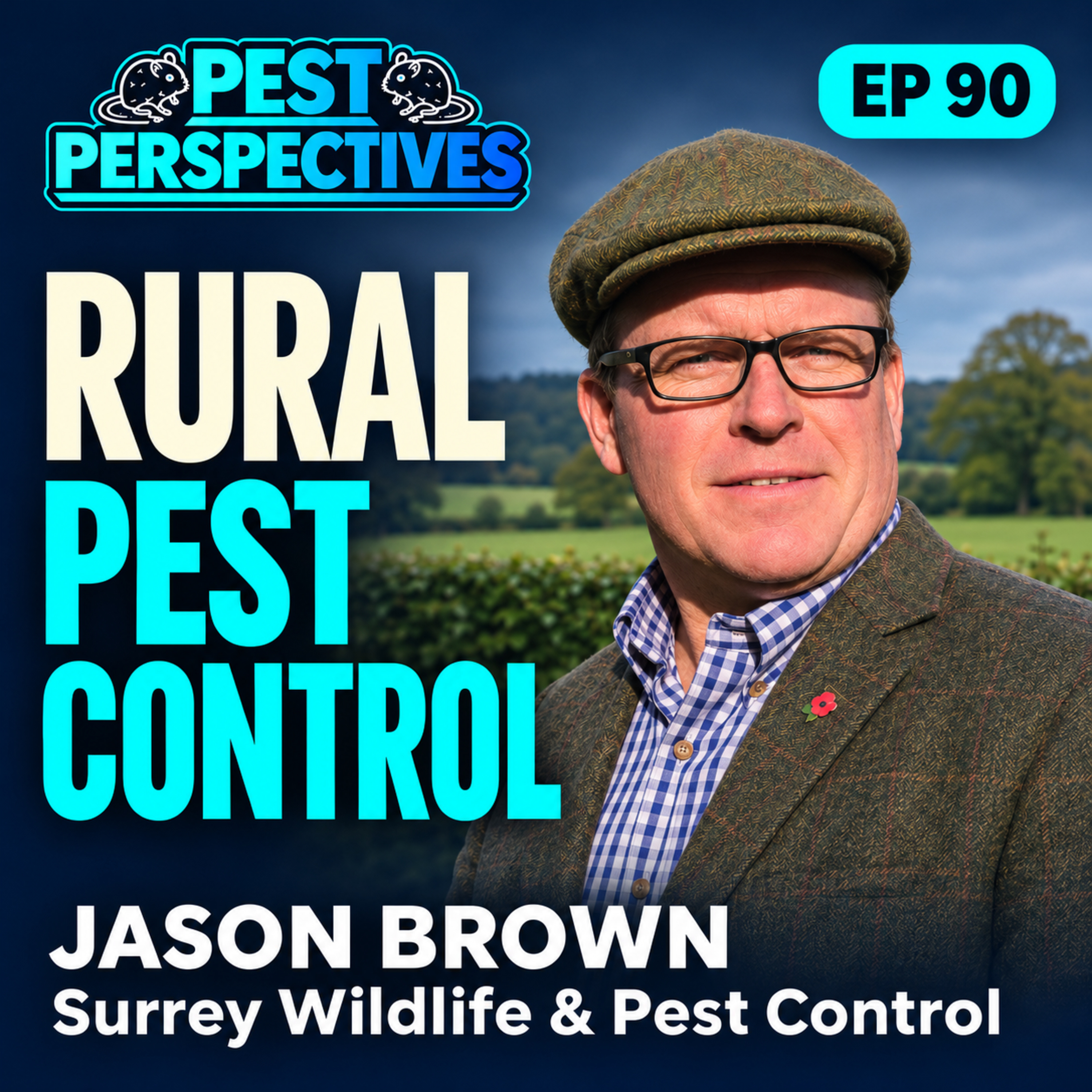
090:Working Dogs, Deer Management & Rural Pest Control with Jason Brown
In this episode
How do you train a new working dog for pest control, and where does animal welfare come into the decisions you make on a job?
For episode 90 of Pest Perspectives, I’m joined by Jason Brown from Surrey Wildlife & Pest Control. We talk about training his new Lakeland Terrier, the role of working dogs in rural pest control and how animal welfare shapes the methods he chooses. Jason also shares his experience of deer management training, and we get into the variety of his work across farms, commercial sites and people’s homes.
We also talk about his daughter Tegen, who’s joining the family business in January through an NPTA apprenticeship. She’s got a real passion for pest control, and I enjoyed hearing Jason talk about her taking her first steps into the trade.
Thanks to our podcast sponsors
Powered Now is the founding sponsor of Pest Perspectives and the job management software I use at Oakham Pest Control. It lets pest control businesses schedule one-off jobs and repeat visits, keep job sheets and reports with each job, and send quotes and invoices from a phone. Explore Powered Now’s pest control software
Periscope CFO was founded by Dan Traynor, a chartered accountant and author of Pest Control by Numbers. Dan helps pest control business owners work out which jobs and contracts are making money, forecast cash flow and plan for growth. Periscope CFO offers support for one-off projects as well as ongoing access to a part-time finance director. Find out more about Periscope CFO
Thanks to both sponsors for helping me cover the costs of making the podcast, and to Jason for coming on. If you enjoy the episode, follow Pest Perspectives on Spotify and share it with someone in the trade.
Transcribed automatically
Hello and welcome to Pest Perspectives episode number 90. I have Jason Brown from Surrey Wildlife and Pest Control. So we have two sponsors. We've got Powered now, as you can see at the top left, it should be. It's a business management software company. You can, I use it personally for the business. You can do all your appointments. You've got your diary, your pest control reports, all sorts. It's quite a good software program for all your pest control needs. You can check it out. There'll be a link in the description once the podcast has been uploaded.
Also, introducing Periscope CFO, top right-hand corner, which is Dan Treanor, the CFO and author of Pest Control by Numbers, turning busy pest control firms into profitable ones. Your support helps fund better equipment software and our website, allowing the podcast to grow. So thank you for supporting the podcast. So welcome, Jason. Thank you for having me. How are you doing? You all right? Yes, had a good Sunday. It's been a good day. Thank you very much. So all good. Yourself? Good to hear. No, it's been a while.
Yeah, it's been good. my wife's friend sent her a photo saying I'm thinking about getting the tree down so I have to get all the decorations you don't understand how much we're talking literally I'm looking at the tree's not up yet she's beat her this year and my wife's not happy her friend's beat her with a Christmas tree up but we have that much decorations mate I don't do any of it it takes weeks and weeks and weeks to get it all together. Right. That sounds like a lot of decorations there. It seems to be more and more every year.
It does. But no, yeah, thanks for agreeing to come on. It'll be fun. It will. So, Jason, for people who haven't come across you before, how would you describe what you do if someone was to ask you what you do for a living? Oh, sure. Well, when I walk around my hometown now, everybody calls me the rat man. Yeah, everybody knows me as the rat man. And from adults to children, they wave and say hi. I don't mind calling me that. But I deal with a lot of more mammals than anything else. From where I'm based in between Woking and Guildford, I've got commercial, industrial, as well as, fortunately enough, farms and, you know, large estates.
So it's a mixed bag for me. But the general public will probably just refer to me as the rat man. Yeah, I get it. I get the rat man, the rat catcher, the mouse man. That's a bit better. The wasp man as well. As well. So, yeah. It's quite funny, especially in the kids as well. yeah so i don't mind it at all so obviously i've been reading your website and it says you were an estate an estate manager before you started the business uh yes i was an estate manager uh many moons back and uh i worked at various estates merris wood being one and then from there i went to nurture landscapes as oh yeah yeah um which was very very stayed with them for 10 years great company to work for i had nothing to do with the pest control side okay early on b2b sites and dealing with um large-scale sites you know so okay and total it was great time wow a lot from it did did obviously going back to when you're on the states did that help you when getting into pest control did that knowledge and help you when you're being an estate manager did it help you with pest control at all i think it gave me a better understanding of what pest controllers have to go through and to understand about dealing with either rural care or a domestic care on that okay it taught me a lot because i was very lucky i had a um countryside and wildlife management team there um and arborists were there so you're getting a large mixed bag of everything that happens in the countryside.
Horticultural plays a big part in that because they're planting things that those creatures eat. So understanding what they're planting when the seasons, you know, squirrels are a problem in early spring because everybody's, the bulbs are coming up, all those fresh shoots. And now, you know, late October when they're planting the bulbs because they're just picking them up and eating them so you have to work with horticulturists oh i see okay gardeners and it just gives you a very good view of everything it's a great um because it's a minefield otherwise because you're having to deal with the landowner or an estate manager and then you're here within the gardeners or you're having to do deal with the countryside workers and they all want their own peace and they all want things controlled and working with them and getting their view on it is quite important.
I'd say, yeah. So you'd be more with all that knowledge and what you were doing, you'd be more versed to talking to farmers. I'm terrible. I'm not very good. Did that give you knowledge about talking to farmers? Because I swear to God, to get on with farmers you have to be a certain way or you now have to handle them yeah you do and the best way to handle a farmer is talk to the farmer's wife really okay yeah because they'll do as they're told yeah so because most of the time farmers are out doing it and it's i find i've personally i found that farmers wives are doing as well as keeping a very good household and doing what they do and and mucking in is they do the books they are helping out doing a lot more of that and i find actually going talking to the lady of the household is far more beneficial because farmers want a quick action a quick whatever it is whether it's deer management or you've got some form of vermin issue and they want it resolved quickly because they're busy doing other things yeah and talking to the lady of the house does get things done quickly.
Well, I'll tell you what, that's some topic by step, that is, because I don't, well, we do one farm, but I wouldn't call it a farm.
He's like a farmer. It's a grain store, basically. We just protect the outside of it. He stores grain in it, and that's other people's grain, and that's it. But he's definitely a farmer type, but he's not a farm. Yeah. There's no animals there, but you can definitely tell he's a farmer the way he is. Sure. But it depends where you are in the country and what you've got around you and what kind of farmer they are, really, is what we're dealing with. Yeah. So, yeah, no, you have some good advice there.
I didn't expect you to say that. Just tell them how it is, I thought you were going to say. Just tell them how it is. Yeah, that's sometimes. They're very plain-speaking men. They are very plain, and they don't want any bull. and they understand because they've got to deal with DEFRA and they've got their own pieces of legislation. They understand that. But the thing is, get the job done, get me some results, and you'll be all right. That's what they want to see. Because I've got a friend, if you've ever seen him on the podcast, Sam Tricky, from Tricky Pest Control.
He's rural and he's mainly, the majority of his business is farms. and he he he all he does is farms you believe this or not he's not got a website all of it word of mouth is the best thing with the farmers this farmer recommends recommend he's built his entire business yeah it's about word of mouth very very very difficult to uh get in with that they are you have to understand things about them and being and working with a Gamekeeper before. There you go. Working for Nurture for me gave me another insight because I'm a Lantra instructor.
I went into front contract management training team. So I went off and learned under a great guy called John Bevan, who's no longer with them, has his own company. Okay. And does some really great training through him I got. And I can talk tractors to them. I can talk trailers. I can talk power tools to them. okay that's a great icebreaker so it is a great icebreaker no that's good that is it's all these little little bits is but i'm gonna bring up something you mentioned you mentioned you've got a new working dog oh yes i did yes she's 18 weeks old now her name's lady she's a lakeland terrier so she's had already um it's a gentle introduction into the pest control world for her she's had three rats already she's doing very well okay you know so she's enrolled in some good classes i do my own training with her okay the other classes is for really just interaction with dogs of various sizes okay she comes to work with me she comes to the farms or She'll come into other jobs that we've got going on so that she gets used to meeting people, meeting animals.
And it's working well so far. Don't like the early mornings, but get up, Dad. Time to get up. Is that your first dog you're trying through being a working dog? It's my second. I actually had a Staffie. Yeah, and she was a great working dog. She was taught to be a scent dog. She was very, very good. If anyone doesn't know, that's the dog everyone making noise. Yeah, this is her. There you go. So she's playing with a bottle that she's found at the moment. You are a puppy. You're all right. Yeah. She's a good start.
She's a grand. And she's just happy in her own little space, happy doing her own little thing. and um she loves being outside that's good so yeah so she's very very good she's got the good acumen for doing that and i find with some of the domestic calls where i've been having a rat in a bedroom is quite scary for a homeowner especially young children and having a dog is a far more effective and ethical way of dealing with that than anything else i'll be honest with you i can't argue with you that would be the perfect way i mean send the dog they would not get away from the dog in the house they know exactly where the dog is and it is it is the best well so yeah it is the most ethical way because because sometimes you can't get the bugger can you you can't no and i've had scenarios where but you know they've literally had to go and sleep in another room and we've blocked the door um and you know you put down your traps and nothing yeah it's it's too frightened and it doesn't want to touch it it doesn't want to go anywhere it just sits in the corner petrified really exactly yeah but no it is a tool i think the industry or a lot of people could start to consider more now with how pest control is going because you've got to be more eco-conscious i'd call pest control more eco-conscious yeah nowadays i would that's kind of part of your ethos for your business isn't it
being more uh it's on you i think your website's more care for the environment or welfare of animals i think yeah the general public is more aware of that and and because i'm kind of it's not really it's it's large towns i'm in and but i've got a heck of a lot of countryside around me it's that appeals to my clientele it would probably be a different story if i slap bang in the middle of of preudem i'm i'm where i am i'm technically more like where you are i think i live in the smallest county in england i live in rutland right so that's very rural but i cover a bigger a big big radius i do go into cities as well so but um if you any if i if i did work in just we wouldn't have a business put it that way this is yeah it is exactly yeah but i totally get that so whenever your previous dog um you said you had a was that dog ratting ratting with you she would rap as well so she yeah she would rap but she was um a very good um blood dog she was very very good okay so if we had a case of um being a humane dispatcher um and i couldn't find it if i was you because thermal equipment is expensive oh yeah it is and um you can get some decent stuff now but um on you would find the deer very very quickly and when then we could um
um dispatch but dogs can find a deer as well yeah well i've never heard of that one before dogs find a deer okay yeah yeah absolutely it's a scent dog uh i mean i'm i'm really starting to get into a lot of i'm looking at other areas in in in my business for yeah um for scent dogs because they're a great dog to to have as well it's not only deer but they can track in america I mean, they're used for tracking humans as well. So yeah, they are. They are. Have you ever had a situation where say you didn't know a rat was there or something and you didn't realise it was there, but the dog did, where you thought there's no way, there's nothing here, but the dog's pointed it out to you?
Yeah. But it's again, understanding the dog's body language and understanding what that dog's saying to you. And if you're good with that dog, And that's why it's important to have early training, not just on the pest control side, but with other dogs. Because she'll learn from them as well, whether they're a fluffy Labradoodle or a collie or whatever. It's the interaction of that, and she'll understand that. So understanding your dog and understanding her mannerisms. She's a young dog. So if the door's closed, I know when she wants to go outside.
Okay. Because she'll walk around in circles and she's looking for a pace to do her business. Okay. She's understanding the dog's language on that. No, that's a fair point. I mean, yeah. Yeah, it's – because obviously I've had someone else on there before and I heard a story about, I think it was Kim that came on from America and she's got work in a lot of dogs. That's their entire business. Yeah. I think it was her that said they weren't allowed dogs to kill in the place. They weren't allowed them.
But they actually found the place where the mice were. They were behind in this office and it was behind a wall. We had to move a cupboard and that's where all the mice were. the dog sniffing out yeah but it's amazing because you wouldn't you wouldn't know otherwise would you well no i mean um a pestle where they had the um bed bug dog the the young lady there with the dog i mean that that i find that totally fascinating oh i missed that i'm so busy i missed that i've seen that was someone took a little video but it weren't all of it it looked absolutely fascinating unbelievable how something that is you know the size tiny tiny little thing and they can the pheromones that they can give off there they know what that is it's really clever it really is it it offers well because i it's it's a thing that i think has become more common but if you're looking to you know within your business you've got the right mindset because that will that will help you especially on farms and not on about but big thing on this pod i don't know if you do them i bet you don't do bed bugs do you do you do bed no i i'm i'm trying to do them but i've i've probably done like three ever okay i never i don really get a call for them where i am to be honest with you No I not inundated but i do know if you go in the cities that it it manic it is yeah but the bed book dogs that there a lot of people getting a dog to smell them out
but i don't think you can get a dog that can do that and rats and everything you can't they can't do everything can they you've got to train them especially i'm not sure i don't think that my one would be able to do that. But I think there's a certain breed for certain tasks. Problems. I mean, terriers have always been bred for that one thing, which is to control vermin. That's what they're there for. Exactly. It is. I'll tell you what, a lot of work I get, domestic work, the dog keeps sniffing in the garden here, the dog.
yes has the dog got the rat oh no no it won't do that it's really interested and they ring you out well what's this okay the dog's interested in this area and some a lot of the time they're right they are yeah absolutely they're definitely you know your main if they're living there all the time they're going if you can't see a run or you can't see a burrow or you you know they'll often I'll say let the dog out I'll follow the dog yeah but yeah but yeah it's been useful sometimes when their dog they go out every time i go the dog's in this bloody corner it's not normal in this corner you know so it helps sometimes not you know the pet yeah promise some pheromones can stay there forever that's the issue that that is the issue Yes, as well.
So sometimes looking at thin air and thinking there's been nothing here, but the smell is still there. Exactly. Have you, obviously I'm not on about with your new puppy, but with your other dog, when your other dog was fully trained, has there ever been a time when you've had a client standing around and you were trying to show them how good the dog is and the dog wouldn't play ball with you? Have you ever had that? I haven't had that no because it's a game it's fun to yeah it's it's it's a it's a reward and so they are at the end of that getting a reward um and it's you know it's very similar I'm sure you've seen it on some of the series on police work and what they do when they've got the dog dog and the the dog sits and then they give that dog a ball or a or a toy to play with it's a game and that's why you've got to make it as fun and as great for them as possible and if you do that then you're never going to go they won't get bored doing it they would it's a game that they're like as soon as she gets in the van with me she's like she's all booked in she's like yes i'm i'm off to work this is exciting what's happening yeah no it's good so you already got in her so it's already there no it's good that is so obviously being rural i see i've seen some testimonials or our testimony on your website about your mold work um yeah so do you like do you like doing mold control i you know i learned from a gentleman and i hope he doesn't mind me saying his name, Alfred Slade, and who taught me to do moles when I was at Meriswood.
And he really started to get my interest up into pest control. And he's one of the most knowledgeable, kindest men I've ever met, who was just a fountain of knowledge. And I said to him, can I come give you a hand one morning doing that? So he's a contractor for the... Okay. He said, yeah, sure, come out with me. And I said, where'd you start? All I can see is it looks like craters everywhere and, you know, mounds of the earth. And he just went, well, come with me, I'll show you. And he was walking around for ages and I said, why aren't you putting any near the mounds or anything?
And he said, because that's not what that's for. he says, I'm looking for their main runs. And he said, that's what I'm doing. And I'll have more success. And probably in a field of, you know, I don't know, 0.1 of an acre, something like that. He'd put down 10 traps, tops. Okay. Come back. Next day, they'll all be full.
He was not, he didn't even touch going anywhere, crisscrossing or anything like that. He was all about the edge. and so yeah and it was a that was the starting point for me and then i got into different things it's molding yeah i still get quite a few jobs yeah especially this year are you one of the do you do farm mold control or not or just domestic i do i do a lot of private schools mold control I do that and a lot of small to medium sized estates around where I live okay I can see yeah the the farmer I'll be honest they don't want to pay a lot do they no we went to one once and we wish we never went it was our own fault for not telling him and no he wanted to pay five pound a mole and that was it I was like it's not 1990 no No.
So I tend to give a field price. I give them two choices. I give them a price per mole, or you can have a field, you know, an acreage price, you know, depending on the farmer, depending what they've got. But they're knowledgeable people. They know what's on their land anyway. Yeah, they do. If you treat a farmer like he or she is a silly person, then you're going to come unstuck very, very quickly. Oh, yeah. No, definitely. I mean, I used to hate moles years ago. we used to do mould because obviously I worked with my dad and my dad used to do the moulds I didn't want I never was interested and I did my RSPH level 2 award in best management I met a lad called Scott and he kept saying there's loads of money in moulds now I said no there ain't it is quite good and after that after that I started to try to do it and I got it I'll be honest I'm not on the level you probably are where you're going oh this main run here and but I get the results.
I do. Also, there's certain times of mud. Sometimes you get like sandy mud. Yeah, because the only ones I use, I use the doofus barrels. I bet you use all of them, don't you? Do you use barrels? I use all three. So scissors, tablets and barrels. So it depends on the situation that you've got as well. So if you've got a couple tunnels that are coming in on one another, depending on which way, which angle they're at, you can use whichever type of trap for that. That just comes with experience. And like I said, I think I've learned from one of the best around, and certainly in my area.
And then I've watched a lot of videos as well and talked to other pest bees. There's not many videos about it almost. Right? yeah but uh talk to other pestis yeah some pestis that i've got around here are very open to talk to you we're all in the same business there's plenty of work for us but we are they're quite honest and um and helpful oh that's nice that is it's uh i'm yeah i i do enjoy it when i catched i remember when i first catched the mole i was so happy i was like yes yeah i was Then one year, probably two years ago now, I caught and my dad was like, oh, you're joking me.
I went, look at this. Two. He said, I've never done that before. He said, well, there you go. I want to catch a white one. Have you ever caught a white one? No. I have not had one. I've seen a few vids on that. And, yeah, that is something I think is quite a special one. And you can't, you have to do something with that when you can't, you know, whatever you want to do with them. That's got to be, even taken to a taxidermist or something, you've got to. Yeah. It would be cool. It would be cool. The albino ones, aren't they?
I'm sure they're called albino. They are. I think so. I'm no expert, aren't they? Yeah. No. I've not seen one at all. But no, Mum. Ever. No. I've seen them, pictures, but never seen one like, you know, well dead i mean yeah i remember one point they were getting there was people ringing around companies it was stupid questions about moles i don't know if you ever got any i was told about can't you live capture it and that would be that would be inhumane it would still die it would like a live trap under the ground it wouldn't even be possible but that would be breaking all sorts of laws that would be i've never been asked that no i got told the people I don't know whether they were journalists or who they were trying to catch people out, and everyone said, no, that's not allowed.
Never been asked. I've never heard of that, actually, live catching a mole. You can't do it. It's illegal. I'd swear that would be classed as illegal, because it would die anyway, regardless. Yeah. I don't even know how you'd do it. I'm sure it would just avoid it if it's seen it. I don't know what you'd use. I've seen moles on top of the ground, but normally that's because they've been pushed out by another mole. I've never seen it. I haven't. I've never seen that. I've never seen trying to life catch one.
I've never heard of that. I don't know if it was just someone being stupid or not. I don't know. They got told. I got told about it. It wasn't me. All right. But no, I have heard. I have people have sent me photographs of moles in their traps, as in, you know, rat trap. Right. They're getting there. Yeah. It's like the mole comes, you know, up at ground. It rolled around into a box. I was like, I didn't know that happened. Learn something every day. I've never seen it. I haven't. You have, obviously.
But you've never seen them above ground? Oh, sorry. Yeah, I've seen them above ground. Sorry, yeah. I've seen plenty above ground. Normally, it's a small mole that's been chased out by a larger mole. Okay. You'll see the larger mole or something being – something's happened for that mole to come out of that tunnel quickly. Okay. Okay. I've seen videos of them fighting as well. I have before. There were some videos on Facebook or something. I don't know. It's hard to tell. I was told by an ecologist that if they were the size of lions, we would be in trouble.
They're quite ferocious. and the strength of what they can do and how they can do things and the amount of soil that they could move around. They move extremely fast in their tunnels and their teeth, you know, they can cause a lot of damage if they bite. So if they were the size of a larger mammal, then, yeah, from what the ecologist was saying to me, said that, yeah, we would be on the menu. Oh, yeah. there we go learned something there that's a good that's a good fact that is um so how do you how do you do your deer management because you're into deer management um yeah that depends on the land what we're looking for and what we're doing we always do a full survey first yeah we need to see what's there how well they are um the amount of land that's there what damage they're doing um um again i have a i have a mentor a gentleman called bill davidson so um i've been working with him for 12 years okay um lots of great guys out there who do deer management as well um and just basically it's always we always start with the survey whether we get um a third party in to help us with drone technology thermal or we're on foot at different times of the day evening night and just going around with thermal equipment and counting and we just want to see what's there and then okay a lot of the states that i i work with you've always got someone from the forestry commission or someone like that who's there to help and guide as well because if i often find that you ask ask these companies for help they're more than willing to help you so we bring them in we get we get help and um we're there to make that landowner stay within the law
and um have a good environment because it's all about the biodiversity that's there and we try to help create a very good biodiversity on site for them no no that's good have you ever had it where i'm i know this might sound like a crazy question where say an animal is damaging the landowner's land but they love seeing the deer on their land you know oh bless them you know that kind of situation well that's that's about educating your client yeah yeah you're not eradicating are you no you're managing troller yeah so you are yeah it's a pure it is not you're not eradicating you want them there but you want a certain level there that allows the the the other biodiversity and the levels of biodiversity that you have in a forest or a to do what it's got to do which is to flourish to grow without being hindered by or predated on by deer so by doing that we're not eradicating them we're managing them okay this yeah I don't know I just thought I'd ask that one because it's it's not it's not a thing we do but I know it's it's a good there is a market obviously for it but I just one thing I wish the I wish the public were more educated on it like Death Row would do some campaigns explaining
why they need to be managed because they reckon I don't know I might be wrong that if they were left to breed and breed and no management was in place they reckon what is this right they reckon there's millions in the uk they could want there's always a number yeah there's always a number that's handed around and no one knows the british deer society doesn't know defra doesn't know no one knows i i can't remember when the last census was done and there's a great guy in the industry called glenn ingram who i've done a few courses with very man probably one of the best stalkers in the country very very nice to talk to very informative has a lot of knowledge and understands lives and breathes dear um you know i've done a few courses via the bds him and he's always got time to talk you know he's on social media a little bit and you can talk to him about stuff but again he's a gentleman that is very very knowledgeable in what he does okay that's good then that is because it's um many i know honestly many years ago before i was a pest controller there's this farmer on the train with my marriage yeah i had his dog with him and he says to me yeah but you know what boy do you know what's the most dangerous thing in the wildlife on my farm i says no idea he says
it's the deer what do you mean he says they come up and attack he says they come up to the farm and he says they attack my sheep i know they don't he says they do he's the dogs the dogs have been attacked by the deer i was like really yeah he said i said that that that amazes me he went yeah they're dangerous everyone thinks they're lovely and i wasn't sure if he was telling the truth he kept saying my sheep have been attacked by deer and the dog ass i was like Are you winding me up? This was long before I was in pest control, but he said it's when humans ain't around.
When we're not around, if we were around, it wouldn't do anything. It's when nobody's about. That's what he said. I've not heard that, but I presume they can. I think nature, you should never underestimate it, no matter what animal you're dealing with, whether it's mammal-based or insect-based or whatever. They're unpredictable, and you should always err on the side of caution. Exactly. I mean, that might not be true at all as well. A long time ago, before I was even in pest control. Yeah. Oh, wow.
You know, it might be, it might not be. So, obviously, your family-run business, you tell me that your daughter's going to be joining you next year. Yes. Yeah, I was quite excited about that. says um tegan's based in retail uh with a large market and has great great customer service and uh his management level there but has decided that she preferred to come on him with me uh which is a great time because we're we've i've reached a point where i'm you know i can't do it can't do it all Yeah so T can come in on board and go invite the 525 MPTA scheme apprenticeship schemes going to to be great So I don know which road or which way she going to go in Eskensville.
I'll support her in any way that she decides to go. It's down to her. But, yeah, very excited about it. That's nice. I mean, did she ever come out with you before she decided to come on? As in, was it a thing? She was like, Dad, did she come out with you? Yes. Yeah. So, yeah. So she would jump in the van with me, come out for a day.
So she'd come out and just come with me on the different jobs that we had. And I think she likes that it's a good variety to have and also that we can, you know, meet different people. and have different a good variety throughout the day so yeah and she just said um can i join can i come and work with you and i just went well okay well let's have a look see what's around see what we can do yeah and um contacted mpta and spoke with graham and um yeah he went yeah you want to do this I went great okay Mr Teagan applied for it and then she had an interview with Richard I think Richard Moseley from Syngenta yeah had an interview with Richard and well rest is history really she starts in the year that's nice that it's obviously I sit on the board of directors for the MPTA and when the idea came out we thought it was a good idea but we didn't realise on the level that people would apply or how known the project would be.
Because obviously I said, I said, it's going to be a big, it's going to do well. No, they were like, no, there won't be much interest. I said, you're giving businesses mentoring, training for free. They're going to, I need every single cohort they've done, it's been full. you know I think I don't know how many submissions they have etc but I believe it's quite well applied for I'm not involved in any of the process whatsoever just so you know I've got nothing to do with it I've met a few of them sometimes at PESSEC I have um but yeah it's a it's a good thing for the industry because as we know the industry does need more young people within the industry because I wish, I still say it all the time, I wish I knew about pass control when I was coming out of school.
I didn't know about it. Oh, yeah. I totally agree with you on that. I didn't. I didn't know about it. I was born in Kingston. I was on a Cambridge estate, so very towny, knew nothing about pass control at all. I think apprenticeships are the total way forward. It is. it's nice of um Syngenta and MPTA to fund all this it's uh yeah it's a good it's a really good thing because also what I noticed was there's also opportunities because there's someone on I think the current one that probably ended I don't know in the end but the one that's on the website um where a business has said we've got this lad uh or girl or lady um and we want to her a job but she's not qualified so one of them actually isn't with the firm but once they pass their qualification they get the job with the company so it's still a route it's still a route to market for that mpta company yeah and it is marketing as well oh and i feel the general public like it i really do i think your clientele like it you know when you bring someone in it's a young person and you've got an apprentice by your side i've had really good feedback from my clients that yeah not because um tegan's a woman or anything but because it's an apprentice so she's actually got it on a t-shirt oh is she okay an apprentice and they're like oh how did you get into this what you're doing that and she then explains the whole thing i'm not actually doing but i'm learning clients like that i think you know we should be doing more apprenticeships not only in our
industry but across the whole there should be more it used to be apprenticeships used to be a massive thing it did yeah for all for overall the industries and i think you know cuts and stuff over time yeah it's like in it i had a guest on once from my local area electrician actually and he reckoned that the T level is really T level at college is really difficult because say for instance you're with a firm and you have to be with a firm but say that firm has to lay you off, this is harsh yeah you have to find another apprenticeship straight away or they kick you off your T level after all that work it's not really fair, they should do more for young people within all industries you're right hopefully more apprenticeships come from within the pest control industry because obviously the 5x25 is MPTA members only.
But hopefully more comes along within the industry over time. But it's been a big success. But it's good to hear that your customers like it and that's a good thing because I imagine once it's all announced, you'll get a bit of publicity on social media too because yeah you will and it will help i i mean i think i think eddie business would welcome that um but you know it's a joint effort and i'm very proud of what she's doing um she's very very keen um i got my uh the british pest management manual down dusted it off and went yeah read that is it the old one where it's the last version yeah it's the last version i can't remember what year it was i said this may help you is it like a boy is it like a folder with a binder because i i went i went off that and there did be rsph level two and a lot of the stuff some of the stuff weren't in it no no it's a handy binder to have oh it is and i've got all my old paperwork from the RSPH level two as well.
And I said, look, you know, you can just, you know, just to help you. I think they have a lot of like, normally when you go through the RSPH level two, or the person management, I hate to say the full name, because that, but the day course I do as well. With the NPT, I believe that, see, if you were on a normal course, you just get your X amount of days, then you, then you exam. But with this, they actually have online training sessions. and I think that they take, I think from what I understand that they train them as well.
So you get a lot more work, a lot more time in, et cetera. So that's what I believe. I was told that they get a lot more training. That's what I said to her. You know, get as much training as you possibly can. I said, you know, it's great because the podcasts that are there and you can go back over them and she's going through them and looking at certain ones that are interesting to her. I appreciate it. There's plenty of them. Yeah, there is plenty of them, yeah. So she's definitely doing that, but she's quite happy.
No, that's good, that is. That's really good, that is. It's good to hear. So with biodiversity, you keep bees, is that right? Oh, yeah. I don't have as many as I used to. I've only got four now, four hives so I used to have a lot more it's time it really is time on that and so I manage around about eight hives for clients, which is good and again, that's quite a competitive market to be in as well but it helps as well because you are trying it's like having you know the rainbow cake you've got lots of layers and it's nice to have lots of layers and if I ever get stuck and because I'm a member of organisations I go and ask them there's nothing wrong with that I can't remember everything it's true it is it's it's it's good I don't I'm not in that world but I know I know people that are my mate Martin Belcher he's on he's on the board too and he's he does bee removals.
He's part of a, is it the, what are these, the local beekeepers? UKBR, the UK bee removal. And then you've got, you've got bee, I'm a member of Guildford Beekeeping Society. That's what I think he's in. I don't know if he's in UKBR, but I know he's done all his training with UKBR. Yeah. And you've got the BBKA as well, the British Beekeeping Association. It's one of them. But he's, I've had Clive on the podcast as well. I have UKBR as well I have he does a lot of he's still in his own right proper skill that is because Martin does anywhere from you know if bees are on your wall at the front he'll go and collect them and move them on for you he doesn't charge much for that at all and he says for that he says they moan at the price I tell them I think he goes locally just to pick them up no no 30 pounds he says that's a bargain but it's just what a money it's too it's too expensive that's just literally just to pick him up off the wall and move him up you know do what he does but he does proper bee removal and everything up on chimneys scaffolding etc so uh he doesn't it's still in its own right and should be recognized as that in in my book because um you know they're repairing everything they're doing it putting it back as it should be um and at the same time they're you know saving the bees so exactly so but yeah it's a it's a great skill to have i enjoy it it's just it is quite uh with with being working on my own yeah trying to get down there i can get through them quite quickly my hives but uh it's again and booking it in and so now they're all asleep that well i've put the high i call it putting
hives to sleep they're all nice and awake and doing their own thing but uh uh my hives uh might just put them to sleep now go back into them in march do you like what does that mean did you like secure it up so they can't get out on do you like so things can't get out it's just we then um depending on where you are in the country because it's all very very different and because of the temperatures are up and down throughout the country um i what i do is i i i take um uh my supers which is where the honey's made i put that on the bottom and then i've got a brood box which is where the queen is where she lays all her eggs and then they're moving in and out and then i put a crown board on and then i put and i feed them as well so uh you know commercial beekeepers will do have if you ask a beekeeper 100 beekeepers a simple question you're going to get 100 different answers okay all right so very much like that and then all i'm doing is i just put a bit of insulation in where my bees are and and then i just go down there once a month or twice a month and feed them and i use a feed that we just put on the top of the ground board, put the lid back on, and that's it.
I don't take them, don't do anything. Okay. No, that's fair. That is. It's something nothing I know about, but I have got a beekeeping book and not beekeeping. I've got a bee removal book. Clive sent me it. It's very interesting. Yeah, it's not as simple as people think it is. No. It's not. It's not. Lots of things are involved, scaffolding, brick repair, how you're going in, where you're going in from, structural issues. There's lots of things that those guys and girls have to think about when they're removing bees from a chimney, a roof, whatever they're doing.
It's a great skill to have, and they should be recognisable. It is. It is a skill. It is. Sometimes, like, see, this is what people don't realise. although you do a bee removal if they're dead it's still the same price. Yeah. It's to remove it all. Yeah that's it. I learned that one. It's yeah. Because you're still doing all that work. You're still removing the honey because it will attract others at some point. You're just removing it. I didn't know a bad autumn winter of rain constant raining chimneys can actually kill bees nests.
I didn't know that. Yeah well I think Yeah, from my experience, they don't like to be wet all the time. They can sustain that, but they don't like being damp because the cold can get to them. I've lost, you know, in the years I've been doing this, many hives. And it just knocks the wind out and you're like, all right, okay, clean it all up, burn it all off, go and get a new brood, start again. but I think if you're in it you're in it for the long run because it is I mean beekeepers are supposed to live longer anyway that's what they say well they keep saying you should eat honey your brain, your cleverer there's a thing for everything with honey but just make sure you buy real honey because I've watched a programme that apparently most of the stuff in the supermarket is fake apparently it's a scam it's a palm oil I think isn't it palm oil or something yeah so if that was ever expected i mean it was exposed but nothing happened there's too much money isn't there yeah there is too much money so but yes so um you know do you have a lot of farm work do you have a lot of farm work do you do any audited farms at all or not no no i've got no red tractor farms or anything like that okay i don't have any of them i'm i'm bidding on one at the moment.
I don't have that yet. Okay. Okay. Because there are some some ones that have got literally where you have to have the staff on site, on board. Because I've got a friend I said and he's got one I think it's for the the egg. I don't know. There's some way you have to check daily. Right. Obviously as a pest controller you can't be there every day can you? So you have to have in-house staff to check for you. Yes. You do. With some of the rules. like trapping all the time, but there's some big rules.
I don't even get that with Red Tractor. I've done Red Tractor. It's not... They're not nothing to worry about at all. Trust me. My paperwork survived. That's when we used to have paper. It's now digital. I've never done a Red Tractor one. They're all right, Red Tractor are. Just make sure you know what they're supposed to check. Because sometimes they can overstep the mark and ask for stuff they're not entitled to. right okay that goes before water so to be fair just make sure you you know what you need but uh on the spec but it can happen it can um so do you do a lot of um do you do a lot of domestic work as in yeah yes yeah rats mice and squirrels yeah do a fair whack of that i would probably say We're about 60-40, so 40% would be about rural.
Yeah. We're about 60% domestic. We've got, like I said, schools and other bits and pieces there. But, yeah, a lot of domestic. Do you try and find the root cause where they get – Basically, what I'm saying is where they're getting in, yeah? Yeah, absolutely. I've done via MPTA some great courses and proofing is far more effective. And clients, I feel, depending on where you are, are a lot happier knowing that. I still go into lofts and there's toxic strewn everywhere. And I still, yeah, I'm doing a job in West Byfleet at the moment.
And literally I'm having to say to the homeowner, we need to remove everything up there for you because it's just strewn everywhere. Yeah. Yeah. So what we do is go in and make sure that we can proof it. And it's normally something very, very simple. Girls will give it all away with the lead flashing and lifting up and warnaces. And definitely proofing is great for that. you know, putting in rat flaps correctly on that. So making sure that's done. And checking the drains. So we do a survey from top to bottom.
Yeah. You got a drain camera then? I haven't got a drain camera. No, I've got, I haven't got that yet. I met a couple of chaps at the show and I'm, they're giving me a call in January. Yeah. Because I've still got my bag down beside me here. Oh yeah. Let's get it. I got a few of them bags out of a spare one. We took some home. We did. And so cracking I had the time to go through but yeah we looking we looking to get a decent uh not not too expensive but we it a it an extra income for us yeah um as well um that we can add on to the survey and yeah it's quite interesting and i have a friend who is uh able to do a lot of the repair good so that's what you need that's a very good that is because we we offer proofing I'll be honest, we've done the proofing, but so far a lot of them haven't wanted me to use the drain camera.
It's a little bit extra. So it's all about the way you word it because our proofing is getting better, but I feel sometimes that because I tell them what he's doing, they try and go and do it themselves. That's the issue. So maybe I shouldn't, you know, a way where it's better for us to do it, you know. Yeah. Maybe I word it better or something. Yeah, maybe. I think you've always got to be careful with your words when you're in front of the client anyway, because they will go off and do that. But I try to understand the client and where they are and what they're from and a little bit of the background as well.
And, you know, because pest control can be expensive. Yeah. And we're in a time at the moment where we need to be careful. and you know it's a struggle for everybody and we've got to make sure that we look after our clients but also we're in a business you know so no exactly it's it's it's true i'll tell you what i have had a big proofing job before uh this year one and a half thousand pound job it was right big house basically proof proofing we just asked her do you want the house proofed up and we're only talking, you know, drain gutter.
All right. So the gutter is in the bottom and vents. But this house was that bit. This is a big, big house. Right. You know when you have suspended floors, you've got that many of them. So it was basically, that's pretty much all it was. But yeah, it came in at one and a half grand. I didn't think she'd say yes, but she did. but some of the products that are out there that were at the show were fantastic the new air vent covers you know you know we don't have to stick them on you can put them in and now twist and then it sits there nicely and it's allowing the flow to go through the you know some of the um gutter coverings that are at the show as well was great just to help against vermin getting on and and squirrels you've got a cover you're on about the one on the ones on the loadie stand yes my friend jason from aspress control he makes them yeah absolutely brilliant i looked at them and i went where do i get these from because that's because i do i you know you you've got the many different types that are out there and i always give the client the choice of what they want to do and how they want to look i don't just go and buy them i say look you've got these ones these ones and this ones but that there that's just so much nicer they are you can actually tell you what he does though as well uh not saying you have to offer this but he offers a thing where he goes back every few months for a small fee and takes a little bucket washes them out and sticks them back on maintenance plan that's what he does not saying you have to do it but you he offers it
to his customers i know i think we have to be as pestis we have to dive be diversable in what we offer yeah it's literally he says i go a little bucket a little bucket off wash it out and he says i do a little maintenance plan yeah that sounds great there you go write that down there you go i think that's a fantastic idea but he does it as well i mean technically speaking if you do sell the non uh you know the wrap flaps yeah you could technically do the same thing for them if you wanted to i i do go back and i and give the client if they would like me to come back on a either biannually or quarterly basis just to check on things yeah it's a thing you can do that so that is because it helps as well it's going because you're looking after you're not just looking after their home.
Yeah, you are right. If someone was coming here to look after my home, I'd want them to give me as much attention and detail as I do to my clients. Yeah, no, that's... No, it's true. Everyone shares ideas, but I do think that... I think that... It's a lot of it's education, isn't it? With customers. Getting them to... Sometimes a lot of people are like, oh, well... I don't know. I just, I've said to people before, you need to get this proofed up. No, I'll be fine. If they come back, because they will come back, especially with, you know.
But in the end, you've just got to get better at talking to customers and getting them to understand what you mean. Yes. I was never trained as a salesperson, never. I just started with my dad. I've never worked for a big company, pest control wise. and it's got to get better at speaking. I'm not very good at speaking to customers, but it's getting the point across about the proofing. I've made loads of articles on my website, though, for open pest control, and I think that helps as well. Yeah. But it's how you word it as well.
You've just got to basically say that, because it's rats, we need to find where they're coming in and get this fixed. Otherwise, this could happen in three months' time, six months' time, two weeks' time. You could keep getting it. over and over and over and over you need to fix the root cause but because that when we do proofing surveys they're free but when it comes to we need to stick the camera in we do actually charge for that because it takes a lot you can take a lot longer it does yeah unfortunately not many clients have took me up on the offer so you know well the one you know one thing i say to the clients is that we're neither you know superheroes are we not superman or superwoman we can't see what's going on underneath the house this is the third time you've brought me back for rats and i keep saying to you that it's in the drains um and you haven't had a drain survey done yeah so you know you could make your home as like fort knox but if they're coming from under underneath there's not not a lot we can do it unless you That's true because obviously when we would put a camera down in that situation we're not doing a drain survey because I'm not it's just having a look because if you do a drain survey you're supposed to be a drain surveyor so do a course on it there's quite a few courses to do but full drain surveys is a lot more involved than just having a look you map the drain, you do it Yeah, it's a lot more involved when you call it a full-drain survey.
But when that needs to happen, we refer parties to it. Yeah. You've got Davey Brown. Yeah. There's Darren Pearce. There's all sorts. I've done his course, Davey's. I've done Davey's. I've done two of his courses, and I recommend him. He's absolutely brilliant. He's on about doing an online course, but I don't know whether he's worked on it yet. That's what he was on about doing. at some point he mentioned it yeah at the show but he wasn't there for some reason so I did expect to see him there but yeah very knowledgeable man he's a very busy man that's the issue he's very busy like he probably never the thing he was talking about we'll see if it happens because he's that busy because he's got he's got a website drain domain yeah if you go on there it's a very good site anyone that wants to learn about drains if it's still up he was talking to take it down so I haven't seen I've not known that one I'll write that one down draindomain.com yeah if he hasn't took it down I would I would honestly try and copy and paste it all down so he could put it off but that was his site it's very old though you've got to appreciate it's very old but a lot of it's still relevant yeah it is it is I'm sure that's draindomain.com I'm sure that's what it was but yeah it's all ways of learning it is so yeah we'll have to tell you what we'll have to do as well at some point when your daughter's in the firm and properly established we'll have to see how you both see if you both come on and see how the dynamics are working because obviously I work with my daughter might be different but me and my dad
butt heads at times over nothing it's just the way it is but I can't see that doing the same thing with a daughter. I don't know. I don't know. She's very strong-headed in her own right. I never taught her to sit at the back of the bus, put it that way. I don't want to do that. I'll be at the front. And she's quite strong-willed and she's, you know, started at the supermarket where she worked as just a Saturday girl and she's worked her way up to being a manager, store manager. So she's done well what she's done.
So I have no doubt that she'll do well in this business. So no doubt about it. That's good, that is. I mean, who knows? With her, you could be in five years' time a multinational company. I'm joking, I'm joking. You know, I think there's a level I'd love to get to. I know it's going to be multinational. It's too much stress. I know. i was kidding sorry i say things like that as a joke a lot of people are happy when they there's a lot of people out there have got you know are happy if you by yourself or you're just too happy what you're happy with some people want a few people and that's it they stay that way yeah i i i agree i i would like to have that the plan is for us is that um when tegan parsons got a couple of years underneath her belt is that we get another apprentice in and i get another apprentice at the same time and we get to that point and then we can just expand a little bit we don't want to go too crazy don't want to go too big um and we want to serve our local community and specialize in certain things and work with other pestis on that and i think that's where that's where we would be i couldn't see myself doing being one of the big boys because it's just just too much stress and working for one of the big boys, but in a different capacity, looking across the desks, as a contact manager to them, and then looking and going, what are you doing?
What are you doing? Why are you doing that? I just, it's all about money at the end of the day and not quality. and we want to stay a company that gives has a very good reputation and gives good quality and if we stay small because of it then so be it that's fair at the end of the day if your business is you know you're making money and you're happy that's all that matters you don't have to be it doesn't matter you know I mean it really because obviously because of what I do I've always got the podcast on the board of MP and a lot of people think my company is much bigger than it actually is it's not i'm from a small little company from little old brookland you say but you're passionate about it and you're doing something you love exactly it is so it's and i wish i could have done it earlier i i wish i was um yeah i wish i had made that decision a lot earlier because it's honestly one of the best jobs I think in the world and yeah you have your bad days and your good days but it's yours at the end of the day you come home at the end of it shut that door and you go yeah it's always tomorrow and it's a good day today or a bad day so it's good it's basically solving problems I mean when I first started I'm a very different pest controller to what I am now yeah because I'm more about trying to solve the problem yeah uh it's you just learn don't you i've got better over
time comes with experience as well doesn't it and learning from different people you know standing in the middle of a loft and you're thinking all right there's no signs of anything here what's going on here all i can hear is squeaking and going on and you look up and you've got bats and it's not rats and so you think one of the biggest one of the one of the biggest um it's the poo in it get the crumbly long crumbly i'll tell you one i wish there'd be clarification on that it's the what you do i need to get someone on the podcast well i've i've had a bit of experience in that and i just contact the back and you can continue as normal i continue as normal because what i'm using isn't affecting them they don't eat what i got and they don't do and they're up there and the problem is on this lower part here yeah and i suppose as long as you ask don't you yeah you get an answer but I'll be honest we're all scared as controllers a lot of us are shut the hatch and walk away that's what most people do you can you can successfully get an oncologist but not everyone's going to want to pay for one of them are they no that's a frightening thought as well especially when you get called to a site and
you then go well I can't actually do this I'm not licensed why do you need a license just bats well the protected species yeah five grand a bat get a bat five grand each so a lot of money oh yeah yeah it's I still think it's an area that they need a definitive what we can and can't do because a lot of the advice out there of trade associations I'm not about anyone specific is very vague because of interpretations of the law and I wish there was a definitive yes or no from these kind of places I do but yeah I think we'll get there one day we will yes but no it's it's been fun to have you on the podcast I hope people have learnt stuff Thank you very much.
Because I'm pretty sure I have. It's been fun, mate. It has. So thanks for coming on. Thank you for the invite. No, thank you. So have you got anyone you'd want to see on this podcast? Not name. Well, it could be names or it could be certain kinds of people or areas I can look for. um it really depends on what angle you're getting what the the subject i mean i think i don't know if glenn would do it glenn ingram i find is one of the really interesting guys uh member of bds i think he's on i think he's quite high up and there he does he's a trainer for them and he does a lot of deer management and i think with rural your rural pest control audience that'd be quite interesting to hear from one of the guys that is you know like i said probably one of the best in the country oh i'll have to see if i can find him on linkedin or whatever he's definitely on linkedin he's easy man to find and yeah he's um i've done a couple of courses i did my humane dispatch and my my um uh dear society uh dear management level two with him brilliant guy okay i'll give it a go i will you say he says yeah jason brown's recommended you i'll say yeah thank you um and that i don't it's a good idea i mean your podcast cover all different you know genres of the pest control industry so i go a bit fast sometimes i go into business i go into any any facet sometimes sometimes it's not pest control sometimes it's related to business as well so i try and yeah cover everything and anything if i can't okay so no but that's great
because that helps i mean because we you know as you know running your own business it's you you can't you can't have the time to find out about everything and then trying to remember everything and then you can go back on a podcast and have a look and go oh right yeah that was said this was said depending on who it is and who you add on there so but yeah no it's great thank you very much for the invite no no thank you i will look him up and see if i can make something happen I will but yeah so thanks everyone and remember to like share subscribe follow helps the algorithm helps more people find a podcast follow on Spotify, Apple all your main platforms we do have it on Rumble as well when I remember to upload it on that platform it's on YouTube anywhere the podcast is you can watch it so just stay on the line for a minute I'll just end the recording so thanks Jason it was good so thanks everyone for watching
Sponsored by


 Spotify
 Apple Podcasts
 Goodpods
 YouTube
 Amazon Music
 Audible
 Castbox
 Castro
 Deezer
 Moon FM
 Overcast
 Pocket Casts
 Podbean
 Podcast Addict
 Podcast Republic