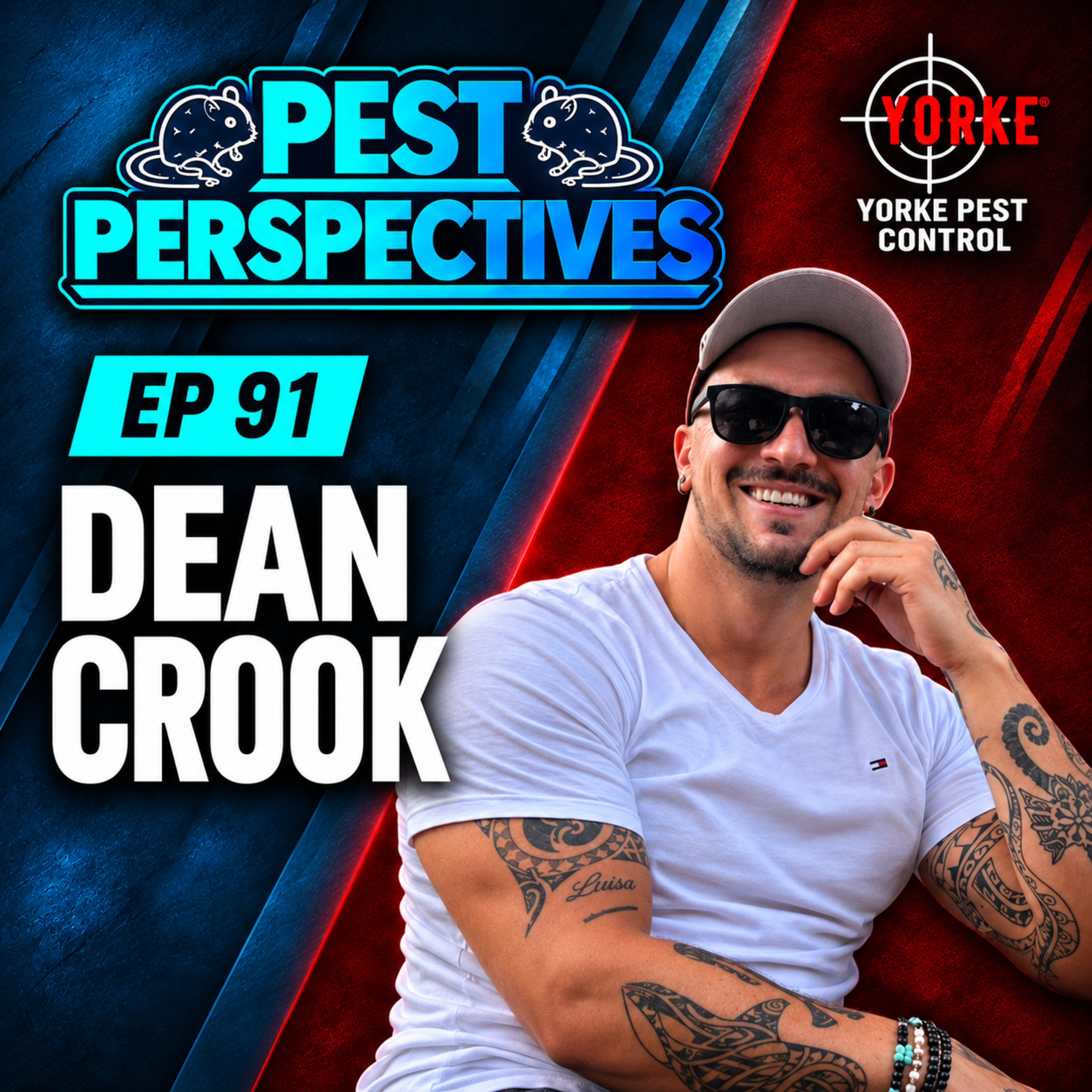
091:From Australian Termites to Running a London Pest Control Business | Dean Crook |
In this episode
091:
How does a pest controller from West London go from tackling termites in Queensland to taking over the business that gave him his first chance at 16?
In Episode 91 of the Pest Perspectives Podcast, I’m joined by Dean Crook from Yorke Pest Control. Dean went to Australia for a visit and ended up staying for around six and a half years. He talks me through getting his Queensland pest control licence, training to work with termites and timber pests, and what it was like spending a day drilling through concrete slabs in the Australian heat. We also get into the licensing debate here in the UK and what Dean took from going through the process himself.
Dean came back to the UK expecting to help out for a couple of weeks. After the death of Peter York, the man who gave him his start in the trade, Dean was offered the chance to take over Yorke Pest Control. He did it in 2020, just as the pandemic hit. We talk about what those early days were like when he was answering the phone, booking the work and doing the jobs himself. Dean explains why getting help with the admin made such a difference, how he moved the business from paper dockets to digital reporting, and how a 17-year-old who came in for work experience ended up joining the team as a trainee.
We get into some of the jobs that have stuck with us, too. Dean shares what it was like dealing with a bed bug outbreak across multiple floors of a care home and why infestations in blocks of flats are so hard to coordinate when different landlords are involved. He also tells me about a callout for bluebottles that led him under the floorboards, where he found rats coming in through a disused cast-iron drain. I share a job of our own where a sunken gully gave rats a hidden route into the kitchen behind the kickboards.
That leads us into a frank chat about selling rodent proofing. How much detail do you give a customer when you quote? What helps them understand the cost? And when is it worth bringing in a drainage engineer? We round off by comparing how we write our pest reports, with Dean using voice-to-text and me talking through where AI helps and what I still check myself.
Find Dean and his team at Yorke Pest Control.
Thanks to our episode sponsors
Powered Now helps pest control businesses manage appointments, reports, quotes and invoices. Explore Powered Now’s pest control software.
Periscope CFO provides specialist financial support for pest control businesses. It’s led by Dan Traynor, author of Pest Control by Numbers. Find out more about Periscope CFO.
If you enjoyed the chat, follow Pest Perspectives on Spotify, subscribe on YouTube or leave us a review on Apple Podcasts. Thanks for listening and supporting the podcast.
Hello, welcome to Pest Perspectives episode 91. Thank you for all the support recently on podcast with with your follows, recent likes, more subscribers in general over all over all platforms. You can also check out the website if you're struggling for CPD. They're all all CPD applicable. So whoever you with with BPCA, British press register and basis prompt. If you have any of them basis prompt, just tell them which episodes e-mail them. I know don't start people, you e-mail them and tell them which episode you listen to and what you learn and then they'll give you a point per episode.
But I think it's only up to six with with them. All the others, you can log what you like as long as you tell them what you've learnt. So yeah, thanks everyone. Just got a couple of sponsors, sponsors to mention. So obviously, as you can see above, we've got the Power of Now logo. So they're a business management software company who has been supporting the podcast since May. They do scheduling appointments, pest control reports, anything you need really. We, we like it. Our customers think it's quite cool and we always get commented that it's great.
But if you want to try it, you can always there'll be a link in the description after or just Google powered now. It's that easy. Also, we are sponsored by Periscope CFO Dan Trainer. He's the author of Pest Control by Numbers, turning busy pest control firms into profitable ones. So basically all all the support and sponsorship goes towards paying for new microphones like this web cameras, software, website, etcetera. So thanks for your support. And this week we have on Dean Crook from York Pest Control.
How are you doing mate? Yeah, all good, All good. Good to be here. How are you doing? I'm OK, Cheers. You're going to laugh though, because before I didn't know that I was listening to that podcast from the Best Pest podcast because I just didn't look into the company. I've always spoke to you. I didn't actually know where you were. I thought you were in York. Yeah, yeah, a lot of. People do. Yeah, yeah. You say you're pest control, so, so how did you, how did you tell you? What do you want to give people an introduction of who you are?
Then I can ask you some questions of like. Yeah, of course. Yeah, yeah, Yeah, that's true. Yeah. So we're your pest control. I took over the business in 2020. I worked for the business for many, many years before that.
Yeah, I took it over in 2020, just a small, a small business based in West London, in Brentford, kind of around W London areas. If if anyone knows those sort of areas, that's where we cover. So yeah, that's, that's, that's, that's, that's pretty much pretty much us, just a small business. Yeah. Right, good to hear. So there's a question I wanted to get into. How does AUK pest Control that end up with a licence to do pest control in Queensland, Australia? Yeah, I missed, I missed quite a little bit out there, didn't I?
So I went to Australia for, for a visit some, some time ago now and I just one thing led to the other and I ended up staying up there for about I think it was about 6 1/2 years. And yeah, so I, I, I definitely wanted to jump onto pest control out there and then. So I, as you can imagine, a lot of things out there, it's different to the UK. Everything out there wants to bite you, sting you and hurt you. Yeah, 'cause you some damage. So I started to get, I started to do my pest control licencing out there.
And licencing is a hot topic, I know, but licencing out there is quite a long process which is good I think. So it took me, it took me quite a while to get my basic licence and then I went into termites out there and that's a whole new world as well. So again, quite in depth timber pests licencing and stuff like that, pre purchase building inspections and stuff like that. So yeah, that's how I ended up with my QLD licence. Yeah, no, it's quite interesting. It's it's So what was your main pest out there?
Because he I know you're not going to say rats, are you? No. Rats. Snakes. Bloody. Crocodiles bloody. Did you like crocodiles? Yeah, resting crocodiles and stuff like that, That's what everyone thinks. But absolutely not like that at all. Rats not really to be. Yeah, you're right. Not, not really. Because if people have rats in their roof space, believe that I'm not most, most root by a hell of a lot of roof spacers out there where they'll have carpet pythons in there. So the rats will not last long in those roof spacers.
Yeah. Oh, really? Really. So that common thing is to have snakes in their attics. Very common and and and it's good because they're harmless. Python won't hurt you and it's like a live in free pest controller so yes. Happy days. I'll tell you what. When we put my Christmas decorations in the lot, I'll tell you what there was. Because obviously with snakes I've got I I'm gone. There was this chap who I did a rat job for few years ago and he says to me on my last visit, he says stay there, boy. He's older.
He just called me a boy. You know, I don't know why, but he said yeah. I said yeah, I was stood there and there was a snake came out there. I says no, you're joking. He says yeah, I'm a snake. So I says thanks for telling me. I was so cautious looking around. He wasn't there. I said it could have eaten the snake. It could have eaten the rats for me. You. Know, yeah. Yeah, yeah. I'm not, I'm not, you know, not a snake person, no. No. Did you used to deal with Obviously it's not obviously in in Australia, although you do snakes, I imagine it's not actually killing them, it's capturing them and taking them out.
Yeah, that's exactly that. You see a lot of videos where pest control firms are paid to literally just remove the snake and that's. It. Yeah, yeah, you, you can't kill them really. Which which you know, which is good. You know, there's no need to kill them. But but snakes, snakes out there is a bit of a speciality, you know, just like beekeeping is for us. I guess that's the best way for me to sort of describe it. So you'll have, you'll have special snakes, you know, snake specialists all go in and deal with all the snakes and they know the poisonous ones and non poisonous ones and stuff like that.
So did you do that? No, I, I didn't get involved in that. I didn't get involved in that. No, no. So it sounds like termites was your thing then, was it? Termites, yeah, was definitely our thing really and really interesting really, because like I say, I'm from London. We don't have, well not yet, we don't have termites. So it's a whole new thing for me to learn about just just incredible creatures really and really, really interesting because you don't just learn about the creatures. Then you learn about the timber pest and obviously over there like America, a lot of the timber frame houses and stuff like that.
So you learn about construction and yeah, it's really interesting. Termite, termite jobs were hard, very, very hard, especially in the heat and stuff when you be drilling all day into the to the slabs and oh, it's back breaking work, but it's all good fun, yeah. No, no, mate, it's, it costs a lot of money to, you know, the jobs are thousands. Aren't they literally because because they're wooden? The house is wooden in Australia, yeah. Yeah, well, they're all. They're all. Yeah, yeah. It's like America then, yeah, basically.
So you're basically protecting someone's house because they could literally make the house fall down. Yeah. And they do, you know, you, you know, Yeah. They cause so much damage. Damage. So it's it's it's a crucial part of pest control out there is termites. Yeah, for sure. So, yeah, it's all good, Yeah. It it did you ever do the ones of I'm obviously being completely yeah, I don't know nothing about them. Did you do you ever do the ones with the tent where you had to tent the house is? That no, no, I've I've never not to my knowledge.
I don't think they do that AUS. I think that's not just specifically America, but I know they do do it in the states. I don't think they do fumigation to to that level on a domestic level in, in, in in Australia, but. I don't know they are, they are quite a strict country, isn't they? Because they've banned glue balls long before the Uki mean, I everyone technically they're not banned, but they really are. They've made it that difficult. You might as well call it a ban. Absolutely. I've never used them actually.
Oh really? Reason to use them? Because I've, I've never had a situation where you've got rats running around the kitchen, you see, And in the there was one case, but we had to, we sorted it out of a different method. Right, right. But. Generally I've never had to use them. When I had that situation, the glue boards weren't available. I couldn't have used them. I see. Yeah. So they they've banned them a long time ago, didn't they? But they are in the UK. They are wrong with that. Or is it? Yeah. It's, it's, it's been a while since I've been out there.
It's getting up 10 years since I've been back here. So as you know, things changed quite regularly. So I can speak for now, but yeah, a little bit more flexible, I'd say, out there, to be fair. Yeah. Oh. That's fair. So apart from termites, what what else did you you do? Well, a lot of basic things, you know, mice, not so much rats really, but mice, rats, cockroaches were big out there. OK. Yeah, very, very, very common. American cockroaches were the were the were the biggest, the biggest issue there.
Weirdly enough, not so many Australian cockroaches. It was mainly American cockroaches. Yeah. It's crazy, crazy, right? Just like us, like the German cockroaches is our common cockroach, so it. Is, I mean, do you, when you were there, was the gels, was that it or were people spraying? Were you spraying or gels? Both, both to be fair. So we'd sort of spray with people's houses. I know you watch some of the lot, the American podcasts as well. So what we do is periodically we'd go around houses and we just periodically we'd spray all the outside, like the whole house, all the outside.
We'd spray it all for spiders and, and then you'd get the Ant it killed, it knocked down the ants and, and everything like that. We spray the whole house externally from a we had tanks on the back of our trucks and with hoses and, and engines on them and just the whole, the whole, the whole set up. And then internally you'd go and spray you border sprayed in all the houses inside. And then you gel the hinges of, you know, like you would for cockroaches. And you do that periodically. Yeah, yeah. It's men, it's mental on it.
Yeah. When you tell them, when you tell them we can't do that. Like what? It's like you can't do that. You have to. You just can't do that. Because when they're outside, they're not, none of them. Well, there's nothing on the label, but they're not actually a pest until they're inside.
Yeah, absolutely. But they just, they just can't, a lot of them can't get heads around it. It's a different, Yeah, it is. It is very different. That's why I say. That's why I said it's a bit more flexible out there in terms of you can, you know, as long as with, with, with reasonable justification, you can say, well, I'm going to spray the whole house because it's covered. It's covered in spiders. It's Australia. It's it's going to be covered, you know, covered in spiders to an extent. We're going to have a huge issue with ants and, and, and everything else like that.
So there is justification. It's not just spraying people's houses just for no reason. Now I think there is justification, but it's a bit more flexible in terms of, I think they realise, well we this is quite important, who's to spray outside And we're not, we're only spraying the houses, we're not spraying fields and, you know, spraying stuff like that. So yeah. That's fair. So yeah, that was a good experience. So. So before you went over there, were you qualified as a pest controller in England already?
Yeah, yeah, absolutely. I kind of like like everyone else. It's a such a common story I saw fell into pest control when I was 16. One of my neighbours said to me who works in a pest control office locally. Oh, I've got a job in pest control. Well, there's a job in my firm for pest control. Would you be interested? And I and I was just like, what is pest control? I honestly no idea, but yeah cool. I'll I'll jump in and have a look and did some did some experience. I just I just fell in love with it.
It's just brilliant. Again, something that everyone says, but every day really is different as you know, yourself. It's, there's no two days are the same. It's different. It's challenging. You're not set in one, you're not sat in one location. It's not really that monotonous unless you, you know, but generally speaking it, it's, it's very varied. So I did that when I was 16 just, yeah, just kept going with it. I did my RSPCH when I, when I was, I'm going to say 18. I'm not, I'm not sure. So sure, but a couple of years after that and yeah, it's just non-stop learning.
As you know yourself, you don't get to a point where you go, well, I'm finished now. I'm I've I've reached this this level where I can't get any higher. It's. A take one thing though, I know you say that, but when I first got into pest control in 2020 and there was going to the shows and stuff, I heard old boys at shows saying they don't need, they don't they know everything. And nowadays when you go to shows, you don't get them kind of people anymore. A lot of the a lot of the a lot of that's gone and a lot of them are more into learning more.
I think there's been a shift where I did you did hear it. I don't I'm only come from my points. I won't learn anything, I think, but but then, but I would say now you don't get that so much because a lot of them will. Oh wow, I know everything You can't teach me and I think. No, honestly, every day, every day I, I think you learn something to, to an extent, whether it's, whether it's about the business, whether it's about running your business, whether it's about pest control or something, you will learn something every single day.
And I don't think anyone can say, oh, you know, I, I know everything there is to know about pest control. Because Oh no, oh, I did. I did hear a lot, a lot negativeness about them, but it's kind of vanished over the years. That has, yeah, maybe maybe some of them people have retired or changed their ways. I don't know who they were, but I was very new. I didn't. But then I didn't know anyone, you know, like I know a lot of people now, obviously. Yeah. Yeah. I never knew anyone, you see. So that's what I've took from it.
But we have met in person. We have. We have. Yeah, yeah, yeah, very briefly for Yeah, for the first time. Yeah, yeah, yeah. That's good. The MPTA Pestech on the door and it was like a blur because I said to people, I'm so sorry if I didn't tag you or whatever, because it says I spoke to that many people. It was unreal. And it was difficult because obviously I'm trying to give out the the bags, etcetera, wall saying hello, hello, you know, and then but yeah, it's it's all fun. It is. It is, yeah.
Good stuff. Yeah. It was a good day. Really good day, yeah. Because on did you like it overall? Did you got any Yeah moments or any any? Stance no good to be honest. I've been going up there. For, for, for. A few years now and, and I, I think I think it's great, to be honest. Yeah. You always, as I say, you, you learn stuff there because you learn about new production, you learn about new things and you meet new people and you, you, you briefly sort of find out the way that they do things. And you just, yeah, it's all.
There's a lot to absorb. There's a hell of a lot to absorb. See, I I don't get the same experience, you see, because I'm so busy helping. I I don't get, when you ask me, I say yeah, but I don't get to experience the whole experience as such. Right. Yeah. Did you like the new demonstration area? Did you like that? The wasp area? Did you? Yeah. Did you, did you see the bed book dog? Everyone's talking about the bed book dog, Did you? See, no, I didn't. I didn't. I missed that. A lot of people was talking about.
I missed that. Yeah. No, unfortunately. But now it's gone down well that area and I believe they're already saying it's coming back next year. There's an MPTA Pestech 2027 link and it does say the wasp area. So I'm guessing it was popular to bring it back. Yeah, must be, yeah. Yeah, you went. Yeah, you went to the last one in Milton Keynes. Yeah, I know. That's it. I've got travel even further now, haven't I? Is it? Is it further for you though? Have you looked? Actually saying that, I don't know, possibly.
There's probably not that much in it really. But no. That's OK though for. Me, it's, it's not. It's quite the same. But right. OK. Yeah, yeah. But it's, yeah, there's a lot more parking. There is a lot more parking. Yeah. No, because it will be. Yeah, it's 50% bigger too. So yeah, they've already, yeah, they've already. It's the interest is through the roof unless everyone's booked and then people are still booking now. So it's yeah, 50% big, 50% bigger venue. The interest has gone through the roof.
Maybe it's also because it's a brand new venue and people want to, I don't know the, the, I suppose it's because it's a new venue. A lot of firms like, oh, we'll try it, but yeah, the interest is great for it. It's. Super. Well, I look forward to it. It'll be good. Be good for sure. Yeah. So when? When, when you work for York, obviously you came back to UK, did you, did you work for York Pest Control straight away? It wasn't. Be honest, it wasn't really my intention to stay. I came back for a visit and I was helping, I was, I was helping the owner out.
I was helping Peter York out with the business for a couple weeks. And yeah, his, his health declined, unfortunately. And he passed away really suddenly and unexpectedly. And, and the family said to me, look, you know, you, you've, you've, you've worked for the firm for a long time, You know, how do you feel about sort of taking it over? And I did have to, I did have to think about it for a while because it's all like, you know, my, my life sort of, you know, so to speak. But I, I decided, you know, I'm going, I'm going to give it a go.
I'm going to give it a go for sure.
So, so I sort of did that and it was, I think it was a few few days later, it was, it was Corona time. So the world was just the world just went a bit mad. So you know, as, as I'm sure you know and appreciate, you know, you can, you, you can be a pest controller and, and, and no pest control and stuff like that. But running a business is is a whole new separate, separate thing as it isn't it, it's there's a lot to it. So I learned. Yeah. So when, when you did you you say take it over, Did you did you pay?
I'm not asking to ask how much you, you paid for it. You paid. Off Yeah, yeah, yeah, yeah, yeah, yeah, yeah. Did you work out like, like, you know, you pay so much, I don't imagine they asked for it all up front, did they? You know, whatever. Period. No, no, I'll be honest, It was, it wasn't a huge deal. You know, I came, like I said, I came back, you know, the company was Peter's health was struggling. So the company sorts was went on the back burner and it it, it was, you know, it wasn't in the in the place that it once was, if that makes sense.
Yeah. So I thought it's a project and it's, it's going to be something I can try and turn around and try and yeah, just try and turn it around and, and go from there. Really. So, so that's what I did. And it was just me and it was just too much work really. And then I was, I was, I was doing all the admin, the emails, the phone calls, the job booking and then driving all, and then doing the jobs. And it's just like just this is too much. So then I sort of learn how to, how to outsource and, and, and I think that one of the best things I did was, was to get APA really to outsource all of the, all of the admin and that side of things.
So I could focus on one, being an actual technician for, for, for, but two, to try and work on the business as well as working in the business, you know, so I try and sort of jug, jug all the two things. So yeah, that's, that's, that's what I did. I got some help with all the admin and then I got some help in, I got some contractors in to help me to deal with all the excess work. And then eventually one of those contractors turned into an employee. So he's, he's out on the road. I've just taken on a trainee pest control technician.
She's 17 years old. She did some work experience with me in the summer and she was, she was fantastic work experience and she, she asked for a job and I said absolutely. You know, we jump, jump on board. So she, she's working with me now. We're sort of going through things slowly with. You, yeah. Yeah, so I'll put, I'll put her up there. Yeah, she's great. She's honestly fantastic, fantastic. So I, I know she'll do great and I know she'll do, she'll do well in pest control for sure. So yeah, looking forward to seeing seeing, seeing where that how how that sort of turns out and stuff like that.
She's doing her level 2 with Syngenta. Syngenta kindly accepted her into the the 520. Oh. Yeah, I was about you. You took it have a mouth that I was like, are you going to put her through the are you going to apply for the MPTA Syngenta 525 programme? But there you go. So that's. Good. Yeah, it's done. Everyone thinks with that scheme, just so you know, you actually have to apply and show passion for the business. It's not like you get on the list and that's it, you got a. Lot. Of yeah, but she sounds passionate, and that's exactly what the industry's after.
Yeah, that's it. And the way I see it is, you know, as you know, there's, there's, there's hardly any young, young, that younger generation in the pest control industry. As you know, when you go to these, these seminars, webinars or trade shows, you look around and, and you think, ah, there's, it's not, it's not the youngest of, of crowds, is it? I'll tell you. I'll tell you a point, Elaine, Elaine from Pest Fix, I heard her say, because I can't remember what I was on about, but I said to her someone should she told me why her hair's pink and I said what she says it's just stand out because she said that someone was looking at all the pictures from the on the road days or sorry, any day that's you know, from any, any of the associations.
You know, the days training you do, you know, you get loads of speakers and they asked why the same people are always in the audience and not she says they're not. They're all basically pointing at the baldies basically in grey hair. She's not the same. She's the different people. But that's the point, she says. I wanted to stand out in pictures. So she's got pink hair, but. Yeah, yeah. But that that says it all there. It's very rare you see a young person even even on them days it. Is it is it is, yeah.
So it's it's refreshing. It's refreshing to sort of see that, that enthusiasm and stuff like that. And, and, you know, I got into pest control when I was 16 and, and, you know, like, like I say, Peter York sort of gave me a chance when I, when I, when I was, when I was a youngster and sort of put me through it and invested in me in time and, and training and stuff. So I, I in a way, there's a part of me I, I wanted to sort of play that forward and give it back. So yeah. I like that I do. I'll be honest, I wish I got into it.
And I didn't know pest control was a thing at all. I didn't know until my dad started doing it. And then he, he's one that took me on in 2020 and I decided to break my knee and I was off work for three months. But it's a good thing working for your dad. You get paid, full pay, you know. Oh. That's a touch. But yeah, if I'd worked for a normal firm, I would have been screwed because his accountant kept saying, you do know you don't have to pay. You don't have to pay him. You could, you could put him in sick pay.
No, he's my bloody son. I'm paying him.
But but I wish I knew. You can't go back now. But they need even now. They don't advertise. They don't recommend it as a career. Schools don't. That's the thing. Like if you need to get into the system, it's like they're building a new framework, ain't they? Like level 1, level 2, level 345. Once that gets established, hopefully the schools start offering it. But they don't generally know it's a thing they. Don't. Well, yeah, yeah. I think a lot of it is, is, yeah. Pest control is such a quiet industry.
I don't think we sort of shout enough and sort of make ourselves known. So. Yeah. Don't, because it's not. It doesn't mean to say you have to be a pest control, that you could do something else within pest control. There's so much to do. There is. Oh, yeah, yes. But now I think I think that's great. You're taking on The Apprentice. I think that's good. I do it's yeah, it's refreshing because it's it shows that you're, you know, you're growing your business at the same time. But someone was passionate enough to ask you if they could work for you, which is must be nice.
Well, yeah, no one's, I'll be honest, no one's ever asked, asked to do work experience. Or not lost. Oh, just someone said so someone rang up. Is it someone you knew or just did a school? Ring No, not at all, not at all. As I say, she, she, she emailed us in the summer holidays and said, look, I'm, I'm interested in pest control and wondered if I could come out for a couple of days with you. And yeah, I, I was, I was surprised, to be honest. Like I say, no one's ever asked us to do experience before.
So that's great Work, work, work, working out really, really well. So yeah, it's all good. Yeah, so now I get it now. Sorry, wasn't work experience at school because she's 17. She'll have left school, right? Yeah, yeah, yeah, right. Well, that that's nice. That is because it's, that is the way to do it. If you want to, if you want to do something, you've got to offer, you know, to work for, I'm not saying she worked for three, she probably did, but to show you because I suppose it's right. I mean, do you really want to, you know, do all these courses and stuff?
If you don't, if you haven't had a go, you may not like it. And she obviously liked it, you see. That's right. Yeah, Yeah. I think, I think jumping and doing work experience on in any industry, I think it's the best way to do it because you like you say you get an actual feel for it. Is this something I like and yes or no really. Yeah, no, no. So I, I don't, I don't think, I don't think it's a, it would be a bad idea if, what, however it looks. But if, if us pest controllers industry or pest controllers or business owners, whether kind of went around to schools when they're at a certain age, I'm not sure when they actually do their work experience, but I think might be 1516.
I don't know. Well, I sort of went round there and just gave a quick talk and said, Hey, I just want to introduce you. This is like this is the pest control industry. This is what we do. If anyone would be willing to, if anyone would be interested in jumping with us and doing some work experience for I think they do 2 weeks work experience perhaps. I don't know what they do tell. You one thing the reason why a lot of people don't because obviously your apprentice have left school the red tape unreal for work experience, you know through schools, So I think I get it will be the red tape was yeah, I could imagine it could be done.
Don't get me wrong it can be done, just there's a lot of paperwork you do. There's a lot of and ideally be a pest control company where there's lady technicians if it's a girl you know to make. It Yeah, I. Don't, I don't know, but I do know that the work experience, there's quite a bit of red tape, but do. It yeah, yeah, I can, I can. But I, I still think it's something that that's, that needs to be looked into. If, if, if you know, everyone's saying that young people need to get into the industry.
Well, let's go, let's go. Let's go and talk to young people then, you know, let's, let's, let's do it. I I was asked to do, I was busy. I got no notice. But the local secondary school, they rang up and asked us to do a talk. Well, it would be me that they would do it, but I was busy. You know, they gave us a day's notice. Oh wow. Listen, if you bring back next year then we might be able to sort something out. But give us some. It wasn't like and it's, it was something, I think it was just in classrooms or something.
I don't know what it was, but could you give us some notice so I can sort of, you know what you're going to say etcetera, might be able to do it? Yeah, and that's what we. Would be willing to do it because obviously now I've, I've spoken in public at MPTA in the seminar I did. But it's, it's frightening mate. I'll tell you, it's frightening. Yeah, absolutely. Yeah. Well done. Yeah. But I would do that. I would. If it came up again, I would. I would do. I'd ask. I'd seek advice from others, too. I would.
What should I say? Things like that, Yeah. I don't know what I think. You just give it a broad spectrum what people could do, basically. Yeah. Like I say, I think it's just the awareness of sort of saying we, we are the pest control industry, this is what we do. And because like I say, I never knew what pest control was when I was when I was young, you probably didn't know what it was when you when you were 1617. So it's getting that awareness out there. I think that's the main thing. I'm not maybe not necessarily even saying, oh, come and do work experience, but just just planting that seed of this is what we are, this is what we do and this is an option for you guys, you know?
Exactly. It's because I'll be honest, I don't like I I tell like I've got I've got cousin younger cousins and I'd say to them or auntie, it says Ryan find his passion because I tell you now you because a lot of them end up in factories. Neither the same. I went straight 19, probably into a factory. I left out my 30s toxic job wasted most of my life. But I don't want to see other people do that. There's jobs people like or careers. So I said don't leave him too long because you wake up on the every 30.
I tell you this has happened to me. I hated my job. It was toxic. You know, like the old school places where people your boss is shouted at you and stuff. That kind. Of thing. Yeah, yeah. Yeah, but I am. Even if it's not pest control, something they're passionate about. Absolutely. Out there, there it is, yeah. Absolutely, Absolutely. Yeah. So, so obviously with your pest control when you took it over, what was the biggest learning curve when you took it over? Running how, how to run a business because like I say, I, I, I knew pest, I knew how to do pest control.
You know, it's a basic pest control and you know the stuff like that.
But running a business? That's it's. Yeah, it's a, it's a learning curve. And it's one of the things where you've got to, you've got to sort of learn, learn as you go. Really. There's no one there holding your hand. Then I'll do this, do that or don't do this and do that. You've got to sort. You've got to sort of make make your own mistakes and learn, learn from your mistakes. Really. I think. And it just, yeah, running a business is, is a, is a very, very, very big learning curve, but a good one.
I think it's a good, I think everyone should, should experience it to some, to some extent, to be honest. Because. Yeah. Yeah, no, it, it is. I mean, I, I can't experience what you experienced because my dad built this app over a number of years and I didn't start it. I can't take credit for it. I've helped grow it, yeah. I've never been named shoes where you've taken over as such and you've got to put the systems in place, etcetera. I've never done that as such. Yeah, Yeah. So I, I was when I was, when I worked in AUS, we use a system like a digital system called Formatise and it's I think it'd be equivalent to like service may or your you use powered now and stuff like that, don't you?
Yeah, yeah. So like a a, a job, a job platform. So I, I use that, I use that over here because it it just works and it's what I know and it's brilliant. You can build your own forms and whatever, but but when I took over York, it was very. Paper. Paper. Yeah. It was we were doing, we were doing dockets and I'm and I'm doing paperwork thinking what are we doing? What are we doing? We've got, we've got to bring this company into the into this century. So, yeah, I've got a lot of systems and made it all digital.
And I'm, I'm a, I'm a big fan of it. I I still know a few people that do pay paper reports that works for them, but it's, it's not for me. I've never ever, ever go back to that to be honest with. You, no, it's not for me. I mean, I remember when we first were doing it, but Dad was like no, we'll always be paper. There's the paper diary and we were chatting about it on the Arvis pitch. There were two award course and all that and and I said back to my trainer, we have passed I feel a couple of yeah, it says we've gone digital it says and then even my dad said once we got it established, no can't go back to paper made it easier too makes your life easy.
You see, once you makes your life easy, a lot of people don't realise, but that customer can't lose that report you give them. It's always there in the system exactly or press send again. It's makes life easy. But I do know when they first started offering digital systems, not now, but they weren't interested in small businesses. My dad said when they first started ringing round it was you had to have 5 to 10 operators that weren't interested. They they something changed where they were operate then interested in one to two operators.
They were. But when you first, this is early, when it first came out, you had to have tonnes of operators working for you. That's really strange. Yeah, he said over the years it's changed. When it first all first all came out, they wanted big numbers. They did. And now they're just, you could have one person now they're not, they're not bothered. Yeah. Like we got 2 users on our on our on our account. But that's that's just me and my dad. But yeah, yeah, you can add as many as you like. You just got to pay.
You got to pay more, that's all. Yeah, you pay per user. So what's your plans with the with the business and stuff like what's your, what's your goal? So like just to keep growing it to be honest. I mean we grew recently with quite a a big quarter. We did just trying to grow more contract work and you know, I want to grow the bedbug side because I know you're in London and it's so easy in London to get the bed bug work in cities. So I've started to add. So I will go into cities. We will. I've planned to go into cities, but for bed bug jobs they're going to pay extra if they want me to do it.
But try and grow that side of the business. I'm trying to grow commercial contracts in recently we've had, we've gained 3 more recently. Oh, just to grow the business and keep it growing. I haven't got any numbers in mind. I wouldn't like to say it on the podcast, but one day you never know. 1. Day we might be half a million, you never know. A year, you never know. That would take a lot of growth, but that would be when I'm fully in control. That would be right. Yeah, fair enough. So, so do you, do I think you like me, you do a mixture of commercial and domestic, but what do you do mainly commercial or what's your kind of ratio?
Mainly our bread and butters domestics so I wasn't squirrels. More. Rats. More rats and mice. Fleet jobs. Carpet beetle, Would you sometimes do woodworm jobs? Oh, do you? But sometimes the don't get me wrong, we've got about 30 odd monthly commercial contracts ish and would would like to grow that. We'd like to have 100 if we if we could get them. But it depends, doesn't it, if you can get them tricky ones. I'm not, I'm not saying a name, but there was a national company that told us, told the company we, we can't do your pest control anymore.
And basically, thank you. Thank you. Yeah. And I yeah, we just got, we got the contract there on a monthly basis and yeah, just just just growing that's all. But yeah, we are the bread and butter is domestics to be. Honest. Interesting. Yeah. Nice, nice. Obviously depends where you are. Good. Yeah, it's not easy commercial. You need to know how to sell as well. Getting better, but you need to go and talk to people as well. Yeah, absolutely. You do. That's the plans. Just carry on working as we are.
But I do want to get a bit more bedbug work because it is there. But the hell we're here is in the cities like the bedbug queen, you know, Lee Derby or them been on the podcast before. They literally rammed as that much work. It's unreal. They're in like, London. Yeah. They're getting that much work, But do you? Do you get a lot of bedbug work? Yeah, quite a lot like I said last the last couple of months, very, very bed bug heavy. And we, we obviously we do, we do a fair whack of domestic jobs. But the main thing for us is the main thing I try and sort of focus on and grow is, is commercial really because.
So in London I would agree with you because I, I have obviously I speak to people at other firms and stuff and block management. A lot of people like to get block management where you've basically got the whole block and the bins and everything. That's what a lot of them try and get. Yeah. Have you ever had it where you've got a big bedbug jog, big bed bug job in a block block where you've it's not just one flat? You've ever had it where it's like that, where it's spread to multiple flats or? Oh yeah, absolutely.
But the, the issue with blocks and issues like that is they're all, well, a lot of them are owned by different, different people, different organisations, landlords. So it's a headache, you know, trying to isolate and do a bed bug job in one particular flat when you know full well that the issue is is probably coming from Upstairs, Downstairs, left and right.
Yeah. Yeah, that's got a big learning experience in itself that has. Yeah, absolutely. Headache. Yeah, yeah, we, we do, we do, we look after sort of quite a lot of care homes and we've had real bad issues with, with, with, with these care homes with the bed bug outbreaks, you know, yeah, yeah. They've, I can't remember that the amount of the, the numbers of rooms and stuff that they have, but they're on three or four floors, maybe 20 rooms per floor, let's say. And the, the VAT from when we did it, when we did a treatment a little while back, almost every room had had some kind of signs of, of an infestation and for us to go in there and the logistics of it was a was an absolute challenge.
It would be, it would be plus the fact that a lot of Pete, a lot of them can't move out the chair, can they? So these things, they could be, it could be in a chair. Yeah, and that's it. So, so they're they're taking them out of their chair or, or they're with the chair that they're sat in into the lounge, into the communal lounge. And then we're like, and we're like, oh, you've just, you've just sort of spread the bed bugs into into the lounge now. So yeah, but this is. The costs on that would be quite substantial.
I'd imagine they would be, yeah. But, but as you know as well, the the time, the labour and and and the chemicals are not cheap at all, are they so? Yeah. No, they're not. They're not. So have you? Have you? You use chemicals, obviously, to do your best. I do. Yeah, and we spoke about it last week. I'm I'm yet to jump on the I'll. Be honest with you. There's nothing wrong with it If it if it works, your system works. It works. I've tried this, you know, desiccant dust and found success, but I've never done jobs on the scale that you have yet.
I was like, well, a lot to try. Like, a lot of the time we get jobs where I think it's just been stuck. It's not been established very long. I've never had ones where they're cruel, you know, the wall comes alive. Never. Oh yeah. Yeah, yeah, those ones, they're fun. They're fun. I never have any that you know, a lot of the time it's low level. We we get never had anything like that. I would like to have something like that. Give it a go. Yeah, it's a good experience. It's it's an eye opening experience for sure.
What's what's your what's your thoughts on licencing? I know it's a it's a hot topic, but what's your opinion on it? Right, so obviously everyone keeps moaning about I'm just going to point this out to people that the trade bodies or governing bot. Let's just, if you're watching this people, UK pest control industry does not have any governing bodies, right? People call the MPTA and BPCA the governing bodies. They're not, they're trade bodies. So a governing body to me sounds like a government agency or department.
So there is none. So the these courses that they all keep saying the trade bodies have made courses to make money. Now everyone is talking about crew, the points you've got to do. So all the courses are free with your trade body, but they're also free if you're on British press Register killed you and I've got a website. You can do all your crew training for free. As far as I know, they're it's all free. So everyone keeps saying it costs it, it's profiteering, there's no money because they don't charge for it.
So on that, yes, licencing, I think obviously I have done a solo podcast talking about it. I, I think it could, it's hard because to have licencing, I would have thought you'd have to remove the domestic market because if you've got to be fully licenced to do your job and then Joe blogs down the road can go and Chuck down bait his bottle for the shop. It kind of knocks the teeth out of it, doesn't it? But I am for it because I think it will bring the standards up because obviously I'm, I'm not when it comes to learning.
I'm not going to pretend I'm a professor. I have learning difficulties, but I have it, It's, it just takes me longer, that's all. But I passed my my exams and that I've done it all right. I'm not. But if you're passionate about something, you'll learn it, you'll learn it, you will. But I'm still, I still think that eventually it will get to that stage where it is licencing because the one day course is the biggest. You know, you can do a one day course and you're good for five years and also point out to people if you're in a trade body, a member, you cannot, you cannot do that.
They both stipulate that you need 20 points with your free crew points per year. So you can't just do a five year course if you're in a trade body. So if you're not, you can do what you can do that you can do them five year courses. You can. So yeah, I'm, I'm for licencing to a degree, but I think it will take a very long time for anything like that to happen. I do, yeah, I agree. You've. So you've been through it, you've been through it in Australia, so you've got. More experience. Yeah, I have, I have.
It took, it took me, it took me about a year because obviously we were, I was working as well. So it took me about a year to to get my basic pest control licence in AUS and then about another year after that to do my timber pest and termite termite licence. So it took me a couple of years to really get, get to the get to a a level where I was, where I was a licence holder and I learned a hell of a lot along the way. You know, it's not just I'll go and do a course, go and do and some e-learning, you know, yeah.
So I, I think it's a good thing. I'm, I'm, I am pro licencing for sure. Yeah, I, I know there are some, some caveats to it. I understand that there is the DI, the DIY model. Exactly, that's the thing. It's like everyone keeps saying to crew, you've got to stop the public. And I keep it's like I don't even reply anymore. Crews mandate is the pest controllers, gamekeepers, farmers. HSC has told crew that they have no mandate on the public. HSC has the mandate. So until HSC changes their mind, Didn't you know that?
Did you know that No I I HSC is the reason the public have got bait and because the mandate for crew is only for pest controllers, gamekeepers and farmers if you read it. And the mandate on the public is the it's the HSE that's who deals with it. And their reasoning is because not everyone can afford pest control so there needs to be a cheap alternative if they can't afford professional pest control. And there could be some conspiracy theories around. There's a lot of money in the public sector selling bait and stuff.
So, you know, I'm not saying that's my theory, I'm just saying I've heard theories on it. Yeah, Yeah, absolutely, Absolutely. Yeah, yeah. Crew has no mandate over the what's sold in the shops at all the the public bait, you know the one. We don't need a certificate that's. Yeah, right, right, right. You you have to convince the HSC to stop selling it, basically, which is near on impossible. I will tell you. Yeah, I won't budget this, Sir. Yeah, yeah, so, so, so yeah. Crew, I've no nothing to do with that at all.
It's not their mandate, but people keep replying with it in the comments. I see it like it's not. If you read, if you read it on the website, it says who they who they deal with. It doesn't say the public. Because I imagine if crew want, if crew could, they would remove it, but they can't, couldn't they? They haven't got the power. But I don't, I can't speak for them. I have nothing to do with crew. I don't. I'm not part of that. Right, right. Yeah, yeah. I'm not, but yeah. So licencing, yeah, I think it will eventually come, but I will have to say we will.
Yeah, yeah, yeah. Did you ever have a job where you had? Where was that? Because on your website there's a review about rats, flies and a smell coming from under the floorboards in a 1930s blog.
Rats and flies. Yeah, yeah, yeah. I think I know the one. Yeah.
So what did the customer tell you on the phone and what did you find when you got there? Can you remember exactly?
Well, I don't, I don't know. Yeah, yeah, yeah, I don't. I don't deal with the job bookings, but I imagine it was it was a trying to think that it's not the problem. I'm. Thinking of it's, it's fine, yeah. Yeah, you know how as you do so many jobs, you think I'm not too sure. I, I, I think it was an issue with yeah, they, they, they had, they had, they had flies initially and we were, and I think I went, if it's a, there's a job I'm thinking of, they have blue bottles. And I was like, oh, why are these here?
So we, I, I went a bit further and I found a lot of, I found a lot of rat activity in there. They had a floor void like a, like a, like a really old building. I like a cruel space underneath it. And it, yeah, really, really, really old, really very unusual. I've not seen that in, in this country. So, yeah, they had about rats coming in there through this old cast iron disused, disused drain. And we, we, we, we dealt with the rats that were, were there, they were in the void and we put a bug in, in the old line and yeah, that was that was pretty much resolved that one.
Yeah, if it does the job. Good work, good work. Yeah. Do you do a lot of obviously. Do you try and get to the root cause to stop the issue if you can? Yeah. That's that's we do. That's my, that's my biggest thing. You know, we went to the job today and they said, oh, we've got drain flies. And it's like, OK, that's that's cool. But but drain flies are usually an indicator or, or a by product of there's obviously something going on in the trains. There's a lot of build up of organic matter within the, within the drains or something like that.
So there's no point just going in with a can of whatever and spraying the flies because you haven't dealt with the issue. Why the flies there, the flight there because of the organic matter. So the, the drain, you know, the drains have got to be treated and sort of jetted out by a, by a, by a drainage by a drainage farm. And we, we, we work really closely with the, with the drainage, with the drainage engineers. Yeah, they, they, they're, they're, they're, they're brilliant. They've got, well, the guard that I use is, is, is great.
So we, we work, we work quite well together and stuff like that. Get rid of all the matter that's building up, which is which is why they're there. And once that's done, it's top John, it's just job done. And and like you say, that's that is getting to. The root. The root. Cause that is root cause analysis. That's that's what I'm quite big on. You know, it's, it's like, you know, you go to the job and you see silverfish and you think, oh, OK, the silverfish are here, but why are they here? Do you know what I mean?
Damn, damn. Somewhere. Exactly, the community is too high. So what do we ever get? It's very rare we ever get a silverfish. Job. Oh, really? Very rare we ever get them. OK, no. I can't remember the last. Time we got one we get roads because we. We do a lot, we do a lot. Of these new builds and they're just horrific. And they're still, they're still there. They're horrifically built and and you see how fast they go up. They do about 25 stories in a week. You think? Hang on. And they go, oh, we got plaster beetles and we got because they're still wet.
Yeah, silver fish and all sorts of stuff. And just think it's just poor ventilation. It's it's horrendous. You're going to have to get some big ass. Humidifiers. Yeah, yeah, yeah. That's right. So yeah. I'm I'm a big advocate. For get getting to the root cause because it gives it gives the customer, it gets them long term results and it also I think it's good pest control to find the root cause. I don't think just just treating the symptom is necessarily great pest control. No, you are right. I mean.
We we had a job still doing it, but. We've we've sorted. It but then we're going back in a week or so under the kicker boards, there was a big hole and this used to be so by it's there's an extension and it it was coming through a gully. So it was coming through a gully and you wouldn't see it from. The other side you. See, because it's sunk. So if you if you walk to the other side and got there's no, there's no, there's no visible damage. So it was a big, big. Hole and that's. Literally the rats have come in through the gully into into the house.
So since we we have killed them off. But we since we blocked that off, there's been no more. Issues there. Hasn't Good. Yeah. Good yeah. And that. Was the gully it's sunk. I don't know the technical terms for it, but it's a gully that's sunk. And when you walk around the other side where we'll look at the gully on, there's nothing wrong, It's nothing visible. And then she was well up and she says, since you've done that, I've not heard a thing. I've not seen a thing because she was Petroff and she kept ringing us.
I said to my dad says, I think we've solved it. What is that? She's not rang. She's not tech, she's not anything. And we went there. She's now it's, it's sorted. I said, that's, that's what you, that's what you aim to do. Because when I first got in pest control, we weren't, I'll be honest for you, we weren't as a we weren't, we didn't do that kind of stuff. But now over the past few years we've learning how to do it because my dad's always known how build his next builder. He knows how buildings work and drains, etcetera.
And now we focus more on trying to fix it as well. Obviously with, with some of it, we do say, well, to do that, that's going to be a little bit extra. We do, yeah, of course, some of the some of the proofing. But sometimes if they don't want to pay, we do tell them what to do if they don't want us to do it. So do you do a lot of proofing? Do you do is? That something you sort of upsell. You do a lot of rodent proofing. Try to, let's say, try. To not one a lot of jobs recently at all. I tell you don't know what yeah, but actual a lot of the time when it's actually a hole, I just fill it, but just do it if it's a little hole.
A lot of time I just, I don't sell it as proofing. I put mouse stop in and it solves it. But yeah, we're not one. A lot of a lot of them recently, I think people think they can do it themselves, I'll be honest. And that's what I think they're doing. Yeah, I think, I think. I think I point out. Too much. Then they do it themselves. Maybe I'm doing it wrong. Yeah, maybe. Maybe. Yeah. But I do try. And push. Proof in and I I I try and root cause and Alice and show them where the issue is. If you want to stop the issue, this is what you got to do.
So we do solve a lot of that, but I'm just saying that I think they do it because I tell I'm too honest in telling them what they actually need. We need only. Only. Only we can do this, but I'm too honest if you see what I'm saying. Yeah, there's nothing wrong with that. We, we do, we do a hell of a lot of a lot, a lot of mouse proofing. And some days you sort of feel like a kitchen filler because you're we're ripping out kitchens and, and because the holes are just everywhere behind the units, underneath units and you just can't get to them.
So we've got to take kitchen units out and bits and pieces. So it's a are you actually or you actually take them out? Will do it. Yeah. Yeah, if they want us. To do it but there but how the? How do you do that? Are you on the back? Actual kitchen units where the kickers are and the sink? Yeah, but but a lot of them are freestanding. Units so we you know, you can take the you haven't got to take the worktops out. You can take the units out either side leave the sink as it is put it out and work around it because because a lot of these new builds, like I said they're they are the worst They are built diabolically.
You've got the wall floor tensions and they've got holes absolutely everywhere. You've got floor missing and they're they are just, yeah, they're a nightmare. But we I always. Say to people, listen this, you need to get rodent proofing done. We can do it. It doesn't matter if you use us or someone else, we can do it. This is going to be this. Is going to be. This is. Going to be the cost, you know, I don't go into insurance and outs of what we use and stuff like that. Not because it's secret information, but it's just, I just don't think so, I think.
I need to do this is to implement that I might get a few more proofing jobs. Yeah, yeah. I mean the biggest. One we got was 1. And a half thousand one 1500 lbs This one big big house and she. Didn't bat her an eyelid. Wouldn't have said it. There you go, I think. I think once you've got. That relationship with the customer, they trust you. You've shown that you can get the, the results. You've shown you that you're, you've shown them that you're trustworthy. 9 times out of 10, people say, yeah, OK, please just do the work.
You know the job, you've started the job. You know the layout of my house. You know exactly what you're doing. You know, I think once you've got got that report a customer, they will say, yeah, come and do it. I think that maybe if I were to say to people, well, we'll use depends on the building, but we'll use let's just say Weld mesh and we'll use cement or we'll use whatever, whatever. I would suggest that I would get less uptake on our proofing services for sure. I'm going to change the way we do it.
Have a chat on me. I think we've changed the way we do it. Give away too much information, I think. Yeah, I think so. And I. Don't, I don't think it's being, you know, I don't, I don't think it's a bad way to do it. I I think sometimes we could be sort of underselling. Ourselves, if we're saying, oh, look. Anyone could do this. You just need a bit of mesh and you just need a bit of that. I, I think that's, that's understanding ourselves. I think it is a specialist thing. It is a specialism that we do and we offer.
So I think sort of keep it at that really. Yeah, I think I might, I might try that. I. Might yeah, because yeah, we'd we do tell them and yeah, that's probably what's caused the problem. Yeah, yeah. But we do get a lot of jobs where where they, where they. Want to they do want to save a a couple of bucks and I completely understand it. I completely get it. And and and they'll say, Oh no, it's all right, we'll do it ourselves. I'll say, OK, no problem, I said, but but just one piece of advice, don't use expanding foam.
Please don't use expanding foam because you'll be calling the next number one. I've still got mice and we'll come and say, well, now that you've put expanding foam under all your jobs. It's going to be double the price because I've got we've. Got a removal of that crap, you know, But yeah, yeah, no, you're right, you are. Do you you mentioned you you have a relationship with a drainage company. Do you have a drain camera or do that Obviously they have one do they understand rats in drains? Do they get?
Yeah, and I've made sure because. I have used drainage engineers before and they are they're good drainage engineers but what I learned as well don't live in the sewers. A lot of them say, I think you could be a good drainage engineer and. I think they're a hell of a lot of good drainage engineers, but they don't understand rats and they don't understand how they travel. They don't understand the biology rats, they don't understand any of that stuff. So you've got to find a good dredge engineer, which is also very PESK.
Aware or or at least you know they understand. Rats and how they how they can get in. So yeah, our our guys. Yeah. Good. That's good then. So you subcontract him then do you for the work? Yeah, yeah, absolutely. Absolutely, because we don't say we're not massively on. We're not. Massive on domestic jobs you know if if we were doing wrap jobs day in day out and we were getting potentials for surveys and repairs or whatever it might be something that I looked that I might look into but as you know yourself the.
Overlay for getting. A good camera and and all the stuff that goes with it, it's just not there. It's just not there for us. I've got. I've got a. Drain camera I have yeah, yeah, I'm not very. Yeah. Not very experienced at using it, I'll be honest. So right, right, right. So we used it a couple. Of times. But yeah, it's, I find a lot of people don't want you to do it. They don't believe rats come from the drains as well. Oh wow, that's interesting. Yeah, yeah. But then you. Have to literally get.
Proof to show them look that so like we solved, solved another problem where we lifted someone's drain cover and literally you can see where they were getting in. You can see the poo and you can see the gaping holes, but it's only little drain. I mean, it wasn't deep at all. It was like you could literally it was, it was so. And we the little, 2 little holes put a bit of compote in, filled them, right. Yeah, yeah, yeah. Yeah, we did. The the 1 is a rat valve so we used a rat gate as well. OK for that.
Yeah, but. They're quite a good product. But. Obviously in the right situation, yeah, absolutely. I've I've seen them, I've seen them not used very well and it's just caused chaos. The issue is a lot of the time is you have to. Like if it's the old ones, obviously a lot of the benching is crap so you can't get it in. You have to like Smash. Half the bench. Up. Yes, we walk away from a lot. Of them it's. Not we can't get it in it's not worth it. It's not worth it A. Lot of them return. Valves that they they slot in amazingly in the plastic ones.
Plastic, Oh yeah. But the benching, a lot of the benching is crap, Yes, yeah, not smashing it all up just to get one in. No, it's not work. It's more bad. Yeah, No, it's not. Yeah. So that, yeah, that's a lot your work then it's root cause analysis and it's good. Yeah. Well, when it comes to domestics, obviously a. Lot, you know, a lot of that a lot, a lot of our a lot of our commercials are we do, we do a lot, we do a lot of schools as well and stuff like that. But a lot of them there's just monitoring as as you know, as as a lot of yours are as well.
I imagine, you know, you're going there to sort of seats just to just to check, check, check, check the baits, have a look around, make sure there's no issues whatever. Sometimes there's there's no need for root cause analysis because there's no issues. So it's more domestics. You know, you go there and you you've got mice. OK, Why have you got mice? Or you've got train flies? OK, well, why are they here? I like to get to the to the bottom of it. Really. I know you're right. You are so. Obviously with you being in London, do you use?
You don't use, You don't use blocks, do you? Blocks no. No, because I hear that You. You. Mainly use in. I'm not saying you, but I've heard that you the the rat. Paste, not the paste. You know, out of the tubes, out the I. Don't use the stuff out the tubes. I use the we call it pasta. We call it the pasta bag. It comes in like the tea bag, stuff like that. We use that. They go absolutely, they go crazy for that. And we use an oat, an oat formulation as well alongside that. They also go go insane for that as well.
So yeah, we use two different types. That was all because I've had other. People say in London that's what they use, but everyone's different. They are, yeah. Yeah. The blocks. The blocks not so. Much. No, no. OK, obviously. What about yourself? Yeah, blocks. Blocks mainly or grain situation or traps. It depends on the situation. Yeah, yeah, it does generally. But yeah, I've never, I've never tried cilantro, but I'll tell you what, we've got a bucket in our we've got a bucket in our stores. Never used it.
Oh, really? Right. Oh, God, When you hear that direct poisoning could kill a dog, I was like, it puts you off a little bit. Yeah, yeah, absolutely. All bait. All bait could. All bait can kill. Dogs, but at least the excess cars have got. What's it called? Antidote. They have. So yeah, yeah, I do want to try it. I'm looking for the perfect job to try it because I want to try it will come up because I think I think I think it will be a good. Project and I think. I think in the right situation it's going to work amazingly.
Oh, definitely. It'll come up, there'll be there'll. Be a right job that'll come up and it'll just be the perfect product to use for sure. Yeah, I do want to try it because I do. Yeah, I do. Believe what people say. I do believe it's a great product because. I'm so domestic heavy. I, I worry about people's pets, obviously. And I, I don't think it's the safest, but there's a product for everything there is, to be honest. Yeah, there is. Yeah. Absolutely right. Absolutely right. Yeah, now you do. Boss Ness this year you don't get any call for that.
No, Gee, I'm I'm trying to think how many of you got. I could probably count on my hands this year, honey Watson SP got. Really. Yeah, we had quite a. Few, yeah. Record, not record numbers, but the season went on longer, like into October because people left it and left it and left it and, you know, before I know it's fallen through the roof now. Oh, thanks for that. You know, Yeah, Yeah, like you said, I I did 1. Last week, and I was like, Wasps. And they're like, yeah. And I was like, yeah, I'm not too sure.
And he went there. He's very active. Very active. Yeah, in the right situation. They can, they can stay going. They can. But then the issue is later on you've got, you've got the Queens, don't you? You tell them that the Queens are separate. Absolutely. Yeah. Yeah, but. I'm not, I'll, I'll be honest, I wasn't too, too upset that we didn't get that many WASP jobs just, well, it just, you know, with the products changing and stuff like that. I wasn't, I wasn't too, too upset about it because yeah, I I got on the right with deadline.
Deadline Piders Pro? Really, don't get me wrong, we've had a few callbacks and but it wasn't, it's not massive like everyone's telling you. It's every job. No, don't get me wrong, I gave, I gave, I gave them a refund because really because end of the day, very rarely do it.
But yeah, get a refund. Is is that? Is that just? Because you couldn't get the powder right. Into where you wanted to get it? Yeah, they have a refund. Right, because then ideally they can't moan by giving their money back. They can't moan at you or say I can't say fairer than that. I troll. Absolutely. That's great. Yeah. I know most people wouldn't do that, no. No. It's just it's easier. Yeah, no, I get it. I. Get it? Yeah, It's, it's it's better, isn't it? Yeah, absolutely. Yeah. Yeah, it is.
Oh, I need to drink. I'll be fine. But yeah, no, it's been a good conversation. It has, yeah. Yeah, it's been good, been good. What's one thing, what's one thing, what's one thing that you change in the industry if you could tomorrow?
Like is there is there anything that you do now you? Think, oh, it'd be so much easier if we we, we were allowed to do this or if we could do it this certain way that that you feel that's better or. No, I'll. Be honest, I'm just trying to think of. Something going on, I wish that our associations etcetera, where it would give us definitive answers on questions we ask, like a definitive answer on what we do with bats and lofts because if you look, a lot of it's very vague. From what I've seen, a lot of it's vague.
We need actual instructions on what we can and can't do. But a lot of it is quite vague. But in general, like if we could, if we could have answers of trade bodies for everything and it was a definitive answer, what we are allowed to do legally, it'd be great. It would. Yeah. Yeah. I'm just I'm. Just trying to think this I've got to. Change can't think about. I can't. What would you change then? That's a good question, isn't? It I I actually I. I think you're right. I think there is a lot of not just with bats, but I think there's a lot of not so much conflict and information, but the, the, the waters are a bit muddy when you sort of when you want advice for certain things.
And, and as you say, some, someone will say something and some, some, another organisation will say something else. And these are out. These are out codes of practise and these are out. And, and then someone else would say, well, you should do this. And it's like there's not a uniform. This is, this is how it should be. And this is, this is what you need to do. I'm not saying strict rules, but there's no, there's no structure. It's all a bit. No, I don't know if you speak to someone else, a lot of it's a grey area.
So it is. Yeah, there's a lot of grey areas. In the ideal world, you'd book an ecologist etcetera, but not everyone's customers going to want to pay for the ecologist to come in. No way. No way. Yeah, Yeah, you're. Operation ones where? Someone did have bats and so he said, oh, I'm I'm in touch with Natural England. There was a guy for Natural England. So we chatted to him. That wasted our time. We literally said he was, he was closing the bats up so it was safe to do this woodworm. We couldn't do it.
He says, oh, give us his sheet. Oh, what's that? What's that? Well, what you can use, it says. I says these ain't even. On the market anymore, I can't. Buy them. So I says we're off. We can't do it. So it says. Really what you should be telling people. Is no. If you've got bats, you can't treat woodworm so. But yeah. He wasn't stuck. He wasn't like to get a reputation be stuck up. He was all right. But we just went, obviously it was sealing them up or something, but, well, he was allowed to. We didn't do anything.
We left it because the chemicals, I don't remember what they were, but I believe that they're not even on the market no more. Well, we've ignored a long time. Yeah, yeah, yeah, we left that one. But yeah, some clear. Definitive answers on things because a lot of time, to be fair, I walk away. It's what I do. Just walk away, right? Yeah, because you do that, don't you? Your. Fingers. It just comes away in your fingers, rumbles. Yeah, yeah, yeah, yeah. So do you do you do a lot of woodworm? Treatments, then yourselves.
Yeah. Yeah, well, not. I wouldn't say it's about high percentage. Yeah, yeah, yeah. We do some, yeah. Yeah, we do. But a lot of people go to, you know, firms that offer it but probably charge them 65 times the price. Yeah. Really. Wow. Yeah, Some, some, some of them are cost of, you know, but it all depends on what you're doing. It does, but Right. Well, we don't. Yeah. A lot of people say, well, pest control shouldn't do woodwork, but it's still a pest enter. We don't. We don't. Get much? Work from it.
I'll be honest with you. We look if it's a handful a year, but we we still offer it. We don't. Yeah, yeah. Good stuff. Yeah, I take. It you don't, you don't get involved. With it, no, it's not something I've really. Looked into, I wouldn't say no, but it's not, it's not something I've really explored, but yeah, we'll see, see what happens. Yeah. Well, yeah, I mean if the termites ever get. Here, then, you're the man. It'd be, it won't be the house as much. It would be the IT would be the roof, wouldn't it?
The roof, Yeah. You don't want that. You don't want that to happen. To you? Well, apparently they're in France. Termites in France, southern France, they they, they're finding them so. It's only a minute time. Yeah. It's, it's it. It is, Yeah. It is honestly as as things warm up and stuff. Oh, uploads of people Tell me customers. That we've they've got subterranean termites. I says. No, you ain't. Probably you've you've took a picture on Google Lens or something because it's told you. Yeah, Google Lens.
Yeah. Yeah, I love it.
Yeah, they weren't. I says, yeah, that's wrong. I said, I'll tell you what, if you are really right, I will call some scientists. Why? I says because this will be front page news. This will be study. I says there'll be a team of scientists wanting to come. Really. I says, yeah, because there's never been an actual confirmed case of termites in this country. Because if you really have got termites, the the scientists and experts will want to come. Yeah, you'll probably be on the news. Too. Yeah, yeah.
That's it. That's it. I says they're that rare. I says, but not rare. Has never been here. Yeah, that's right. That's wrong. They will. Wonder. They will. They will. They will get here and we'll get, we'll get few. We'll get the others, we'll get some some more species of mozzies and I think we'll be more prevalent now, aren't they? Yeah, for sure I have I. Have a fly machine in the summer in the. House. I'll be honest, most of them, there's more mozzies than flies. Yeah, there is. Absolutely. They can't.
They can't hurt you. I'm not a Gabba. They can't. No, no, they're not like them. Dangerous ones. They have an America in Africa and stuff. Yeah, Yeah. But. We'll see what happens over the next however many years. See what? They say the UK is warming up, don't they? Not this winter, not this autumn. It's a lot colder this year, isn't it? I I. Think it is. I don't know, don't know I'm. Not sure. You're in London, you've. Got all that? You've got all that. Humidity from. Your all your pollution, all the pollution's keeping it warm, isn't it?
Yeah, yeah. I went there once. So and I went there and I said to my mate, 2020 it was. I said why is it so? No, not 2020. Well, we took the. We brought the. Kids as well, so it. Wouldn't have been 2020. That was before. After that I said why is it so muggy? Oh, it's a pollution. What do you mean it's the pollution? It's it's so sticky. It was in the summer. Muddy, mucky, muddy, whatever the word is. Yeah, He says, yeah, it's all the pollution, really. He says, yeah, I was like, damn. I was like, it was sky.
Yeah, I suppose you've been live in London. You're used to it. Yeah. I I I don't live in London. I so I travel in, I live in, out, in, out in Hampshire, which is a bit more. Oh, nice. Yeah. So. I travel in. So yeah, but nice. But no, it's. Yeah, it's good. Do you use AI within your business at all? I don't like reports because I do no to. It's not really. I'm not for report writing. I'm not, I'm not anti yet, sure, but I just not something I've really integrated to our report on our reports. We I do, it's pretty basic, but I do voice, voice to voice, to text.
I'll just speak the report, what I want to say, you know where I want to put it, whatever. And that just puts it in place for me. And that works for me to be fair. So yeah, what what about yourself? What about yourself? How? How are you doing at your side, AIA? I, yeah, I tell our AI what the findings, OK, and I don't, I don't voice note it a lot. It can do the same thing and it knows what Powered Now wants. So I copy and paste it into Powered Now press report. And that's how I do it. I try and make it sound like myself, but I'll be honest with you, a lot of people use AI for for press reports.
Yeah. It makes it sound more professional as well. But you've obviously got a proofread it because it can lie. Oh, yeah, yeah, absolutely. I didn't say that. Well, and it goes. I know.
Yeah, yeah. It hasn't done it in a while, but because it gets used to your nuances and gets used to you, right. Yeah, yeah, yeah. That, that that was. Sorry, Carry. On No, no, sorry, I was going to ask. What what your, how you implement AI into into your pest control to be honest. So I think you sort of answered that. Yeah, well that. That, but I've also. I use it for the minute I'm. Yeah, I use Power now, but I have got my own pest control app which I don't actually use. Literally. Actually BT can make you like I can.
I've got a form for everything in it. Don't use it, just play with it. I use power now but I have played with it. You can do cost reports, anything, so I had to I. Got a school? And I had to, I've got an anti slavery policy now. I had to. So it's. Actually PT made that for me was like. There we go. Environmental policy I had to have so I've got 1, so basically only other contracts will get them now. So they asked me for it. And I didn't have one. So I made one. But yeah, because we're being such a small business, obviously I didn't know you needed one, but there was an on boarding for a school and if you have one, I thought well, I'll just make one.
There we go. So easy nowadays. Yeah, yeah. It is but a lot of the like you can you can. Do you know, I obviously used, I use Work Risks to work risk management software. You obviously you're an MPTA member, are you? Yeah, yeah, yeah. Are you? Are you not? Using that then there's like a. Health and safety portal you can get through MPTA, it's in your membership and you've got loads of cost reports in. There. And you can use it as your health and safety portal for your business. You can have inspections and everything in there.
Just give an e-mail and ask them for your for your login and you can store. All your health and safety. Documents in there, but also they actually in the training they said if you want to put any documents in there doesn't have to be health and safety. You can put anything in there you want, you can WRM. So I've started to use that more now. Within WRM, there's 10 points for health and safety on courses to do as well. There is. Well, yeah, but yeah, so that helps. As well. You can use that. As well you can.
But it helps anywhere from all these policies. It does, yeah. Well, you need them, don't you? You need. You need to have. Them in fact, I'm still new at that, I'll be honest, I'm. Still new at having all these policies. I won't pretend I'm like, you know, but we've got everything we need to have. But I didn't expect them to ask for stuff like that. So I had to make it. Yeah, yeah. Now we'll just use it. And obviously I've, I've had it since January of this year, haven't I? Yeah. You can backpack stuff, can't you?
That's right. OK, Yeah. Good stuff, good stuff. No, it's, it's learning. It's you always learn. When you are, you know, I've got more to do, but I think it makes you all more professional if you can get different documents. And obviously I've got Mccosh invite, you know, environmental, all that kind of stuff. Yeah, yeah, I think it's good to have it. Just just just, but when someone asks you for it, you know, these rather than you panic and go, oh, I haven't got that. I'm going to put together. It's it's if it's already there, it's it's in a file wherever you just shoot over to them.
It's, it's done, isn't it? But with digital again. If you wanted to, you can't take them too. Yeah. Oh, it didn't allow you access to that part of the portal. I'll. I'll get that. I'll get that opened up. Not saying I've done that. I'm just saying with digital you can. Yeah, yeah, yeah. Stuff. Absolutely. That's. Great. Yeah, yeah, yeah. Any. Other questions you've got for me as well. I don't think so. I don't. Think so? Nah. Do you like heal? I do actually. Yeah, yeah, yeah. What about you? Are you on the heal?
Train or not? Never, never had it. Never tried it. OK, probably. Be a lot of fitness if I did. Lost a lot of weight, but it'll probably be a lot of fun for it. I've had drunk you. It's a fair. Yeah, I'll give it a go. Yeah, I'll give it a go. Honestly, I'll give it a go. It's it's good stuff, good stuff. So yeah, I recommend it. Good. But yeah, no. Thanks for coming on. I'll be. Honest with you, it's been. Bouncing back and forward and guests don't normally ask me questions like like like you. Oh really?
Yeah there's no I loved it it's fine. A lot of games don't really. What's your opinion on this and that and I don't really get yeah, I think it's been been really good. No good stuff. No, it's been great. It's. Been great. Thank you for having me. I appreciate it. Hi Robbie, is this everyone? This will be out. Tuesday but this sounds silly but you will see it. Choose Hello Tuesday, but yeah, I will release. It for Tuesday. But yeah, you start the line. I'll just end the podcast. But yeah, thanks everyone.
Thanks, Dean, for coming on. It was it was it was fun. It really was a good conversation. It was, if you please best follow on Spotify rate the podcast 5 stars would be great. Apple podcast. We have like 1 review so I know there's 10. There's about 5000 downloads on Apple. A couple of you could. Just give us a. Review, but yeah. That would help YouTube. Subscribe, Facebook, follow. But yeah, so thanks everyone for supporting the podcast and I will see you next week. So thanks everyone and I'll speak to you soon.
There we go. Thanks. Let me go.
Sponsored by


 Spotify
 Apple Podcasts
 Goodpods
 YouTube
 Amazon Music
 Audible
 Castbox
 Castro
 Deezer
 Moon FM
 Overcast
 Pocket Casts
 Podbean
 Podcast Addict
 Podcast Republic