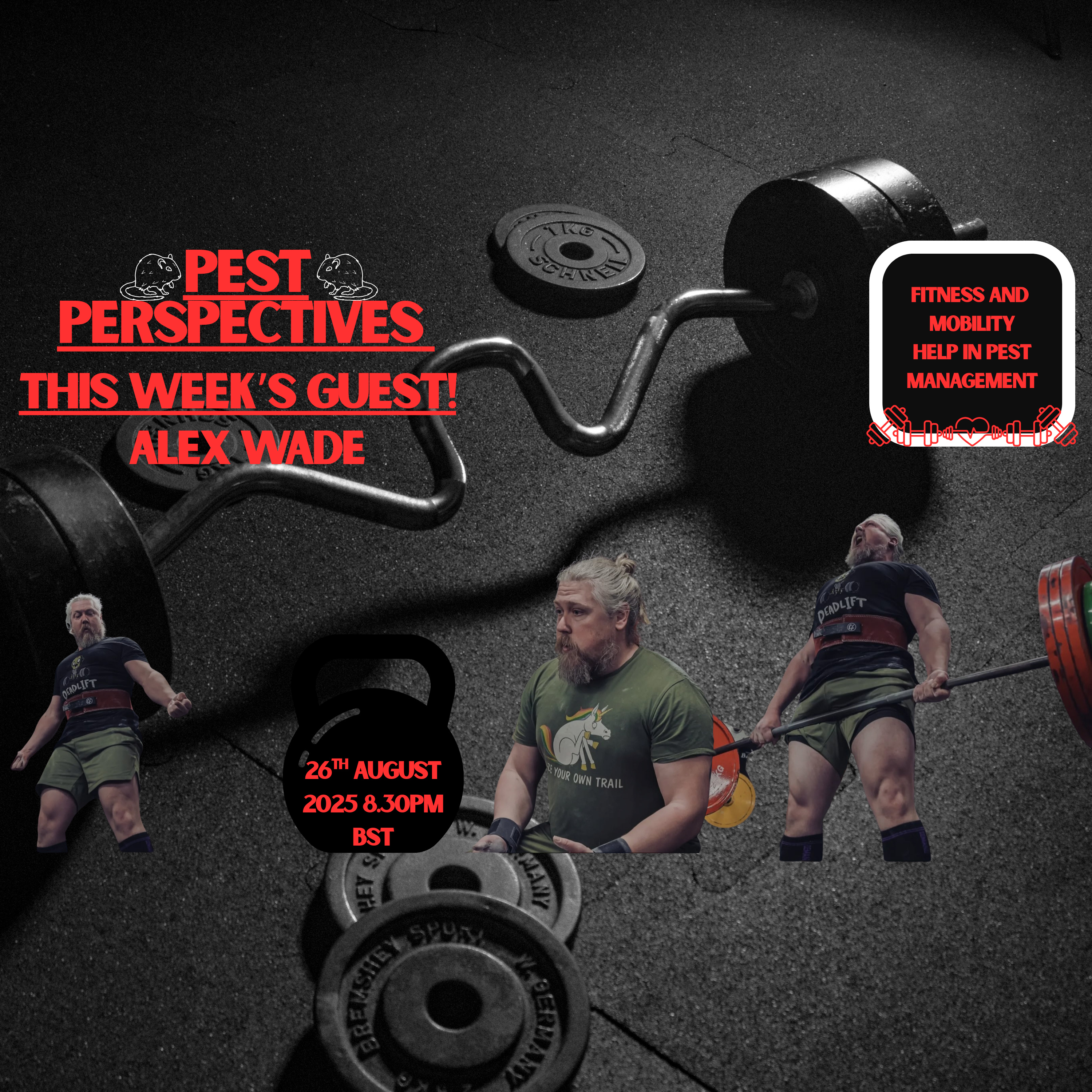
Fitness for Pest Controllers: Strength, Mobility & Injury Prevention | Alex Wade
Tonight's Episode
Fitness for Pest Controllers: Strength, Mobility & Injury Prevention | Alex WadePest perspectives EP 29 - ALEX WADE - Fitness and Mobility help in pest management.
Alex wade will talk about fitness,health,weight lifting dead lifting,strengh training and how it can all help us to do our pest managements roles better! Adding to the fact i am big advocate for this as i am equally love fitness and weight lifting!
For all Pest perspective podcast links
https://linktr.ee/pestperspectivespodcast
Register you're CPD with The British Pest Register
There we go. Hello and welcome to Pest Perspective episode 29. It's quite hot today. It is and this week I have on Alex Wade. Now this is just Alex Wade, not from any company. We're talking about health, fitness, weightlifting training and how it all can help your job, whether you're going into lost spaces, having to go on the floor to do moles. It's it's all links. I think it's, I think it's an important topic. So I thought I'd get Alex on. And Jasmine was the one that requested Alex as well. So she better turn up and chat for some point.
But how are you doing that, Alex? I'm doing very well, I think. As you all know from my ramblings on beauties and beasties, I am. I am not a fan of the heat. So actually it's it's cooled down a little bit. Hey Jasmine. He's there, he's there. I am a much, much happier Bunny at the moment, Absolutely. But yes, not here to talk about the weather because that's a quintessentially British thing. Let's let's talk about let's talk about weightlifting. Let's talk about exercise. Yeah. So where did it all?
Have you been doing weightlifting and fitness for a long time or was there something that spurred it all on? Was it? So weirdly enough, when I started my my journey into fitness, that sounds wildly pretentious, I actually used to do a lot of rock climbing. So I used to live over by Guildford and there was a lovely little wall down at the university called Surrey Sports Park. And I used to go there, you know, Wednesdays and Saturdays and meet up with a little tribe of people down there who were just used to rock climbing and bouldering and did that for many, many years.
And I met whilst I was down there a couple of really, really lovely people, a guy called Chris Bramley, a guy called Mike Green and a lovely lady called Karen who's Polish. And I'm not even going to try to attempt her surname because I will cause a diplomatic incident. But she was wonderful and beautiful and all of the other things. And they were very much into they, they did the climbing for fun, but their real passion was going to the gym and doing well. It wasn't powerlifting, it wasn't weightlifting.
It was probably close to a bit of bodybuilding actually. And I was intrigued and I got on well with them and they invited me down one day to this gym in Woking called Gold's Gym, which was. A gold gym. A Gold's Gym? Oh yes, absolutely. And it's not like the gyms that you might think of. You know, all of the running machines and treadmills and exercise machines and bits and bobs like that. It was rusty iron, old benches, huge guys. Yeah, yeah, absolutely. And it was a very sort of like rough and ready gym.
And they they sort of like they started me on this little journey. And as I got more into that, unfortunately the climbing kind of like ended up taking a bit of a back seat because block climbing and powerlifting are diametrically opposed in terms of body shape and skill sets. Because with climbing, you need to be very lithe and you need to have sort of like you need to be have a good power to weight ratio. Whereas with powerlifting you still have a power to weight ratio, but you you want to be as big as possible so you can shift more weight.
So as I got more into one, I got listened to the other and yeah, for many years just got more into that. And then finally I ended up moving away from Guildford, moving closer to Basingstoke for work. Hey. Hey Andy, how are you doing? Hi, Andy. Oh, hello, Kurt. Thanks for popping then. So yes, moved to Basingstoke. Not a climbing wall anywhere to be seen have to travel sort of like a good 40 minutes to get to the nearest wall. So it became wildly impractical, but had a lot of gyms does Basingstoke as as a phenomenal number of gyms, in fact, for for a little nowhere town.
And with that ended up getting more and more into the IT was just general gym fitness at that point. And then there was a free session, you know, a free session with a coach. And I thought, you know what, I'll take this. I mean, this coach specialised in powerlifting and so followed them for a little bit and ended up sort of like getting, not just sort of like generic gym to keep fit, ended up really sort of like finding this passion for powerlifting, which is a very specific kind of weightlifting which your viewers may or may not be aware of.
There are different, there are different groups, there are different groups of gym bunnies out there. They will do slightly different things. They do. It's like it's, it's like you see the the bodybuilders that won't touch the deadlift, they won't do does this or the main it's still inside there. I don't want to. I don't want to pull my back out. That's what they say.
Even bodybuilding, it's very specific because you want to sort of like work one particular group of us because you're going for an aesthetic kind of look. So generally speaking, and I'm being wildly reductive here, they tend to stick to doing exercises which what we call isolated. So you will do a very specific exercise or use the machine just to work one very small group of muscles at once. Whereas things like powerlifting and Olympic weightlifting, it's a lot of compound moves because it's about moving an entire bar.
You know, with weightlifting it would be clean and jerk and snap. So you're lifting a bar from the floor and ultimately either putting above your head or just simply just getting it onto your your chest at that point. So a lot of technique and weightlifting. Not again for me. I tried it for a little bit, genuinely thought I was going to, you know, go and see Jesus at one point. It it definitely more technique, more skill than I. I had confidence in my level to produce that. Has really stuck to you, isn't it?
That little saying, come to Jesus? It's really stuck by you, isn't it? I use it all the time because it's it's, it's funny and it is graphically accurate at the same time. Oh, it is. It's like I've got a friend at the minute. I don't know. He probably watches because it's it's all weightlifting related, not, not a pest control. The Billy, he's he's not, he's getting close. He's doing immense. He's think he's going for the men's physique in bodybuilding and he's lean at at the minute. But he he's because he last year he got through, he got he got through to go to Europe, but he didn't go he wanted an extra year to get get a, a better body to place this year.
And he's, he's because he wants to go to America. You see, if you get, if you play, you go to Europe and you play well in Europe, you get to go to America to up against them. And that's his ultimate dream. He wants to do that, but he puts the work in. He really preps, like proper preps. He's he's he's lean as you can. Yeah. He's he's serious. It's a hard division that demands for Zeke. He's a he's a good, lovely guy, though. He's got his own YouTube channel as well and makes content but a lovely bloke is so.
One of the coaches there around here, lovely Alaska called Wally. She, she does a lot of coaching, She coaches people. She does a bit of powerlifting coach as well. But she decided she's going to take a bit of a break from powerlifting and actually move into doing some bodybuilding and actually sort of like do a bodybuilding competition. She documented the entire process from sort of like the day one where she decided to do it all the way through to sort of her comp day. And she continued afterwards.
And it, it is, it was a real eye open, actually. It was really sort of like good to to be able to see this because it is, it requires so much, so much more discipline than you might imagine, especially when you come up to comp day because they're on these very restrictive calorie diets because they need to shred down, lose every last inch of body fat to, to avoid this world, you know, you know, biologically unsustainable. You'd never find a human being in nature who naturally sort of like had this, you know, unless something had gone wrong at that point.
But it it, it was.
It was. Really. Hi, Martin. Like watch. Thanks Martin. Get Martin one day to ask to ask him the story about how we found the rats one night with a flashlight and a scream. Definitely will be acting. It's a it's a fantastic story, but yes, she documented cell process and I think that's one thing that, you know, let's let's take this back a bit with all of these, you know, weightlifting, powerlifting, bodybuilding, or in fact, anything, anything down at the gym, probably one of the biggest things that you will get from it rather than, you know, not just your fitness and your ability to sort of survive.
There's a huge mental element to it. 11 Is this the only positive catharsis of doing exercise and still in your brain? But the other thing is instilling discipline to go to the gym, to turn up, to do the things, to lift the heavy circles and put them back down again when necessarily you don't feel like it. And that's energy transfers, I believe, to the rest of what you do as well and the rest of your life career. Because if you can get up at 6:00 in the morning to pick up a heavy circle just to put it down exactly where you picked it up, then absolutely you can walk around the site and you know, check 200 bait boxes in the absolute smashing rain in the middle of winter.
Because nothing is going to be harder than walking out of the door at 6:00 in the morning, those buckles up and put them down again. No, it's so true. It's because, but a lot of people, it's like, it's like when I started my journey back in 2024, a lot, I'll tell you now, a lot of people did not believe that I was going to stick it. I joined the gym. Admittedly, the business pays for it, but that it's the expense. It's a, it's a company benefit, they'd say. And people don't tell you they don't think you're going to be able to do it.
But I got hooked. I got absolutely addicted to going up. I mean, if I look back to where I started, obviously because I was rehabbing off knee surgery, but I did it myself. But I told the I told the surgeon, no, I don't need your rehab. I'm going to go gym do it myself because he obviously broke my knee. I broke my knee in 2020. I lost a load of weight, put it back on mentally. I wasn't, you know, there, but this second break and I thought I was hang on, wait, 20 I'm holding all right. And I thought I can't do it no more.
I'm just trying to think. When was it? It's 2025 now. I was young, right? I'm 41, so. Yeah. So I'd say it right. Just trying to get the. Mental maths going on there is. Brilliant. I know the mental maths is right. Obviously an age thing comes into because it was mentioned on your podcast with Anna Mullins about and it something to do with people that are coming up to or have just passed the age 40. And I think thinking back on it, that was linked to it. I think I've I've smashed my knee twice. I'm massive and I didn't realise how big I was until my wife told me she heard a surgeon overhearing how, how And she goes, You do know there was a CAT scan I had to have and there was a weight limit and he goes, he is a, he is a big gentleman and he goes, no, don't worry, he's just under 30 stone.
So that's how, how much I weighed just under 30 stone. So what? Is that what's in real money? What you on about? You on about KG or pounds? KGI don't. I don't know. Do you not use stone? Then? Do you not use stone? No, no, don't. Use stone. So the KG would be, I don't know what exactly it was he just said under 30 stone, but she didn't want to tell me that obviously at a time. Let's have a look, let's call it 29 stone into KG. So, so 29 stone is 184 KG, so I could have been 100 and 100 and 87188 KG, something like that.
I could have been and I didn't know until I misses told me that time. We don't want to tell somebody how big they are. Mentally. I knew something was wrong. But you don't want to totally admit it, do you? Because I didn't like being in photographs. I take photographs of myself all the damn time. A bit of a poser, if you notice on social media, I am I, I can also take people that say, oh, you're this and that. Trolls don't bother me no more. But so I got down lost about a bit. I need to get back.
I think probably 99 stone I've lost now. And I'll be honest, a lot of people knew that I was doing it and thought I'd quit because I did quit last time, but I did it. But it's become like a hobby slash passion when I go, when I go gym and when when it's leg day, I love leg day. It's actually someone's there can fill my dead lifting with that slow, slow down motion videos. I love making them. But it become like a passion. But when I started I was weak as shit. If I look back now as to how weak I was compared because people look at me like that's a lot of weight.
I think is it? It doesn't feel like a lot. It's just because I'm a big bloke. But I had to be so careful because I was rehabbing. My knees say very. I went really low to start with. But thinking back, it was so what's it called so low? But it doesn't that way it flies now that does. This is it. If you there's a expression and paraphrasing it here, you know, I'm probably sure the great Marcus Aurelius once said to be good at something, you first have to be shit at it. And you have to accept that you are going to be shit at it to begin with because nobody starts at the top of, you know, that particular pile.
And a lot of people get disheartened when they, and again, you know, we're talking about the gym. So let's put this into gym contents. You turn up to the gym and you look around and there are people sort of like hefting big weights or running for miles on the treadmill or, you know, doing one of these classes and walking away from it with barely sort of like a a puff out of breath. And your knee jerk reaction is to instantly compare yourself to those people without thinking that they have already put in the the months and the years to get to that point.
And in fact, the first time they walked through the gym, they were shit. And everyone has to start off and you have to accept that you are going to be shit before you are good. And so there is nothing wrong absolutely at all with walking into one of these environments, be it rock climbing, be it any kind of sort of like exercise and not being good at it. Because half the joy as as you say, is not being good. And then week on week, month on month, year on year, watching that progression, seeing how you grow or shrink or sort of like the weights get bigger or you get better at something or faster at something.
So anyone listening to this who's sort of like thinks to themselves, I want to do this, but I I don't want to look like an ass. I read a fantastic book years ago all about rock climb, not about the gym. And it's called 9 out of 10 climbers make the same mistake. And the number one mistake that rock climbers make, and this could be transferred to anyone, anyone else, but in the context of rock climbing was you will underachieve your, you know, golf, your turn up. And so, for example, I was climbing up to V6V sevens relatively good, but I would hold myself back because in some instances I would think that everyone was watching, you know, you, you step up to the wall.
He's very sort of like not exposing. It's it's very sort of like visible is rock climbing because everyone steps back. If you walk up to the wall, everyone steps back because you don't climb over each other. So it means that as you walk up to the wall, your back's to everyone, everyone's watching you And you don't want to be shipped. You don't want to sort of like get up to the wall. You don't want to sort of like pick a route, get halfway up and fall off because everyone's watching. But the reality is, is nobody's watching you and certainly nobody is is judging you.
And if you just pick the roots that you know you can climb and you are safe to climb and that you know you can do and do well, then you'll never end up pushing yourself outside of that comfort zone. So one of the big mistakes is when you go into these places, you play it safe. You don't push yourself because you don't want to appear as though you are struggling. You want to, you want to look as though you are doing it. But reality is, is you need to push yourself beyond that. You need to to grow out of that.
And you need to understand that when you go to these gyms, you go to it despite the fact that there's a mirror on every vertical surface going and you can see sort of like, you know, everywhere at the same time. Everyone's focused on their own thing. Everyone's focused on their own journey. Very rarely you're going to find people sort of like laser beam and you're from across the room and honestly, you're doing something wildly, wildly ridiculous. They're just. Going to. They're going to. Shoot in their own thing, yeah.
It's true. It's like I tell people, especially people I know that go gym that that want to go that are women because they get especially intimidated by it. I said they're not looking at you. I said, although they're in the zone and if they peer over you, it may appear they're looking at you. They're not even thinking about you. It's because they're just they're just it's, it's quite intense, doesn't it? It's like you're not actually. If you look over at something some brief second and it's not on purpose, they're not looking at you.
However, there was this lab the other day that I was looking at because he was doing what I thought was an ego lift. Young lad on the hack squat, weighed it out both sides and he was going down. Not where were we going down a bit like literally not even moving. Hardly. And I thought they were filming. I thought, I hope they put that online because he's going to look ridiculous. That's the first time I've seen anyone try and do ego lifting in there before. It is. So just to just to clarify for people who are lift watching it, an ego lift is when someone lifts a weight that is.
So high it's it's not pushing the boundaries, it is just it's well out of what should be a sensible or even a safe lift. And in order to achieve that sensible or safe lift, you end up sort of like cutting corners as so there instead of doing a full range of motion, which would be sort of as we would say asked to the grass, you end up sort of like dipping. But that being said, you don't know what his programme was. He may very well have been just training the initial sort of like so. My my opinion.
So my cultural occasion would get me to do things like. So for squats, I won't do a full squat. I'll put the safety bars in and I'll go halfway down so the weight comes off my shoulders and then re engage. And so with that, it looks as though, and you, you do that at a very heavyweight because the idea is to try and sort of like get yourself to sort of like be able to brace underneath that initial weight and sort of like be able to take that weight and be able to sort of like start to lower it down and then to drive back up and through it.
Because the mechanics of your body differ depending on the different stages. It's you can get, you can get scientific if you want to really get into this, there's a lot of mechanical advantages and disadvantages that you can, you can use. And that's kind of why I like powerlifting.
So what weight does count as what weight counts? Does the ego lift? It varies for each individual. I've been guilty of it before, you know, wanting to take pictures for Instagram and the rest of it. Just the idea is just don't do it every day. Yeah, it's, I mean, you're right. He may have been doing that, just young lads doing that. I just thought he's ego lifted, but he may not have been. He's what's with someone because on the hack, you've really need someone with you that can push that weight back up.
Because with a with a hack, if you were to go down, you can. There's no stable, but there's no there's no way of getting out. There you say there should be a little. There should be a little stop anchor at the bottom to stop you turning yourself into a prawn like. It probably is. It's it's a brand new piece of kit, so probably there probably is. They've bought 4 new Jim Lecko Jim Lecko pieces of kit and one of them I hate with a vengeance. You know why, Alex? Because no, no, tell me what the bit of kit is and I can probably guess why you hate it.
What? What's it for?
It's lead curl. Yeah, OK.
You won't be able to guess it though, but you can have a go. Have a go with a lot of those sort of like like isolating leg car machines or or leg extension machines. They never seem to be they, they seem to be designed for the average human being only. There is no such thing as an average human being. So you end up either getting the bar hot so far away up your shin that you've got no mechanical advantage or ends up being so far down like your foot you feel like your football punting it. So I would say you just don't fit because I don't fit into them either.
Yes, I can't get my legs into it, but all the bit, all the but I feel all right because a lot of the big guys down there can't get their legs in either. So I feel like one of the big. So all I've got left is I have to do lying. You know the front lying curl where you like you lay on your front and you curl that way. That's the curl I do. I can't do those. Oh yeah. Slightly hilarious reason. So I also used to do a lot of mountain biking, and downhill mountain biking at that because I grew up in the woods like a feral child.
The little village I grew up in just just outside of Guildford, there was 1 bus in, one bus out, but a tribe of us all the same age lived on the same St in the neighbouring street. So like a little pack of yeah, feral goblins would get our bikes and would cycle until it got dark and then cycle home precariously along the road. But we used to do a lot of downhill mountain bike and actually I had quite a nice full suspension downhill mountain bike. And one day when I was travelling at superluminal speeds down a hill, I came off as as I wanted to do and gravity became my Co pilot.
And as I flew through the air, I hit a tree stump with my chest like literally so tree stumpers but that high on the ground had just been cut off. But it was almost perfectly this shape and I hit it so square on in the centre of my chest. It detached my sternum. I literally broke all of my ribs down here and I didn't feel I was broken them at the time because it just like. Did you get back up then? And like I said, kid not knowing. Oh. Beg. What's the kid that's like 20? Sorry. Sorry. Yeah. But like this, like it, it knocked the wind out to myself and I thought I'd just winded myself and the rest of it, The next one I woke up and at this point I just, it was well, probably wasn't probably 18, you know, just before I went to university.
I wake up and there's this great big purple bruises going all the way down my chest. My mum is a nurse and she was like someone giving you chest compressions. And I was like, no, she's like, that's exactly what it looks like when someone comes through A&E after having sort of like chest compression. Basically. All your ribs broken there. So depending on which way you're looking at, I've never broken a bone or technically I've broken every rib in my chest. But the reason I can't do the laying leg out is because the bottom of my stern just here it never fully attached.
I've got the bottom bit of my stern. So when I'm laying down on these prone machines and then taking all the weight the bottom of my sternum, just like hell no, it just folds into my. Chest. Oh, OK. So yeah, there you go. There's something you never knew about me. In fact, to this day, let's do that. You can. There we go. Oh damn, didn't know that. I do but I can't. I can get a certain range of motion but I can't get it fully like you should do, but it's enough is. Yeah, it's good. If you want to do good dead lifts, you need to have good hammies.
So the machines like that, although they're. I use ham raise too. I do. I do the ham raises as well. Yeah, I'm not saying it right. Where you you basically bend over a bench basically in old weights. I'm probably saying it wrong, yeah. Yeah, it's it's, yeah, I know what you're talking about. It's not ham raisers, but for everyone listening, bending over a bench isn't as unusual as a may say in the gym. No, I can't think of what it's called it off the top of my head, but I can see it. I just can't think of what you actually told it.
Back extensions. That's it. Back extensions and the hip. The hip hip abductor is primarily good for that as well. It is. There we go. But yeah, it's all good. I said like my, my particular flavour, let's say of gym exercise is, is powerlifting, which is it is, there's a lot of technique, but it's all about the numbers. It's all about trying to shift as much weight as you possibly can. And there are some people who, you know, the world record holders. So for example, it's it's 3 lifts is powerlifting, it's your squat, it is your deadlift and it is your bench press.
Strict versions of each. But just to put into context how monstrous some human beings have got the mountain thaw from Game of Thrones, he recently broke his own world record at something like 505 kilos. They claim he's going to do it again. I'm sure he is. It's just it boggles the mind or boggles my mind, should I say, how a human being is capable of moving half a metric tonne by themselves Is it's, it's amazing, it's incredible. I mean, I am nowhere and I will never be anywhere near that. I'm happy with my numbers, but it is an inspiration as to the feats of which a human body can endure and demonstrate this this just raw power at the end.
Oh. No, it definitely is. It's like Eddie. Eddie Hall congratulated him. But when Eddie did his lift, he nearly died, didn't he? He did he. Did. Yeah, absolutely. He was all kinds of haemorrhaging, feeding those eyes popping out of his head. Human body definitely should not be able to do that and yet and yet they do so I'm not by by all means I'm not saying to anyone who's joining the gym you that's that's the level at which you need to aim most healer human beings you're aiming a little bit a little bit lower than that it's.
Like when I see a lot of the young lads, sometimes they're deadlift. I was like, and they start putting the belt on. I'm like, I'm going to, they're going to lift something big and they don't. I was like, I, I it might. Be big for them, though it might be big for them. It may be, it may be, but I've never actually used a belt. I've got to learn how to use what I've never. It's all about breathing into. I've never used a belt yet I haven't. I haven't needed to. This is the interesting thing about powerlifting is powerlifting is really good for strength.
It's absolutely terrible for aesthetics because the when you're shifting so much weight to parallel. And so put this another way in, it's sort of like a biomechanical kind of like context here, which is if you are trying to compress something down flat like that, which is exactly what you're trying to do with both a deadlift and a squat, you've got a lot of weight and it wants to basically reduce you to a thin red smear on the floor. But mechanically, the best shape to have for that is a cylinder like that, because you try and compress a cylinder, you cannot.
Well, you can, but it's a lot harder to do so with that. A lot of sort of like your the skill and the technique of powerlifting and the rest of it is to be able to sort of like brace your core. Not just sort of like pull your core down, but actually engage all of those muscles around your core to create a solid almost sort of like tubular shape, which a barrel shape I should say, which allows you a much greater level of stability and control when you are sort of like like dipping down or lifting up these weights.
And that the point of the belt is it helps to that helps you brace that barrel, brace your core against that belt. Yes, it definitely is a skill in it. And it is, yeah, about your breathing. It's about your mindset. It's about the timings of it. It's not just walking up there screaming, you know, Leroy Jenkins and then just whipping the thing off the floor. A little bit of preamble goes into it. Yeah, no, yeah, I've never actually used the belt yet, but I would have to buy my own belt because the belts at the gym are for little people.
Yeah, because one of the powerlifter succumbs and brings his own. He came second recently. He came second at a local event. He did. He did. So he says to me, I've got. He says I've got no intentions of trying to GoPro. He just does it for fun. He says I'm not, I'm not going to go try and be the world's strongest man. He says I'm but just he just does it for a goal.
That's the other discipline as well. Sorry, strongman. Strongman is all about sort of like, yeah, strongman is about lifting heavyweights and all. That's what he's in, sorry, not powerlifting. It's strongman. That's what he does. Yes, the boulders and stuff like that. Atlas Stones. A bit of me wants to give that a go, and another bit of me thinks that my spine would fold faster than a cheap suit. I turn to bubble wrap and just crinkle like somebody just, you know, kid at Christmas. It makes me want.
To but. I don't, I'm quite happy with just going gym and not trying that because I don't want to hurt myself. It's. Good to have a goal there. I mean, so I'm, I'm going to be entering a competition at the end of the year. That's my, that's what I'm going to try and do and it's a qualifier. So I've done competitions before, but they've not been qualifying competitions. They've just been for a bit of fun and I have to say it was so I did my first comp probably April, not last year, maybe it was last year or the year before.
With the pitch, that's where the pictures come from, weren't it? Oh, not from now, that's. Where the pictures came from. Yeah, yeah, yeah. So it was it was, it was a novice comp. It wasn't, wasn't ranked, wasn't qualified. It was just to get some experience getting up on the platform. And it's crazy because you are the only one there and there'll be a crowd of sort of like 50 to 100 people just watching you. And you'd think it'd be really intimidating, but everyone's there, you know, the, the people you're competing against their friends, their family.
And they're just like, lift it up. And like the whole room erupts and shouts and it's, it's like that it's the best environment going because everyone is cheering you on. They don't care who you are or where you're from or what you've done or how much you're lifting. They just want you to lift it up. They just want you to do it and it's just that fantastic. That being said, when you actually stood on the podium, you don't hear a single bit of that. Like your brain just goes down to sort of like your whole world reduces to the judge sitting in front of you who is like down and up and that's that's it.
And then you're just like, oh, did I say something embarrassing?
Like total fugue state what happened for the last 5 minutes? Where was I, What went on? But this is it. So in December this year I will be entering my first proper qualifying competition and one of the reasons I've left my qualifiers so late, and this is the irony of it, is as I turned 40 this year, I've now gone from the Open class to the Masters class. Oh the masters. Oh, the masters. Masters class, but by going up an age class means that actually the weights that I need to lift in order to qualify has reduced by 1/3.
Really. Oh, OK. It's going to be easier for me to qualify, to get to Brits, to get to Euros, by being older than it would have been by working harder. OK, well, fair enough. I didn't know that. Then we choose the number. Oh yeah, yeah, this is this is, this is my golden, golden age. It goes, goes down every year from here as I get deeper into the masters category. But there are some people like in the Opens who are just phenomenal athletes. They're absolutely incredible. There was, they had the IPF World Championships the other day and there was A at last she was 55 kilos or something like that.
So she was in one of the lighter weight groups by far and she shifted I think a little over 4 times her own body weight. That's mad. That would be like me shifting a 400K squat. Damn. Wow. Yeah, yeah. I think I've got more chance of surviving a direct nuclear strike than I have at holding 400 kilos on my shoulder.
It's one of those things that is just are outrageous, let's say, but it's all the challenge, it's all the fun goal to strive for. And as I say it, it helps with the motivation, it helps with the discipline. And of course, one of the things that we wanted to talk about today, of course, was how all of that translates them back into our job at the end of the day. It does. So have you found it? I mean, because you mentioned your knees and by far and away the pest managers that I've spoken to, it's their knees.
The knees are the first things to go. So how have you actually how felt it's? How has this helped your knees? So since rehabbing, I was warm. When I had surgery, obviously I got warm first time and then second time in the winter when my legs get worse, when it gets cold and. That's fairly standard, yeah. And so obviously I do a lot of mould, I do a lot of mould control. So I do to get down and up. But I find it very easy now. But I also do use, I've got a little, I've got a knee pad specifically for the mould jobs.
It's fit so that helps. But I can get up and down no problem. Now I can compared to what I when I first started the gym, obviously it took time for it to me to build my legs up because I would say everything I'd say I'd say my legs are bigger than anything because they normally are. But I would say it's helped massively in terms of me even going down to check a box or having to go under a kickboard in the kitchen. It's not difficult no more. It was when I first had the surgery. It was difficult to get up and down, up and down, up and down.
But it's massively improved the game of pest control with with with my knees alone. But I do use a I've got a special knee, a knit knit kneeling thing because I haven't got shin pads built into my trousers when the summer I wear shorts, but I don't. But I got a kneel, A kneel pad thing. It's quite good. It is. But yeah, it's massively improved. I would say if I hadn't rehabbed and looked to the gym and whatnot, I don't think it will be half 1/4 of what I am now. It's massively improved. It helps so much.
And a lot of people think I was just saying that. I mean, it genuinely is the truth. You don't realise and how much you need your knees, legs until, well, effectively I lost them. I I lost my legs for three months. We actually had to go in a wheelchair. And I can tell you now you get treated different when you're in a wheelchair. You know, there was a local shop, my message pushed me up around the corner once and I'm outside when you're right, mate, ignored me. I said ain't I'm not a cripple. I said I'm not disabled.
Oh, sorry, I'm so sorry. I was like, why would you ignore me if someone said hello to me? Why would you ignore someone if even if they were? I know, I know, but a lot of a lot of people, sadly I noticed this. They ignored people that are disabled even if they say hello. I've never ignored anyone but I did not like it. I told him I could get up, I would, but I can't. I could get up, I would kick your ass, but I have neither the effort nor inclination. But but that's all the time I wait in the wheelchair.
Apart from that, I'll be honest. Yeah, massively help the the job in general in all forms of getting up and down off a floor because you have to and it is the main thing people moan about it is their knees the. Funny thing is, human beings as adults, we forget how to get up and down. That sounds like a really dumb thing to say when you're like, I, I get up and down all the time, but we don't, we, we kind of like we, we build bad habits into what we do. We will either hinge or take the laziest option to try and pick something up from the floor or something like that.
Because you only have to look at kids, for example, toddlers, they do with that, they do the perfect squat. Like if they want to get down the floors, stand up. They do like they have the perfect range of motion. They hinge in the right way. They do the rest of it. And then we sort of like grow older and we stop doing that and we forget. And then that's why it's sort of like when we get to our age, when starts stuff starts to break down and you only have to bend over the wrong way and suddenly that's it.
Three to five business days. You just stretch it out, unable to do anything. So again, another one of the good things about the gym is, is it teaches you re re teaches you how to do a lot of these what what should be normal human behaviour, but you know it. Bending in the right way, lifting things up in the right way, and being able to lift things up in the right way and not doing yourself a massive injustice or injury at the same time. Because when you get out of the seat as well, It's another thing I learned in a rehab first time round was you're not actually supposed to.
You know how some people push their hands up with the seat? You're actually supposed to just stand up without anyone helping you, aren't you? Most people out, you know, just. Yeah, you most you're asked. It's supposed to just stand right. And I know I do. Nowadays, I don't usually say I stand right up, but most people, if you watch them, they'll use their hands to get up. They will. Never realise that I'll have to pay closer attention. I've been standing wrong all my life. But yeah, it's, it's again, it's one of those things.
So the other thing, and I've noticed this with with me is by doing more exercise and you know, also eating a little bit better because I haven't been quite probably the best of that. And past your energy levels changed significantly as well, which can really help get through the day because you've you find yourself not flagging round about 3 or 4 or clock anymore. You don't find yourself sort of like or feeling the need to sort of like pick and snack in order to sort of like give yourself that false sense of energy to keep going.
I found that it helps to, it helps to, it helps with that significantly, that regulation of just energy that is used throughout the day. Oh no, it definitely does because you remember, you're not carrying around as much weight because I told a while ago, I told somebody and you're like, and he told me a way to think of it. Like he says, think of, I don't remember how much I technically have lost, but he said, think of X amount of cement bags you've taken off for you. And that's when you realise, wow, that's a lot.
That's a lot, isn't it? And you think of it until you like you say how many KG you are and that's like, I don't know, like you've lost 2 bags, 2 black cement bags or 4 cement bags and it's, it's massive. Don't get me wrong, I've, I'm not, I'm not at the end stage. I want to lose far more and get more stronger. Well, I think I've done well so far and I have got a lot more energy I have than what I did have back then. I wish I had more photographs from back then, but I didn't like taking photographs.
So I've kind of got photos when I can. But people took photos, but I didn't know they were taking it. But, but generally, yeah, a lot more energy. Alex and I honestly, your stories are your. Honestly your Instagram stories recently have been so cool. Yeah, I'm either going to live forever or have a heart attack by the end of next week. It's it's a, it's a, it's a coin flip right at the moment, but that's it. Andy asks a good question, actually. Saying. Squat near down or bend to check the stations.
I would say it depends on how how long you're going to do it. If you're just picking something up from the floor, you can do the age-old golfers lift which is where you just swing your leg out and you're lean down. But again, I reckon it depends on your mobility. If you're going to be working at it for a while, kneeling down is good. But as Sean says, you need to make sure you have proper knee protection because kneeling concrete to knees straight onto your Patella is going to just basically it's going to grind that back and it's going to grind that down and it's going to want to push it up and out the way as you're kneeling on it and pushing down South.
Investment in a decent pair of sort of knee pads in order to try and take some of that abrasion, some of that shock out of it is good. If you just sort of like scooping down to pick something up, the rest of it, yes, that's good. Just, you know, pop a squat, pick it up and go. If you're lifting something heavy, absolutely go for a squat. You know, anything, you know, 10/15/20 kilos above that, if you want to be lifting, you're holding it as close to your body as you can and to minimise the amount of tilt that you're going to be experiencing at that point because that keeps you back happy.
This is turning into a health and safety seminar. Yeah. Yeah. Don't twist when you're lifting. Well, it didn't teach you. It didn't teach you to bend your knees, Please don't know. And squat when when you when you lift the box manual. Handling, I worked, I worked for years and years in a factory and every year we had our compulsory manual handling courses to go on, which was great, everyone practising lifting up cardboard boxes. But yes. So I had another question for you, which was leading on from the back of this, which is the the ways in which, I mean, we'll park powerlifting for a bit and we'll come back to that because that's a passion and that's fun.
But that's a way that's a means to an end rather than something that you need to do.
Coaches. That's what I was going to say because I have, yeah. You do you too. Haven't you actually, you know, my coach, She used to. She used to work for Wade Environmental. Jeez, Elaine doesn't work for you, Ella, What should I work for the? Member Ellen no, no, she a little while back because and this was it. She is not not because she didn't enjoy the pest industry. She thoroughly enjoyed the pest industry, but her passion always lied with with this and after. So she is technically a record, a world record holder or was for a while until someone took the place.
But she was very good at it, phenomenally good at it. And she she decided to see the photo and more powder and absolutely all the best. Will there be no parting on I'll terms whatsoever? She had to pursue her passion and I'm behind. Oh, yeah, yeah, yeah. So she, she was a coach before we met, but she was also a forensic scientists. That was what her training was at university. But it's always been a passion. And when she had the opportunity, when she was a bit more stable and she could devote to it a bit more, yeah, she just went back into it.
But but she's my coach to the point that she got me. She I went through some rehab. So I, I damaged my ankle quite badly March last year of all things, falling down the stairs, which sounds remarkably sinister, but it was. Oh. So I'll tell you this story because it was probably one of the dumbest things I've dumbest things I've done in a very long time. Let's be fair. The list of dumb things that I've done is is a book into itself. But this this kind of sits at chapter 1. And I was just about to start my new job, you know, a week before starting my new job.
And I was just about to drive down to Liverpool to go and meet Sharon and meet the rest of the team. And I was literally out of the door and as I was walking down the stairs, I had my laundry hamper on the stairs. You know, as you do, you know, you finish your laundry, you take it out the washing machine. Where does it live? It lives halfway up the stairs to encourage someone else to take it up the stairs or the virtual Hamburt halfway down to it go. But on the way down, I was eyed this thing up and I got 2 steps past it.
And I remember an old axiom that my father used to tell me, which was the mess that you walk past is the mess that you accept. And so I just had his little voice in the back of my head being like, if you walk past this, then you accept that you are going to live in an untidy house. So stopped, twisted on the stairs, picked it up, turned background, went to go and step, missed the step. And a bit of my brain betrayed me and just went, you've missed this step. You should go for the next step. And the next step was not the next step.
I ended up stepping like goose stepping like Monty Python from halfway up the stairs to the very bottom of the stairs He just took, took the entire flight of stairs in a single bound, which obviously my ankle was just like, well, fuck you, buddy. I'm going to have some words about this. And yeah, it's basically it's mine that's fault. Everything's mine. We've all met. We've all met my father through this industry. We all know Joe. But yeah, I do step down the stairs and basically landed on my ankle, which folded instantly.
But now, that wasn't the dumb thing. That was just the unfortunate thing because this stuff happens. The dumb thing was I was just like, I need to make this meeting, which is at 9:00 tomorrow morning. My ankle hurts, but it has not yet swollen up. So I get my big old army surplus boots on, pull them up, you know, bandage my ankle up, pull my boots up, do them as tight as I can, and then drive 4 1/2 hours to Liverpool, to which point I get to my hotel. I look at my foot and I'm like, yeah, I'm not taking that boot off.
It's not going to slip with my boots on for that night. Terrified of taking it off and never getting it on again. Had the meeting was, you know, taking ibuprofen and painkillers literally like they were candy sweating like it was. I was situated 3/4 of a mile away from the surface of the sun to the point that Sharon was like, are you OK? And I was like, yeah, yeah, yeah. So I fessed up like two months later being like, oh, I, I've absolutely just destroyed my ankle. I was in so much pain and then drove home the same day, drove home and came back and at that point, no.
No, I'm sorry because it would have been easier. It's it's it was my right foot. So it would have been an absolute as either which way. But Long story short, at that point I got speaking to Ellen again because at that point she was still working for WE and she was like, yeah, you need to do some rehab on that. So signed up to her coaching and she did me through the rehab. And so and it was a long time. It was about 4-4 months or so of just not lifting heavy weights, just of ankle mobility. But the point of that is, is now I can still do the thing.
So I'm back to my back to my comp level squat, which is about 200 kilogrammes, which I never would have been able to do if I, if I'd not taken on this coach, if I'd not taken on this advice, if I'd not done the exercises and the rehab, I would never have been able to. I would probably would have been able to barely walk up the stairs if I'm brutally honest. So yeah, having the right support and doing the exercise and doing the stuff is phenomenally important for maintaining just your health at the end of the day.
So there we go. That's that's my dumb story for the night. Well, I'm just I'm I'm just more thinking about you can do 200 KG. What is that free bar? Yeah. You want to know what my numbers are? So what my my comp numbers from? SO comp numbers are the only ones that really match. At the end of the day, what you do in the gym is fun, but what you do on the platform is something different. So at my comp, at my fun comp that I did, which is still the same, it's still sort of like measured to the same standards as a real qualifier.
It's just not a qualifier. So my squat was 200 kilos and I bombed out at 205 S, My opener was 190 kilos. So the way powerlifting works is quite unique. You have 3 attempts at three different types of lift. So you come in and it'll be squats first. So you say my opener will be, let's just say for the sake of example, 100 kilos. If you manage 100 kilos, you can say right, I want to go up 110 kilos. And if you manage that, you go up 120. But if you fail it, then you have to redo the weight that you did.
And then you do the same for bench, and then you do the same for for deadlift. And then your score is the highest number from each of your lifts. So you know, it's not the cumulative of each lift, It's the highest number. So if you do 200, a hundred, 200, then your cumulative score is 500. And so so there we go. So yeah, I opened at 190, whistled through that, did 200, honestly thought that I was going to invert myself and then went for 205 and I just went down, down, down, down, down, and then was just like, I'm not getting back up from this.
Just like a little like a little crab scuffling along the floor. Do you have people, do you have people each side to to help you in case you get into trouble? Yeah, yeah. Yeah, yeah. So the golden rule is in comps issue, don't bail your weight, you don't bail it because if you bail your weight, that's like 200 kilos just flying through the air or rolling through the air, someone could get hurt. So you haven't you have someone on each side and someone behind you. So the person behind you keeps you upright, you know, just they their arms underneath and put the money just to keep your body upright to keep you sort of like posture good.
And the two guys on the side just take the weight up, but it's still you driving up. So so you have to have at least a little something left in the tank. So yes, my open was one 9200 was a three light confirm and 2:05 I died. I died very visibly and in front of a lot of people in my bench press was 100 and then 115, which was quite fun. And then I thought I was going to be really, really big. I was like, I jumped from 100 to 115. It was that was no problem. Let's go for 125 and I went, yes, this is good, this is good.
And it came down to my chest. So this. Is not moving I. Think I managed. I managed about 6 inches. I was just like and then held it and then everyone was just looking at me. I was like this is not happening. This is not moving guys lifting up off me. And then my deadlift, my deadlift is the weakest of the three. It's, it's 200 kilos. But that is because I have, I have this weird mental blocker because when I was rock climbing, I fell off the walls so many times and injured my lower back so often.
That deadlift is all about that hinge between your hips and your, your back. And you know, that's, that's sort of like moving out movement. And there's a bit of my brain that it's just like if you, if you try and hinge this, you will snap like the old grey twig that you are. So I, I have this mental block because I can do deadlift variants, I can do all the accessories and theoretically I should be well above that to the other day I lifted 200 kilos. It was absolutely fine. I put 2 little a little biscuits on the other side to take it to 205 kilos.
Just couldn't move it just. Couldn't move it off the. Floor I was so frustrated. I was just like, this makes no logical sense. I should at least be able to get it halfway up, but I just there's a bit of my brain that was just like, no, so that it's a huge, you know, it's competing with yourself at the end of the day. I think that's probably why I enjoy it more than anything else. It's a competition with the only other person really that matters is you or or who you want to be or who you thought you were.
That's the people that you're. Do you use straps? Do you use straps for your deadlifts? Are you allowed to use it in competition? Straps, you're not. No. Don't use Figure 8 straps for dead lifting, are they? No, it's it's, you know, hand strength that could crush a watermelon are. You are you allowed chalk? Are you allowed chalk in your, your gym? Chalk. Chalk's not really allowed in our gym, you see. To get some liquid chalk. Oh OK, I'll try that then. Do they get better grip? I've got crap grip.
I have there's. A bit of it, it's mental. Another little bit of it, you know, you get sweaty palms which which definitely detract. From you on a hot day, you know how all these heat waves have been having. I went to try and do deadlifting. I have a wear of them, yes. And I was like, I couldn't lift. I had to drop the weight right down. I couldn't do it. My hands are slipping on the bar. Oh, that's. Nasty I'm. Sorry, that's. Just nasty. I got I, I, yeah, I'll try that then, because in our area we've got a, a, what's it called?
There's, there is some power lifters in my area. This is like they've got Dan Wigan in our area, but his, his girlfriend's on the, I think she's on the Team GB list. I'm not sure she's, she's in the genius division. She's got pictures of the International Powerlifting Federation and Elaine follows Elaine follows George powerlifting. She's called, I've never seen her just watch the videos and, and she has all them videos and like a team of people behind her, you know, going all the way down in case anything happens.
I see all that stuff I do. Jasmine another question. Jasmine, another question she did.
So what's the coach? So for me, coach does different things for different people, right? And anyone who's been listening to this who thinks actually, I do want to go into the gym, but I don't know what to do or I don't want to go to the gym, but I don't know what best to do in order to try and sort of like maximise my efforts or the rest of it. So coaches can do whatever you like. So you can have like an online only programme. And I have to say that there's a load of coaches down here. There's four of them that I can name off the top of my head or absolutely phenomenally wonderful people that all do online course.
So they're, they're all power lifters, but they're all sort of like they're all placed either nationals or worlds or you know, 1 world, you know, world titles and the rest of it. So they're really, really great people. So Ellen of course, because she's, she's that a friend, Ash, Jess, Holly there, look them up. They're fantastic. But they do what it is that you need them to do. So Ellen for me just basically sets a programme and every week I put my numbers in, I've got an app on my phone, I record the numbers.
Just you say, right, I need to do these exercises in this order on these ones. And with that, record the numbers and the number of reps you have and then tell me how hard you thought that was, how hard you're working. And then she'll review that. And then the following week she'll be like, right, What we're going to do is these are the areas where you're weakest. We need you to sort of like we're going to just so deadlifts are weak. So instead of just powing on trying to do deadlifts and deadlifts, we're going to do some accessory movements, try and work out the bit of your lift which is weakest and focus in on that.
So that's what she does for me. But coaches can also do nutrition plans as well. Nutrition is a big part of your programme. It's a big part of your life. To be fair, it's probably the biggest part of your life is what you eat. And so they can tell you, you know, give you, you know, not tell you necessarily what to eat, but they can certainly help you make better decisions. What fits your macros, what's what's going to be best for you different sort of like training phase and the rest of it. They can help with rehab.
So as I say Ellen, help me with my rehab and also if you if I wanted to, I can send in videos so I'll. I can set a camera up, although I absolutely hate doing it, feel myself doing a squat or feel myself doing a deadlift. And she'll look at it and she'll be like, right. What you're doing is when you're setting up for your deadlift, you're actually setting up with a bar a little bit too far away from your body. So that's the first you, you're like losing a lot of energy bringing that bar back in line with your body.
You know, a lot of the lot of wasted energy bringing the bar in line with the bar path. And what you need to do is you need to start, you know, in this position. And it may not be, it may not be intuitive, you know. So with me, when I start my deadlift, I feel as though I'm just about to like pitch backwards, you know, my weight is very far back. And so she'll work on it with that. She'll give me cues, you know, engagement, you know, pull your shoulders back, your lats down, brace your core, all of those things.
So they teach you the skill, they give you the motivation to do the right exercises on the right day, they give you feedback. So they keep you sort of motivated to do the right thing. It's it's all a process there. And some people like to have it face to face. So I know that both Jess, Ash and Ellen all do sort of like face to face sessions. So they will sort of like coach people or you can just go online. You know, I know several people whose coaches live out in the States, you know, and they'll do exactly that.
They'll sort of like fill out a fill out a workbook or they fill out an app and they'll send it off to them and they'll work for it. And these people are professionals at the end of the day. They are professionals in helping people best utilise, you know, their, their bodies, their skills and their strengths. So lots of things a coach can do for you. It's not just a case of having a cheerleader because obviously they are that as well because they want you to succeed. But it's the technique, it is the motivation, and it's all of those other things in between.
I know that's a good, that's a good, that's a good summarise. That was a long answer.
That was an essay. No, it's a fairpoint. It's there's a lot of PTS that are at my gym as well that are always training people who are obviously, obviously I'm not asking you to say how much you pay, but is it, is there like a like a rough price you pay per hour if somebody's actually PT in you or is it vary on who it is? Is it like? It varies. It varies on who it is. It varies on what you're wanting to do. So a couple of these ladies that I mentioned, they'll do classes which which are a bit cheap.
You go in as a group, you'll do a class, there's a set of routines and exercises and I'll coach you through it and do it. And that's, you know, that's, that's just one end. That's a very sociable end of it. If you want to go all the way up to the other end, if you're sort of like getting to the more professional, because all of these coaches have coaches and you know, you get to that level. You might be talking honestly, sort of like a couple of £100 a month, which is far in excess of anything that you or I would ever, ever, ever need.
But that's, you know, a professional level of professional coaching. My 1 and I won't be, you know, it's not too bad. About £100 a month is what I spend with Alan. And you know, it's, it's, that's a moderate package. She she probably does me more favours than than not just simply because of our, you know, history relationship, but with that she she does all of those things. And if it wasn't for her and you know, these, these others, I don't know, Ash in particular, they I would not be able to shift the weight that I do because I would still be faffing about doing what I thought was best.
When in reality, sometimes you do need to do the boring bits you need to have for weeks. Because sometimes, and this is a strange thing, it's not all about going in and lifting heavier than you did the week before and lifting heavier than the week before. Sometimes there's a huge amount of benefit to be had in heavy weeks where you are relatively sedentary. We, we take the weight right back where you deload that weight and you decompress and you let your body catch up with what it was doing the week before and allow the tendons and the ligaments to strengthen up and get better.
Otherwise you end up having, you know, other issues. So it's, it's things like that things, things that we don't have the time to learn about. But it's their job, it's their profession. They know all about it. They know the best way to to maximise your efforts. OK. Do you take supplements? Do you take any supplements? Yeah, actually. So not anything exciting, certainly not anything that you have to administer with a syringe. Yeah, I, I, I just take the very rudimentary. So I'll take a little bit of pre workout just to get me going, which is mostly caffeine.
It is just like it's like a very flavoured shot of coffee. But that that gets you sort of like get you get your gears working first thing in the morning. But I will take protein powder just just to make sure that I'm getting enough protein the day because most of us do not get enough protein every day, which is a sad fact. So I'll take a protein powder, I'll take a multivitamin because and creatine, which which sounds like it's, I wonder, but actually it's a lot of research has gone to creatine in terms of not just muscle development and growth, but also brain function.
So one of those or you know, a scoop of that in the morning after I've done my work out helps. And that's it. Not more, not nothing more or less exciting than that. Just protein and multivitamins and a bit of creatine on the side just to just to help me keep going. As I say, we we're of an age here now where we have to do that. I take. Far more. I take far more supplements than that I do. I take a lot more takes like Omega free fish oils, BLABCAAS, creatine monohydrate, sometimes creatine 100% pure, all sorts.
I get it for free. You see, I'm like a brand ambassador for Weight World, so I get a lot of my supplements for free. So I do take quite a bit, but it's all it's all legal #4 is. Yes, when you when you start making these alchemist cocktails, people look at you a little bit funny, but that makes a good point which. Is he really is asking the questions tonight, isn't she? He is absolutely loving it. So for me, I've got because because at the ripe old age of mid 30 something I developed a lactose intolerance which has made me excessively sad because not only does it mean that I don't get to put milk in my coffee anymore, it also means I don't get to eat pizza.
So actually it's probably been quite good for me, but it means that a lot of the protein powders you get are way isolate, which is basically dairy. And so I'm limited. So I have to have like collagen, collagen protein powders, which I'd say come in a range of very no, I know Jasmine, those sad times, but country about this clear. It's basically clear collagen powder. It is Peach flavoured and so it's like having a nice little Peach cocktail each morning, each morning. Would you believe? So it's not so bad.
It's quite nice actually. I quite like it. But I've known people who will basically get a nice Greek yoghurt, mix your whey powder in that, make a nice little pudding dish with it. And there's all kinds of things I've known some people to try and sort of like bake into cookies and bread, although never was a fan of that. Yeah, if you're struggling with the protein shakes every morning, I highly recommend just getting some nice Greek yoghurt and then mixing it in just to make a little bit of a pudding for it.
There's a more palatable that way. Never thought about that in that way. I haven't. Oh yeah. So all tricks there. So my question to you is, what do you think it is? What do you think it is that stops pest managers from engaging in exercise outside of work? Because it's, it's, as you say, it's a physically demanding job. We're standing up, we're scrabbling about, we're climbing up. We are doing all of these things. And you know, there's, there's probably the element of at the end of the day, do you really want to go and do more exercise after that?
But I mean, what, what, what do you think is the reason that people do not engage in in these extracurricular adventures? I just think a lot of pest controls just tired already. I've had a hard day at work. I don't want to go out and do more strenuous work, you know, in the gym. I just think that's what a lot of it is or it is simply don't have the time for it. They're that busy. I understand obviously it depends on your schedule, but they always say you don't have to go. You have to go to the gym.
You can go for a walk, you can go for a run. You don't have to do weightlifting. It helps with mobility, but you can get some weights for your home. You don't have to do it at the gym, you can take. That you made a couple of. Really good points though, Alex. I've got weights at my house, believe it or not, and I couldn't keep to it. But when I went to the gym I kept I kept to it. So it's.
Yeah, so I mean, there's the three things that said that. And then like, I go on to Jasmine because that's going to be the the trifectry of the three. But #1 as you say, exercise doesn't have to be the gym. I'm a big advocate for the gym because for me it's a it's a place which is distinct from home. If I'm home and I So I've tried to do workouts at home before and you just get distracted with home things. You know, the dog comes over, wants to give you a hug, fine, that's it. That's 10 minutes wasted.
You know, you hear something on the telly and you get distracted. You suddenly think, oh, you know, I've got to put the washing away. So having a designated space to do your exercise is for my mind is fantastic because that is that is exercise place. This is home place. And you know, never the twain shall meet. So yeah, absolutely that that's number one. Number two, which I can't remember what number 2 was exactly. So what Josh Trump's number 3, which is don't have the time or don't make the time.
This is it. It's, it doesn't have to be a long time. You don't have to sort of like spend 5 hours down there. You don't have to supply most of the, most of the time I go down there, I'm in and done in less than an hour. Because anything more than that and actually you're working against yourself. You, you, you're just absolutely making yourself tired and you're giving yourself muscle fatigue rather than sort of like muscle growth. You're just working against yourself. So it doesn't have to be a big thing.
And as you say, it could be a walk around the block, it could be a ride out on your bike, it could be all of these things. Oh, that was the that was the last one, which is I feel too tired to go and do it. But that's a self fulfilling prophecy because the point is, is actually this. They're doing this extra excite. Getting yourself fitter means that you the day becomes less strenuous. At that point, it becomes more manageable. You know, those tasks are not taking 100% of your effort anymore. They're only taking, you know, 6070% of your effort.
You can get more done. Your energy levels are speaking. They're they're, they're doing better. You do get to the end of the day and there is a huge amount of catharsism in that exercise that you do. It's really good. You know, by no means is the gym a substitute for proper therapy. And as we spoke to to Hannah before, the gym is not, it's not a crutch. It is not a substitute for looking after yourself mentally. But what it is, is it is a very good release. It's a let go of those stresses of the day.
Or if you're like me, when you start the day, it's a very good way to sort of like centre yourself to balance yourself to start the day, to sit there, to basically start. RIP the blank page and to start again from fresh. And you know, usually I do that the last 50 minutes of the day of the gym, I'm stood on the treadmill and I'll go through my work phone and I'll start to prioritise my day and get an idea of what I meant to be doing in a calm and sort of like good place as opposed to frantically sort of like pitching about and sort of like trying to get myself ready.
So it's good for your health. It's good for your mental well-being. Not necessarily sort of like mental health. So but mental well-being is very good it. Makes you feel good, doesn't it? And it. Makes you feel good. It makes you feel good. And it makes you, yeah, it makes you look good to be honest about it. It makes you feel better about yourself, which is a huge thing. You, you know, at the end of the day, you're accountable to yourself. You have to live with yourself. That that is the face and that is the person that you walk past in every reflective surface.
And so you need, you need to be happy with yourself. And I'm not saying you're not happy if you don't go to the gym. That's absolutely not the same. But it does, it does give you a sense of confidence in yourself that it undoubtedly it does. And we. Don't do a little bit more than. That at the end of the. Day. Oh I definitely agree. It's like when I first started you must have explained how big it was. I buy a brand called Explosive Ape, I don't know if you've heard of it, a gym brand. They're quite good.
No, you probably haven't. Most of their gears, 1010 lbs to 20 lbs. But it's a it's a brand that's exploding. It's quite good. I started off with their shorts at 5 XL. I'm now at XL shorts. So over time I've gone from 5:00 to to XL. So it's not bad. Obviously their size is slightly bigger than not like a Nike, a pair of Nike, but but that's not that's not bad from 5:00 to XL. It's not bad down from 5 XLT shirt to three XL. Now with their brand I am it's. Great. Yeah, I was saying like that, that tracking progression, it's you, you attract your progression either by seeing the weights go up that you're lifting or seeing the sort of like clothes sizes going down after I'm I'm terrible for gym attire and apparel.
I, I, I don't think I've ever worn gym clothing to I'll sit, I, I will sit and I'll go and like T-shirts like this, like Monty Python T-shirts. So everyone else there and they're sort of like SPD and their A sevens. And you know, as you say, the, the, these brand names all looking very slick and professional and sort of like, like they should be in commercials. And then there's me with a T-shirt that says something like feed me and tell me I'm pretty on it. So, so again, you don't have, you don't have to have, you don't have to have special gear.
You just need to have a pair of Trekkie bottoms and a can do attitude and that's about all you need at the end of the day. You don't. I train with my brother a lot. And you see my brother, he's an absolute unit. My brother's been training for years. If you'd see him and me, you'd know we're brothers. But you could say, damn, he's worked, he's worked out for years. He can lift a lot. He doesn't do don't lift him though, but he can lift a lot. He can alive. He says to me, oh, you'll be more you'll you'll have more power than me.
I said, what do you mean? Wait, you're just unlocking it currently. Once you unlock it fully, he says, I think you'll be stronger than me because you've got a bigger frame to start with. It's it's weird because there's like literally that much difference in height. Yeah. But when it comes to setting up the machines, he says, I'm I'm like training with four. You have to move your seat right back, he says. I think it's to do with you. They say people have got different. What's it called? You know where you look, your knees and legs are, there's different sizes.
I've seen some gym videos where they they say that you could be that much difference, but you have to set up the gym kit differently. I can't think what it's called the it's weird. It's been like that much difference, but you could be a different height on the machines. It's wings. So he always goes to manage that joke when we're training. Oh, I forgot I was training before today. Me. And my brothers, we have sat down, you know, sat around the dinner table or, you know, we'll all roughly be the same height, all look each other in the eye.
And then we stand up and we are three, you know, 2 very different heights. Sam, the youngest is ever so slightly taller than me, although I that's probably his hair. And Ben, the middle brother, is exceptionally tall. He's much taller than the pair of us. And I always say that Ben and Sam are, you know, they're tall, beautiful human beings. They've got dark eyes and mousy brown hair. And, you know, they, they have naturally athletic frames. So basically they've taken my father's height, my father's physique, and they have my mother's beautiful good looks.
Whereas I, on the other hand, have my mother's height and my father's looks, which means that actually I have these, the two people I compare myself most to is my two brothers. And they are sort of like tall, stunningly beautiful, you know, naturally athletic people. And then I look like Gimli from Lord of the Rings. I have to work hard. I have to work hard at just becoming average comparative to them. But they, Jasmine says. Like how much further force I have to move my seat compared to my husband.
I have I have this I nearly have to pull the seat the entire way back. I feel sorry for the kids. My wife gets in it's far. It's however, my sister-in-law also uses the car and when she pulls, she pulls it forward even more. I'm like I'm going to have to make a skip one day. Me trying to get in the car when you lot have been in it. I will. I'd I'd fall over getting in the car. I would because I'm like 6. I'm 6 foot three, I think. Yeah, 6 foot 3. I am definitely not, I am 5 foot 9. But there are advantages to being a short ass like myself, which is when you have to fly long distances you fit into any seat.
Public transport in general. When I go on holiday, we use public transport to get down. We just go skeggy and I have to sit on the aisle seat so anyone comes by. I have to quickly get my knees in and put my knees back out again. I'm just too tall. The thing is, even with powerlifting like it being different sizes of having different lengths legs depends on whether you're best or not doing sort of like conventional deadlifts or sumo deadlifts or or generally speaking, you know how far you have to physically move the weight up and off the floor.
If you've got big long legs, then you're having to move that weight actually sort of like considerable distance further. So actually being a short ass is playing into my advantage in the way from one I've. I've thought of what I remember now. I watched a video on two people that nearly the same height and it was their famous that were different sizes. Something called a femur or whatever. That is no expert. That's the bone that connects your knee to your hip. Yeah, that's it. There are two people that were nearly the same size, but the femurs are different, so they had to set the machines up different.
That's probably what it is. I don't know. No, no, it, it, no, it is that, it absolutely is. It's, it's all to the the length of your legs and that ratio between leg and torso. But yeah, you know, these are things that you learn. There's, I think the big take away from this is at the end of the day, you just have to just be active. I think is the big thing. It's that's the biggest take away. Like I'd love it if everyone joined the gym. I'd love it if everyone sort of like approached my coach, you know, friends and took an online programme.
That would be absolutely fantastic. But the reality of it is, is you don't, you don't have to do that to be fit and healthy. You just have to have some time and it's, you know, it'll instil discipline, it'll instil energy and it'll, it'll help at the end of the day, even a little, even a little bit every day builds up and gets, gets you in the way you need to go. And because I think that we've talked about all the bits on the outside, you know, we've got, we've got 5 minutes left. But of course we've, we've mostly focused on the very bigger muscles and sort of like bigger, stronger, faster.
Makes you look bigger. Exactly. That, but what we haven't, what we haven't talked about is the, it's, you know, helping your blood pressure, you know, helping your cardiovascular system and helping your, your, your lung health. All of those things are big factors in not just feeling better, but also living a longer life as well. If you have a healthier heart, if you have a healthier a whole, you know, vascular system and, and your lungs are in better shape, then you're going to do, you're going to do better just just as a standard and you, you sleep better.
That's a big thing I found good exercise. You, you sleep better, you feel better if you lose a you know, if you, if you do feel like you need to lose weight, you find that you, you will start to sleep better after that because you suffer less from things like sleep apnea. And, you know, I know that when I was a couple of kilos heavier than I am now, I used to have the most like terrifying snoring, You know, you'd sound like someone was trying to drill a hole through the wall. But as, as I, as I lose weight and as I sort of like get that those kind of things.
OK, it's not 0. I still snore massively, but I do. But yeah, but you get more air into your lungs despite, you know, you. Know. That so. But I was in hospital, you say. They were seriously concerned about me. I woke up and he was like, the doctor came and seen me. He's like, really, you need to lose weight. I just what you mean he says we've got you've got sleep apnea. How do you know that it's we had to when you were in surgery. But when they got knocked out first time round, they can't knock me out anymore.
They're not allowed to because I had a bad reaction to waking up. They struggled to get me to come round. So it took hours to get me to come round. I was hallucinating, delusional, everything and I came round in the end but after that I was banned from I had to be awake. I did but. Let me say before you, before you finish your story, let me just quickly jump in. This will be this will be the story for for the night you had a bad reaction to to waking up from and it's a couple of years ago. I, I had not the reverse, but near close to.
So I went in for, for an operation, probably when I was in my early 30s, went in for an operation and signed a bit of paper. You know, they said, hey Sir, would you mind? We've got a whole load of trainee doctors and nurses and anaesthesiologists and we'd like to know, we'd like to them to sort of like view, you know, it's the routine operation. We don't expect anything. So it's I was like, yeah, sure, sign it up. So there we go. And I'm in the, the little room, the pre op room where they give you sort of like all of your pre op meds and the rest of it.
So I'm in there and I'm wearing this little gown which is nothing more than sort of like a tea towel covering, barely covering, sort of like. I know exactly what you mean. Yeah, absolutely. You know, it comes down to your knees and it's, it's not that. And the room's full of doctors and nurses and anesthesiologist and then it's full of trainees, doctors and nurses and ethnologists. And then through the window, just that they've wielded me through all my parents who have come to see me often say goodbye.
Well, not goodbye, but you know, see me through the door and I've got my cannula in my arm and they give me a shot, which is obviously the the sedative, you know, the the pre to knocking me out and they give me the shot and I can feel it tracking up my arm. I can feel it going up the vein and this cold sort of like sensation moving up my arm and then it hits my chest and obviously hits my heart and then wash cold feeling all over my body as it basically just squirts this. But in my head, in my brain, I just went, dude, I feel really drunk because I did.
And the the, the delay between my brain saying, dude, I feel really drunk and my acting out to say that I basically sat bolt upright on this Gurney and just went, dude. And then I was unconscious and I just pitched, pitched off this Gurney onto the floor. But I was unconscious by the time I hit the floor. But this room, you know, there must have been two dozen people. It's crowded around this room, my family looking on through this door. And basically what I've managed to do, all anyone saw me do was just take the shot in the arm, sit bolt upright, go, dude, and then pitch naked off the Gurney people has lift me back on.
So no matter what you may have done, I don't think you could have nearly been in some benefit. No, no. No, definitely not. Definitely not. Sorry, you were saying? But no, it's I was they, they, they wouldn't let me be knocked out after that, which which that's the last time around for surgery I had to have. You know how they say when women have babies and that you can't feel the bottom half? I have to have that often. Epidural. OK, epidural. They called it a block. It wasn't exactly the same, but I couldn't feel the bottom half.
And I tell you what, that's weird. You know your legs, you can't even feel your legs. And I, and I said to search and in surgery it says the anaesthesia. I says when, when you're starting. Then he says I've got to do his watch. And he says started 10 minutes ago, Sir. Oh, it says I could just feel them cleaning my legs. Just know that they're operating on your legs. I couldn't feel nothing.
Oh no, that makes me feel queasy. Well now it's so I know I could hear them commenting on the previous surgery. He's had some good surgery done in the past and they're high 5 in each other after and what a good surgery that they they did. Excellent stuff. Look at that. I even managed to stitch my name into his Patella. There we go. But yes the main take away is if if pest controllers who can try and get more active or if they can get to the gym. It will improve your your job no end. Especially if you mould control any kind of pest control work.
You'll have more energy, you'll have more mobility and flexibility which will improve. You may not think of it now but when you start the process you will notice massive benefits. In the end. It's not overnight. Don't think you're going to the gym once and that's it. You'll you'll notice overnight, it will take a while and you will start to notice. But I do think that people should consider it even if it's a slow start. Baby steps. It it all helps, it does it's all be healthier and be able to do our jobs better.
Far and away the best tool you can take to the gym is a buddy because they will hold you accountable. If you miss it, they will hold you accountable. Um, and so exactly as judgement says there, who fancies a group exercise class in the next region event? I will organise that. I'll bring Ellen down. I'll get Ellen down and I'll get to all to do kettle belts for a bit of fun, but have someone have someone to be accountable. They don't necessarily have to come with you, but someone who you are accountable to.
Because sometimes it's easy just to make an excuse to yourself. I don't have the time. I've got things to do. I really need to get on this. No, no, it's it's easy. It's easy to deceive yourself many of the times, which is where the discipline comes in. But if you have someone, especially in those early days, to hold you accountable, to go to the gym to do the thing, to lift up the heavy circles, it does help. And so if anyone actually sort of like listening to this and wants to know where to start, more than happy.
I'm by no means an expert. I'm by no means, you know, a guru, but I can point you in the direction of the people that can. And I can help even if you wish, hold you accountable. I can sort of like sit there and you know, cheer your numbers along and get you going, but by all means, find something, find your passion. Rock climbing, mountain biking, walking, skiing, paragliding, whatever. It is just something to get that blood pumping, to get those endorphins running, to get that routine going because we are more than our jobs at the end of the day.
But this will definitely help us with our jobs. Oh, no, definitely. Well, great. Wise words there next. Wise words. It's the grey hair. It's just creeping in. That's what's happening. It's slowly taking over my brain. I've got a bit of grey hair, but because I've got no hair, I keep shaving it off, you see. So when I when, when, when my wife cuts some hair because there's no point in going to the barbers, you couldn't. It's like a handful of hair. You've still got hair, you see? It might be great.
You've still got hair when you look at me properly. When I haven't shaved it, I look a bit like a monk. You see around the. Side you just get yourself a little tonsure going on. There we go. No, thank. Thanks, Alex for coming on, agreeing to come on. And Jasmine was here for the entire show because she wanted you on. She did. Absolutely, She asked some fantastic questions as well. You did you did. Like I say, thank you ever so much for having one. It's been a real pleasure to talk about something actually outside of the industry for a change, because I think many people know me as just, you know, Lex pest guy.
But it's nice to be able to talk about things that are are not necessarily, you know, pest adjacent. Let's say there's more to me than, you know, sending, sending, sending the creepy crawlies away. So there we go. It's been an absolute pleasure. And I it's been. Good to have you. On to reach out and start that journey.
I will. I will happily help you take those first steps. I can't can't guide you much further than that. I don't have the skill or the knowledge, but I can set you on the path if you so wish. Yeah, no thanks. Jasmine's enjoyed it, she said. It was nice change from the usual sort of topics. Yeah, it was. It's pretty unique. I don't even think you've done a show like it's on your podcast, have you? I. Don't believe so. I mean we've done some sort of like pester Jason type things. We've certainly never done one on exercise and we've done them on mental well-being and and you've never done them on never done normal physical well-being.
Yeah, I wasn't trying to like I was like, no, no, no, you've got you've got you lot are covered far more than me. I'm still catching up. I am episode 29 now. I am. Yeah, you're. Crashing away, though, you're catching, you're catching up. I do it. I like to think I'm a bit I've asked people about because a few people I've asked and they thought when my podcast starts, I was literally a copy of you guys and I've asked am IA copy and they said, well, no, you, you do it completely different or you your style's very different because you're you're two people interviewing.
I'm by myself or kind of different. I'm not. Don't get me wrong, not every not every podcast is complete fire and amazing, but I try. I do. All podcasts. And then Sean, my Sean, Mr Mooney, he always says that podcasts are never in competition with one another. It's it's not like we compete because at the end of the day, if you listen to one podcast, you'll listen to two, you'll listen to three, you listen to 8. Yeah, it's part of your routine. It's not level certain. Yeah, I listen to yours. I listen to when he makes them.
He doesn't make them more often. He doesn't make loads of them, doesn't he? No, but when he does, they're golden. I have to say, did I tell you sorry, we're running away from this? I actually got to see his little set up when I went to go visit Andy. I'd go 3 slabs. The sorry set up got to sit at the desk. So now every time I listen to his podcasts, I can imagine him Saturday's little desk with all of his sound stuff. It's perfect. But yeah, I mean, I would love to get Sean on at some point, but he won't come on.
He's like, Nah, mate, no one wants to hear me. No one likes me. I was like, you did very well on the On Andy's podcast. Yeah, but he's a strong army into it. They said they'd fall out with me, so I had to go on it. So he said that. That's why he said no one watch it. If I come on, I says I think they will. You've got a good voice. I'll get him on eventually at some point. 2026 Year of the Mooney. That's what we never know I'm I'm I'm nearly all booked up for this year. You know I'm booked up till December.
Yeah Oh well, I'm having some I've got a few plan that are actually 2 within one week. I have I'm also getting on where do. You have the energy for that. Irene, the lady who made the Wasp book. Serene. Serene yeah, she's emailing me soon middle of all because I'm getting there on and that will be a special one on different day. But yeah, I am year of the Moonie. Hopefully I can get him on next year. But yeah, I just enjoy doing it. I do so and please anyone, if you're watching on Spotify, I've looked 51.
If you follow the podcast, go to where the podcast is the three little dots with 50 reviews it would be but more people, more people watch than that. But clicking review without. But please, if you could do that. If not, just carry on watching. It's all appreciated is but yeah, thanks for giving it your time tonight, Lex, and hope you have a good evening. You're not off, you're not off back to the gym here. I've already done my gym for the day. That's it. No. More not, Not until tomorrow morning at least.
All right. Thanks Alex for coming on and I'll see you all. Next week. All right, All right. There we go. Thanks. All right. Thanks.
Sponsored by
 Amazon Music
 Apple Podcasts
 Audible
 Castbox
 Castro
 Deezer
 Goodpods
 Moon FM
 Overcast
 Pocket Casts
 Podbean
 Podcast Addict
 Podcast Republic
 Spotify
 YouTube