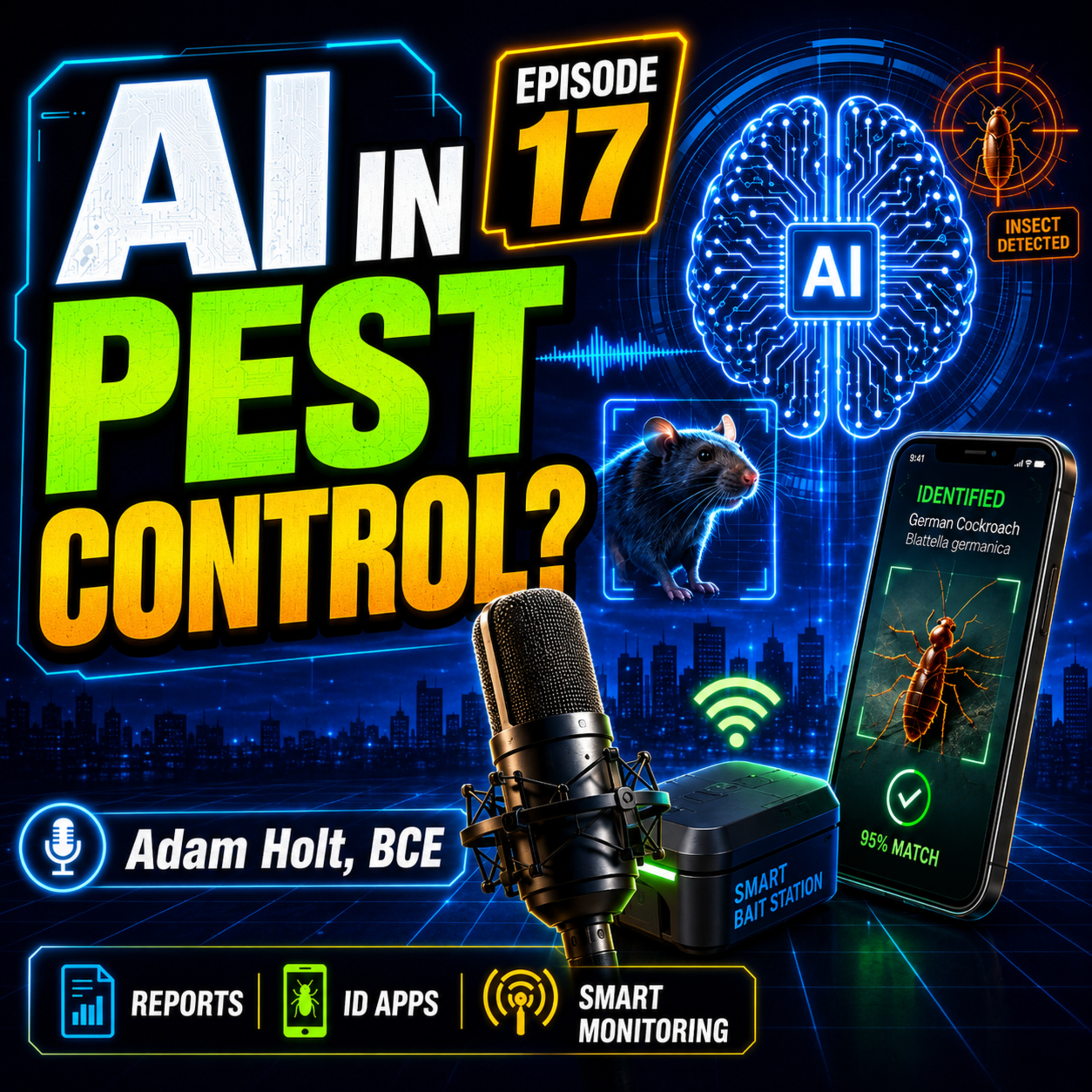
AI in Pest Control: Will Artificial Intelligence Replace Pest Controllers? | Adam Holt
Tonight's Episode
AI in Pest Control: Will Artificial Intelligence Replace Pest Controllers? | Adam Holt
In Episode 17 of the Pest Perspectives Podcast, Shaun Muller welcomes back Adam Holt, BCE, a Board Certified Entomologist with around 25 years of experience in the pest management industry.
This episode focuses on one of the biggest conversations currently taking place across the industry: how artificial intelligence will change pest control.
Rather than replacing experienced technicians, Adam explains how AI could become a powerful tool to support pest professionals, business owners and technical managers. From improving service reports and developing training materials to creating marketing campaigns and analysing data from electronic rodent-monitoring systems, AI is already beginning to influence how pest management companies operate.
Shaun and Adam discuss the opportunities AI presents, but also the risks of relying on information without checking its accuracy. AI-generated content can sound professional while still containing incorrect pest identification, unsuitable treatment advice or information taken from another country.
They explore why technicians and business owners must continue to apply professional judgement, verify technical information and seek input from suitably qualified experts before using AI-generated material.
The conversation also examines the growing use of insect-identification apps, Google Lens and image-recognition software. Adam explains why identifying an insect to a common name can be relatively straightforward, while reaching an accurate genus and species identification is far more challenging.
The episode also covers the use of AI and data-driven technology within electronic rodent monitoring. Shaun shares his early experiences using remote monitoring equipment, while Adam discusses systems capable of measuring bait consumption, detecting whether an animal entered from the left or right, tracking movement between devices and potentially distinguishing between rats and mice.
Other topics include the importance of professionally written pest control reports, creating report templates for technicians, using AI to prepare course agendas and educational content, the environmental impact of data centres, and why pest professionals should start learning how to use AI effectively.
The key message is clear: AI is unlikely to replace a skilled pest control technician, but technicians who understand how to use AI may have a major advantage over those who ignore it.
Topics discussed include:
- Artificial intelligence in pest control
- Whether AI could replace pest technicians
- AI-generated service reports
- Improving grammar and professionalism in reports
- Creating pest control training with AI
- Fact-checking technical pest information
- Google Lens and insect-identification apps
- Identifying insects from photographs
- Common names versus scientific identification
- AI cameras for rats, mice and wildlife
- Remote electronic rodent monitoring
- Measuring rodenticide bait consumption
- Rat and mouse identification through monitoring data
- Marketing pest control services using AI
- The environmental impact of artificial intelligence
- Why human knowledge and professional judgement still matter
This is an informative and honest discussion about the benefits, limitations and future possibilities of artificial intelligence within professional pest management.
Hello and welcome to Pest Perspectives episode 17. Now this is this is a podcast. First for best perspectives, we have a returning guest, Adam Holt, BCE. How are you doing mate? Oh my God, I'm exhausted. But thank you for having me again. I'm super excited to be here. I like I said, I'm just getting out of a mosquito control webinar. So I was having brain farts. I like we were talking about a lot about putting together how to create market, how to create educate market of mosquito control programme.
And so part of that was going over 80s and Culex because they're the primary 2 species that into care targets, if you're familiar with into care. And so, but I was like having a brain part about which one was the container breeding mosquito. And then I was able to confirm that 80s are the container breeding mosquitoes. And so anywho, sorry, let's move on. Yeah, No, no. So good, good tap you back home. It is the people who didn't listen to the last one. Do you want to tell people who you are and what you do?
Yeah, I'm sorry. That's a lot. That's a long speech, actually. Yeah, correct. I agree with you. I think it is a long speech, so sorry about that. I just need to take a bite of a snack. Yeah. All right. So for anybody who has not seen me before, again, my name is Adam Holt. I'm a board certified entomologist, but in the pest control industry about 25 years now, 2526 years. I would, I would definitely say that I've been around the block when it comes to pest control. You know, I started my career in Florida.
I've since I left Florida in 2017. I've since lived in Colorado, Michigan, Northern California, back over to Philadelphia, then down to San Diego and now to Hawaii. So if you're kind of thinking about like, you know, geographically, Florida, Colorado, Michigan, Sacramento, Philadelphia, San Diego, Hawaii, you've travelled. I've travelled quite a bit. You know, I live the farthest. I live the farthest now away from my family, which is, you know, not always the best thing, but it's also I live in Hawaii, dude.
I mean, like, who can say they live in Hawaii? That's. True, that's. True. You know, I live in paradise and so, you know, I was actually talking to a buddy the other day and I was like, hey, do you think I should consider moving back to the mainland just because of my business and having that face to face interaction? And his response was, dude, if I could do what you're doing and stay remote and live in paradise, I would 100% stay in paradise. So it was some it was, it was some really good perspective.
Ha ha, no pun intended on, you know, the direction of where I should go. A good perspective. Now today we're talking about a specific topic. I've never done this before for the show, an actual nail down. So we're going to be talking about a, a conversation that continually it keeps coming up within the pest control industry and on LinkedIn and podcasts and everywhere. So it's AI in pest control and how AI will help, obviously not take the job away from the technician, but there's many ways that AI could help technicians do a better job in the field.
It is. It's quite an interesting topic though, aren't you, Adam? It is. Yeah, it's a very interesting topic. I mean, it's becoming bigger and bigger. I don't know if you're familiar with Chaz. Do you know who Chaz is? Chaz. He's from Nicis Chaz Estrada. Oh, yes, yes, yeah, they just. Published. They just published their music video today, which is just. If you haven't gone to listen to it, it's literally hysterical. I've just seen it. I didn't listen to it. I've got I've just seen it on the phone but I need to go back and watch it.
But was that AI then? Yeah, so let's just see for a second. It's a it's a great example to show people. So let me just show people real quick because this is just such a good thing to kind of show you literally what it's capable of, right? I'm not going to play the volume just because I think that's a little much in the, you know, in the podcast. Copyright. Maybe, you never know. Well. Not even that, but I'm just trying to show people here. So he's literally sitting here and he's doing. It's a country.
Music video on. Buzz right, But you'll I think him. Here, but he watched that. Yeah, but you'll see him here in a second. He's singing and he's singing this whole thing and they made-up and the AI not only made the video of him doing this and singing, but it's also of him of the, I mean, it made the whole, you know, the actual song. It did all that stuff, you know what I mean? So you're saying that he wasn't actually singing? Put his voice through it. Oh wow. That's not even his voice. That's not even his voice.
Oh, I've really got to listen now. Hi, Jenny. Thanks for tuning in on LinkedIn. Jenny. Aloha. Yeah. So you know what I mean. It's just it's insane to think that this is literally had. This is just his face. That is very interesting. Did you know what he used? Which AI? You know, that's a great question. I think I could actually ask him which one he did. I mean, it'd be very easy to find out. Yeah. But I don't know which one he did though. But they reckon within because I listen to people like Gary Vee.
I watch Gary Vee and he reckons we're in the next 5 years, all these big Internet stars, there'll be loads of fake videos where AI has changed the words around and you won't be able to tell who's actually made the real video. Has it been up? Frightening. Scary it will. I mean, it is, well, what also makes me wonder is what is that going to mean for like the movie industry, right? Like, what does that mean for, you know, like all that kind of stuff? I mean, and granted, I know we're here to talk about pest control, but let's get back to pest control.
Sorry my mind getting. Everywhere. But as far as AI, you know, for me and pest control, I'm, I was a little like, you know, unsure if I supported AI in the beginning, but I also realised that we don't have a choice. AI is the wave of the future. You know, I think my biggest thing that I've learned recently is I've heard a lot of people say that supposedly AI can have negative impacts on the environment from an energy perspective. I don't know if that's true. It's just what I've heard. It's a data centre.
The power, the power consumption it requires, yeah. It's not very. It's not green friendly, It's not. Well, that's where I get concerned is if it's if it's not green friendly, where where's the where's the balance going to be with that right, You know what I mean? I don't know. I'm not an expert, but I've been told it's not very green friendly. It takes a lot of computing power and electric etcetera to to power it. So I don't, I don't know any more than that. I don't. Yeah, yeah, yeah. But to to get back to pest control, as far as you know, where I see it really being, I would say probably super effective and pest control is more from a more from probably like an office standpoint, right?
Or like, you know, a managerial standpoint. I could see, you know, I could see people using AI for developing trainings and developing, you know, social media campaigns and all the things they're using it for now. And so, but here's the thing that everybody has to remember about AIAI is literally cross reference searching all the information on the Internet, right? Yeah. So the reality is the, the reality is all that information was put on the Internet by you and me and other people, right? So there's a good chance that what do I always say?
Garbage in, garbage out. There's a good chance that a lot of that information might not be fact full information. So for anybody listening, for anybody that uses AI or anybody that uses ChatGPT or any of these things, you want to make sure that whatever you take out of it, you're fact checking. Right. I'm not saying which companies, but I have seen companies in the UK clearly used over a year ago. It's not happened since used the top bugs in the UK termites, wasn't it. So that's obviously grabbed it from America and they've not fact checked it obviously.
So we don't have termites here. It's not a problem. It's not. Yeah, I mean, it's not. The crazy thing is we don't need AI for people to make mistakes. It's true. You know what I mean? Like a good example. I'm like you remember and this might be before your time, Sean. No, actually, what? You just turned 40, so we're close to 8. Do you remember the magazine called Time? A magazine? I think it's still around. I've. Heard of time? Yes, it's still around. It's a big one in the mainland. So back in the day, and this was like late 80s or early 90s, they went to post a thing on mosquitoes, right?
Because there was a big deal with mosquitoes. And literally, this was on the this was on the cover of the magazine. Guess what creature they put as the cover of the magazine that they said was a mosquito? Wasp. A crane fly. Oh. OK. A crane fly, cause a lot of people call crane flies like the mosquito Hawks, right? Because they're literally the size of 1/4. They're huge and they do look similar to a mosquito, but they're not a mosquito. They're a crane fly. They're in the order Diptera. I mean, they're definitely not mosquitoes at all.
So it was just crazy to think that Time magazine put the wrong insect on the cover of their magazine. I still do, even normal newspapers in the UK like beer and like with a lot of age because they all panic about Asian Hornets that may like last year they were panicking because they Asian Hornet. Correct me if I'm wrong, it's not as big as the European Hornet. They stuck on the European Hornet instead because it's bigger.
Oh, they made a mistake and didn't know which was which. I will tell you this, I am not big. I'm not a big hymenopterist. And that's what all of your ants and lots fall into. Even people have come to me and said, hey, will you do a training on ants? And I'm like, I will happily do a training on ants, but I am not the expert of ants. So I will basically go and. At least you're clear. You're clear and transparent when you say I'm not the total expert, but that's good. It's. I mean, what else are you supposed to be?
I don't want to set somebody up for failure. Right. Exactly. Exactly. I mean, I don't, I don't ever. By the way, how did you make your your background black on your screen? My wife made it on canvas. It's, it's actually, it's not built in. It's actually she made this by the way, for me. So it's kind of a green, a virtual green screen, but it's black with best perspectives on I didn't make it. Anything that looks good that I've made is not me. I'm going to upload my background now let's see if it'll let me do it.
I'm going to see I'm trying to see if it'll let me do it here. Let's see here. There we go Yeah save background. Let's see if it'll let me do it because I was like wait a minute. Why do I not have my background here it? Shouldn't let you. Last time we done, they said we're in Riverside and you were, you were on the, you're on a mobile phone, I remember. Right. Yeah, but it's like, there we go. There's my name, that blog. Yeah. There you go. So one thing we did talk want to talk about is because we had a conversation about apps that the book identification.
So I showed you an app and you said Google Lens is probably just as good. So I cancelled my subscription. Thanks for that. But I'll tell you what it claims. It's got all these experts. I can't what you and it's terrible, but false positives. So there's loads of bugs where you take the photo three different times and three different insects will come up. And also, it's not really, is it? It's not really. It can't be what? You're talking what you're talking about, Shawn. I love the idea of this, right?
So Google Photos is something I've used a lot of only because Google is going to cross reference search the entire Internet, right? That's what Google does. So if you use Google Photos and you basically take a picture of an insect and then you click that little button, that's all it's doing is cross reference searching that picture across the Internet, right? And so your, your fingers are crossed that like 99% of those photos were identified correctly. But the reality is there's a good chance there's not.
And so to Sean's point, any type of AI technology that's going to do software image, sorry, image software recognition or image recognition, Let me say that, right, Any AI software that's going to do image recognition, it just like any, any other AI software, you have to train the AI software, right? And so, you know, I've talked to other people about this and we've had a multitude of conversations where if I were to, if I were to want to create my own software, right, that did what you're talking about.
And that would actually be like an insect photo thing. You, you would have to upload thousands upon thousands of photos of a certain species for it to be done right. Because it's not just about a dorsal picture or a ventral picture. It's about capturing all the different angles, the lateral, the posterior, the anterior, all the different angles you want to catch of the insect. And so to your point, there's some relatively decent ones out there. But at the end of the day, it really depends on also how finite you're wanting to get with your identification, right?
If you're just wanting like a common name, you can probably snag it from the Internet. But if you're wanting a more specific, like scientific name with the genus and the species, that's going to be more challenging. Well, so far, compared to that app that I cancelled, Google Lens has been better because I've been playing with it. I've been sending it through free time to say because what I had on that app was sometimes you send the same photo and try it again or a different angle. It tells you something completely different.
But Google Lens so far has been coming back with the same result. So it's better than what I had. But cheers for that. Cool. You're welcome. Leave that, leave that thing to get hold of you. They do. It's a bit weird though, because they claim that there's it's expert back then, it's thousands of people around the world, but it can't be making that many mistakes. Yeah, and I would say, I mean, I, I know there's a lot of entomologists out there. And so again, I mean, it's about, it's about training the software.
And so I that would just take like like thousands and thousands of, you know, man, man hours, you know, all that kind of stuff. So it would just be, sorry, excuse me, work hours. It would just take thousands and thousands of hours per insect to get all that trained it. Would it? Would it's? You know, but I think, I think another AI thing that I'm sorry, my mind just twirling. That's good. That's good. That's good. You know, as far as even what I was just talking about my webinar, you know, if you were wanting to put together like a marketing campaign for something that's a great opportunity to use again, AI or like ChatGPT just to get that foundation, right.
But once you have that foundation, you you don't want to take whatever you get out of ChatGPT and just go use it. You want to make sure again, you Fact Check it and it's also a good idea to have somebody like me, like a BCEAA person of a technical expertise, Fact Check it for you, right? There's no offence and this isn't any offence to you, Sean or anybody else who wanted. To I'm not as qualified as you I'm. Not, you know, most people are not going to have that technical background to be able to look at it and say real quickly and spend less time, right, Because time is valuable, time is priceless, time is money.
And so if you can take somebody like me and pay me a fraction of amount of money to look over for you real quick versus you spending 3 or 4 hours looking over it, then I can look at it real quick and I can say yay or nay. Or here's some of you know, here's some enhancements, here's some improvements, make the improvements, send it over to you and say here you go, you're good to go. You know, go with it. Fly with it. Yeah, because obviously not male ione the average pest control like usually does so many.
I don't do that many. I don't do that many insects, I mean, and few weeks not and bed bugs, fleas, carpet beetle.
I don't do money. I don't. So I will tell you, you bring up something I'm infatuated with. I'm actually infatuated with ectoparasites, but fleas, I'm super infatuated with that. Don't know why. So I actually rode, AI say rode. I kind of created a dichotomous key to the fleet to like the most common flea species. Oh, OK. It's actually on my website. It's a little YouTube video I've made and. I will have a look. Yeah, it was just me doing it for fun, but I think my whole point to that is just like that kind of stuff infatuated me.
So I kind of dove in a little more and, you know, focused on that. But again, we're getting off topic here, Sean. We're here to talk about AI, right? I'm just talking about whatever we want. It's all. Connected it is. I've also heard people using now. This one I think is quite clever. Obviously we've digital reporting now which which I use as well. I have. It's not made, but I have heard of people that do to make their treatment reports sound better and more worded and so say. Are you are you talking about your service report that you give to the customer?
Or or or commercial client to make it look look written better if you get a worded much better having AI help you. So if you tell it what the report is and they have it worded better say rather than saying block that oh it will tell you why. I think a part of it, and this is not me being offensive to anybody. If anybody does this thing, I apologise in advance, but I'm, I'm very, I'm a very like, I'm very big on grammar and syntax and all that stuff. And so quite often what you get into is I've witnessed this so many times is that you'll have that server summary, right, written by a technician at the top of the service report.
And it'll literally just be a big run on sentence. I was here today and treated your plays and treat and did 17 bait stations and did this and did this and didn't find anything and blah, blah, blah. I'm like, OK, I'm, I'm reading it and my mind is about to explode because of my grammar. You know, my, my grammar thing going on. So I think to your point using ChatGPT is not a bad thing but it's also and this is what I see as a for future generations coming in current like younger generations I see there being classes on how to properly use AI.
I'm still learning, I'm having a look. Obviously you're money. Well done mate. You see my post that was written by AII was playing with AI. I've got to get the nuances right, It's not easy. No, it's definitely not. And learning how to actually pose what learning how to, you know, put in the GPT what you want to get out of it, right, That's going to be very important. So I'm learning that as well. Everybody's going to be learning that. But it's very interesting. You kind of evolve, but you learn real quickly based on if you like what you get out of it, you're like, wait a minute, what did I do?
I just need to go back and remember what I did so I can recreate that whole thing. Yeah, right. And. So because how much? And once you get used to it and you've got the system to know what you want, make it sound that way. You can make it. You can make it right like it's you you can. And you know, one thing I love, so like I'm creating a lot of CEU courses, continuing education units for the right now for clients. And like a lot of the different states require like an agenda, right? So when I go to apply for a seat and U course, I have to submit a title, I submit a title slide and then I submit an agenda.
I ain't got time to write out that agenda. So normally I just go to chat TBT and I'm like, write me a, you know, 7 section agenda for this topic and make sure to include biology. I say make sure to include all these things and then pops it out for me. And correct Welcome, Hugh Radcliffe. You have to ensure it sounds human, correct? Oh yeah, we. Use chat GP, ChatGPT for reports sometimes. I'll tell you what I do do as well. After the podcast is uploaded to Spotify and once the transcripts are uploaded, I obviously I go back in and what's it called?
I ask AI what the best version of podcast platforms would be for the descriptions. And I also ask out of this podcast, what do you think would be the best learning points? To be fair with that, it's quite good. So I mean, so where what software are you uploading the the the podcast to? Yeah, yeah. But when it's on podcast platforms, it gets uploaded to Spotify for podcasters. No, no, no. What I mean is so like have you heard of clipto?
No, you should. You should write it down clip, like CLIP and then TO clipto. And so essentially it's a soft, it's a, it's essentially like a video software where you could upload the podcast. It's going to transcribe the entire thing for you. And then if you want a detailed summary, if you go to my website, all my detailed summaries from my podcast are from Klipto. I thought it's not free though, isn't. It it's not free, no, I'm. Not sure I've been looking, I've been scouring the net. Sean and nothing, nothing, you know, I'm going to tell you the same thing I tell everybody.
Nothing's free. It shouldn't be free because somebody put time into it, right? That's. True, that is but. I mean, but I mean, we all like free. That's how I do it. It is to get the learning points. It generally does come up with correct answers from what I I check the podcast and what's been said. But yeah, it kind of works. It does, yeah. And Hugh's. And Hugh's definitely right. You want to add the human touch to it for sure. And kind of getting back to your service report. I don't, I think with service reports, honestly, one of the reasons, one of the things I like about pest control softwares is that they've got all of the, the back end database parameter tables that you can basically create what you want to what you want the technician to input.
And then you can control what the technician inputs, right? And so I love that for that reason because like honestly for me, if I owned a company, I would not allow technicians to leave a summary just for that reason because of the fact that their grammar is typically horribly bad. They don't take the time to even check it and make it look nice. I mean, or if I was going to let technicians leave a summary, I would have a pre scripted summary that I give them when they on board that would be copied into the notes section in their phone and then they could just copy and paste that into the service report.
I. See, I think that's all. I think that's well, the people that I've spoke to, that's the they've got like not a not a blank copy and paste because every site is different, but it's more like what I, what I use when I find this, this and that and when I find a hole in the wall, this is what I write to make it look more professional, but all. Right. But when I say that, when I say the copy and paste, that's just the template, right? The copy and paste might say, you know, thank you, pest. Thank you, Pest Perspectives, for allowing me to visit your, your company today.
It was a pleasure to service you and your, you know, your team members today. We did blank, blank, blank and blank, blank, blank. You know, obviously it's a template, you know what I mean? Yeah, but that's more what I mean is at least the templates there. And at least as a company owner, I feel comfortable with with what's going out there because everything that leaves anything that's part of your company is a representation of your brand and your company. It is. It's true. It is. You know. It is obviously I presume we've had sense that must use I presume or not, you know when they measures the bait that.
Is AI. Oh yeah, Is that AI? The bait is actually not AI. The bait is actually like, it's actually it's, it's weighing the bait. Oh, just playing it and reporting back. Basically a lot of technology built into when the rod actually clicks in. That's going to basically calibrate it to like 0 whenever you have the bait on there. And then as the baits being consumed, it's actually weighing the percentage. It's it's, it's in real time, it's sending back information saying this percentage of baits been consumed.
This percentage of baits been consumed. I'll tell you what, that's a useful feature. Very useful. Feature I was actually not to. Talk to you about it because I'm, I know you're, I noticed you're getting into the whole electronic rodent monitoring and I'm like, you should consider trying out the whole pest sense thing. Well, yeah, it's because obviously I've got a lot of, I don't know if you caught any of the podcasts with Andrew last week and he was asking. I unfortunately did not. No, I'm not. You're a busy man.
It's fine. He was talking about how often do you go back once they have been activated. It says, well, I went back to 1 box over a weekend that was hit 19 times, I said and only half the bait was consumed and I was like, I thought it was all gone. So. So I'm going to wait till it's more's gone next time. Wait a minute, you're using bears, right? What's that? Which which brand are you using? Is it Syngenta? Since Syngenta is a secure. Choice is it? Is it not real time? It's real time, but it it can't tell you how much.
Bait's gone, obviously. Oh, so if you were using Pestilence it would be more information? Yeah, it would be. It would be, but, but I do like it. To be fair, it's the first time someone's let me use it at a trial. So what are you, So what are you getting is Syngenta just basically, is it just motion sensor? So essentially when you're when you're getting when you're getting data, right, or you're getting notifications that are you're getting notifications. I'm assuming you're getting notifications that there's an event.
Yeah, right. So basically it's letting you know that maybe a rodent entered the box. Yeah, yeah, right. And I think it's. Motion and vibration. I can't remember which one it is. And it, it could be so with pest sense, with pest sense, the, the AI that's built in the pest sense would be something like there's essentially, and actually, no, this is, I'm trying to think is, is there AI? Yes. So there is AI built in the pest sense, The AI that's built in the pest sense, that part of the AI that's built in the pest sense, there's a lot of different functionalities and pest sense, one of them is basically, obviously the bait Wayne component that's not AI.
There's also the ability that it'll, you'll get, it'll let you know whether it's in the left or the right side of the station. Also extremely valuable information, right? Because then you know where it's coming from. We've actually just added some technology to the software where as events happen, you can go into the software and you can actually see where the rodent has been running really. Have you got a camera? Yeah. No, no, no camera. It's basically it's, it's basically, yeah. So the data that it's got the, the data that each box is gathering is basically able to say, OK, this this data, this data point equals this data point over here equals this data point over here.
So it's basically pulling all that data together and saying that essentially this specific rodent that's causing this data point is going to all these different boxes, OK. And that's going to be that's not going to be more AI than that's going to be more obviously data algorithm versus AI algorithm. But where the AI is built in is that they've actually trained the software to be able to recognise whether it's a rodent or a mouse. Wow, that's that's very interesting, that is. And so that's going to be based on training, obviously, you know, the algorithm to be able to notice whether, OK, is it a, if it's a, if it's got a, if it's a heavier thing, it's going to be a rat.
If it's a, you know, less heavier thing, it's going to be a mouse. And so yes, I would say there's definitely AI built into that. I don't know exactly what AI is built into it. Oh. You don't need to know. They probably be their own or proprietary or I don't know, but I wouldn't. Even be interested to know some of that, but it's very interesting, right? It is probably interesting. Most definitely it is. Supposedly, just so you're aware, supposedly you know what? You know what Bell is, right? Like Bell, I've.
Heard of this? Yeah. Yeah. So Bell is supposedly, I think they're also building a a sorry. They're also building a electronic rotor monitoring that will also weigh the bait supposedly. I don't know. OK, because theirs is more. You've got to be on site, haven't you? So currently with Bell, you have to be on site. It's Bluetooth technology, yeah. And so essentially you hook it up to the Wi-Fi and then when you're on site, you open up the app and it goes and it pulls in all your data. And so that's the nice thing with that.
However, they supposedly are adding I think lower based technology to their upcoming new release as well. OK. Yeah. I mean, so Bell sensing is if you haven't heard of Bell, I mean, when I back when I was with advanced IPM before I left them, what is somebody what, what just popped up? Adam well bang City tree and Adam said he used Bo before it kept playing up. He he's used a few different ones. He used to work for Eco Love. He did. Oh, OK. Yeah, yeah, yeah. So and and a few other companies like that.
He did. He's a nice guy, yes. Gotcha. Yeah. So I've actually used a tonne of them and thanks for chiming in there. Yeah. So when it back like I said back again when I was with the main psyche and before I left them, I had deployed 5000 Bell sensing devices. I had that I remember. Those, yeah. And so it was just insane amount. Did they give you a? Did they give you a bag on the solid? I mean, they've given me a free trip to freaking anywhere I wanted for that kind of stuff. But no, they did not. But anyway, it was a really, it was cool to be a part of that journey and, you know, be a part of all that.
I mean, there were a lot of things that went into that and they're actually a great company. I mean, we had, when I was with advanced IBM, we had some very challenging issues and Bell stepped up to the plate and fixed them, which was really cool. That's nice size. That's really nice size. I've got a couple of friends that are trying bell Bellsense at the minute I have I need to ask them how it's going. Actually I. Haven't since Here's a here's another thing to talk about. Like the difference right now, the difference between Bell and like Pest Sense is that with Bell, once the battery dies, you have to replace the entire device.
Oh, OK. Right. So I don't know how it is with Syngenta, but with Pestsyn, so you can actually interchange our batteries, you can open up the thing and put in your new AA batteries. I think the batteries last up to like five to seven years. Usually it's two to four years. I don't know. I was told like five years, but I would. I would be very surprised now. Does Syngenta have the ability to replace the batteries physically?
I I don't have to send you them, you can put them in obviously. No, I'm saying, so it's not just regular AA batteries or what is the battery? Thing, No, no, no, it's not just, it's just the battery it's been and you put it in, there's no AA batteries, OK. I'll have to look at it. I'm not. Quite sure. I'll send you a message, I'll send you a message, I'll send you a message and show I've got a picture of the box open and you can see and you can see the sensor. Right, Yeah. I'm more concerned about the batteries though like that.
It works on batteries, it works on low power. Very low power it does. Got you. I don't know. I don't know how that works, but I was just told that they last low X amount of years. They do. So here's the question, when you got them, did you have to install batteries into them? No. Yeah. So I'm going to guess if they're, I'm going to guess if they're like anybody else. More than likely the battery is inside the actual component. Maybe that's it. You don't have the ability to replace the battery like you would on a flashlight, you know what I mean?
But that's kind of it. Maybe that's it. I don't, I don't know. I'm new to all this. I am. I'm new. Yeah. So like with us, with Pest Sense, with us, you can literally open up a little thing and you can put in the new batteries. OK. Which is nice because then you're not having to. Let's see here. They don't all have traps either. It's usually T Rex style traps. Yeah, it's all about the bell set the bell senses is. The Bell sensing, at least last time I had checked, had three different types. They had the IQ trays, which is basically goes into the bell the the Evo Rd of bait station.
They've got the 24/7 trapper. That's your glorified tin cat, but it's the plastic version. And then there's the T Rex trap. OK. So that's traffic that T Rex trap, Sean, don't, don't play around with that sucker. She'll get you. She'll bite you. That's nothing mate, any UK we use something called the Black Cats that will break your finger. The T Rex trap I think with as well. Yeah, they're insane. Like the power they do. That makes sense, right? They're supposed to be able to. But to be fair, the black you need a you'd need a much larger box to get one in them.
They're massive. They you need a much faster box. You would. But they're they're a favourite over here with pest controllers, especially in people's lost spaces and places that are safe, obviously, But they are big. They are quite big in comparison, so you wouldn't fit an average one of them in any of your boxes. Unless you bought a big one. You wouldn't. Oh my gosh. So did you and Andy talk about, did you and Andy talk about AI or any type of rotor, rotor, electronic rotor monitoring last week?
Oh, we did talk about it. Yeah, he was. He was talking about pest sense. I don't know if it's available in the UK, but he's been trying it. He's like literally under snow and he was still working literally because I've never seen the photo. And he says, yeah, it's still working perfectly fine. It was he's he's I like Andrew. He's very analytical. He's very, yeah, because he was asking me like, and he was saying, So what would you do if you had loads of sites and how many activations you've got? I said, I'll be honest, I said I'm just trying as I'm still new.
And he was telling me how you got to think about if you get multiple sites, you've got to work out how many activations to, to go out because the bait might be there. You can't go out every single time. And he thinks about it from an analytical perspective, which is, I suppose you need to do, don't you? What's that used to the product? I think the thing I like about Pestilence and the bait weighting perspective is that you know if the bait's been consumed or not, right? So if there's an event and something just goes in the station and comes out that not that that's not valuable data, but then you don't have to run out there like you said 19 times.
That's true. I didn't run out at 19 times by the way. I just meant, I just meant that debate point had been hit 19 times in one weekend. So did you go out there whenever you got whenever you got a hit or what'd you do? Well, that weekend obviously it was bank holiday weekend and no pop pop. We popped in on Tuesday, so Black Holiday Monday you don't work but, well, we don't anyway and was there. Any was there any bait gone? Half of it. So there's two blocks in it and it was just half of the two, so.
So one of the blocks was gone or half of 1 block was gone. Half of 1 of each was gone actually, but it was and that was it. But I do like to go more regular because I'm doing a trial and I'm supposed to give an honest opinion. I am obviously, so I don't. Know if you know, I don't know. I don't know if Andrew told you what he does, but Andrew, supposedly he puts the devices he's trialling next to the devices he usually has and then he basically does that cross comparative. I actually said he's got a new site set up where he's got a multitude of different devices, he said.
He said he's got one word I'll. Have to go listen to it. I haven't talked to him in a while. I need to catch up with him anyway. Yeah, OK, Back on the podcast. It'll let you all. I haven't been on yet. I've not been on yet. You. Haven't been on his podcast yet. Not yet. I'm sure I'll get the invite eventually. I will. Oh yeah. For. Sure. What other podcasts have you been on so far? I've been on beauties and beasties to talk about. Don't post dead animals on social media if you're a pest control company.
That was a very interesting conversation because. You said don't post. What now? Dead animals on your company's social medias for the public. Why? You know, why was that? Why? Why did that topic come up? I'm just curious. No because I made a post about it on LinkedIn and it blow up. Literally, it was. In a good way or a bad way? The vast majority of people agreed, but there was obviously a few people that didn't agree. But when Sean got me on, he was like, when he read it out what I said, I said that's not what I said because he said you said pest controllers shouldn't post dead animals on their social media.
Said no. I said pest control. Pest control companies on their social media brand accounts wouldn't posted animals. Why shouldn't they though? That's my question. Get a lot of bad rap. You can. It's terrible. You can I. Mean so I think. I did that in my area. If I did that in my area, I was doing all the work. Trust me, a lot of work over there. So from from. From your perspective, I can see the point from a client perspective because there's it's almost like you don't have the compassion for the animal, right?
Educational wise, I can. If it's educational posts for other other people in the industry, then that's fair play, but that's what the podcast was about. But it was fun. I'd also been on Tales from the Cruel Space European edition. Yeah, I still haven't gotten. I still haven't gotten. Are you talking about what's his face? The two guys. Yeah, tracking Brad. Yeah, I still haven't got to get on there yet. I've been asking them to get on and they. Oh wow, it's very. Would you be OK on a podcast like that though?
I mean, I don't mind it. I know they're very vulgar and it's very kind of open concept, but I I kind of like the idea because it's also a very relaxed atmosphere. I'm always messages. I will have a word for you. Yeah, so I'm like, I just, I don't know if they, I mean, he, he had mentioned possibly having me on at some point about ants and I was like, dude, I'm just, I'm not the Ant expert, you know what I mean? But I'm like, I'm literally fascinated with gross out content. You know me, so that's what I'd do, you know what I mean?
So like botfly removals, ticks, lice, all that kind of cool stuff. So. I, I will have a word for you and that's basically I, I would on the European. It's my first ever podcast for pest control. In my opinion, I was rubbish on it. But since saying I've done my own podcast and I am getting another invite back on. I don't know when whenever they want to get me on and yeah, they're, they're the only ones so far. But I, I, I enjoy doing my own so don't have to be invited on other people's. But I eventually will make the circuit eventually for now.
I mean, it's already, it's probably already involving enough for you to do your own, you know what I mean? Much less to be a lot of people takes up enough. Time. Oh, I don't mind. I don't know. So with this one right here, because this is on Stream Yard and it's live, when it's done, does it just basically download the recording and then you post the reporting? Exactly that. It also it also makes a load of clips as well. They're not always that good, but some of them are. Fair enough, but stream yard's not free, correct?
Oh, no, no, no, that's not free. No, no, it's A and. I'm not advertising for Starbucks people. I'm just drinking it. It's. About it's about £30 a month I think it is. How much a month? It's about 30 lbs. OK, geez, that would be probably a lot for me because your pound is worth way more than my dollar. Yes, yeah, yeah. Hang on. You've always wanted it in Adam. You've always wanted it invite. Oh yeah, I'm sure I've asked you loads of. Times, man who is now I got to see who Adam Edwards is because I see his picture.
So let me go to LinkedIn and see if I can find Adam Edwards real quick. He said no, It's it's a good mate. Mom, we talk all the time. We go. The CEO and a pest control company. It's got yeah, got a small little business are still. Delivering topic, Adam. We're only doing guests every other week as well, but it'll happen. Oh, I believe you, Jenny. We're good. Oh, sorry, I've also been on the pesticide podcast this week and that was all about fitness, health, linking to pest control. It's quite fun because.
Of your amazing weight loss journey, I love that. It's, it's, it's still going. But to be fair, Adam and Adam he he doesn't use LinkedIn a lot so it's every he logs in every so often he does. Is this Adam Alberto, owner and pest control technician at TNR Pest Solutions? That's him, That's him. OK, well I'm going to connect with you anyway, Adam. So there you go. I connected with you buddy. There you go. But but there, yeah, I was on good on pathogen. I haven't. So what would you, what do you reckon about?
It's obviously got a good, good conversation on the beauties and basties about AI regards to because you're almost talking about cameras where cameras will detect. Yeah, that's we're, we're kind of back to where cameras, OK, AI cameras and detecting things. It's kind of back to the image recognition, right. So like Google Photos or anything, you're going to have to train the AI camera, right? It's got to be trained. It's not just, it doesn't just you don't just turn on the camera and it just recognise things.
So. Right. So the AI camera is going to have to be trained. I mean, for for something like, I feel like wildlife, that's not as big of a deal, right? It can probably delineate a fox or a coyote or even, you know, those kind of things. But when you're getting down to the insects, unless they're. Extremely. I think so. I think he, I think he really meant rats and mice. Yeah, I. Mean, right, yeah, I think when you're talking about wildlife, that would make sense. That's easy. I think that's not that's that's fair.
I mean, I say it's easy as long as there's nothing that's similar, then, you know, you might have a false positive every once in a while. But at the end of the day, I'm I'm very much, I don't understand the point of having an AI camera for wildlife, right? If I have a camera at all, that's especially like, let me just kind of revert back to the mainland right here in the United States with a lot of wildlife trapping. They won't let you use a camera for verifying that the trap is empty, right, Or verifying that something's been caught.
Yeah, quite often. You have to still go out there and check the trap every 24 hours. Oh yeah, I think, K, that if you've got unlock a camera on it 24 hours a day, it's it's fine. But I don't quote me on that. People don't quote me on that. Yeah. And with that being said, even for the states here, I know that if I were a pest control company owner and I had a wildlife thing going on, and I've been on what I've been on the wildlife, you know, consultant podcast with Steven like twice now. And so we've had this conversation before where if I were, if I were to be a company owner and I were to have that set up and have a camera.
And if the state came to me and said, we're going to find you because you didn't have somebody checking them and be like, I've got a camera, it's got a picture, it's got a date stamp, it's got a time stamp. This is literally more validity than my technician driving out there because who's to say we can trust them to write it down on a piece of paper, right? Right. This is literally more evidence than my person driving out there. So I would be that person where I would argue it and I would say I'm not going to pay your fine and I'm going to appeal this until the, you know, until the, you know, whatever.
It's common sense. I mean cameras, it's, it's the modern winch 2025 that should be acceptable because most of the detection, it goes off. You see everything because in the UK the they're not, they're not actually pest control cameras. A lot of us use, we use something called I think they're probably American. We use Rio link cameras. We do they're very they're very good. We use a promotion control when, when, when you've obviously got some trapping programme or something going on or something not quite right in a loft space and you're like, put the camera up.
Usually solves it and and what and back to treating and passed away. Afternoon. But yeah, Aloha from Hawaii. So back to your thing though, as far as the AI camera, I thought Sean was also talking about insects, not just. He may have been, he may, I can't remember why and. So I still have. I still think that we are. I don't even know. I don't even know if we'll see in our lifetime to have AI that successfully identifies, you know, insect species, sorry, insects down to the level of species. Andrew saying Hughes post about LinkedIn, sorry AI and he actually put a he put he he tested chat GPTI think 21 speak insects.
OK, and I have to find it, but I'm pretty sure it got about 17 right out of 21. So when you say he tested ChatGPT, what does that mean when you say he tested ChatGPT? I think he hang on, that's where's LinkedIn. Did he like actually add a picture of like in the ChatGPT or? Andrew, there he is. Hold on a minute. When I'm the fly, I'm the fly post. Oh, there we go.
So how accurate is ChatGPT for pest identification? You asked? We were prompted by Hugh Radcliffe over the weekend. Below is selection of 20 images we fed into ChatGPT. These images are mimic the actual mimic the actual type of actual photos we capture in the field or clients provide us via cell phone camera. No microscoposcopic image was used. The results was 85% accuracy. AI correctly identified 17 out of 20 specimens. It was. Incorrect down to what level though?
It's what he says in this it was incorrect with assassin bug, the yellow garden spider, the Carpenter and frassa. For those it was provided identification of a left footed bug and a few of us. But you don't probably have to go and look at the post you would. So I think where I get concerned just from what you're saying right now, and that's great. I'm not I I love what you're saying, but I think where I get concerned is the IT sounds like it's doing a common name, right, Because you mentioned an assassin bug and a left footed bug.
Those are all common names, right? And so I would be more interested to know like what would be the accuracy down to the species like the scientific name, genus, species. Level. That's for a. Common for a common name, at least here in the States. Like if I were to say a water bug to you in California, that's going to mean a cockroach. In Florida, that could actually mean a literal water bug, which is in the heteropteran species where a cockroach is in the militarious species. So that's where I'm like, if it's a common name, that only concerns me a little bit, but I'll reach out to Andrew too and find out what he was saying because I'm very interested now.
Yeah. Which is? Yeah, they were common. He didn't list them all, but yeah, Adam's well impressed. You live in Hawaii. Say you're from Hawaii. Wish I was there. I live in Hawaii. I'm not from Hawaii but yes I live in Hawaii now.
Yes, I'll mention Pestilion. Jenny, I don't want you crying. Pestilion podcast. Amazing. Yeah, Jenny and them seem amazing. I'm I'm excited to be on that at some point for sure. So I've definitely, you know, owning my own business has been very eye opening. I tell people for anybody who wants to start a business, you know, I think I say you take the leap of faith as soon as you can because I wish I would have done this like a decade ago. I love being my own boss. I love being able to help others and give back.
And so I don't regret it at all. And I'm just looking forward to, you know, every day as I advance on this, you know, evolutionary journey. It's. Good. That is, that is. Yeah, it's a it's a good thing because working, working for yourself is is much better than having someone else telling you what to do. You make a schedule. You make a schedule also. When I work for myself, I determine my own fate, my own future. I don't have to worry about, you know, being fired or let go for some weird reason or being in trouble for some reason.
I, I get to manage all that myself, you know, And so that's one of the things I love about being my own boss because I get along with pretty much everybody. But you know, there are times where I've been told that I have a little bit of an intimidating personality, and that's fine. I don't. It's not on purpose. It's just more because I feel like I have a lot of knowledge sitting in this brain right here. So sometimes I think that's the intimidating part. No, I think what the atheist you you you're quite what you call a if you're a strong personality, you are.
Right. Extroverted. Yeah, that. That scares some people, but. That's fair and I'm OK with that. I'm very funny. I'm also that person. Closest I got to Hawaii was last week watching Lido. Oh my God, that's so funny. Well, you got to come visit. I know you're a long way away, but come visit for sure. Anytime. Hit me up, We'll go out, we'll do some fishing, eat some sushi, eat some poke.
But yeah, no. So as far as AI goes, though, again, I, I'm a big proponent of it. I guess that my biggest concern is the environmental impact that I've heard about lately. But I also think that they're going to find a way to balance that out. They probably will, they probably will. They always, they always find some way. But they I do think it's an area that all pest controllers should be researching what AI is and how to use it because you're going to use it. I'm not saying that AI is going to go and do your job for you.
It's not. But you need to be up, up to speed with things and there's a lot to it. It can help your job. I really think people should spend some time or an hour awake or half an hour awake just looking at it and and playing with it like because it's once you work it out, it's a powerful tool. You've got to work it out first. Obviously it keeps ramping up, doesn't it keeps getting better and better and better. It does. But again, anybody who wants to take advantage of AI, you need somebody like me, a board certified entomologist, to give you that technical review, right, to ensure that all of your information is accurate and correct.
That's where the punk flying. And you can catch me right here at name.bugconsulting.com. You know, I, I don't like to try to sell myself, but I. No, it's cool. It's it's why you come on there. You have a conversation as well. And I also, like I've told you, I give back. I want to give back. And I'm not here to like, you know, kill people when I try to like, I got to make a living as well. You know what I mean? And so I love that outlook, the business owner, but the double standard is mini that have that view then want people to work for them.
I think we should realise that all walks are just as important. Oh yeah, it's true if if if you want to work for someone. 100% if you don't want to be a business owner. I used to work a terrible job for 16 years, which I hated. I wish I didn't stay there for that long. And it's a terrible story if I ever tell you it. But but you. But you know what, Shawn? Though? You wouldn't be where you are if you hadn't gone through that. That's true. Well, it's my dad to go into pest control base. I wouldn't have been in it.
One thing I'll encourage everybody is you don't regret anything you've been through because it makes you who you are and it makes you where you are. That's true. You know what I mean? So I could sit there and say I regret things all day long, but then what does that do? That just makes me, gives me anxiety, gives me all these like emotions that I don't need to be experiencing other. I think more than anything, I want to take where I am now, take the positivity that I can and use that to propel myself forward.
That's true. It's, it's good that it's, it's, yeah. It's a it's a good thing. That is because it's pushing forward and it's it's, yeah. As far as far as my response to Jenny and the business owner thing, I mean, I think if you can do it and you want to do it, it's a great thing to do. If you want to, I mean, we also need those people in the retail environments, you know, at fast food restaurants that are doing what they're doing because then we can't have our fast food if they're not there, right?
And so everybody has their place. And some people are just not built to be business owners. I think I was specifically talking to those people who have considered becoming business owners, you know, because I've been consulting for literally a decade. And I just think about the fact that I, I kind of wish I would have just done this a long time ago because I love what I love. But does that mean I'm going to be doing this forever? I mean, I'll probably be a consultant forever, but there's a chance that I could go back to a regular job one day.
Are you still doing your teaching work or have you got rid? Of no, no. Well done, because I know, I know you weren't happy with it, so well done. I quit. I quit teaching and started this full time back in March because I was, unfortunately I was. Unfortunately, I was like this close to being physically assaulted by an eighth grade student. Oh, OK, that's not good. That's not. Yeah. And there were some other. You can't actually do anything back as a kid, didn't they? I mean, you can defend yourself, but supposedly there's like limitations to what you can do with obviously students who are trying to assault you.
So luckily it didn't happen and I didn't have to worry about that. But I'm like, there were other things that happened. And so it's just teaching for me. I just realised at least here was not where I needed to be. And so that's why I started this business full. Time. Oh, don't you have made the right move. I didn't know you'd have to be left. You teach the job. I've, I've been, have respect for that. Yeah, big, big respect for that. Yeah. Well, Adam's opinion is don't work for someone else. Ever.
I mean, yes and no. I mean, I think it's just for me personally and my journey, it's better for me to be my own boss. Yeah, that's fair. That is, it's everyone's got a different view on how where they are in the journey. Yeah, for sure, some, some people are meant. But this which schools would teach people? Well, over here, they they teach kids to how I should say they teach kids to work for someone else. They don't tell people, oh, you could be a business owner, you could do this, that and the other they don't.
It's not that mindset. Well, I think, I think, I think I like the idea of teaching them to work for somebody, because teaching them to work for somebody means teaching them to work with people, right? And working with people is extremely. Important Tell them they can do that, but they don't. They don't. They don't do that. Well, I mean, don't can't you, can't you watch Shark Tank from over there? Or can you not watch Shark Tank? I've watched all the shark tanks. I loved that programme and watched Track and then I watched, I watched The Apprentice.
Oh yeah, I watch all them kind of programmes. Did you watch the last episode of Shark Tank recently where Mark Mark Cuban is officially gone from Shark Tank? Oh, I bet I watched that then. I've been watched that. It's the last episode he retired, so he's officially done. Oh OK, well I will watch that. I don't think I've watched that one. Was that a live episode or? They're I think they're no, I'm sorry. It was. Sometimes they have an audience, don't they? Because I because I, I watched Shark Tank?
No, they do. Yeah, you have because I watch more of my messages and I think the ones for an audience is, is crap because they're playing to the audience. Yeah, yeah, giving money and they're they're literally waiting for the cheers. They were. I don't think they'd do many of them. But yeah, Adam said. Totally agree, though. We've working for others others good, bad experience and gaining knowledge definitely moulds you enough to take the leap of leap of faith as a business owner. Yes, that is 100% accurate.
I mean, I think that's where you and you ultimately end up. How do I say this? It it it helps to, you know, elevate and push you into that next step. And so you know what I mean? Like definitely the experience that I have with teaching was just that catapult, right? That's what I was looking for, that catapult to throw me into becoming a business owner and just doing it, you know what I mean? And so it's been rewarding, definitely been pretty successful so far. And so again, every day I just look forward to the next step.
And anybody listening that wants help from me, if you go to [email protected], you can go check me out. You can see everything I have to offer, training, quality assurance, quality assurance softwares, licencing, licence management software, all of the above, social media, all of the above. And so again, it's I'm Adam holtitsname.bug.com. And if you want to reach out to me on WhatsApp, you can use my phone number. It's 3524086122. Again, that's 352-408-6122. And yeah, my e-mail is [email protected].
So, Sean, it's been amazing being on here. Dude, I super appreciate you. So our podcast people, I've booked Adam for an hour. So he's he's a busy man. He is, but yeah, thanks for coming on. I don't mind. I've we'll probably have you on again in the future talking about something else. But you are the first one that's had two. Oh, there we are. Where are we? 222 invites. Thank. You, I appreciate you, I'm humbled, I'm honoured. I appreciate you Sean. It's always amazing and I always watch your journey with your working out and your fitness and your weight loss so.
Yeah, I'm taking it to another level now. I'm taking that to another level. I'm taking it to another level now. What does that mean? Diet's gone cleaner. Yeah. So I should start dropping more weight. It's gone cleaner. Are you trying to? Do your weight loss journey like on your own, Are you going to consider using like what is it like Wagovi or any of those different things to help people out lose weight? What do you mean no injections? Yeah, you've never heard of that? Yeah, the injections, the Wagovi injection.
I'm not into that. I can do it myself, mate. I know I can, all right. I'm not into them. I don't, I don't. I don't like needles to start with, so. But that's a big a big a big reason why I won't. But yeah. You know, I think, I think for anybody listening just to kind of like, I know we're kind of wrapping things up here soon, but you know, for you to be able to post your journey that that's that takes, that takes a lot of courage, right, because it does. You're, you are, I'm, you know, you were, you were obviously at a weight you weren't happy with and you're trying to, you know, go on this journey where you're trying to lose weight and become healthy and become that better version of yourself.
And so for anybody listening, posting that journey is a good way to also get that support from everybody, right? To be fair, I've not actually had anyone be that couple of comments on TikTok, but I don't, I don't really care. I'm not insecure, but in general, the vast majority of people and it's, it's not, it's good. People have called me inspiring. You're inspiring people. Yeah, I have a guy I follow on TikTok. I'm going to keep watching. But he was £700 What the hell? And he's now I think like under 300 and it's just like insane.
Like I think he's I think he's like triple, triple dad or something or like 3. He's like, it's insane though, but he's like. How much? Great. Wow, that's 50 stone people. Yeah, well, I mean, I was nearly 30, so put it that way, I'm not now. I've lost seven, maybe 8-7 or eight stone. How much is 1 lbs? Give me a minute. I'm like, I don't know what that means, sorry. Once it's fine. One stone and pounds. So that's 14 lbs so. You've lost over £100. Yeah. Well, congratulations, dude. There's Thanks.
There's there's the fist for you. The fist, palm. There you go. There you. Go, yeah, yeah, thanks. But thanks for your time and having me on and I'll send you the link. So if you want to download the podcast yourself, you can. Yeah, of course I'll put it up on my website. It goes on my blog as well. So that'll be easy way for people to you should set up. Yeah, you should also build a link into like your stuff where people once they click on it, it'll take them to your website if you if you want them to.
I have got it. It's like I haven't got a website but I've got a link tree that all the. Podcasts. Yeah, that's fair. You've got your stuff, you've got your best perspective, so that's fine. Never mind. I'm it's early. It's still early for me. So it's late for you. Early for me. But yeah, thanks for coming on and thanks for everyone in chat. It's been reckon it might have been the most engaging chat so far with people. Maybe I'm getting more and more people as time goes on. I am. Yeah, I appreciate you, Sean.
Thanks. SO. Much, buddy. Thanks everyone, and I'll see you next time. I'll speak to you soon. I'll speak to you soon, Adam. All. Right. Bye. See you. Thanks. Bye. Bye. Bye.
Sponsored by

 Amazon Music
 Apple Podcasts
 Audible
 Castbox
 Castro
 Deezer
 Goodpods
 Moon FM
 Overcast
 Pocket Casts
 Podbean
 Podcast Addict
 Podcast Republic
 Spotify
 YouTube