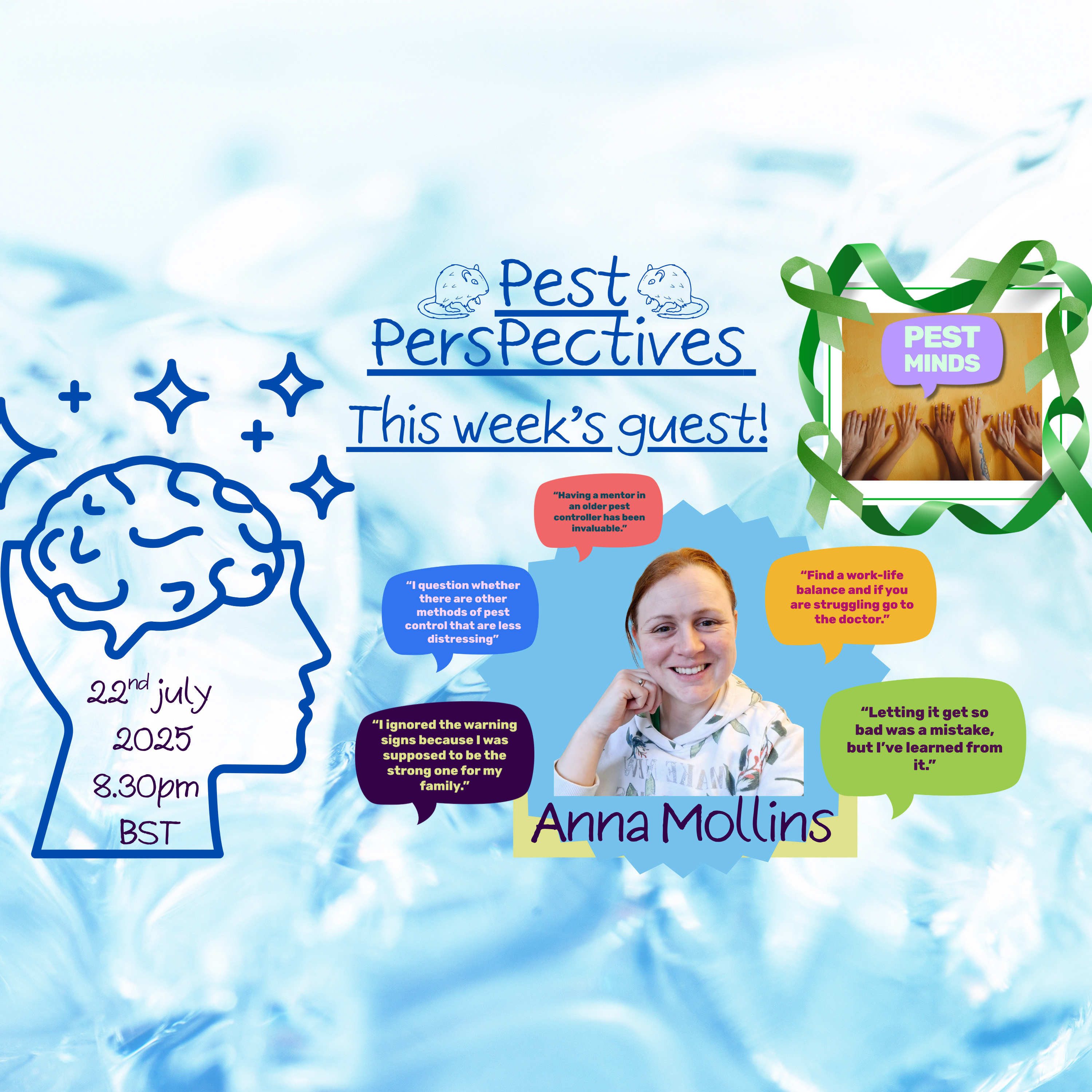
Mental Health in Pest Control: Breaking the Silence in the Industry | Anna Mollins, Pest Minds
Tonight's Episode
Mental Health in Pest Control: Breaking the Silence in the Industry | Anna Mollins, Pest MindsPest perspectives EP 25 - Anna Mollins - Pest MindsPest Minds is a site for individuals within the pest professional industry can tell their mental health journeys anonymously with the hope that by talking openly, we can show that you are not alone.Anna Mollins created Pest Minds after hosting a talk on mental health in a trade association conference. A short while after this a pest professional sought her out to thank her, because in hearing her and another’s own experience with mental health struggles, it gave them the courage to seek help. Knowing that they weren’t alone had helped them to take the first positive steps in improving their own mental health.
https://pestminds.co.uk/For all Pest perspective podcast linkshttps://linktr.ee/pestperspectivespodcast #pestcontrol #pestmanagement #mental #mentalhealth #pestminds
Register you're CPD with The British Pest Register
Hello and welcome to Pest Perspective episode #25 This week we have on Anna Mullins from Vera. Right here we go, Veritas Pest Consultancy. Have I done? Have I said it right again?
There we go that's it. You told me that, but I messed it up this time round so I'll be able to see this time and also Anna Mullins part is the called lady in charge of the Pest Minds initiative as well, which we'll talk about later. Very well. So have you had a good day? No, you've been all right. Yeah, it's been a busy day, summer holiday, so it's kind of juggling work. Are you in the first week? Are you in the first week of it? Yeah, first week SO started yesterday and kids are in day camp today.
Mine started earlier than that. Mine went the second week I was finished, not last week. The Friday before that I did does. That mean you go are you? Are you because you've got a longer week? Longer. No, what it is, all it is is our school. The kids school. They finish later but they add it up in time over the year. So in October when everyone else gets one week, my kids get 2, they do so then because they finished later like 3:50, they add the time up over the years. So they get to finish early, but they go back.
Pretty much all the schools go round there, but pretty much the same time. Yeah. Yeah. Well, no, when you get when you've got an Academy, you don't have to follow. They don't have to follow what the government tells them to. OK, True. They make their own rules as long as they do enough hours, etcetera, whatever they 10. 3:50 pick up must be quite. You can get that little bit more in when it comes to being a working parent. Oh, yeah, yeah, yeah, it will be. It's yeah. Because I remember when I went to school, I mean secondary school, I finished the 2:50.
I did the secondary school. I think they still, I think they still finished that school at that time, I don't know, long time ago that was. So do you want to tell people what you do in your current role at the minute? OK, like in previous roles in other places, I am a woman of I do this and I put on many hats. So I came into Veritas officially, I'm a business development manager. I think that's it's just something to put on on a piece of paper really. So what I do at Veritas is football and and the team and in various ways.
So one minute I'll be consulting on some bird netting. I I'll the other minute I'll be talking at one of the shows trade associations. I will be doing the marketing, I'll be doing the business development, I'll be doing some consultancy work or some auditing. It's a whole, whole kind of mixed bag of things training as well. But it is, it's all the stuff that isn't directly pest control. So anything else that's sort of satellites around pest management, OK, controlled services, that's what that's what we as a business do and I kind of put myself wherever is necessary or needed, so.
OK, what was a thank you for something Paul didn't? Thank you for making the quiz book volume 1. Yes. Because it suggests us more, suggests us more, doesn't it? Volume. One that came up that did. We will be coming out with that. So yeah, he's, he's got Paul's got a fantastic Bank of knowledge. And we decided, yeah, he's been egging to put something through together. And I said, all right, let's do this and make it an annual thing. And it's really nice. I love the fact that it's a little bit of quirky lunchtime fun and I had way too much fun making it with him and doing it.
And the fact that you can get us at 15 BPCA registered points just from doing the book. There's more than half a year's worth of points. It's 12. It's 12, isn't it? Yeah, yeah, yeah, yeah. No, no, no, it's 1225. Yeah, 12, Yeah, 12 puzzles. 25, Yeah, 25 pages. So yeah, 12 puzzles. It's good because it came up and I've got a whole story about what, why, why It was quizzes. I thought I didn't expect the story. He got his now. It all started at the PPCAI was told as a trainer, it has to be fun. It can't just be off a spreadsheet or whatever.
And that's when he started coming up with a more curative ways of learning. Yeah, that's where it where it all came from. Paul's fantastic and it is It's capturing beyond the PowerPoint presentation, dull training. It's death by PowerPoint is not what Veritas is about. It's all about reaching everyone's unique little learning patterns and ideas. We're all a very practical it's a practical job. So it's, there are obviously a collection of of the the science pods within us, but actual hands on learning with activities and other ways that aren't just trying to absorb some form of knowledge in between trying to get your job done.
Is is it's not what we're about. We're about, yeah, interesting, fun, new ways of learning. I mean, they aren't. I'm going to complete it by the end of the year, but I keep asking Paul to because now I'm obviously with Big Basis Prom and the British Press Register. I've got no way of registering with the British Press Register because you know how. I have contacted Sean a few times asking if I can get it registered. I have no response so fast. I will consume. Monthly chase you can prod however you want you can.
Look at the problem. I will prod him. OK. I didn't mention to Paul, I would like because you've got with basis you've got to send photographs well on there that would be very difficult that would on there you. Don't actually when it comes to basis prompt, you can send me or that send Veritas the evidence of you having done it and then we can register your points. That will be easier because at the minute you just get an auto response that they can't help you. At the minute they do, yeah. So we, we, yeah, yeah, absolutely.
So we've got as a, as a trainer, we have online sort of setups that we can add and manually add. So just as long as you send me some pictures to prove that you've done it, then I'll. Yeah, but I will when I've done it, I will. I've I've learned a lot as well because I've been thinking now some of the things I don't, I don't know a lot about to be honest. I mean, so the, you know, the, the gas, the the. I. Know nothing about that and I was going to my dad but this and to be fair, he's done the ticket a long time ago and he he got most of them right.
I didn't know any of the answers really. I'm not, I'm not trained in it. I'm not. That's it. And this is the whole point the the the collection of the book. It's like you're not expected to be able to do the whole book. If you do them fantastic, but it's about finding those little answers. There's a few in there that are just like actually, you know what, I I might need to look this one up. I'm not quite sure. And have you, you or is it what page is it? The page page 49. There is a there is a typo in there.
And I'll give you extra bonus points for trying to figure it out. There's a typo. There was one. There was one of them where I thought, this ain't right. I don't know if I have to look after. Is it in? What is it in Wasps? No, it's not in Wasps, it's in vertebrates. OK. OK, I'll have to. Have a look later. When we, yeah, we launched it in November. So around press tech time is when we launched Volume 1 and we'll be doing Volume 2 and every year we'll have a new batch. So those who are doing their points and enjoy it and like learning.
I think it's good. I'll be honest with you, if anyone's listening, I, I, I mean, I don't know how people are struggling to panicking about their points for next year. Because if you're with the British press register with my podcast, you can, you know how basis limit your amount of podcast you do or the this British press register, you can claim as much as you want. You can, but crude, crude price is separate. You need to do that separately. But in general, it's quite easy. I mean, I said to someone, get this book.
Well, I mean, look at it. I said, OK, got paid for delivery, but you're really looking at a pound of CPD point. I said you can't get no better, but that says it's fun learning, isn't it? It is. And you're not having to do anything outside of you. You're not having to leave work for half a day a day. You can just put it in amongst your day-to-day and do it lunchtime, your lunch break, just whipping a puzzle or two, half one whenever. Yeah. It's the most creative strength. It's it's the most creative thing I've seen in CPD world in a long time.
I've just bought the cards as well, but the van with a clip. I've bought them the the but I can't remember whether you. Went to the clip, to the lease. Yeah, I brought in the clips. Yeah, I mine the clip version. I love hanging around for the van, for the van as well. But I, I came up against some people online. They were like, oh, don't you think this is a bit old fashioned? I went, yeah, but I said it's a better way of learning. But it says, you know, a lot of the AI apps, I've I've tested them and they've actually got it wrong or I've put the photo in four different times and I've got four different results ideas.
So at least for this, it's more about learning what they actually look like. And I'm don't get me wrong, I know what's looks like etcetera. I'm not, I'm not like probably if you were to look at something, you'd be like, boom, straight away. But I want, I want to be like that. I want to be like that is as so and so beat or whatever I do. That's why I got it. It comes from practise and and regularity and there are so many of the pest insects, particularly the insects anyway, that we don't come across regularly that you may have learned and you may have been fantastic or fantastic scores and your RSPH, whatever it was level 2 or beyond.
But if it's not a regular reoccurring pattern in your day-to-day job, then it easily it just slips and everything sort of so. Right, there's a. Saying reminds you so. That's a saying you don't. Yeah. If you don't use it, you lose it. So if you don't do that pest, you will forget. Over time you will. But yeah, just got. My favourite thing about the cards, particularly when you're with customers or clients or, or, or anyone who's in the industry getting them out and just kind of highlighting it's not just cockroaches and this and that here client look at look at all the scientific knowledge that we know and we've learned that all these pest species, it's yeah, my favourite trick is getting, I think it's at least 8 to 10 of the stored product beetles, the ones that look very similar and kind of go here you go.
Any of these could be in your factory or something like that. And they're just like ah OK, I I saw one and assume they're all the same thing, but no, they're not so. They're all different. They are. Does that make difference? But when you tell them there's like so many species and subspecies and that many, that many, it's ridiculous. Yeah, it is. There's that many there it is. But yeah, no, I just think I think Veritas, there we go. I think it's something unique to to learning. I do that that's been needed because it's mostly, I mean, podcast is a big change, isn't it?
A lot, a lot. You can do more learning with podcasts, but mostly before that it was either region magazines or go to on the road days or courses, etcetera, which is all good. But this brings a new new spin because I I recommend this book to people. I think get some CPD and buy this book. You learn a load, get 12 points. You don't. When we have this conversation, so if I am at one of the the MPTA on the roads or at a forum, I'm like, yes, it is that many CPD it yes, it's fun learning, but it is actually that much CPD and you do somebody get something out of it.
And there's no regulatory of having to try and do learning of get your points for the year. It's not. It's just it's a bit of fun and it's great and you can just have your CPD points pretty much done for the year. Yeah, you can. I'm like 42 something. That's something I'm trying. I'm trying to beat last year's. I got passed by level 2 last year and let's do a clarification. I passed my RACPH Level 2 awarding pest management because if you say level 2 now, people presume you're on about the lower one.
But you have to clarify now like 75 last year without. So I'm seeing if I can hit more than that without it, but we'll see. We will. We. Will and it is interesting. So, so if you're on the pest, are you on the pest register and you're or you're on both you said. I'm actually on both people or not. I won't, I won't. I won't be able to beat the points level of the British Press Register though. I won't be able to beat that different. Schemes are all on different sort of levels, aren't they? In terms of what?
Right? It's because they're a self register. You see British press register, you can register if you listen to a podcast, what you've learned, etcetera. And based on how long the podcast was, you get points where basis it's literally set to six points only for the whole thing. But yet I'm I'm a now CPD provider who has been given 10 points where people can only use 6. I don't understand why they give me 10 for the year. It's the same, it's BPCA registered, so I'm with them as members of BPCA and our team.
But it's the same process there, self registering, explaining what you've learned, how you've learned and you do then also reflect on that. OK, actually what can I use and utilise? And you can, yeah, you can use your own job and what you're doing day-to-day because that is learning on the job, learning and and things from here and there. There's no sort of you must hit this certain. It's like, no, no, we all learn differently. We all observe different things as well. So self registration is, I think, the way to go with CPT It really is.
Well, I do because I meant I, I emailed Scott and I from the BPC and I I didn't know how it worked. I just said I got this podcast and I said it's a learning podcast that says are you interested? He says no, he says we are, it doesn't work like that. I said, what do you mean? Oh, it's all self register. So if we tell them to register their CPD with us, they've just got to tell us what they've learned and how long for. So they could have all your podcasts if they wanted to. He says. It's it's up to them.
So self registering looks like the way forward. This maybe one basis might do it one day. You never know.
You never know. Who knows? Who knows, Who knows? Indeed, it's, it's a different way. And with the changing the, the upcoming changes, obviously for the, the whole structure of, of pest control learning and, and qualifications as well, that's going to kind of make a change in terms of how people are thinking of learning as well. So as well as you see the crew deadline as well coming up, everyone's sort of it was, it's always been a bit of a battle for the CPD. But actually, if you now think about it, you're thinking of learning all the time and you're doing it.
You're like, actually I am learning and I'm able to meet all these kind of criteria and I'm doing it anyway. So just reflection. Oh yeah, I mean it's I'm going to have to make some videos on it because there is people still stuck about how to get the points for next year. I look like there's information in all the magazines. The podcasts have mentioned them, Newsletter Centre. I imagine the BP Sayer doing the same thing as the MPTA they've got in their magazines as well. I don't know how much more we can do because it's everywhere what you do and it's quite simple, but people are panicking over it.
They. Are, well, it's what, what the question is, people are either panicking or they just aren't in that frame of mind where I need to be doing learning. So it's it's all there when you're willing to go and do it and actually acknowledge doing it is is kind of a it's getting out of that. There's a pre concept isn't there of of it being oh CPD I've got to do this for the year. Yeah, I think it's changing slowly, but it is, I think. I think it is changing because you just got to say it from a different way point of view.
You just got to say that your customers, well, it's helping you be the better version of what you want to do in your job, just become better. Even if you don't use all that knowledge in your job, you still know it and you've learned something fresh. Yeah, you never know when it's going to come up as well, so. It is. So how did you get into the the industry then? Where was your first start in the industry? I mean, I can go all the way back to university and I did an ecology and conservation degree, so I did that.
I remember doing a, my dissertation was based on the study of leaf litter degradation and unnatural cockroach species in the UK and things like that. So it started there. But then I ended up, I wanted to go into through proper ecology based surveying and I was going to be a bat specialist in surveying. But you have two years of voluntary work to get your special species licence. And I lived in Brighton at the time. There was no way I could afford a flat and get do 2 years of voluntary work. So I was like, right.
So I kind of went off and did jobs XY and Z and somehow ended up in back into the sort of area by going into pest Fix when it was when it was a teeny tiny little company. It was just the two England brothers and a warehouse guy and me. And it was literally four people in a little office. And I, I, I think I don't know how I got the job. It was related to the fact that I was moving and my degree and just other other experience. Are you sorry? Just jump in. You did great. Are you? Are you not? Can you be called a doctor?
No, I've not got a PHDI have ABSC honours it's. Still cool BCE. BSc. BSc. OK, the. Bachelors of Science. Very nice. That is all the clever people keep coming on my pocket. That's cool. I mean, for me, I just, I, I didn't know where to go next after, after like high school. So it was like, and then it's like, OK, you can do university and I'm like, OK, fine, I'll just roll into it. What do I kind of like? And I'm just ended up in, in that sort of world and then came out with a degree. I think I, I became more independent at that point when I was in, in my wee infancy.
Not that was quite a long time ago now, but yeah. So, yeah, having the degree side of it, it's definitely, it's a step into science and that's and and studies and and research and and that sort of world. That was nice. But I did leave that behind for a good eight to 10 years because I couldn't couldn't carry on with it what I I thought I wanted. So yes, I ended up in Pacifics and then. New to the industry as of pest control completely in that respect, I have my science backing. But in terms of the pest world, I knew nothing and then just sort of rocked in.
Did my RSPH Level 2 award in pest management, did it all online I think and then the exam in a few months and then I just kind of developed from there. So I was there for new or nine years. So what do you do? What do you do from when you started to where you where you like went through? Was it? Did you do a whole? Was it another job with all the hats? Dan, a multi hat. So Dan and Dan was a pest management professional who wanted to supply bird, bird specialist products to the little man. So effectively you didn't have to spend hundreds of thousands of pounds to get decent discounts.
The whole point of pest fix when it first started was flat rate any trade pest controller so that everyone was on the same playing field, particularly as obviously a lot of pest controllers. They want to be sole, sole traders and they like their own working environment. They didn't want to be part of something big. So I kind of came in because that was growing and developing and I was helping with initially sales admin, debt control, then I went into sort of marketing and helping with the warehouse and product development.
And then just through training and learning and everything, I just kind of grew and grew and grew and we grew the business, got extra people in, developed our product range more and it just naturally grew and I grew with it. So wherever I was needed, that's kind of where I was. And I was constantly doing all sorts of different things at all different times. And any question, it was like, Anna, Anna, can you, can you? Yeah, I can answer that for you. We can do this. We can get it done. And any project that came forward, it's like, right, Anna, I've got this idea, make it happen.
And I was like, OK, fine. Yeah. And then I think it was only last year actually. Now it's coming up to a year that I left Pacific. So I left it got to a point it's a a large corporation type. It was going for the corporate route. And I was like, you know what, I've grown this child as far as I can grow. I want to keep it ethos and stuff, but it needs to grow and develop on its own. And I want another challenge. I want something else. Yeah. Can I remember? I remember, sorry. I remember you announced you were leaving that entire industry.
Then you're getting back. You did, yes. Three weeks, 3 weeks, I was like, I didn't know what I was doing. I was like, well, I know this is time for me to go. I need to do something else. I want to use my skills and have it make more of an impact in terms of helping a small business or, or kind of developing from infancy to larger. And I ended up just rocking into, I think it was a chimney cowl products. So ironically, it was actually higher, no relationship. It was more the fact that I happened to know the guy who worked there.
It was down the road from where I live so. He was. Like, yeah, you know what? I knew you from a baby group. Let's take you on. So. But after three weeks, I was like, I miss, I miss the pest industry. And I remember in my interview to this place, the chap said to me, he's like, look, I've been, I've looked on Facebook, I've seen all your, you've done lots of interviews and things and public stuff. And one of your interviews worries me. It was with the, I think it was one of the Pest X or something.
And it was with BBCA. And I was explaining how if someone's in the pest industry, you rock into the job, either you're spat out within a couple of months or you're in it for life. It kind of just happens that way. Not many people kind of come into it and then stay for a few years and then go somewhere else. And he says, should I be worried? I was like, no, I invest myself, whoever it is, I put in heart and soul like, and I did. But then I just thought, I miss it. I really do. So then I knew Paul Westgate from years and years prior.
So he would be, he did some aluminium phosphide training for pest fix and some insect identification training that I got him to come do. He did audits as well because it is a store of pesticides and he works with bases to do that. So I knew him from years and years and years. And it just so happened that we had, we had to sit down and he was like, you know what, I think I'm ready to take Veritas. We need, we need something. And I was like, all right, I can help you do that. And then just sort of happened and now I feel like I'm back in the same situation where I started in Pesfix.
I'm now in Veritas, but in a, and definitely within a company, which it's ethos is, is exactly what Pesfix was at the beginning. It was, it's the alignment of it is fantastic. And it's not out to make money. It's not out to like take over the world and buy companies or do, I don't know, lots of different things that you can see in the, in the industry. It's about bringing the better best of the best pest control, bringing it out of the pest controllers, but educating the public, educating the commercial aspects of it particularly.
So we do field biologist inspections for a lot of food factories and things that running under certain standards. And it's kind of highlighting how good pest controllers are and what worth that they can bring to a business and in auditing and supporting them. It's, it's, it's all about bringing the best of best management. And I think that is where the industry is going. Generally. We're all trying, or at least I can see the ones who are striving, they're the ones that are talking about it trying to be better in themselves.
You know what you say with the change in the CPD attitude, everyone. I think it's starting to change. It used to be used to be a bit of a Oh no like a task and now it's like more like I want to learn. Yeah. And then I, I remember when the crew scheme first came in, I was part of the development with not the development of it, but the, the auditing side of it and, and the, the general resistance to change and the oh God, I've got to learn and everything. It was just like, no, I know what I know and and I know I'm doing a good job.
And you're like, well, do you know these changes? How? How have you learnt? How is this going to change and how does this better you? And the same with the loss of the famous Ficam. It's it's not a subject. I know it's not a subject. I know, I know. Lighting how skilled a pest controller is compared to, as we always read, the dodgy window cleaner who thinks you can just do it down there, you know, now they don't have. Well, no, you give out of it. People will have cheap ass, they will pay pennies just to get a quick fix.
People, public, general public see a silver bullet and go, you know what? Yeah, yeah, that's I'll, I'll make it and you're like that. But now they haven't got this beautiful instant kill option. I will say something, all the window cleaners have still got it. Don't worry, they've all still got it. Stockpiles of it they have I. Know anyone who didn't stockpile for a certain level? I'm not, I'm not on about pest controls or about window cleaners. There's a lot of them. But yeah, let's skip over that.
Let's it will run. Out. It will run out, but it is. That's when you'll notice the real level playing field. Yes, it's highlight the skills of the pest management industry and it's only when they're going to, it's going to, they're going to fall off a Cliff because they just don't have that scientific knowledge and the learning behind it and it's bringing back the worth in the pest controller. Oh no, it definitely is, but if only we had to have certificates to buy professional insecticides. I know the likes of the big companies won't sell the to the public if they're not like an insecticide, but you can go online and literally buy any insect.
It's frightening. They've got on the back event side, but you can go on any website and buy whatever you like. You can, and there's no certificate required, so maybe one day there'll be 1. Maybe, but saying that? You don't know how to use it. Well, they don't know how to use it and they'll fail anyway. But it's the, the way that redenticides have gone. Obviously now it's it's started at so level, but it was like, you know what the biggest culprits are in terms of the agriculture. I think I don't have official data behind that, but we, and so it's changing.
And from my perspective, and our perspective is Veritas, we work with bases, we do auditing of like storage of pesticides, so large agrochemical stores for their fields and things. But on the side of that, many of them sold redenticides. So as part of the audit, we do this little side piece which is about redenticides and are you doing it under crew and XYZ this year? So many of them are like, don't bother, we don't need an audit. We're not doing them anymore with the new regulations, it's not worth it.
We don't get that many really so already the avenues in which the the agrochemical farmer down the road mate got it from his local store, they aren't going to exist anymore because it's not financially viable for the the wholesalers. So this change, which is a bit of a pain in the butt, they. Might be ringing us instead, but. In theory, they're going to get to January and you're going to hear lots of, and I've got, I've got loads of, we've got loads of agrochemicals kind of contacting us saying like we need to get trained, we need to get trained.
I'm like, or we have to wait till after harvest season. You're like, well, it goes in 2026, you need to wait and do your training and then it's got to go and you've got to get your certificates. And there's going to be delay because there's going to be so many people. So either they're not bothering or they're getting trained and most of them are just not bothering. So therefore, it should at least for the first part of 2026 to the full of year, unless you'd be going to the professionals. So if anything, and though it may mean you've got to retake your exam or you've got to sign up for CPD, which you could get most of your points from a crossword book, which is easy.
It's going to be a good thing for our industry. And I can see it happening. So you can the best professional can, can be confident and comfortable knowing from what I've seen anyway that it's the Agra is just aren't offering anymore that that's saying that the pesticide certification. If we think about how much we've had to do and what our constraints are with the rodenticides, imagine the amount of red tape we'd have to go through with the number of insecticide actives and having them vetted and having the certification and the right training for the right ones.
We'd end up going down the route of like Agri chemicals. So having PA1PA6, we'd have to have all these for every single kind of equipment we use to it's. Are complicated. Yeah, it's a hard 1. So though it's horrible when you see any Tom, Dick and Harry are buying it off of the Internet and buying it and doing it themselves, actually, they're going to do a crappy job because they don't have the training behind them anyway. So I'd I'd say protect and keep it as it is. Just wait. It's always up. Be careful what you wish for as well, Lewis.
Yeah, absolutely. So did you have this funny story about you getting locked out some toilets or something? You told me. Oh this is my This is my token story and I love it. It happened at a BPCA forum so I was at the in its infancy with the the two bosses. I think it was my third or fourth forum. It was in a room, it was all together and there was some bathrooms within the same room, but it highlighted, it really highlights the story, the gender change or the gender gap in the industry, which is now a lot better.
10 years ago at least, it was me going into the ladies bathroom, which is literally straight off of a room. The door and the people were right there. I get locked in. Locked in. OK, I get locked into a bathroom cubicle, but because there are no other females in this entire forum except for our beautiful Lauren from the events team. But she's far too busy dealing with the actual event that's running and making sure all the the talkers are having their So I'm in there for at least two hours. You. Didn't have a mobile there.
No. Because. I didn't I didn't take my mobile in because the desk I was in a forum. I had nothing. I couldn't I was engaging so nothing with me so I couldn't contact. I'm smashing on this door, whacking it with shoes. No, nobody listens or hears. Nobody's coming in to see because no one in the events female. And I'd come in my lovely formal salesperson type because it's quite early on in Pacific. So I'm in in tights and skirt and heels and I'm like, and this cubicle, there wasn't an underneath and there was a way at the top.
So I got right. OK, it's been 2 hours. No one's coming. I need to get out. Why are the bosses, by the way, Didn't notice that I disappeared for a long period of time. Thanks, guys. So yeah, I'm there. I throw my shoes over the top, I throw my tights over the top and I start climbing like a little monkey have my hands hanging at the end of this door trying to work out. I didn't have the very good upper body strength of that type of mind. I don't know how I'm trying to get up And at that point Miss Lauren day with I want to say it was, I want to say Kevin Higgins.
It was what it was someone well known in the industry for their fantastic, you know, their information and stuff comes in and with my claws over the edge, shoes tights on the on the other side. And I'm just hanging there going. Laura, is that you? Let me out. I've been here for hours. But it's it's just that little story of me being embarrassingly caught in a situation which was just. But yeah, if there have been more males, more females in the industry, I might have been able to get out sooner.
Oh yeah, you're not wrong. You can't. If you. Yeah, I could say why that would happen. Yeah, that's not. AI say that nowadays when I'm at these events and I am at them fairly regularly, it is very much a different. It's it's scenario now. Before you never used to queue for the ladies bathroom at these events, but now you do have to queue because that gender is is slowly changing. It is and it never will be a complete never changed fully. But there is some evidence of it kind of getting a bit more both ways.
Getting better and there's and obviously you're seeing it you, you've got to far more events than me. You do. I've only been to one. Well I'm going to one in September to kill German and that's the only. And then I've got Pestech because I'm obviously helping with Pestech because I'm on the committee. Well, that's it. You're, you're, you're part of the, the MPTA now. So you've got to kind of represent at some point, I suspect. Oh, but it's I, I, I'm, I'm helping organise the, the pestech and I tell you what you think it's all easy.
It's not you budget this budget that get agreed everything agreed. It's it's fun, though. I'm liking it. I'm going to I'm going to the the meal the night before. I did not know there was a meal night for and I'm going on to a meal the night of PCN or news or something going to that. Never, never done anything like that. Ever. This is the thing, if you don't go to these events and you don't read like the news articles and the magazines and you don't actually keep up with that sort of part of our industry, then you don't know what goes on and it's difficult in getting the communication out.
So I'm on the the outreach and communications committee for the BPCA. One of our drives is to try and get communication out to the press controllers who just aren't, they don't read the emails, for example, they're not sort of people that sit there looking at the work emails, which is, you know, it's great. But these podcasts are a fantastic kind of step to getting learning, communication and everyone in the industry kind of all together as a community. And it's it's great. I think it's a, it's a great thing.
And I want more people to be able to click it on Spotify, have it in their car whilst they go from job to job. It's it's great. It's a good good. Good, I was thinking. What else we could do? I don't know. I mean, this is a video podcast, but for the the vast majority of people probably listen on Apple. I don't watch it, but the the biggest platform for for the podcast or as in what you define as a podcast platform was Apple. However, Spotify absolutely crushes it. Now it it does. I don't know whether it's people that are watching the videos.
I don't know because you can watch videos on Spotify podcasts you can yeah, you can watch. I know. I don't know if I don't know, but Spotify for for the video, for downloads, basically what is actual podcast is or used to be that does the best it does so so yeah. So it I don't know what the next thing could be. I don't. I don't actually know. I don't know, I simply I love an audio book and I do a fair amount of travelling so but it depends you your your sort of person who ends up travelling in the last long distances, but I, I. Do have audio books too.
My wife's like there is. I'll tell you one thing, there is not any real audio books out there for pest control. And if they are, they're very they're not by people within the industry. They're like and they're eating it. I tried to put stuff in as nothing. My wife's nearly invested in Audible. I mean the amount of book she owns with Audible is unreal. I love Audible. Yeah, I, I audio books keep me going on the road. And yeah, if I had something that was just even if it was just someone talking at me instead.
Of reading something recently, a book on entomology. I've had a book on that and that's that's I'm doing a diploma in that I start doing it open as a diploma in entomology. There's no time limit on it though. If I've probably said it wrong, but it's just try and get make me better at books identifying books as well. It is, but that's 150 CPD if I ever get it done. Beg, of course, that is. Honestly, entomology is fantastically fascinating. You'll never see me and me and Paul, even Sam, one of our FBS, we will go around and in every single bag handbag I have, there are little pots so I can get samples at any time.
Microscope go. I just it's. Fascinating. The biggest thing that fascinated me was the fact that I did not know. I know it's a bit morbid, but on murder scene crimes they look for bugs and all sorts. Can tell them when the person died or killed or whatever that's mental that really is.
You've got loads of places that they will, particularly those that are in, oh, what's the phrase? You know, when you convert an old pet or an old animal? Taxidermy, that's the one. It's a taxidermy. Or there are collections of people who do skulls and like bone based anatomy for teaching. Then we use thermostat beetle, a pest beetle to devour the flesh so that they can have a nice pristine bone to then teach to the students. So it's it and that's that's pest control. That is a pest control species out there being used and farmed specifically for a job.
Yeah, it's interesting, isn't it? So talk about pest minds and what and what pest minds is because you're, you're creating quite a stir. People are people are liking it. They are your, your new project. They are. Good, good. So what Pest Minds was a concept that I came up with and it was sitting there mulling in my brain for a few months and I was like, you know what? Let's, let's, let's actually do something here. Let's see what, see what happens and let's see if it makes a difference because in my mind, making a difference is, it's fantastic.
So I've done a few talks on mental health in the pest control industry and the, at least there was 1 specifically that always rings true in my mind. But there's a few where people come at the end, they will talk to me about that. You know what? It's been great. You've been talking about it in this way. And I, you know what? But someone specifically came up to me and said, I heard your talk last time, there was something else. And because of you, I decided to go and actually get help. And it has changed my life.
And for someone to say you've changed my life just with a few words, just with a few stories. I mean, I'm, I'm, I wasn't going into super scientific detail or I think it was just a form of communication and kind of questioning the stigma behind mental health and how we perceive it and our perspectives. But to have someone say you've changed your life, that's, that's, that's fantastic. I mean. What you want exactly? Did you? Did you, did you cry at that? Did you motion them over that or not? Not in front of them, but I did have a little bit in the car.
I, I on the way back, it does and it's still, I still touches me. And it's the fact that we don't communicate mental health, though generally, not necessarily the president, but overall and the stigma and kind of the presumptions behind mental health, they automatically make us close up. And we are afraid of being able to communicate because of those perceptions. So looking weak or being vulnerable or not seeing, you know, might be not be a reliable person or they might infect their work because someone's like, you know what probably wouldn't because of.
So all this sort of worry and angst that goes behind it stops us from talking about it. So I'm like, OK, what can we do to make things better? And one of the talks we had people communicating saying, you know what? I won't say anything about mental health. I mean, I have now because I got to a certain point because I'm worried about losing my gun licence if someone finds. That's came up a lot. That's about the guns. So there was, I was too worried about it. So I just, I just buried everything in my mind.
I didn't, I didn't want to talk about it. I don't, I, you know what I didn't. But actually it came to a boiling point. And then actually when I went and sought help and I spoke to my local, you know, the PC department and things like nothing happened. It was all fun because I want to see help at the right time. And I and I had a right plan and things were and XYZ because I can't speak for everyone's constituencies and everyone's, you know, police departments are different and the licencing rules and the opinions of certain police officers may have an impact, but that's one of the constraints.
And then others were, I don't want to talk about it because I don't want my boss to find out. I don't want him to find out. I don't want to, you know, OK, so I thought, you know what? There's no communication. How can we make this communication easier? How can we break these barriers down? So I created Pest Minds. It is a communication platform, effective. It's a website where people will submit their mental health stories and I will then publish them on the website. I've done a collection of media training and and mental health training with mind to kind of make sure the stories are both anonymous, make sure there's no inference in service provision in certain areas.
There's no inference to the person, their employer. There's no, it's all kind of I tweak to a level where it's made it acceptable for publishing on to general Internet. So there are certain things that you have to kind of say with certain words and phrases, but it generally is their story. So it's their story of what, whether that it's a big story or it could just be a small thought, but because that story is coming out, someone might read that. And if that person reads that and goes, you know what?
I'm, I'm now confident that I'm going to do something about me. I've noticed something naturally. You know what, I can relate to this. Maybe I should go and see help or this is a really good thought pattern. Like one of them is someone who does, he's a sole trader, he's got his own business and he's, you know what? I separated my work phone and my home phone. I literally made two mobiles. One goes off over the weekend. I don't touch it, it's off. And just by doing that, my stress levels and my general mental welfare has increased fantastically just because I turned it off.
It's simple little things. Some of them are really big stories. So some of them are someone's gone through a very, very big journey from from a very basic thing, or someone's noticed something in somebody else, or there are certain triggers. Some of them are very small, but it's amazing what one person's story read can do to you. So that's the whole purpose behind it. So if someone wanted to give you a story, but they weren't Bob, they say they wanted to give you a story, but they weren't saying they wanted to say who they were.
Would you, would you put their name out there like against your policy? Say someone wasn't saying they said he wanted to put their name on it. Can they? No. So then there's story submission that is literally is a put your name, your e-mail and give me your story. The name of the e-mail can be a complete alias. You don't have to put anything real. It could be a fake e-mail and a fake Mrs Niggins name. It doesn't matter. The only reason I have those two parts in there is I, I will say here's the slightly tweaked version to make it safe for, you know, it's a mental Health Communication site, so we have to be careful.
I have to put triggers, warnings and things. Here's the version of it before it goes live later today. That's literally all that emails for and that all that name is for. So anything that gets put in there that has any form of identity will be taken out. And there are TS and CS on this website explaining exactly what's done. So obviously standard communication protocols, no racism, no hate speech and all that jazz. But there's also a no talking about the company you work for. You can, you can put it in your submission if you don't want to think about having to figure it all out and what you can tell me your full life story.
But I will make it so that it is completely anonymous so that anyone who does read it doesn't know who it comes from and where it's. It's so generic in that that's. Fine, you mentioned mentioned mines there. I did. I did AI did a charity walk for them. I raised 300 and 54949455 miles. Yeah, it was this year 55 miles over 55 miles over a month. I did for them. I raised quite a bit for them. Yeah, mine's a fantastic charity. So I mean the NHS is brilliant in what it does, but mine supports the NHS very well and it provides that communication and the information that you might not get immediately from other services in your area or they might just kind of direct you and give you a bit more hard hitting information.
So some of the stuff that you really just want to know as well as well as other people's stories and, and things. So it's just, and that's kind of where I got partial inspiration from because they have a lot of things about people's stories. But it's like we need to have this pest industry relatable because it, it just won't support the pest management. We are, we are a group of people, a community that are very quirky. No one knows our industry unless you're in it. So being able to communicate stories from each other, it makes a huge difference, it really does.
And I all I want to do with this is just help by just communication. That's all it is. Oh, it's definitely true. I mean, although I wouldn't say I suffered with it, but like with I broke my basically broke my knee twice, left knee twice over since 2020, rehabbed and then, you know, I lost loads of weight. Did all well and I just couldn't be arsed in the edge and then I like all back on. Then in April 2024 I re broke the knee, the kneecap and then got walking again. And ever since April 2024 to the day I've lost 8 stone and I've kept it off.
And I tell you what, it helps you mentor. You feel a lot better about yourself. Plus one people, one people don't realise it's because in pest control you need to be mobile. It helps do your job far better. And I've noticed when I go to the gym, it's right. I don't, I wouldn't say I've suffered with it. I've, I've have, I've experienced it where you know in your head that you need to do something, but you don't actually want to do it. And you're like a shame because there was sadly there's no photos to meet my highest because I didn't like both being photographed.
How you look? Do you? But then I found some, but not the ones that are peaked. But we're talking, I was nearly 30 stone we're talking. So I've done quite well in that period to lose a lot. I have so, but it does it does. I'm going to be writing an article soon about this about weight loss and the gym. You don't have to go gym. Anyone can do whatever they want and it helps mobility within pest management because a lot of people don't think about being healthy within pest management, do they? It's not something they think about, but you've got to think about.
Like I, I do a lot of mould control. I've got to get up on my knees, but I've got, I've got knit, I've got a knee finger sit on. But to get up and down. When I broke my knee I couldn't get up and down off the floor. Now it's like no problem. But yeah, it's all connected. I reckon it's. Oh, absolutely, yeah. So there's all sorts of different parts of you and your personality and when something jarringly changes that and has that impact and whether that's not being able to be at work or not being able to do a certain thing or generally.
Yeah, your health has deteriorated and you just your mental well-being alongside the physical aspects of things make it, it's a huge, huge I. Think it's clapped in my brain though in when I've done it in April 2024. Where I don't know if it's what Sean said on the podcast, but I had not long become 40 and in the December and obviously they broke my knee for the second time and I thought, kids, I've got kids. My missus. I can't do this again. I can't be off. And like, that's a lot. That's part of it.
But like my kids like can do this on my on my belly and show me where I was. It's frightening as to where I was, where I was at, but yeah, they're all it's a it's a big thing and they're all proud of me for it. They are. It's it's a good thing, but much got much more energy. Now don't get me wrong, I've I've still got a long way to go, but I'm happy where I am now. I'm carrying on going, but it's I think it I think it helps in general. I. Don't. And that's that's a very key point, being happy in yourself.
It's easy just to kind of roll on day on day and go, Oh yeah, you know, I'm not. But to be able to look at yourself and go, I'm happy in me wherever you're at. And and to be proud of your own self is is huge. It really is, because it's easy to be proud of other people. It really is. But being proud in yourself is very difficult and quite can be quite uncomfortable feeling. I am, but it's taken a while because although a lot of I've shared my story, you see about how much I've lost on different platforms, even next door, all within the company socials and a lot of people have called me inspiring.
And when you hear that like you've done, you've done really well. Keep it up. It's I struggle when people actually praise me face to face or on a pod on a podcast or something. I, I don't know what to do because I've had some people call me, some customers say it's really in spite. I've seen what you've done. You've done really well. I don't know. You should be like, yeah, I am, yeah. But I'm like, have I have I really lost that much? Because in your head you sometimes don't think, oh, I've lost that much.
But it's when someone's not seen you for ages, It's, it's a weird thing in your head is I know I've lost and done well. Maybe it's imposter syndrome. I don't know, some crap like that. I don't know, but it's, it's always weird when people tell you. It's nice when people tell you because you know you do, you know you're doing a good job. But I have inspired others to try and get on the weight loss journey. I've never told people to. It's people seeing the story, that's all. And that and that there's two parts of what you're saying is, and one of my one of the mental health talks I've done, one of the points is that's called be a nice cream coat as well.
It's got a little gear when it goes around and it's just the nice things that you see in your head. Actually say them. Don't just think it. It doesn't have to be a friend. You can be a stranger, but by doing so, you actually make a huge impact in someone's life. So someone telling you how well you've done and that you're inspiring immediately makes you feel fantastic as well as the person. And but if that hadn't been said, well, you're depriving. What? Why? Why hold back? What I mean, there's a part of when you're a kid, one of the stories I say is I had this kid.
I do a gardening club for the children at school. Just I don't know how I've ended up doing it, but I'm doing it. But one of the kids came to me and says, if it weren't for you, Miss I, I hate school, but I love it now. I love coming. Back. And as a kid, they're so open and honest and willing to say what they feel and what they think. But as adults, we somehow get into this weird, oh, what do people think? If I say that? What do people? But complimenting someone very briefly, even if it is just a stranger you just walk past and go, I like shoes, mate.
They're great. Makes a huge impact on someone's day. So it's important to and it's great that you're getting that response and acknowledging it. And though it does make you feel a little uncomfortable, it does make you feel great, right? A little bit. Yeah, it does. I mean, I, I'm one of these people in the gym now. If I see someone that's been going for quite a few weeks and they're really trying, I do go up to them and say you're doing really well. I've seen you and a lot of them say thanks and start smiling.
You know they do. Yeah, it's, it's and you just saying you communicate in your story is having an impact on someone else. And that's the whole point of Pest Minds, to communicate the stories. And when it comes to mental health, it's like you don't realise how amazingly important your impact, your story can have. You could, I mean, we talk about and you hear it publicly in the news and a lot of obviously about suicide rates and mental health declines and everything else. It's all can be quite hard hitting and just one person's little story, you could effectively save a life.
So why don't you just communicate it? And that's kind of, I'm trying to encourage people. Obviously some people aren't in the right place and it doesn't feel right and they don't want to. That's absolutely fine. But if you think potentially, you know what, it doesn't have to be a huge thing either. It could be something very minor. So you, I mean, you're telling me now that your mental health hasn't, you know, it's not really a mental health thing. Well, actually. It probably was. Probably was. OK, if you got to a point where you were injured and then you put on weight and you felt bad in yourself, you wouldn't take pictures of yourself because you felt awful in.
In Oh, you take selfies all the time. Now I'm a right composer. Complete. And that is an impact on your mental well-being. So that in its own right is a story. Obviously I don't expect you now to to write a publishing because obviously it won't be anonymous, but that's what I'm trying to communicate to people and that there are some interesting stories that have come through. I mean, one of them is about the the distress that someone has felt from dispatching rodents and animals. Oh, OK. And you won't hear anyone in our industry.
I mean, we don't like and some people are really happily bragging about how many rats there. Are made the first time I had to shoot a squirrel. I wasn't the biggest fan of it. No, but it had to. No, it's the first time. It's a fantastic story that someone's going to, you know what, even if it made them feel a little bit lighter by saying, you know what, I, I, I couldn't tell this to anyone openly in my industry because I didn't know what people would think about me, but they said it. And actually dispatching animals.
Some people it doesn't matter, it's part of the job and it just goes on. But for some it does actually have an impact. These are live and it might have relationships with their religion or culture. So these stories make a huge impact and it doesn't matter how big or how small, you don't know what's relevant to another person. So by communicating never, never hold back and kind of shy away if you think you are ready and willing to to kind of communicate. Oh, oh, it's good that is. I didn't realise all that was connected to mental health at all, what I did, but it sounds like it was.
It was, it's. Well, mental health is is the same as exercise in your muscles and your and your you know how well your body is doing. It's easy for us to break a leg and openly talk about it and walk around with a cast in work and you don't feel bad about it. But if mentally you are struggling, there are neurochemical there are reasons, scientific reasons. Our brain is an amazing piece of engineering and if something breaks a little bit there because of, and that may be our own behaviours and actions.
That is still an illness that is still say you've pulled a muscle. It's it is something and you're having to heal and, and, and kind of get over and hiding it away and, and not being willing to kind of see it as a as something to work on. It's a shame, but. It doesn't like, like I have shared my story and in general people are people are nice, but I have the odd bug because I put a lot of my stuff on tech talk as well. But I don't have insecurity. So if someone says nasty things and they have it actually doesn't bother me.
It's their problem. They're insecure about something else. I've learned that, but I don't. I don't. I've got a thick skin now in social media and if someone wants to say something they can't. It doesn't now. It doesn't really bother me. I usually get oh fuck lips. Well done mate. I'd I really heard that. I've heard that before. Very original. Good on you. Sometimes you do question like OK. You've never heard that. Ever. I heard that when I was when I was a kid, I. Remember being bullied as a kid and what it did, it got to a point where I was just like, actually you're saying the same things over and over again.
And So what? It's amazing. You kind of get to a point where you pity the other person if like if that's what you want to communicate and that's how you want it all. It's funny because in the real world they would never walk up to me. I'm quite a big guy, I'm 6 foot 3. There's a high chance they wouldn't even say anything to me. But in this world of social media, people feel that there's no person behind the other side of the keyboard and they can say what they like, but that's the that's the world we live in now.
But I do put myself out, and admittedly I do, but I've learnt to have a thick skin I have and that's. Why Pest Binds is anonymous and it only goes and the submissions only go through to me and I'm not affiliated with any. It's not with Veritas at all. So ignore that. Ignore that logo in the corner. It is me and me alone to work through and I do it all in my own time. It's all out of ours. So it's, it's, you know, someone might publish a few stories have come through and it'll take a couple of weeks for me to get round to really spending proper time on them.
But to give people a little bit of confidence knowing there's no sort of, there's no alter background, someone's going to find something out and it might lead to me being found out in some other company. There's none of that. It is just to communicate anonymously. And there are as well, obviously links on the website of if you are in a worry and you are struggling or you want to get some new communication, then there are links to to sites that are fantastic. I mean, one for example, is called Shout.
It's a text system and you're messaging and you get instantly put through to somebody by the text message and you're you're talking to them for a period of time and you're not having to wait for someone to pick up a phone. And you, as you say, sometimes messaging and not having that human sort of manipulative sort of interaction, you can't help but try and make certain ways you talk. It's just human nature. You want to come across as a good person or something. You want to come bring your personality across.
Well, and other things you kind of don't want to say or prejudices. Yeah, anyway, there's none of that. And so message existence. Kind of, yeah. It is a lonely industry, pest control, though I do, I do work my dad's dad still, which is great. I speak to a lot of pest controllers daily on we message on either WhatsApp or or, or met or Facebook Messenger. And these are guys, honestly, they're like solo operators and we message each other all day. And I find they've told me that really helped. That does because there's a talk it's just about anything, you know, not not it's not specifically always pest control, but that helps because it's very lonely and it's because of the ones that a lot, a lot of people.
And you say to your clients and you kind of put on a professional face and like, right, this is me. But actually it's not you, it's you being a professional and to a certain level. And you can't really you're trying. Some people are great at becoming relating with with their customers and having those conversations. But to others, it just doesn't come naturally. So to have this, a community or support network for them that understand the job, understand it and, and you can say something and have a bit of a joke, a bit of banter, but it doesn't actually have to be anything professional.
This community is, is, is important. So communication is, is huge and finding a support network is really good. And I I've had a lot of pest companies, solo ones or those that are small groups anyway, micro businesses who say that initially they're very afraid to talk to their local besties because they're worried about competition. And, and you know, but actually when they do have these conversations, nobody's really fighting, particularly if they are these small sole traders and micro businesses, they're all supporting each other and actually tend to help each other out when it because you know what, I'm out on holiday.
Can you cover these clients? Yeah, great. I'll do the same for you. And I think that supportive network and it is just kind of taking that step to have that communication thing. I, I get on with the vast majority of the local ones. I in my area, not going to say all of them, but the vast majority I do. It's always back. Well, yeah. What's it called? My friend, he doesn't mind mentioning his name. Sam Tricky went to one of your conversations at MPTA in Southwest. He thought you'd done a very good, very good talk.
He did well. It was very informative and helpful. He says he seems a nice talk. He did, as I mentioned, had your own. Oh, make sure you tell her that. Enjoy your talk there. You go and this is it. It's just communicating and it makes, it's amazing what impact it has on people. It really does. So talk about anything.
Exactly, exactly. So what would you say to somebody if they didn't want to say re reach out for professional help as such, but needed help in a way? Would you say talk to friends or something like that if they weren't ready for the next step? OK, so my, again, this is another one of my parts in my talks where, OK, a lot of people will go. I, I feel like a burden. I don't want to lay this on to somebody else. I feel like I'm having to deal with all these problems. I don't want to then put someone else under this pressure and stress or, or whatever it is.
So I say flip, flip it round. If your mate came to you and said, do you mind just having a chat with me? You think actually, yeah, you know what? Of course. And you feel great for helping that friend. So if flip it back around again, if you're not, you're contacting the people that are around you, whether they be very minor friends or very close friends, you're denying them an opportunity to feel good about helping you. So it's kind of like a flip it round and actually you're not a burden on someone.
And nobody who's ever come to me with a problem and said at no point have I gone, oh crap, I've got to deal with them. And there are times when you're not. I'm really busy. I am here for you. Can you just give me an hour? I'll, I'll call you back and that's fine. You're allowed to have your own life and be busy and and so forth. But at no point have I gone. You know what? I it's too much stress. I can't deal with you. Even when I've gone through struggles and I've been at a place, I'm like, look, I'm not in a place right now.
But but going and talking to anybody, honestly, anyone that even if it is your work, so you're your colleagues, your bosses, don't hold back in worrying about what other people think of you because in most cases, nearly all cases, they want to help. We are humans. We, we want to help others. And if you don't want to talk to friends, there are loads of different places you can go. So I've said like the shout, there are links on the Pest Minds site of lots of different kind of avenues that you can take to seek help.
And it doesn't necessarily mean making an appointment with the GP, which is a fantastic way, but there are other ways you can have. A mess? No problem mess. The problem mess for that is the most GPS now make you ring them up. They make someone ring you back, tell. And then you've got to tell the receptionist what is wrong with you. And a lot of people won't want to. OK, I'll, I'll pass this back at you. Most GPS, the majority now have something called an E consult where you can input directly off the website.
I think it's only for like half of the day, but you can submit online via the NHS and you don't speak to a certain person and they will only ring you back and they'll, they'll send you. You can say I only want text messages and they say you've made an appointment or we need to talk to you. Please call us things like that so you don't have to. Have that. But saying that to ring someone up at AG PS office, do you really? I know it's not nice to have to communicate and take that step and it feels so uncomfortable to open up to perhaps a stranger or someone who maybe in the past you're like receptionist God, they just don't want to hear from me.
As soon as anyone mentions mental health, the NHS, the reception teams, anyone will immediately, right? I know that I wanted to talk to and I need to give you at least 1/2 an hour appointment.
So it's kind of like that. But as I say, yeah, GPS are one way and they're econ sorts, but that doesn't have to be the route you necessarily take to seek help. So there are loads of different charities and communication streams. Some of them are based on the industries or your age. There are loads of ways to see help and it's just and taking that step and finding the information it's. I just thought, I just thought I'd bring them things up because people be listening, thinking of thinking their kind of roots.
And because I, well, I remember when I was ringing doctors, I weren't ringing for mental health at all. I was ringing because I was ill. But on the phone at that time, it actually said if your your case is mental health related, they actually gave you a different number to ring. They did.
So it's whether somebody was going to ring that number, weren't they? So what a peak a while ago now. But that might put someone off. But you don't know, do you? That's the thing you don't know. So there's you don't know what you don't know. And I mean, that number might have been a number, which meant that you had someone who was actually going to listen to you with sincerity instead of worrying about receptionist who's going got Mrs whatever says that her foot corns or bunions or whatever need looking at today.
And you know, the stress of everything else. So you you can't you can't predict what's going to happen. And to be fair to the NHS, there are certain areas where some people have had bad experiences. But like with any experience, you don't tend to talk about the positive ones to people very often. But if you have a bad one, you're willing to tell lots of people. Same. Like, you know, you go shopping and you've had a really crap service, mate. Don't use them because they were awful for me. And he tells it.
But you wouldn't turn around and say, you know what? I went into that shop and I, I, I purchased what I needed and I came out of it. You don't talk about that. So it's very and it's the same with social media as well. Negative stories tend to reversal rate very quickly. I mean, we know in the best industry mega Wasps and this negative here. And it's like, whoa, whoa, whoa, whoa, whoa. It in because actually the science behind it is and you know, but you're it's, it's, it's a bizarre, I don't know.
Are we as humans, morbidly curious as to the negative and the bad? Seems to be now everything's geared towards negative. That's why. I mean, I'm no expert in this, but I believe that if you want to have good mental health, do not watch the news because that will destroy it. That's why it's depressing. That's why I say I only hear it every so often when it comes on in the van, the radio is on. But in general, I don't turn TV news on because I do. It's factually proven that it will make you depressed.
It will. They don't report nice stuff today, nice stories very often today. Not often, no. And I think your local radio stations are your best way because they. Do they they do actually local? Community and and and and stuff. But yeah, you're right. I don't go to the news. I see my husband looking on it on his phone and I just think I, you know what? Mentally. Especially the minute, especially the minute of all the crap going on in the world. Do not look at it. Do not look at it at home. That's the best thing you can do.
Live in your moment and enjoy what's going on around you in a positive light and notice the things, they may be minor small things. You're allowed to enjoy the small things in life, really small ones. Hence me, I'm sitting here with a glass of wine with a little Star Trek logo on it right now. And I'm sitting there going on, it's kind of, I don't know, little things that I'm living in. I don't take pictures anymore. I've, I've got a bad habit of that actually, but I feel like I'm mentally taking pictures in my mind.
I'm living in what moment I'm in SO. Oh yeah, it's like all that situation where in like, say, I don't know, say you're I've got to stop. It's auto focus on the camera. Stop me and the Charles. They're still. There right where say you see these images where say a load of people when when Prince Charles, not Charles Prince, his son Prince William got married and you've got all these people with their phones out watching through videoing. But again, you've got the elderly lady, but watching through her own eyes rather than it's better through her own eyes and not through staring through the camera because all that stuff will be on the Internet for you to watch later.
It will. Absolutely. It'll be on you later. And what is it? What are you recording it for so you can tell someone else that you've been somewhere? That's what they're doing it for this. Is it? When did you actually, what did you feel at that time other than I'm at somewhere I need to tell us no, no, no, absorb, enjoy. And I that's one thing I miss about this, the social dynamic of going out for a drink with mates or going to a pub and having conversations, not having your phone. So you know when you're sitting there having a chat with someone and.
Going, oh, it's addictive and it has the problem. Yeah, it becomes addictive, doesn't it? Conversation about it, enjoy the moment because yeah, you know someone's wrong somewhere but by looking it up and I found out the information and it's done all right OK And then you take it a step back and no one's actually going out anymore because you just. You don't need to. You can communicate in other ways, but I mean. Yeah, well, I don't play on my phone. I get far more done or learning. I can learn something far more than when I'm on my phone.
Like tech talk. It can doom scroll. You can. You can sleep better. You can sleep better as well. You can. Yeah, yeah, that's and that's one thing I'll tell you now from one of my jobs in pre PES fix and pest industry, I was in pharmacy and I did, I was like a pharmacy dispenser. I did lots of healthcare training and stuff behind it. And that's partially also where my mental health kind of stuff coming from. But one of the things is that your phone has a blue light philtre on it in the settings. If you don't have that on the blue light that comes from your phone in the dawn of day, the first light that comes through from dawn that has a higher level of blue light that comes through, which reduces the amount of melatonin that you produce in your eyes.
And because from your from the triggers in your eyes, sorry, not from your eyes. So that and the melatonin is what is kind of like an inducer of sleep. So if you have blue light, all the light coming from your phone when you're doing scrolling at bedtime, which you know some people do, some people need to wind up, but you're getting the triggers chemically that will tell your body it's still daytime. I do not need to be asleep and nearly every phone in the volume settings there is a sometimes. What is it called I comfort shield?
Yeah, there you go. I comfort Shield. It's on. Yeah, it's on. So. Now you may find if at night time you are doom scrolling or looking for your phone the the chemical reaction from the blue light that's now not there will help mean you go to sleep better. Well, it's been switched on, I hope. That's one, that's that's there we go in healthcare. There we go. But yeah, I'm sure someone's learned something. They're probably gone right to the phones now. Oh, it's not on. Turn it on. Yeah, and if it helps you sleep, they're fantastic.
It's. But no, thanks Anna, for coming on. I think it's, it's been a good conversation in general. It has.
You've got anyone you'd you'd want to see on the podcast in feature Paul's been on already. Oh, Oh no, Paul's everywhere. We don't know. Fantastic. He's a great tool and and honestly, his wealth of knowledge is is and his stories are fantastic. He don't want it. 2025 years, 30 years in the industry. Brilliant. For me, it's not necessarily about the person specifically. For me, it's the engagement and the communication and the charisma. So being able to listen because I listen to to podcasts if I can in the car.
So anything that is a great conversation isn't Death by PowerPoint, anything's fantastic in that respect. So anyone that's within our industry and it doesn't necessarily have to be pest professionals or it doesn't have to be, there are lots of kind of side shoots to our industry that don't tend to communicate.
Put someone on that has a chat with you. I'd love to listen to it in the car. Well, I've got guests that we've booked up to just just before and yeah, just before Pestech. That's why I'm booked up to. I am. There's no podcast. There's no, there's no podcast that week, right? Well, go to the pest control dinner and then you can happily sit there and record someone on the event and then you sign up a load of people. You'll see it's yeah, it's a really nice, nice day. I think the dinner as well is a really nice sort of everyone.
Let's not let's down their guard, but kind of just it's a community. Let's all have dinner and have a have a drink and it'd be nice to each other. I don't. Know that's good then yeah, might do that. I'll see you. There is some people I've been trying to get on, but I probably might see them there. But I find it hard because chemical companies are not as open to having their staff on. I'm found getting barriers like that. Yeah. And you might have loads of those, those particular people who want to and they'd love to communicate, but they have strict protocols and these Agri chemical companies, they're huge.
Some of these people want to get on the geniuses and I'd love to get rich. I'd love to get rich on the Minvoo, but I've so far no. Basically, I don't get anyone from the a lot. It's hard to get anyone from a big company on. I understand why, because they want to. They want to make sure that everything's fine. I've even offered to record it rather than go live. And no, not yet. But you never know. One day, you never know. Keep trying. You never know. And even if it isn't, you know, the big names from those companies, perhaps even some of the smaller aspects or just like we'd like to have a chat about what it's like to be somebody else and you're interested, you know, perhaps a different reflection in that respects.
That's not. Yeah, I don't know. It's a difficult one for them and I know, I know people in that. Industry I I understand why, though I don't understand why I don't like that I do, but it I'm just looking for someone where because obviously I had I'm homes on the other week and he he worked at Elsys. He explained how product development works from start to finish of like EFKS and I was just trying to find someone who would from a company that would explain how a chemical start to finish works. It's not going to be as simple as that.
It's not. No, but who's to say you don't look at some of the small minor areas that do very minor chemicals. That's. True, the principle behind it is generally. From what I know it's generally the same, but the time scales are huge. 8 to 10 years before something an active ingredient can get on the market. People kept telling me all that they, what's it called? The chemicals get removed quick, quickly. It's just, no, it's just that we've had a load recently. But in general, it doesn't happen very often, does it?
It's very. No, it doesn't happen often. And actually they cycle so they may go from one business that may not have them anymore. So then some other businesses besides you know what, this is now financially viable and it's just so happens that the pest. And they launch it as a new product and they it's not it's the same active but a new package. But if you think about the, the sales of pest control products for the urban pest industry are such a tiny drop in the ocean compared to the agro chemicals in the vast area of it.
So if you were looking for something that I'd say you're looking look at like the buyer size. So like getting chemicals onto the market that are for bacterial based, you know, not necessarily for urban pest control or pest control as such, because that will give you an idea. And I think they're a lot more open, particularly since COVID and the whole structure and I'll. Try that end then I will. If that works, I will. But yeah, thanks for coming on. Stop autosocusing. Stop moving me edge. There we go.
I think there, right. Yeah. Thanks for coming on, Anna. Anna, it's been great. You want to tell people where they can find you, but I have linked your website in the description as well. Yeah, I have. Press mine.co.uk and you can find me on LinkedIn and DM and DM me on LinkedIn. So if you need to talk to me personally, then yeah, all.
Right. And thanks for coming on, Anna. And I'll end it there and I'll see everyone next Tuesday. As always. I can't remember who I've got on next week, so you have to wait. I'm not very prepared like that. I can't look after the podcast. I do so right. And thanks everyone. I'll speak to you soon. Stay on for just a second.
Sponsored by

 Amazon Music
 Apple Podcasts
 Audible
 Castbox
 Castro
 Deezer
 Goodpods
 Moon FM
 Overcast
 Pocket Casts
 Podbean
 Podcast Addict
 Podcast Republic
 Spotify
 YouTube