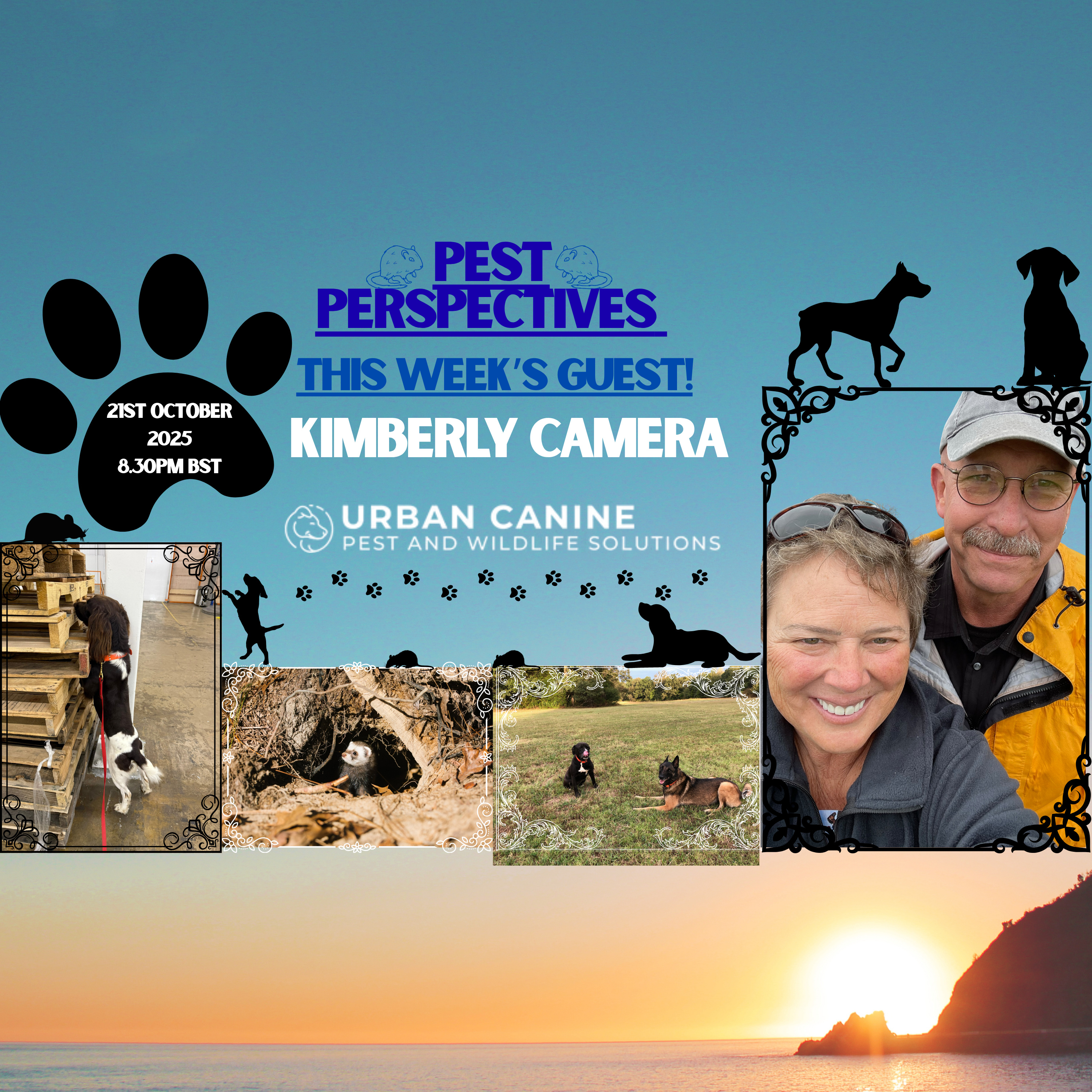
Pest Control Detection Dogs: Bed Bugs, Rodents & Wildlife | Kimberly Camera
Tonight's Episode
Pest Control Detection Dogs: Bed Bugs, Rodents & Wildlife | Kimberly CameraPest perspectives EP 39 - Kimberly camera - Urban Canine Pest and Wildlife Solutions .
Urban Canine Pest and Wildlife Solutions (UCPaWS) is a leading provider of innovative canine pest control and humane wildlife removal services for both residential and commercial properties. We specialize in detecting and removing rodents, nuisance wildlife, and invasive species using expertly trained K9 teams.
Canine rodent inspections and removalBed bug detection dogs
At UCPaWS, we’re revolutionizing the pest control industry by reducing dependence on toxic pesticides and rodenticides. Our K9 detection teams utilize scent-trained dogs, much like those used in law enforcement, to detect target odors that humans can’t see, smell, or access—delivering pinpoint accuracy and faster solutions.
By integrating advanced canine techniques with the latest detection technology, we offer a more effective, efficient, and environmentally responsible approach to pest management. Whether you’re dealing with a rodent infestation in a high-rise, bed bugs in a hotel, or invasive wildlife on your property, we tailor every solution to your unique situation.
Our mission is to set a new standard for the industry through excellence, innovation, and a commitment to humane and sustainable practices. We don’t just offer services—we collaborate with you to develop a custom Integrated Pest Management (IPM) Canine Program that delivers measurable results.Let our expert team build a customized canine pest and wildlife control solution tailored to your property’s specific needs. Experience the power of precision with UCPaWS—where highly trained canines make all the difference.
Pest Perspectives Podcast is a UK pest control podcast hosted by Shaun Muller of Oakham Pest Control Ltd. The show features practical conversations with pest control technicians, business owners, suppliers and industry experts, covering rodent control, drainage investigations, bee removal, bed bugs, wasps, commercial pest management, compliance, business growth and wider pest industry topics.
Listen, watch and learn more at:
https://www.pestperspectivespodcast.co.uk
Register you're CPD with The British Pest Register
#pestcontrol #PestControlEducation
#Pestmangerment
#ArtificialIntelligence #DigitalPestControl #PestTech #IoT #PestControlBusiness
Hello and welcome to Pest perspectives episode 39. Pest perspectives is about trying to educate and entertain at the same time. We have guests from all over the industry every I try and get every facet on. If there's somebody you want to see or a sector you want me to try and get somebody on on recommendations, please let me know. But this week I have on Kimberly Canberra urban canine pest and Wildlife solutions. How are you doing? Hey, I am fine, Sean, how are you? I'm I'm good, thanks. I am. Thank you so much for having me on.
No, it's good. I've been see you on Wyatt's podcast, a swarm cast. Shout outs to them. I will get on there one day. He he keeps mentioning getting me on but he hasn't yet. But I will get on there one day. Oh, you love. Wyatt, he's amazing, the sword cast is wonderful, and it was just a fun interview, so you'll have fun with him. Yeah, if I ever get on Wyatt, come. On Wyatt. No, I will one day. He's a busy man. But yeah, no. So obviously this is like a learning podcast. It is. And I thought you do canine, you do a lot of work with dogs ratting and you know your stuff.
So I thought I asked you to come on. So how did how did you get to where you are now? Did you come from the pest control industry beforehand? No. And I'll tell you what, I wish I knew more about the pest control industry 30 years ago, this would have been my career. I just, I absolutely love it. I started in the animal world and I started in the zoo world training animals. I've trained everything rats to do tricks on up to birds of prey. I had a big, I did a lot of free flying bird shows and I've, I have banded birds all over the world, birds of prey.
And I have, I'm a Falconer. And I landed at FEMA. Yeah. So I spent about 9 years with FEMA deploying all over the US with natural disasters from floods to hurricanes to are. They a charity? FEMA. FEMA is the federal organisation and so FEMA has to be invited to the state. So when there's a natural disaster, like some of the really bad ones we've had recently, the state will have FEMA come in and help. So yeah, yeah, all types of heavy equipment. And I ran cadaver dogs and I ran lifeline dogs. And when I retired from there, I lasted 6 home months of sitting on my butt and I was bored to death and so are my dogs.
So we started doing bed bugs. I couldn't get anybody to talk to me about rodents and that's where I wanted to land. Well, I was watching people like Stuart Blair, David Byrd, some of the some of the ratting groups like the Solfolk and Norfolk Ratting Organs and I was in love with what they were doing. UK boys have got it going on over there, let me tell you. So I said to my, I started working for pest companies. So our bed bug, our bed bug work is about 60% pest control company driven and the rest is goes through US private.
And I said to my salesman next year I'm going to have a rodent programme and she spun around and said I need it in three weeks. Well, not only did we do that in three weeks, that little dog was so amazing. He found the Burrow that went under the restaurant into the French drain, into the pipe that they didn't know existed and they were using that as they run through the restaurant. And then he found it inside the restaurant, the wall that had the issue. And I was hooked. I was hooked on rodents.
So our rodent programme is 100% pest control driven. OK. So obviously you you say that the the dog found it. Yeah. I say that. You you say? You say the dog found the Burrows. Yeah. So how'd you know that there was pipes? Did you did you have a camera on the dog or did you go under yourself or no? We didn't. He literally disappeared. It was a little tiny Paterdale and he had a little Pearl up there, just a waggon, so we knew there was something and you could kind of smell rats at that time. I was so green when this happened, so when we got him out I reported it, we marked it and they eventually had a plumber come in and run a plumbing camera through there.
Oh, OK. He found the hole that the rats had chewed in too, and then three months later they cut into the wall that he hit on. He was just digging at that wall like crazy. And when they dug into it, they found, I mean, there were so many, so much rat faecal in there and the odour was terrible and live rats everywhere. And it went right into that pipe. Once they excluded that and then they fumigated it, it was over. So that that got me hooked, yeah. That's good that it's a, it's a good. It's obviously how old were you when you found when you found that?
Because I, I didn't get into pest control because I'm 40 now. I didn't when I'm not good at math. So I started in about 20-20. But like, I wish I found it, like you said, I wish I found it when I was younger because I, I really like, I really like pest control. I do. Oh, I. I am in love with it. I'm 63 years old and I am dumpster diving into these dumpsters and my husband reminds me every time we go out. He's retired and I'm like you said you wanted to travel. He's like, oh. You do? Yeah. He's like not in a dumpster catching rats.
He's I was like, you should have been more specific and we were together. So that's. Yeah, I, I he's on the phone now.
Did you show him that? Yeah, yeah. Was he on the phone? Yeah, yeah, because he sent me. Honestly, I forgets, right? I normally get someone says to me, I say send us some pictures you want on the phone now and the logo. I tell you people, I have never had somebody who sends me an entire photo gallery to choose from. Obviously there was there. I've got a thing about I wasn't going to pick the ones the rats in that were dead. I've got a thing about posting dead animals on my podcasts. I don't actually like it, but obviously I do understand that that's the work everyone does.
I do it too. But I just don't like to put it on the podcast or my company's socials. But everyone is entitled to do do. Do you put down animals on your on your socials as as well to to get work or did you not do that? I think there's a no, I think there's a a mixed feelings towards that. One of our issues is the clients always want a head count. Oh, right, so. Always want a head count and so we've really struggled with that. We used to just tell them, well, we killed 327 rats today and that wasn't good enough.
They wanted. To see them. So that we don't always line them up because I don't necessarily want all the kids driving by on their bicycle to see them or the residents living there. They don't need to know how bad the infestation is. So sometimes we'll just put them in a Home Depot bucket, a 5 gallon bucket. When you see 7 buckets full with rats, that's also a statement. That's a statement. 55 gallon buckets. So, and I, you know, Sean, I think the reason why we've gotten successful is my, I'm, I don't come from the pest control world.
I come from the animal training world and from wildlife. So I, I grew up with a sportsman family. And one of the biggest things that my daddy just instilled in us is observation. And if you, if you think about a, a sportsman, they observe, they stalk, they know the runways of the animal that they want, they know the feeding habits, what time they're moving, they know everything about that animal before they harvest it. So we took observation and we put it into the programme and that's when our programme changed.
That's when we started getting mass killing. And if you lack for a better word, and not long ago, that was early, maybe January, we had week 675 rats in the first, the first day. Wow. It hit me. I I said, Oh my God, these are all males. It was 87% males. And serious. It was my aha moment that we're not finding the satellite colonies, we're not finding the maternal protection colonies, and that is finding it when you're 675 and 87% of males, that colony had reached high capacity. So that just told me that we needed to dig in deeper.
We needed to spend 2 days observing. We needed to know everything about that colony before we laid a hand on it. We, you know, what time are they moving? Where are they moving? Where are their runways? What concrete slabs are they running under? Because what happens is when you start putting pressure on them, as you know, as the pest control world knows, they can disperse and you can force them into a forced migration and you're going to miss them. So we started observing for the two days, collecting all that data, and then just hit them with everything we had for the next three to four to five days.
And we can take a colony down by doing this technique, 7 to 10 days, you will still have rats because there's, you can't eradicate a rat, but you'll still have them. But they'll be undetectable. So the clients very happy they, they, they look at their pest company as the heroes because that's our job. We're partnering with these pest companies to try to stop the client bounce. We want the clients to stay with the pest company, not go to the next pest company and have the same thing happen so we can keep them from bouncing to the next pest company.
Then we go back for two visits, 2 monthly visits twice. Yeah. And by that second one, there's no boroughs opened up anymore. Have they moved? Have they migrated somewhere else? Have they fissioned? It may be, but time will tell if we start seeing them. We have a a place in Atlanta, GA. It's been 3 months now and they're not seeing rats yet. Now when we go into the dumpster, we're seeing footprints. We're seeing one rat run, so the rat's still there, but they're not seeing them yet. OK. So we can just lower that colony so quick.
I'll be honest, it's it's really impressive. But when you mentioned you go in and do 2 days of surveying, wait a minute. Sorry to have checked, I just got to check something correct when you go in you mentioned. So I'm guessing that you charge higher fee than a normal pest control company because you've got to get paid for them days where you're surveying then doing the work. So I'd imagine that do it the dog way and rat it. What's the is it canine way you call it over there? Is it ratin? What's the term for it used?
We call them rodent dogs or canine rodent dogs over here, over here we have to certify them. So our rodent dogs are certified through 2 organisations, NASDECA which is a leading national organisation here and CDA which is another leading organisation. So that just helps with our insurance tells people our dogs know the odour. I don't know, I mean, they kill, you know, they kill rats. So do we charge? And I'm glad you asked that we do charge, but we are, we're a free service to the pest company that wants to use us because they're going to pass that charge on to their client and they're and they're going to do it a markup.
So they're, they're making money, they're keeping the client and, and these are all commercial clients and the rodents, the rodents are leaving quickly. We'll go say we're doing an apartment complex the first day we visit every single building and we're looking for ingress to the rats. Where have they gotten into that building? Because that's not something we can take care of that something pest control has to. But we're telling them where that information's at, you know? Do you? Find do you find I don't know if a dog could do this, so I'm asking it might sound stupid.
Do you ever put them in the in the drain area? Can a dog going down drains or not? Can it go near a drain area? If there's an obvious because a lot of obviously a lot of rat why they do in England, a lot of rat jobs stem from from drain faults. They do. Not all of them, but. I would never put my dog in a drain because the Lord knows where he would end up chasing rats. But when we walk them around those area, they're going nuts because that odours coming up. There's a backdrop that odours coming up and they go crazy.
We recently were in an area that they were going crazy right there at the, at the drain, You know, the, the runoff water drain that off the road complex tore that up and there were Burrows galore under there. So we use what was called a Burrow RX and we we basically gassed them underground and killed them underground. So. So what's so what's So what's that then? What is it? Is it a gas or is it I put, oh, is it, is it that ice, water ice? No. Well, it's the same thing as dry ice, so you can use dry ice.
A lot of countries can still use dry ice. Here in the United States, they've turned it into Rat Ice and has a label on it now. OK. We can't purchase that in the South yet. It's coming. But we can't get that here. But we can use what's called a Burrow RX. It's a a lawn mower, a little tiny lawn mower machine. And it puts carbon, it's carbon monoxide, right? Yeah, carbon monoxide into the hole and fumigates it. So we can kill underground and we can kill above ground. And the first thing we do when we, when we get that machine out, the dogs aren't out.
I don't want the dogs around that gas. So we'll, we'll put oil in that machine and it'll turn into smoke when we turn it on. And we can put that into the Burrows and we can see where the Burrows are running, where the where Burrow A is running to Burrow B, we can start closing down Burrows. So we're only giving them a few places to come out and then we pay attention. We flag all the Burroughs because we want to know what's opening up and what's not. We flag the nursery Burroughs. So when you you get a A2 week old pup that comes up, that's going to be a nest.
So we're going to flag that. So we flag all these things and we watch them over months to make sure they're not opening back up again. What we don't charge for, we've got a lot of farms here and we don't charge them. We look at them as we want to get back to our farmers, they're the backbone of this country and we get back to them and we'll go out there and we'll work for free and just, it gives our dog some fun and practise and we're going to get young pups coming along so we don't charge for everything.
OK. That's Adam's just put. Is it this gas you see it on screen? I cannot. It. It has a pop. I'm in it of, I don't know, you say foxed in gas. I'm probably saying it wrong.
So you go ahead, say that again. I'm probably saying it wrong. It's frosting gas. I probably said it completely wrong. It's. Carbon monoxide. It's just like turning your car engine on. You know you can put. You can stick a box up on your tailpipe. It's the same thing. And just put them to sleep. Very quick, very humane. And then of course, a lot of rats are running. So the dogs are catching rats. We're killing underground. The dogs are catching rats and we're catching rats. We learned to catch rats because the first apartment we went to a complex, as we pulled in, they said you can't use the dogs.
They just had a visual, you know, the dogs ripping and shredding. They didn't know what it's really a peaceful event. It's it's nothing they didn't know. So that's where I learned how to hand catch rats. We caught almost 900 rats that five days that we worked. Can you? Sorry I had I just saw there a couple of shout outs to people in chat. Thanks Jason from Ask Ask Pest Control for watching. Thanks Adam Edwards and thanks to the Pestigen ladies for tuning in. I think that's probably, that is probably Jenny fossil toxin.
He's saying Foss toxin, Adam saying Foss toxin gas. He's saying no. Let me get this here. Maybe I can. It's a yeah, it's just a just carbon monoxide, like what comes out of your, your, your car. That's a, it's a lawnmower engine. So it's the same thing. We also use ferrets. We use ferrets. So we've started flushing. We use that. We started flushing Burrows with ferrets. My issue is a lot of time, by the time they bring us in, there's, you know, somebody to put tracking powder down or there's been some poison pads put in the the Burrow.
So we really can't use the ferrets with that when we have that. But I love using my little ferrets and we imported them from the UK. Oh, what you're saying? Do you mean like poison blocks? You said poison pads. What's a poison pad? So they they have these like they look like, I don't know a lot about chemicals, I'll have to admit, because that's not my Forte, but they look like dishwashing pad, you know, pods, you know. Oh right, yeah, I I get. Pods, yeah, that they'll put out and and put in the things.
No, I get what you mean now. I do now. That was the most interesting thing I listened to on podcast from Swarm Cast was when you said I hadn't catched rats. Can you explain what this is? Are you actually grabbing them? We can catch rats with our hands or you'll step on their tail then pick them up because sometimes the dogs are too busy and I don't. I hate losing a rat. Oh my worse, I hate losing rats. So we put up barriers, OK, we'll use Nets or we'll use RAM board or a heavy cardboard and we'll put barriers up in the area.
So when the rats are running and the dogs are catching a rat's clear over there, I can go catch it. Greg is great at Greg's great at catching rats. He's he's gotten better than I have. But yeah, we just can't catch them. So what do you do when you catch the rats? Do you, do you truck them to the dogs or do you just dispatch it there and then? Sometimes if we catch a rat, to be honest and the dogs are paying attention, I'll throw it down to the dogs. I like that quick humane kill. I know we're killing rats and I know it's a rat, but I still don't want anything to suffer.
I don't like the suffering. And with dogs, there's not, or we'll put them in a, a big like a trash can with a lid on it and, and then we'll just euthanize them later. You know, we'll just put them to sleep later. But usually the dogs get them all, but we just have to help them. Sometimes terriers in general like the focus, like what's right in front of them and there's rats running around them. So so we we jump in there and help them too. OK, but yeah, that was I never heard anyone ever say I can't catch rats as well anywhere on any podcast.
I never heard it ever. Yeah, well, and see, we learned because on our way to our very first rodent job, we were told we couldn't use the dogs. And I, I said to my pest person, well, what do we do? She was, I don't care, figure it out. So it's like, well, I don't like to fail. So we figured it out and we, we flushed them with water because we didn't have anything else to flush them with. So we flushed them with water and we also used a a leaf blower and flushed them with air. That worked to a point.
It worked to a point. Nothing worked as good as the dogs nothing. We can use smoke candles too. A non-toxic smoke candle with a leaf blower that puts a lot of smoke just. Smoke so in the UK not so many people use it now, but you can still use it. That is exactly what you can do in the drains to find the obviously, obviously a full drain survey of cameras probably needed. It's the real route. But you can, you can put the the smoke like you say with a, with a machine that blows it through to find all the holes.
So you can't. You can't. And we've done some of that. But you know, what we're doing with the Burrows is just like doing a smoke test for the for the for the pipes is you're looking at where does a pipe lead? Is there a hole? So it's the same, it's the same basic things that you know, that we're doing and the what we like to we kind of have a structure where we look at education to the pest controls. Client sanitation is always a must. You know, once you can get the client working with the pest company with their sanitation issues, observation exclusion, rodent dogs, trapping and then the pest company, what will happen is once we get all that to a really low, you know, population to where it's not detectable.
Now that rodenticide can work and it'll work more effectively because when we're there, we're seeing rats that we know have gotten into it because they're really healthy until the, I mean, there's their hair is just gorgeous and, and their eyes are bright. I mean, they're horses animals, right? And then rodenticide comes. Now we start seeing hair loss, a lot of itching, a lot of, they'll just sit there, you know, they don't feel good. Some of them it'll kill, I mean, some of them won't. We're starting to see a resistance with some of this pesticide or this rodenticide.
So you know, I think with using the dogs, doing it quick, doing it fast, stacking the pressure, I, I think it's just a much more effective way for everybody, for the client, mostly the pest company secondly, and we get to go have some fun. You know, definitely, I mean, it's, it's becoming a more, more the way the world is now. There's a lot of regulations coming in and it's a lot more environmentally and mentally friendly to have someone with dogs. I don't have dogs, but it's becoming you're getting more and more people try to train that dog or have a dog that's trained to try and help with the help on that front you are because it's.
It takes a special dog to do it too. I'm it's not every terrier that'll do it. If I get a phone call from somebody who says my dog wants to kill my cat, I want that dog, I'll take that dog. We like them to stay targeted just on what we wanted to stay on. We don't hunt any other animals. We're only dealing with rodents with our dogs. We we also do rodent detection. So when you get into the warehouses, food production, food storage type of warehouses, we don't, we don't do abatement. I mean, that's, that's a lot of contamination.
You know, if you're in a splattered or if there's blood spattered, whether it's on a dog or whether it's the dog or the rat. So we have dogs that just detect they'll, they can find 1 little faecal. We train them like a bed bug dog or a drug buy they're trained the same way and we want them to just alert, hey, there's faecal back here now the pallets can be pulled out and pest company now can mass trap more effectively. We can find we found the best hole had the fight to get into the maintenance room.
And. And they said there was no nothing in there. And when we got in there, Bailey, she found a tiny hole underneath this big electrical box that the ratitude through the caulking that went, you know, between the, you know, where all the conduit was. They cut 28 mice the next day because they knew where to trap. And so, yeah. So I thought that no, I think that is good because have you ever done it where you've found like, say, I don't know, a big massive rap Burrows in in walls before? Oh my gosh, yes.
So we we showed up at this place and they said there's a lot of rats. It was a Rockwall. It was a Rockwall. And I was like, Karen, the rats are living in a Rockwall. She goes, yeah, I know, get them out. And I was like, Oh my God. So we had to sit back and we once again we put our observation for two days. We found the Burrows. We also found they were running under the road. It was, it was a bad infestation. This Rockwall was loaded, loaded. So there was over 3000 rats that we took out above ground.
Above ground, John. We don't know what we. Killed. Yeah. We don't know what we killed in the wall or what we killed below ground that was above ground. That's what the apartment complex got to see. 3000 rats. I'll be honest though, if you were trying to tackle that infestation with even on a bait programme, you'd seriously struggle you. You'd struggle that. 3 fouls and rats you say? Well, and that's the problem is we put out our rodenticide. You know, we come, we have a process. You come, you put your bait out, you put your rodenticide out.
And half the time it's really not in the runways. When rodents feel pressure, they hug that wall and they'll run that straight line. But when there's no pressure, they're not running those straight lines, you know, And they do like the dark, quiet areas most of the time. It's like a tree a long ways away in the shadows. That's the runway. That's where the bait box should be. So we can find where those bait box might want to be planted, you know, more successful. But yeah, it you're, you're the pesticide just can't keep up with 3000 rats.
You can't keep up with the breeding. Even if though, but even if you'd have, even if they were going in the boxes, you'd have to have hundreds, wouldn't you? You'd have to have, you'd have to have that many hundreds because I'm actually. But think about this. So now that we're starting to come out with this new thing called a ball that's a birth control. So what? Oh yes, I just listened to a podcast from India. They're starting to use it. What if you take you add that into your sanitation observation exclusion canine when you get down to the Rodentia side.
So now the canine is taken that population to Ground Zero. You know it's undetectable. Now you add your bait and birth control. So now you're, you're hitting them at both ends. That might be a good strategy. I don't know. That's going to be up to pest control people to see how that'll work. They, I mean, traditionally birth control, I think traditionally it's not really work because, you know, as soon as this population gets low, another population comes in and just keeps going and going. But I'm just curious to know if we added that to that bait box.
So they were eating both, but when you're working when when you work at a dumpster you don't get a lot of them feeding off of bait boxes anyways.
Yeah, because there's too many, there's too many alternative sources of food, isn't there? There is. Oh, it's too. And they're really they'll eat anything. They eat anything. No, they they, they do. It's yeah, it's so I'll tell you it's so interesting because I've, I've never, I imagine that, you know, you do your surveying, you know, like checking the scope in the area out. Is that just visually with your eyes or do you set little camp? Do you set cameras up to to look at the area too? We do. We run cameras, we're out with a thermal camera we put in, we put in stationary cameras and then we take a lawn chair and just sit and watch.
And that's why we knew they were running under the road, because we found the hole that they were coming up from the Rockwall and then sliding onto the road. And you just see rat, rat, rat. And that road started to sag. And we told them, and then we blew the Burrow, our X, and the smoke went from one side of the road to the other and came up. They dug all the way under that road. They damaged the road, They damaged the road then. Oh it was awful. They collapsed more than half of that road to that apartment complex.
The the garbage area, the this beautiful Rockwall collapse. It was starting to collapse. You could see the A4 inch difference because of all the excavating underground that the roads were doing. It took about two months and, and we got that down and now their pest control is working and I think they've got the road, the road fixed. But I think that's why canine really makes a difference. It's not something the rats are used to. They're quick, they're humane. And I mean it's nothing for us to go in there.
It's really nothing for anyone if the rats are there. But they have a canine programme. If you can get the rats out, you know the dogs will kill them. Yes, it is interesting. I'll tell you it's I reckon this episode to be quite popular because it is a so here's a question for you. I know there's a lot of I don't know what dogs do what, but there's always I always hear these a lot of the people that are into ratting. They always go what the best dog and they always have this joke every is and what's the ever wonder per I don't know what what the dog breeds that that they rat in the best?
I've got a golden retriever that's really, really good at ratting, so it's really. It's really. Oh, you haven't? Yeah, Yeah. Yeah, it's the prey Dr of the dog. So I've got a, I've got a little tiny. What's it Jag dog that yeah, she she likes being out there, but she doesn't really want to rat. She'll rat here at the farm all day long. But when we get into big infestation. So I I just think any dog, honestly, terriers are bred for this. Terriers have an extinctual drive to do this, but anything with high prey drive.
When you hear my dog wants to kill my cat, that's a probably a really good ratter. We we use terriers, spaniels, ferrets and I got a couple months back there. I have a lurcher too. I really like my lurcher. He kind of just stands back. He's the hippie. He just stands back in the background and waits. And when a rat gets away from the other ones, he grabs it. I just thought I'd ask because I, I can't think of the breed that they say in the UK there's like 2 dogs and like he always laughs saying one versus the other.
Which one's the best? I just can't think of it off the top of my head. But Jason in Yeah. We've got a dachshund that's really good. Yeah. Yeah, the rats are as big as the dachshund. What's the dachshund? A little Wiener dog. A little tiny dog. Really. Yeah, he's grown. That's good. And Jason in chats just said he's had a lot of cannibalistic rats this year. We've. Seen that here. I've seen it on the trap where because we're the trap down and it's a black Black Hat traps, I don't know if you have them, we call them black hats.
Then if you've got your fingers in, you might break them if you get it off, but and it was only the mouth that was left. So they do eat. They will eat each other. They do, and I actually ordered a case of those black cat traps I. Love them. I'm more. Worried about breaking my hand with them but they're. But to be fair, I'm not scared of them compared to what they call the Fen Mark 4, which is meant for. It's meant for obviously squirrels, but you can use them for rats too. Now that trap. You can, that is, yeah.
When when you learn how to use it, you can hurt yourself. Well, at least at least with a black cat, there's a lot of safety in it. There is. Whereas with this one, you physically got to pull it and get it in place and lift that. I'm still new to that one, but. When he brought up the cannibalization, so we had a waste management place that had a lot of obviously sanitation is used. So the rats are crazy and you know, they're always bringing new rats in. So once they got that sanitation cleaned up, I mean it was picture perfect.
The rats were crazy. They were, You could literally throw a glue board across the on the ground with a piece of dog food on it. A rat would hit it and another rat would hit that rat to try to eat that rat. Oh, it was terrible. I I ran because I saw a rat stuck in a trap. We couldn't use the dogs because somebody put tracking powder out so the dogs couldn't come out. So it was just us. We had seven traps and three glue boards in our hands and I had a, a trap that the rat was caught on. I ran to get it.
I reached out and picked it up and a rat came out and I was like tug of warring with this rat for this other rat. I, I was like, I can't, didn't have that on video. But we've been seeing that too. The especially when sanitation is cleaned up, you know, you remove their foods, you exclude them. They're, they're going to turn on each other and that's why it's so important when we get these high colonies, when these colonies reach that's Max capacity, that you find the satellite colonies and you find the maternal colony where those females have taken those young or the pregnant females have gone to get away from those males because they'll cannibalise those babies.
So we really focus on finding that. We usually find it under the dumpster because they can just go right up into the dumpster and feed and right back up and down. I'll tell you one thing I would really love to know why these, I don't know if it's the same in America, but the companies that make these, these trash bins where you know, the wheelie bins, the big ones, why do they use plastic bunks? They all have plastic bunks that do It's crazy. They're terrible in here. You can get animal proof ones, but they don't have drain holes in the bottom and when we stick our thermal camera down you just see rats go up in the dumps, turn down up in the dump, they go right to those drain holes and come right back down.
So you meant you mentioned something there, Have you, have you been paying attention to the UK? You mentioned the word glue board. Oh, you guys can't use those anymore, can you? There there is a licence, however you've got to obviously you've got to be trained to RSPH level to award in pest management, you've got to do the the latest glue trap court of course, and you've also got to apply for a licence to the for a government department and pay for it. It's not cheap. So basically it's an effective ban.
No, but from what I understand hardly anyone uses them. Not worth it. Is it because they're, I mean, we watch ours. I don't like something to lay there and suffer on it so. I said no, it's it's more to do with non targets Clayton Wilson then non targets we're getting on them, but. Well, I. Here, this way, this way, the the public are still buying them. Well, well, that's just it. They sell them here at Home Depot and other stores but. They they've been marking them up, marking them up as something else.
No, they're insect boards, but they're, they're rat boards. So just change the name. We have them for snake boards. They call them snake boards too. Pest control companies here don't put those outside. They're only used inside. So there. So there are rules and regulations how you can use them to prevent, you know, a non targeted species getting on, getting on them. So mostly just in enclosed, enclosed buildings along with a lot of the other stronger rodenticides. Only, you know certain places they can use them.
I'm studying right now. I have such a great deal of respect for the pest community, for my operator's licence. I don't want to be full pest control. I'm going to stay in my wheelhouse, but I want to understand it better. Yeah, I want to understand the labels. I want to understand the compounds. I want to understand all of that. I'll be honest, you've, you've got a great sense of knowledge about rats anyway, just like you've been saying you've around piece of paper means nothing with the knowledge that you've got.
I'll be honest. And Jason just wrote that licence costs £535 plus the VAT. Oh my God. So basically no one's and he's come up with a dog. I was looking for Patterdale. And we've got a couple Paterdales. So, yeah, so it's got Terriers versus the Paterdales. And yeah, on on the other podcast they had, they've had some ratting people on, on the beauties and beasties. I don't know if you ever watched it. And they have a laugh and they have a laugh about that, about the different breeding dogs and which ones use us and which ones not.
But by the sounds of it, you would say it's down to the person training the dog and picking the right dog. It's picking the right dog. I mean, seriously, picking the right dog. I've I've got dogs back here. That and our dogs are our family. Somebody at well, Wyatt asked me on the podcast, what gets you up in the morning? What gets Kim camera up this morning? I was like 22 dogs that want to pee. So I've got so we have 22 dogs. We've got a we put in a really nice kennel indoor, outdoor. These are our kids.
They rotate in and out of the house all the time. I've got dogs I can hear, I don't know if anyone can hear them bark and they're out playing. We've got about 14 acres all fenced in for them. Nice that is so. They're family, you know, they work with us, they live with us, they sleep with us and they travel with us, so. It's nice. It's that you treat your animals because they, they, to be honest, say your family and your bread and butter. That's how you earn your money. It is. So we've got a couple.
Freeloaders. I got a couple chihuahuas that are freeloaders. All they do is bark. OK, so with with with with dogs and training them to be I don't for rats or whatever. What do you do to actually train them to actually become? How does that work? How do you actually train a dog to become, say say a rat, a rat dog for rat? How does that work then? I'm sure you UK boys will laugh at me because I'm a little Sissy when it comes to it. So we get, I like to get my dogs as a puppy and then I can blend them in with the pack and I can, I really want to make sure their environmentals are strong.
They're OK with sounds because we hunt a lot of cities, we hunt along streets. I want them a really strong obedience. I want to be able to call them when they're chasing that rat and they come back to me and everybody does. I don't use E collar. I just call them and they, they'll turn around and come back and growl at me. I really. So we start them as they're little. We work environmentals. We teach them obedience and at six months I'm depending on the dog, I'll let them, I'll, I'll put them with a live rat.
Until then, they're finding an odour. We have a, we have a competition in the United States called Barn Hunt and it's where pet pet dogs go find rats and they're in tubes and they get points and they went ribbons and all my puppies do that. Get used to people, they get used to dogs, they get used to hunting and they get used to using their nose. And in about 6 months then I'll use a domestic rat. And that's the hard part because I like domestic rats. So I like rats are so intelligent. How can you not have respect for that?
They are problem. And. Intelligent and they're they, they stick up for their family and communities. So it's, it's, I'm kind of conflicted sometimes. So we'll do a, a, a maybe a three to six month old rat with a dog. We don't want to do it. Those big Norway rats, they get a hold of a dog and if the dog, because a dog doesn't know how to catch a rat right away, they want to grab it from the back and the rat stands and bite them. They don't learn to catch it by the neck and shake it and be done with it, drop it and move on.
So we work. We work on that really hard. I don't like my dogs to get bit and I try to prepare them for that before we go out into the real world with those big Norway's. Does that make? Sense. Does that make sense? No, no, no, it does make sense. Is there any do you have to take them to the vets to have regular vaccines? Because because they're they're working with disease ridden rats is is there anything you have to do? We do they and they're constantly checked for parasites too because. You know.
Rats spread longworm and it's fascinating how it spreads. So if anybody is listening that likes to eat like escargot, wash, wash, wash, wash it, wash anything out of the grocery store, wash, wash, wash. Because the, the snail has to basically collect the faecal or run across the faecal and then the rat lung worm is spread that way and that'll go right to your brain. So we're really careful with that. We're careful with all the parasites. If a, if a dog gets bit there, if it's a bad bite, they're taken out right away.
It's cleaned up. We check it out. But after every single day, after every job, they're decontaminated. We bathe them before we even take them back to the hotel or wherever we're staying. But yeah, they're fully vaccinated. Lepto is a big thing for rodents. So we get, we give an extra lepto booster. That's why we kind of got away from flushing these Burrows with water because if you think about it, there's all the urn in the Burrow, all the faecal in the Burrow, and we're just moving it out into water.
And I died when I saw one of my dogs drinking. Like no. Yeah. So live and learn with some of this stuff that we've, we've very, we just have great dogs, healthy dogs. Our dogs live old age, so yeah, I love what I do. I can tell it's a it's definitely a passion. It is for you. I'd like to encourage everybody to just try observation before they jump into anything, you know, and the, and the issue with pest control, it's hard to take that time because you're, you've got to go to the next job and then you go to the next job.
And here are some of them are paid on Commission. So test technicians I just think do an amazing job. And so I don't think they're given the time to do even a better job. So observation is really the key. We would never ever have figured out we were missing populations if we didn't have that count of eight, 675 rodents and all 87% male. It was the biggest aha moment ever. And that's now we count every rat we kill. We count them. We start looking for satellites, we start looking for the the maternity nest right away.
See, even that, if the stuff you're talking about here, the average pest controller wouldn't know about different. Most people just say, yeah, they're in the borough, that's where they live and that's it. Now you're talking about nurseries, paternity, all different facets. I'm saying now. And we didn't know until that aha moment because we were going in and just aha, you know, cowboy in it, getting the dogs out, flushing rats, killing rats and bagging them and throwing them away. But we just weren't, we weren't taking care of the colony like we thought we should.
We were still seeing rats three months later, even though we were killing a lot. So with this system, we can go in. I mean, it's it's I would I would love to show anybody and and walk you through it when you can go in in seven to 10 days, take the colony to a non detectable level of Norway rats, roof rats or tools of the devil. Norway rats. Do your follow up. So you, you, you have. You have. So you're saying you have black rats as well? Yeah, they're. Terrible to deal with. It's not it's not a common thing in the UK.
Very rare. It's not it's Norway rats. But they they do still like roofs. They they like to go in in attic spaces still, but it's very rare. Very rare. I mean, it's mainly Norway's. Here it is. Well, I want to come over and rat over there. I want to so bad come over there and watch some people work their ferrets and work their rats and just have some fun. I really, I mean that's I've been watching UK people forever and. Well, there, there's some, there is some good people where there's some paper they're probably I've been I watch been watching Stuart Blair's videos more, but I didn't know he had a YouTube channel till recently and.
Do it. Blair, I started watching before he had a YouTube channel with his thermals. It was he, I mean, he helped me get my gun. He won't remember that because so many people talked to him, but he's I talked about thermals and air guns. We do a lot of air gun work when we get into places that we can't use the dogs, so we'll use air gun and thermals. He's not been on yet. I'm try and get him on next year. I will see if I can get him on. Oh, that would be. Wonderful. But there is there is people in the UK that do, I don't know who, but there is people do use ferrets.
I've heard of people, I just can't name them off hand. It's I can't, there's no, I don't think there's a lot that rat with them, a lot of rabbit and ferrets. The the issue with ferrets, with these big Norway's is a big Norway. I'll crush a ferret's head and I don't want to lose my ferrets. I don't, no, So I, I get so attached to them, I'm like, oh, no, we're not running them today or oh, Nope, it's not perfect. Usually the bike, that third day when we, we've taken down a lot of the adult males, you know, we're, that's what we're killing primarily.
At first I'll run them because they'll run on the juveniles and the sub adults and, you know, they'll move those Mamas out. So but yeah, but yeah, it's a it's, it's, I think you just have to stand back watch and say how am I going to handle this? The dogs are not the only tool. The dogs are the biggest tool we have, but you've got to really immerse yourself into it and look at what type of barriers you can use. Always put your barriers up when you're going to go chase rodents because otherwise they know where they're going so freaking fast you won't catch them.
That Rockwall we were talking about, we wrapped that Rockwall with shrink wrap and then and we, we left two places where they knew they were coming in and out of. We left it unwrapped and we gassed it and we, I think it was over 600 rats came out of that wall if I remember right. I'd have to go look back at the data. And the dogs. Caught every one of them. Right, No, it's absolutely crazy. That is, Jason's asked. Do you do any shooting with air rifles at all? We do, Jason. We use the FX, we have an FX and then we have a thermal scope.
So for rodents we shoot during the day. We've got a little, it's a 22, it's a 22. So that's and we'll, we'll, we do a lot of waste management areas that we'll go in and shoot. It's safe to shoot in there. Apartment complexes? Not so much, because. You know, no. Shooting at apartment. Complex. I know what America's thought. You probably have the the firing squad out someone shooting. Well, I, I had to find a way to take the thermal off of the gun, you know, because I was using the thermal at night for observation.
But I'm sitting there like this at the dumpster with something that looks like an A, an AKR 5040, whatever. That gun is there. So we now have it on a tripod. It's a little more peaceful looking. Oh nice. They just thought I'd ask it. It's but no, it's I imagine some of the waste sites you do because I've heard, I've heard that a lot of the time the waste site rats know when the workers are going home because when they go home, the rats start coming. And apparently I've heard I went, I went to like price up a site.
I didn't get it, but they said to me, they said he says the floor. What do you mean? I says, he says to me, the floor moves. He says when the workers go home, they know you can hear them coming. He says they the place comes alive, I mean. Some of those videos that Stewart puts up, they're they're at like garbage places. It's just, it's just, oh, it's just unbelievable. And we find them in the back of the trucks, you know, the trash compactor trucks that they don't get emptied, they'll be full, full of rodents in there eating.
So sanitation is number 1 of of these rodent issues. That's that's you know, that's where we're going to have our issue. You get rid of the food, you get rid of the water, you exclude them out. We can start handling it a little better. But I think with with the I miss, I'm missing the big thing down in Florida this week because we have so much going on past. Oh, past world. I seen it earlier. There was a video opening ceremony, cutting the yeah, cutting the tape or whatever. And I was going to be there and she's speaking on her dentist side and resistance and I really wanted to hear that talk.
So I'm hoping it's on a video somewhere down the line, but I think that is a big issue because we see it all the time. But we, we've obviously got resistance in, in the UK, but it's depending on different areas. But you're talking about escars and yeah, you're talking about the first or second generations. They are important to have them because although you've got like caricolciferol, which is like cilantro, you've, you've got cilantro, yeah. And that doesn't have secondary poisoning. So it's safer as such.
But you've also got, you've got to be careful because if you use that in a setting where somebody has got pets, there's a high risk not of that. But you don't know if you don't know if an animal is, is a rat's going to drop any of that bait and it's a direct poisoning. So you've got to be, it's all about risk, risk management, isn't it? You still need have escars, but I understand why people are worried about them. But if you have no escars at all, you'd be in a world of hurt. I know you've got your dogs, I know you've got your dogs and you've got other things, but people don't realise how the prices will go up for pest control a lot.
It would. Oh, I agree. I. Think if we have you know in your IPM. You've got to have a balance and the whole system you have, you've got any tool kit. But I think if we have, you know, take your IPM and add a really strong pest risk management, now I think we've got some place, but I think the risk management is overlooked sometimes and we just go right into boom, you know. So I, I think the risk management needs to be a top priority. In the end, you're in the IPM, and the more I'm talking to people, the more I'm convinced that needs to be a top priority.
Yeah. I mean, it's, it's obviously different in, in America, you have to like do your licences every five years or something. Yeah. Every five see in England, you don't have to once you've done your qualification, just your qualifications just set so and let but now brought in a thing as of next year. You don't have to either redo your courses every five years. And now we're talking about a one day course here. OK, right. Or if you're a member of a trade body or a or a, you know, continuous professional development provider, we do educational hours as long as you do 20 hours a year plus three of the crew ones they want you to do.
You have to produce a crew certificate from next year. Well start in January to use to use debate, but it's still not, it's nothing on America's level. It's not. But yeah, MPTA trade body, I'm, I'm obviously part of that, the National Press Technicians Association, I'm a member and I'm on the board of directors for that as well. So, but there is other trade bodies as well, and there is. But you guys, what I've been looking at is you guys have a lot of education, a lot. I mean, don't you the with the past, with your past organisation sponsor a lot of different education?
It just seems like you have a lot of different education, hands on education going on. Yeah, we do. You don't. I'm just pointing out how we do it. But yeah, there is. There is a lot. I'm just saying a lot of people in general just get one. See, I did my basics a few years ago, then I went on to do the higher one, which is the RSPH. So I'll tell you that Royal, Royal public, wait a minute, Royal Society of Public Health, basically in pest management level 2 awards and and a lot of people stay at that, but you can we all do training throughout the year.
There's there's seminars you can watch online, there's quiz books, there's magazines you can read. There's this podcast. Is CPD approved? This form will earn people CPD for listening. So yeah, you can do podcasts too. But yeah, we are. Well, we're very education driven. I mean, I'm at I'm at 71 points for this year. You only need 20. I look at your classes that you offer and I'm like wow, because they're all hand, a lot of them all hands on. And I just love that, you know? So I think the UK is doing a good job.
I do from everything I'm seeing, but I'm not on the inside. Oh, no, there's a whole new system coming out soon that yeah, there's going to be a restructure of stuff, but it will take, it will take a lot of years to to actually implement and agree on etcetera. And. You know we were. And when we were talking about the Burrow RX, if you would ever want me to demo that on how that works when I'm actually at a site, I could send you a video to that if anyone. I don't know if that's something you can use over there.
I'd have to have a look, but I don't, I don't know it's, I don't know well and. I've seen it over there. I've. Seen Cho. Is it? Yes. So it's not a gas then? Yeah, it's CO2. It's just what comes out of the back of your car. You. Know, I think we can do that. Yeah, it's a little lawn mower and it's it's, it's self targets. It's it's a non rudential side method. It kills, it kills really quick underground. There's no residual or secondary poisoning. I'll look into it and it probably is, but have you seen videos from the UK of people doing it?
Not with the Burr or X, but they've self-made them. They will take like a, a little gas engine for like a weed whipper, you know, a trimmer and they'll turn that and they'll just revamp it and they'll put a hose on it and they'll stick that down into the hole and it flushes. You know, they come out so freaking fast. You've got to get the rodents out of the Burrows. Otherwise why are you there? You know, we have to, we got to get them out of the Burrows. And I think water is too dangerous for the dogs.
My dogs know a lot of obedience. So like when we start blowing the Burrow racks, if I say back up, they back up. If I say go to the left, they go to the left. I want them to stay out of the gas. That's good though. It's now Jason's just said you, you use a chainsaw.
I like a chainsaw. But he's, he's the one that made a video on he did make a video on where you put the fog through the drain and he had the machine pumping it through. So in in the house, you could see where all the, the the air is that they were coming up, coming up where the the. The the yeah, the past with the drain, have you? He means the he means the motor, not the actual chainsaw bit. He meant the motor. Have you guys seen the the whole assassin, the the the pipe assassin, the sewer assassin?
Have you seen that? It's our YouTube channel. Yeah, it's a it's just a trap that goes on your sewer outtake of your pipes. You know, like where the rodents could come up to it and they come up and they get it's a trap. It's awesome. It's awesome and it works in the pipe. I'm going to try it. Sewer Assassin sounds like something that wouldn't be allowed here, but I've got to have a look. I will look. At Sewer Assassin. I will, I will. It's a lot of things that you, you, you lot have got that we're not allowed.
We're getting apprehend soon at some point the next couple of years. Oh, I like now with apprehend what you know, again, I'm not a pest control, you know, with the chemical, but we do big bug inspections. As long as it's as long as it's stored appropriately, it works great. But if it's if it's not, it kills it. It'll kill the it'll kill the fungus. But I love it. I like it's safe for my dogs to search around. It dries quickly. It kills for 90 days. I've really I like that. And it's it's not a chemical.
It's going for approval, but I've heard rumours that it obviously the the argument was that they they were, they were treating it as a chemical, but it's not a chemical. No, it's. So they reckon, they reckon it's about two years away, but they reckon it may be sooner. But that might not be true because they're fighting the fact that it's not a chemical. Oh wow. Well it's a it's an active fungus. I don't know what they would call a chemical. I'm not in that pest world, but I know it's an active fungus.
So yeah, it'll be good when it finally comes out. But with your do you do a lot of bed bug detection work then with the dogs? We do. We've got 7 bed bug dogs and they're out all the time. My husband's leaving tonight for three days to go to a camp to search for bed bugs, and we have, they're at all different levels. I've got one dog who's so freaking good who can find one egg, one flipping egg. My dog's like, yeah, there's nothing here, but she missed that one egg. So, so her, her, her level of her odour level is not as low as as his dog.
But we have 5-5 people that work. Everybody has their own dog, but I send everybody out the door with two dogs. So. I don't like to overwork a dog, and if you have 100 apartments, every dog does 20 and they go home happy and we'll rotate them out and that way they're always searching, always having fun. I just don't want to burn them out. How long can they work for the nose without? How long can they work for this? Oh, is that a sniffer dog? Is that different? Yeah, no, it sounds, it sounds like a sniffer dog.
I mean, they're trained the same way. So for it just depends. If we're doing warehouses, I, they last about two hours and where they're really hunting and they haven't slowed down and stopped and pretending and all that stuff, about two hours for a big warehouse. Apartments about, I like to swap them out at 20 apartments and then set them, put them back in their crates, let them rest, and then if we have to, we'll rotate through them again. They're excited when they first start. Younger dogs, they don't pace themselves, so they were out a lot faster.
So by the time they get to be about 3, they're kind of getting their groove on and their pace and take their time more. Yeah. No, no, no, no. Scott just thought that's oh, that's that one. It's obviously it's does it you get quite high temperatures where you live. Do you, you, you, you, you. I mean, obviously that affects how long the dog can work. Does it the heat or? It does and we work a lot of for bedbugs, we work a lot of low income senior living and a lot of them are on blood thinners and know their.
Apartment. So hot. So that'll affect the how long the dog can work. And rodent work is brutal in the summer. So, you know, we run our band nonstop. We've got air conditioning on it. So we wrote we'll rotate those dogs about every 30-40 minutes or sooner if we see the dogs getting in distress, If they're just standing there with their tongue open, it's time to because they won't quit on their own. They're too high drive. You got to make them quit. Oh, OK, OK. But yeah, it's it's all interesting stuff, I tell you.
It's it. I wish I. Would have gotten into this 30 years ago. This is I like taking my wildlife background and, and moving it into pest control and I'm learning more and more about the pest control industry every day. And it's AI mean pest control is your first line of defence for a healthy environment, whether it's commercial or residential, it's the first line of defence. So there's a different mentality in the UK to to what in America? A lot. I'm not saying it's it in your state like or whatever, I don't know.
But I know in America it's normal to have a pest control contractor on a regular service. It is not normal here. We've got a few, we've got a few, and these are people that have requested it. But it's not a thing that people go. But this way, if you went door to door in this country, you'd profess control. You'd probably get a slap because if people think, oh you, you say I'm dirty. And that's how people start hearing door knocking, you know? Yeah, the big thing here. It's different if you can say someone's actually got a boss nest and it's affecting the neighbour, then we normally tell them to speak to their neighbour.
I don't really like doing that. It's not, but door knocking is not a thing for especially for pest control in England, it's not a thing. It's not. You probably get a slap.
And we're getting, we're getting more and more into commercial. We started in commercial. I don't know how, but we started in commercial and we're getting more and more for the rodent dogs into food, food warehouses and food storage and food production. Well it's good it it also hits their not saying they have them but it hits an eco target too. I don't know if they have them, but maybe they have and it a lot of them, a lot of these big or a lot of these big food manufacturing plates have targets on EB more eco friendly, don't they?
I might be wrong, but a lot of them seem to have a lot of sustainability and eco policies now, don't they? Dogs would fit. Dogs would fit right into that. It would. We had one job that we had to put the dogs in hair Nets. That was a trip did. You take photos. Yeah, they had to be all in hair Nets and you had to buy like a show dog hairnet. And my dogs looked at me like they were going to kill me. I I, I was like, I know why animals kill people now, because we do. This. But they got you to do it pretty quick.
Something too that you guys could consider doing that we just started doing when we go into these warehouses and we're seeing all this rodent, we have one where just miser and sane because they're coming in from the tractor trailers. So we just brought in a system that you guys could use. I don't know why you couldn't. It's an air sampling system. And we brought it in from France and we're learning to use it. We're training our dogs on it. I'm actually meeting with Gregory Herron, who's the researcher from France next week.
He's coming here. And yeah. So you can take this system and you can suck in air for three minutes and, and, and 250 square feet and a tractor trailer. Take it back, let your dogs inspect it so your dogs don't have to go into a sensitive area. So and these tractor trailers, they can never fit in anyways. And the tractor trailers are usually what's bringing the mice and the rodents in to the warehouse. And then they split off. Now you got your resident population living there that you've got to find that's come in from the tractor trailer.
So we're going to see if this will this system will will help and. So what? What does that do? Suck in the air? What does that do? It's a, it's a special system and there's a, a tube, there's a special tube called the Gentex tube inside it and it'll collect the air into that tube. All these odours in that room will be in that tube. Just like if the dog went into the tractor trailer to smell, he's going to smell. And dogs smell in layers, so they smell like the spaghetti, they smell the meatball, the sauce, the noodles, the plate, they smell in layers, not just one big odour.
So that dog will dissect that tube and he will find that rodent odour if there's rodents in the tractor trailer. And then he'll give an alert just like a bed bug. We're training them just like bed bug dogs. So I'm tickled that Gregory's coming here. I said I, I'm not putting this on the market until you come here and make sure we're doing this right. So and then we're going to use it for the food warehouses, so. What you're saying is it will be able to detect if this if each warehouse has got wrapped in it or wrapped rats have been in there.
Is that what it's saying? Is that what you're saying it? Would be able to detect live rodents in the back of a tractor trailer because I'm only I'm only training the dog on live rodents. I'm not training the new people on your. This is specifically for the tractor trailers, but you could take it to, you know, a pallet area and do an inspection, you know, and take your air sample, take it back, run your can line and if there was a rodent, a mouse or a rat in there, the dog would find it. He would alert on that can that had that tube in it.
So we would know where to go back and search. Pest company would search. This will be really good for sensitive areas or areas that don't want the dogs in the actual warehouse part, but yet we can be set up in an office somewhere off on the side and, and help them out. And we're also clean. We're also cleaning. We're getting into these warehouses and we're, we're cleaning up. We're, we're taking the boxes apart. We're pulling mice nest out of boxes left and right. We're sanitising, restocking the product and moving on.
So we're taking up just one more, one more level. That's good. You do you get lots of subcontracting for big, big, big national companies as well. Do you do a lot of that as well We. We do, we, we do. That's mostly where our work comes from as the big national companies, whether it is through a pest company or whether it's through ourselves. So we, we hold several national contracts right now. So which we which we just got. So I'm really tickled about that. Good, good. I won't ask you for names, obviously, but that's nice that is.
Names, but they're big. I I wouldn't ask you when I won't put you in, but now that's nice that is. It is. We're moving slow. I mean, we've been doing this for four years. So we started our bedbug company right before COVID hit. Then COVID hit, and then I said, well, let's just train. So we trained until the world opened back up. I went out with pest companies and learned my job because I think it's important we know our jobs. And then mix it with the dogs and the rodent work was started almost three years ago, you know, so it we're growing, we're growing in it and just learning every day and podcast like yours is just, it's valuable for us to sit back and listen to and get ideas and get answers.
And it's been, it's been nice. But yeah, I mean, I'll be honest, we do have a lot of people from America listen too. So they could, you never know, someone might, someone might reach out to you and say, I heard you on the podcast. I think you could do with your help. You never know, do you? I hope so because that's we're a service. I mean, it's a free service to a pest company and the whole goal was my is to stop this client bounce. You know, the clients get, they get fed up with this pest company, so they moved to another pest company.
But then the problem doesn't get solved because they're, they, they want quick answers. You know, here in the US, everything's fast food society. It's quick, quick, quick, quick. And pest control is not quick. You know, it takes days, days for most pest control. So if we can get in there, eliminate that infestation quickly, then the pest company wins and the client most importantly wins. That's definitely true. It's it's a good message, but no thank. Thanks for coming on. It's been it's been really fun to have you on the show and I'm sure a lot of people have learned a lot.
I definitely have. And I'm sure there's been quite a few people in chat and they'll be more after the fact. But I I think it I think it was a really good podcast. I do. Oh, sorry, I tickled to death. You invited me and anyone can reach out because I learned from everybody that I've talked to. So, you know, please feel free to give my e-mail or even my number out. Yeah, no, you link, the link is in the description or it will be, but it should be now actually. So have you got anyone you'd like to see on the podcast?
Well, I think you should drill Wyatt on the podcast. I think that would be fun. OK, I can sort that out hopefully. I think Stewart would be wonderful on the podcast. I mean, he is so well versed and and all these issues, he could help everybody out with their air guns or thermal scopes. I think he'd be excellent to have on the podcast here in the how about Jorge? Jorge is wonderful with cockroaches if you want to do. I mean, he's phenomenal. He's up in New York. In George. Yes. He's phenomenal. Oh has he isn't.
He, yeah, he's still calling, he said. I love him. I know because Marcus, I had Marcus Scruggs on the other day and he went whole high. I said, who's whole high? He said, you mean, you mean George? Yeah, I said yeah. I said I said, yeah, he's been on. What's that? I love him. He has been, you know, and there's a guy in this is a neat angle. So Warren, Warren, Robb, Warren Ryan, Warren Ryan. I've been meaning. I've been meaning to get him on. I have been meaning to. He's wonderful and and I've had a lot of conversations with him.
So he's, you know, he's went into the consulting business so he is the liaison between the pest company and the commercial organisation. So that is such a neat thing to hear about that walking that tightrope. But that's his job is to to bring them together to, you know, solve the issue. So he's just a really giving person too. I'm starting to book for next year or whether you laugh at that, but I'm booked up for the rest of the year. So I'm going to start to I like to be ahead. I don't like to go, you know, like a month.
Oh, it's two weeks. I haven't got no one on. I like to book really real ahead. So I've got I wasn't meant to get get Ryan on, but I will get him on. So I will try and get Stuart Blair on. I will. I'm sure he'll come on. I'll say I've had a request. Here's the clip. Here's the clip. But but no, that that's that's some great, some great ones. I might also try and get at some point on the guy called the Mink Man. I'll try and get him on. I will. Joseph So Joseph's a friend of mine and he's the one that taught me how to hand catch rats.
I did a, I did a farm with him way up in Nevada, right next to the Canadian border. There was a moose in the field and we we took a lot of rats out of that ranch and that's where he taught me how to catch rats. Oh nice, yeah he's a bit of a celebrity. He's got a massive channel yeah so hope hopefully get him on. Also I don't know if you heard of him. I want to get the Hornet King on. I have emailed him but no reply. Yeah, he's hard to reach. I would just text him. I'll actually send you his number.
But no, I'll probably try for next. I did try, but maybe it probably went to the spam folder. You know, I'll try for next year. I will. But yeah, no. Thanks for coming on. It's been good to have you on, Kimberly. Thank you so much as. So at the end of this show, I'm going to play an advert I don't normally do. I'm not getting paid for this. It's the pest. Have you ever watched a Pestigen podcast? The girls a Pestigen and this and Jenny. Oh, OK, yeah. It's a, it's a female pest control podcast. Yeah, just before the end.
I'm just going to play this advert then. But then I'll then I'll do the boy. Is that all right? I'll just, I'll just play it. I will. OK, my girl, my back has been bugging me so much lately. It just won't stop. Can't stop, won't stop. Just kidding, sounds like a real pain. You know, it's been a real pain lately. Trying to find anything relatable to listen to while I'm working. Girl, I got the answer for this one Pestrogen podcast. It's a pest control podcast, but with a lady twist. It's fun, laughable, and we'll make you say, Yep, get that?
That sounds so awesome. So like where can I find this at Anywhere We got the YouTube Anywhere where you get your usual podcasts and they have a Facebook page for ladies in the pest industry only. Sold. You can catch the Pestrogen Podcast video cast exclusively on YouTube and listen to the audio version on Apple Podcast, Spotify, iHeartRadio, Audible, or wherever your favourite podcasts are currently crawling around. Pestrogen Podcast because when it comes to pests and podcasts, we know how to bug you just right.
There we go, first girl, my back. Has. Been bugging. There we go. First time I ever played a advert, but but yeah, no, thanks for coming on. You want to check that podcast out If you're it's more, it's more of a not educational, it's more of a from the technician side than a female perspective. But they do talk about men. It's not women only. It's a it's a fun one. But yeah, thanks, Thanks for coming on. And it's been a good, been a good, been a good one. So our industry now and thanks for taking your time to come on and it's been good.
Yeah, thanks. All right. And thank you for that.
Sponsored by

 Amazon Music
 Apple Podcasts
 Audible
 Castbox
 Castro
 Deezer
 Goodpods
 Moon FM
 Overcast
 Pocket Casts
 Podbean
 Podcast Addict
 Podcast Republic
 Spotify
 YouTube