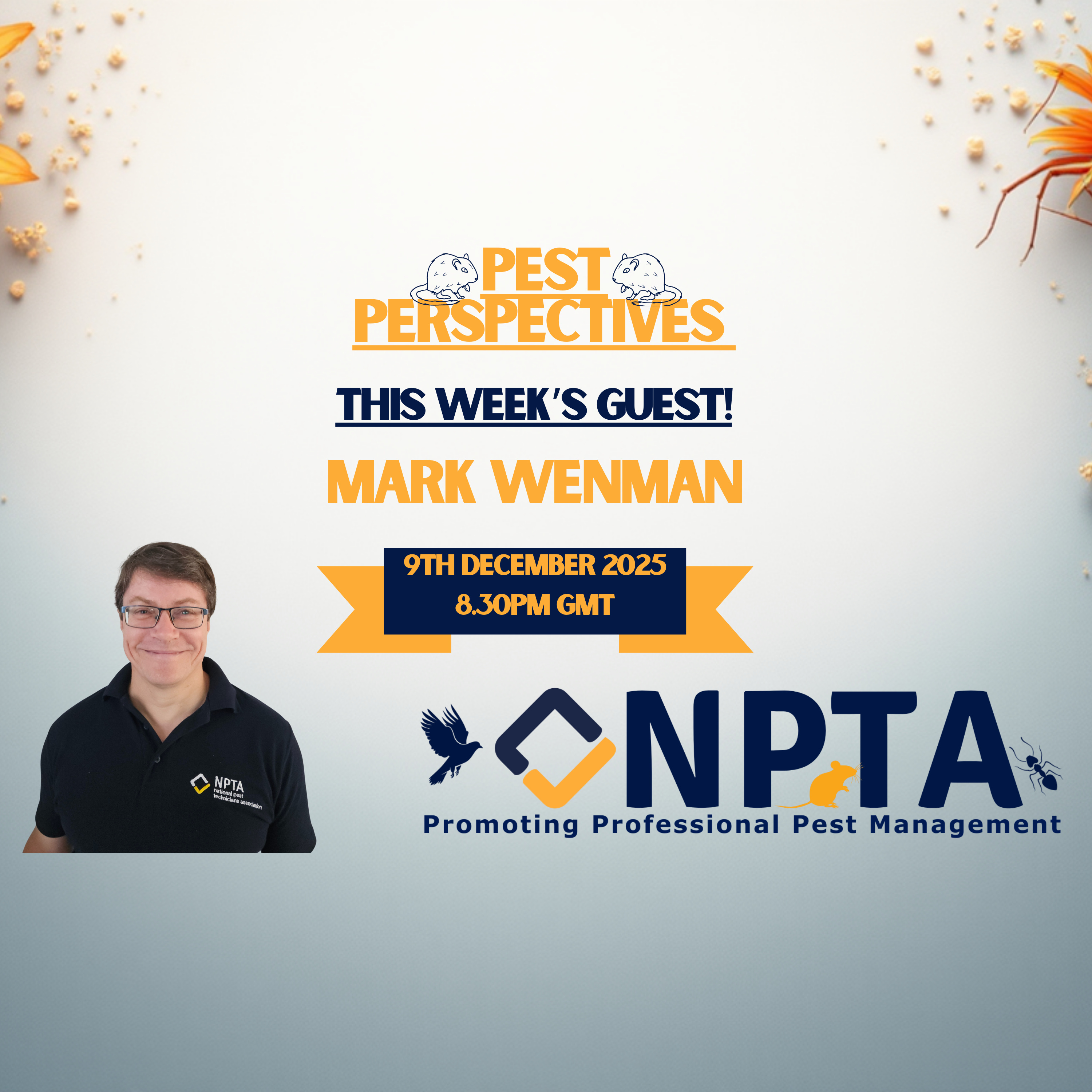
Pest Control Training & Technical Standards: The Future of Pest Management | Mark Wenman, NPTA
Tonight's Episode
Pest Control Training & Technical Standards: The Future of Pest Management | Mark Wenman, NPTAMark Wenman (NPTA) – Training, Technical Knowledge & the Future of Pest Control
In this episode of Pest Perspectives, Shaun is joined by Mark Wenman, Technical Manager at the National Pest Technicians Association (NPTA), for an in-depth conversation on training, technical progression, and what makes great pest management professionals.
With over 30 years in the industry, Mark shares his journey from engineering graduate to technician, service manager, field biologist, manufacturer technical specialist, and now his role supporting NPTA members. The discussion explores how structured trainee schemes shaped the industry, why hands-on mentoring still matters, and how modern training mirrors the best of the past.
The episode dives into real-world experiences from central London pest control, including extreme infestations, ethical decision-making, and the importance of Integrated Pest Management (IPM) in high-risk environments such as food manufacturing and hospitality. Mark also explains the role of field biologists, auditing pressures on food sites, and how fresh, independent inspections can support pest controllers ahead of major audits.
You’ll also hear insights into:
Practical vs classroom training and why experience matters
Store product insects, bed bugs, cockroaches, ants, and rodents
Bird control, product development, and why innovation takes time
Drain surveys, roof inspections, and using drones for surveys
Supporting small businesses and lone technicians in the industry
The NPTA’s approach to member-focused training and CPD
This episode is ideal for pest professionals interested in career development, technical excellence, training pathways, and the future direction of the industry.
🎓 CPD:
Remember to log your CPD with your association or the British Pest Register (where applicable).
National Pest Technicians Association website https://www.npta.org.uk/
If you enjoyed the episode, please leave a review or comment on Spotify or Apple Podcasts — it really helps support the show.
National Pest Technicians Association website https://www.npta.org.uk/
The host shaun muller is director of oakham pest control ltd
https://www.oakham-pestcontrol.co.uk/
Pest Perspectives Podcast is a UK pest control podcast hosted by Shaun Muller of Oakham Pest Control Ltd. The show features practical conversations with pest control technicians, business owners, suppliers and industry experts, covering rodent control, drainage investigations, bee removal, bed bugs, wasps, commercial pest management, compliance, business growth and wider pest industry topics.
Listen, watch and learn more at:
https://www.pestperspectivespodcast.co.uk
Hello and welcome to a Pest Perspectives episode 45. A pest perspectives if you're new is a podcast that's aimed to educate and entertain people within the pest management industry. You can earn CBD points with both associations for this, also with the British Pest Register as well and basis prompts some of the older episodes as well. But this week I have actually got Mark Wenman, technical manager at the National Pet National Pest Technicians Association. How are you doing? Awesome. Good to see you Sean and a great instruction.
Thank you. It's very posh. I didn't know that was my role.
MPTA has always eased the sound isn't. It it is, it is. And if you do, please subscribe like the show and say hello. It helps the algorithm subscribe all that business, especially on Apple podcast and I know there's I've got about 8 or 9 reviews. Spotify people just press that button and get I could have at least 60 to 70 reviews. Just saying I know you're watching if. I could get my phone if I could get my iPhone to work properly. I'd give you a review, but that's good. Me. That's fair. Thank you.
No, it's good. It's it's been a lot as all as all my guests say it's been a long time in the making because I've booked people like 2 to three months in advance. I do. I do remember it was in my diary and we chatted. We always chatted only so I wouldn't. Oh we definitely do. I'm already booked up till mid February. Fantastic. That's no surprise to you though, I'd imagine. No, you're very good at planning, I must admit. And you're very busy. Guy, So you've got a plan ahead, You have agreed you've been in the industry 30 / 30 years, is that correct?
It is. My gosh, it's coming up to 32. I still remember the day I joined, that fantastic day with National Britannia. So, yeah, great. I would like to talk about that. What was that like? Because I wanted to compare it because I noticed it. I didn't, I didn't realise on LinkedIn, I want to compare it to how we're doing the MPTA 525. It's SIM similar kind of way you got into the business. I'm not saying it's it's anything like it, I'm just saying it's a trainee scheme. It's spot on, absolutely spot on.
I mean, I, I do remember the first day when I suppose the history is that I'm, because I'm an engineer. I did my degree in engineering. It didn't really, it appealed to me. I love engineering, but actually doing that job, it wasn't really for me. But then I saw the opportunity with National Botania on their management trainee scheme and it had health and safety as one of the kind of movements within the scheme. You'd move between different departments. My finding of dissertation was health and safety.
I always joke before it became popular. So this was kind of in the early 90s when it was like, oh, health and safety, we need to look at that. So I did, it didn't really tickle me. But then when I saw pest control, Oh my gosh, it was amazing. I was, I was in London. I, I could go anywhere literally by going pest control. Can I come in? I was like, yeah, come in, no problems at all. And I love the challenge and I love helping people. That's kind of, really kind of when people realised how we'd helped, we'd solve their problems, a look on their face and their fangs.
They just kind of made me and I thought I'm living the dream here. So yeah, I, I worked in the office in Caerphilly, which is kind of now the Ecolab office for a bit. And I, I remember the famous words of the, I think it was the chairman or one, one of the people there. They go that Mark, you've got 2 choices. They go, you're not really an office person either. You go back to London in the pest control department or we're going to sack you and let you go. I was like, OK, I go back to London, I won't stand an office.
So that's when I realise I'm kind of a person that needs to be out. Yeah, doing things. And was it more? You're more talkative or talking all the time or was it like they could tell you weren't ready for that environment or it's not for you believe. It or not, I was actually, Can you believe this until the truth? A little bit shy then what? Yeah, yes. So I think I think it's because my personality is is doing engineering. It's kind of, you know, solving a problem and being in the office wasn't really as such.
I do like it. You know, Caerphilly is an awesome place, but I mean back and you write National Britannia to kind of ask you a question mate, National Britannia had that E force to bringing people in. We kind of the right personality, you know, the right, right kind of skill set to be then polished and grown. And I would have been 22. So yeah, under 25. And yeah, it was the same route. Mentored, moved through, given training, given opportunities. So yeah, absolutely 525. There was probably more. And some people that are kind of in the industry went through the same path.
And it does show that 30 years later, there's still people here that are are doing things and have moved through the industry. So yeah. Fantastic scheme. So. So the scheme sounds like obviously it worked for them and used to the industry and many people are, it's very sorry. It was, it was very good training then. Was that what was it called then? The training it's RSPH levelled, was it like diploma or something? Was it called? It was the Diploma Part 1 and Diploma Part 2 and it was still as it was, still was tough.
And I think, gosh, you dig into my memories now that the kind of diploma Part 2 is similar to the similar and people can say, well, similar to the Level 3 now. But it was definitely a very much I didn't do my Part 1 for maybe, gosh, six months. I'm trying to remember. It was so long ago, but there was a lot of practical on the job training, mentoring in in in sort of South London, but in central London. So real kind of mentoring for doing that. So it was a little bit different rules back then. But yeah, great.
Really hands on and some of the stuff I've just never forgotten the kind of cockroaches raining down from the ceiling, SPI literally everywhere. Moths like good clouds of them. So good training, you know. Really. Well, I could do something going to something like that with my with cock.
Jennifer America's listening and she always goes on about you've never experienced it until they're raining down on you. She's done plenty of cockroach jobs. I couldn't believe I've never done one until recently. I think maybe the obviously the rotations of, you know, insecticides with the gels that have been developed that just came in different standards, you know, it's, it has improved, but I've heard of interesting infestations of bed bugs etcetera that are probably worse than I've actually treated back in the day.
So yeah, things haven't really changed a lot, but they have. But no, the the trainee scheme was spot on and you're right, it actually mirrors the 525 in many ways, you know, bringing on people that have the right skill sets that can then move on and and lead the industry in the future. So that's. Got just a couple of shouts outs. Jasmine's on LinkedIn. Hello, Jasmine Martin. Hello. He's off at 5:00 AM tomorrow because of the this and yeah, that's it for now, but yeah, yeah. Thanks, everyone. You've got six people watching now.
We're quite popular tonight. I don't get this many people. You've you've brought the people in you. That's not bad. That's. You know, with your diploma, was it, you know, was it, I know you said very hands on. So was it just questions or was it actually was there practical elements as part of the the the the exams tests do you mean? Yeah, I mean the, the, the diploma Part 1's similar, I suppose you could say to the RSPH Level 2 and the Diploma Part 2 was very similar, I suppose to the Level 3 now or advance technicians.
So yeah. And then also kind of, I guess similarish to maybe some of it the food biologist. So it was very much a not not, not kind of, you know, tested on hands on, but very much you need to have that knowledge. So yeah, I think yeah, levels are very similar from then to now, not a lot of things have changed. I saw the scientific names for the insects. They're certainly the only difference. So it's always, I joke with Duncan, my colleague, that back then we had to learn the scientific names of all the insects.
So I can still remember them. I can't remember many things in life. I remember that a lot of the scientific names of insects. So does it help? I think it does sometimes. But yeah, you mean scientific or do you mean the Latin name? Because there were, there were some different names. The Latin names, yeah. In fact, they do that. So it's universal around the world. People understand what they are. That's why. Yeah, they are. So occasionally I've kind of used it. I mean, I guess on the bird side, yeah, when you're talking about certain species of different types of crows around the world, the pigeon's a pigeon, but it can look a bit different.
So it's useful. It is very useful. So makes you sound really technical. You sound like when no one is doing when I don't.
So yeah, it's, it's, it's and it used to be back then it was part of the the test as I remember. And it come again, come on to a few biologists for that specifically store product insert as it is. But it does help me differentiate, you know, if some somebody comes on the phone to me and says, Mark, we've got a cockroach problem, as we always say, what species? So yeah, it does does help because you know, yeah, different species, different solution, different integrated pest management. So yeah, you need to know not just me being difficult.
What is it? Yeah, simple photo. Exactly. Also Hugh Radford's In Chat. Hello. And someone called Rusty H. Awesome. So, yeah, so when you were obviously when you passed and what, what was it like being in London being a technician was it, did you like it as in because you've got a lot of hands on experience? Did you do like high end hotels and stuff like that and shops? And what kind of experience did you did you get once you're a technician? Because you moved through the ranks, didn't you? Within the company, Yeah.
Thank you. Yeah. When I first started, I was sort of covering, I suppose Surrey, been in Sussex and in South London and South London had quite a diverse portfolio and I loved that. But South London or Southwest London went right up to the Thames. So that was kind of central London. And then I had an opportunity. Then I was a technician a number of years, loved that, absolutely phenomenal. Then I was a sort of biologist, technical inspector. I did that for a period of time, loved that. So again, kind of auditing some of the sites, I was a technician before, which kind of like, you know.
I would say. Briefly though, obviously before another technician to go, but and then I then had an opportunity to kind of come into the central London. I was service manager for the city in West End. And that's kind of where it got really fruity and interesting because obviously some of the yeah, the problems, particularly cockroaches, mice, bugs were, were pretty interesting. So that's where I kind of, I've got the grounding of my team. Obviously then due to the fact of just doing good IPM, we've solved a lot of the problems and yeah, things like other techniques that have been taken off the market that we won't mention reusable then.
So yeah, it was a real, real good grounding. But obviously, yeah, when you're in a centre of a city, you don't have so many store product insects or wildlife, of course. So there's always a trade off about knowledge. So yeah, it's give me a great grounding. Did you have any ones that were very unique but you that you can talk about without mentioning where they were etcetera? Have you got any ones that were quite challenging? That's a cunning question. I mean, there, there were restaurants in southwest London.
That's kind of before I suppose when I was a technician. So we've been in the mid 90s before the gels really came out. They kind of they were there when I mentioned the brand, but the the gel was as opposed to being the the small tubes of the well, I think the 30 mil aren't they were like 300 mil. So it. Was a massive. Tube, but it was different different percentages of active. So before they really came out, we were, we were doing different treatments for, for German cockroaches in restaurants.
And some of them were just scary. As in you're on the on the verge of saying, do I need to involve the EHO? Because yeah, there was foods then they were brushing off the cockroach before serving the food. It was like, look, I'm a I'm an ethical member of the public professional pest controller. We need to stop this. That's it. So I, I did much to the chagrin of might be my service manager. Then I did lots of extra treatments talking about what the contract was to ensure that problems were solved.
And that's why it kind of. Yeah. That that EFOS in me did basically solve a problem. Yeah. It's not just as you know. Yeah. You've got 8 visits per year. The 12 visits per year. I was like, right, I'm going to solve it no matter what you're paying. I'm in. Then. Did it. So that was that was really then useful. Yeah. The the brushing the cockroaches off the food. And the one I remember, I can't even remember what the site was. Again, it was in southwest London where I went in there and I'd never seen so many German cockroaches.
I mean, like your guest was saying the ceiling was black and moving and it was just you. You treated it. It was literally. But I remember kind of, yeah, the old, yeah, disposable boiler suit stripping off afterwards to ensure I wasn't going to. And I never took anything home. Not not to my your flea I think probably, but I never infested where I lived.
Yeah, I've never done that yet either. I have. Good on. Yeah. Good on. Yeah, yeah. Store product insects. I remember. Yeah, Some really interesting problems with Pharaoh's ants with the old fashioned liver bait, which was really interesting. Tower blocks. So basically used to be liver mixed up with the active that you put in the tubes and you positioned around before the new baiting system came out. So they like liver then? Did it work very well? Yeah, I mean, Ferrazansa proteins, feeders. So it worked well, but it was inordinate.
I remember one of the first things I did was it was like, it was like almost a wind up on my service manager. I think it was Alan Tate. He was awesome. And he was kind of teaching me yeah, much to get a lot of liver, really put on expenses really mixed up really. And then obviously you get the act in mixing really. And he's like wind up. It's not yeah, they love, love liver. So yeah, really, really interesting to do that. And it I think now it almost gives me then that history. Yeah. Even though it's an interesting story to go to any, any trainees or anybody kind of advising it then fits into a nice pattern of actually it's now we used to put down the bait for Pharaoh's ants, even though it's quite niche because back then it used to be hard.
But it still makes you think about how they're active and how how they trail and how how the insects do behave. So yeah, really interesting to have. It's great that I've got that kind of history it. Is it is I love, I love when I'm on training, training courses that people the people teaching and bringing up different stories related to it. It's like Hughes just said, liver and boric acid it. Was. Martin said he's recently used honey on Pharaohs recently. Interesting. I do like honey. Used to be whatever you can get on expenses.
Yeah, I quite like Snickers. I used to mix up. So for in central London, when we could mix up our own rodents sides, I had the deadline liquid concentrate and because the mice in the central London was so spate shy and very hard for them to get, you know, going into a box, let alone take the poison that I used to mix it up. And the one that being I did find was peanut butter smooth nutty. It has too much, too much in there. So so I used to mix it up in my job on a Monday morning in my stores for my team of 17 big rubber glove smooth peanut butter.
I mean, we're talking it was over 5, I think. No, it was more than five. It used to be 25K drums and I think I used to mix up 10 kilos at the time. I can't remember. It was a lot. It was kind of like almost like rubber glove going into the wow. Obviously with four PP on mixing up with a deadline that can concentrate and yeah, really effective, but obviously. If it worked, it worked. Is that a thing about is that? Is that a thing in London that they prefer that style even now? That style bait in London?
You obviously can't mix up your own. No, I mean, I mean you can obviously there's gel versions. In there, yeah. I think it's, that's the old cliche, isn't it? It's thinking, I mean, when I was part of kind of maybe moving on a bit, when I was part of Network, Network Birds sort of after a yeah, sort of jumped over a bit of a period there, but maybe come back to it. But when I was part of Network, it was owned by Sorex, then became BASF. And they were great. You know, their great marketing campaign was think like a rodent.
Think my one was think like a bird, which is like food food. So you think like it and then you you apply the, the technique based on that. So it was based on, you know, mice like wetness, you know, kind of something that's different to the food they're actually feeding on a restaurant. But actually it was there was a lot of greasy blur in some of the restaurants that we're going into. So peanut butter was smelt a lot was different, but actually quite the same. There's water in there, isn't there because it's quite hydrated.
So we found that peanut butter worked really well. So, yeah, it's, but we, we had enormous success clearing some really very large interesting problems in hotels, restaurants and sweet chains. No, that's that's pretty good. Great. So. So you worked for them after you worked for Ecolab, then you worked for them after Ecolab? Yeah, sort of the National Britannia and then I became service manager just as Terminix kind of bought the National Britannia entities. So it's. OK. Energy Record and the others sold to them.
It became different in, in Terminix, but still. Yeah, very good company, Lisa, for my team in the central London. And then Ecolab then bought the entity when Terminix regressed back to the Americas. That was original Terminix. Yeah, the original Terminix name. So what same company, but the original iteration. And then, yeah, I worked for ECLAB. So say we were ECLAB for a number of years, Loved it. They're a great company. And then I, I moved, so I relocated and stayed with them for a while and then saw an opportunity because I think for, for me, I mean, there's different reasons maybe when I left, but for me it's kind of, you know, you do your good stuff and it's not my company per SE.
So I kind of done the best I can. And then a fresh challenge. So when the, the role with Network Bird, the manufacturer and supplier bird products came up, I was like awesome. So I joined them and then worked with a wonderful guy called Nigel Batten who who retired unfortunately because he's awesome, he still still visits the industry and stuff. So I work with him and Graham Turner so. Yeah. It was US free. So I work with Graham sort of them. So it was US free sort of the network doing bird within Sawrex originally when Sawrex bought them and then briefly for BASF and.
So what did Network Bird do? Did they make products? Were you designing products or is that was that the job or? Yeah. So I was again sort of there, I suppose. I've always been technical. That's that's the thing I enjoy. And now I was sort of technical in the technical team for birds. So yeah, we manufactured all bird products, brought a few in and then essentially fully supported. So we weren't just a a manufacturer as in his approach. That's it. We would support persons on the job, we'd train them, we'd need technical advice, anything they needed.
If there's any issues, we go out and help them. So between myself, Nigel and Graham, yeah, we fully support of that. So yeah, it was awesome. Really, really good. And again, tick the box. And I kind of the the thing that I kind of loved as well is that almost then I could say, although I can't. So forgive me if any engineers are listening. I became an engineer then because I was working with engineering products and things I love, you know, metal and plastic and talking techie stuff about different grades of stainless steel and all that sort of thing.
So. Yeah. And going on roofs. So it's always like, can you talk Mark, are you on a roof? Which normally I was so safely, of course. So yeah, I love that. I loved it and yeah, absolutely great. Again, to support people and see the satisfaction when they've installed a very large roof net or solve the problem with feral pigeons causing risks of health and safety of the people. You know, given that solution that yeah, makes the end user very happy and protects them. So I love that it. Will do, Martin said.
You're you're mentioning some great names so far you are. Yeah, some. Some stalwarts and industry, including obviously Martin. Who? Yeah, it's awesome. Adrian. Yeah. Definitely Adrian. Yeah, for sure. I used to do some training him myself and Adrian used to run a training course. So yeah, it's kind of, I think training in itself is, is moot, but actually training should. Nice. Cliche. Forgive me for the term. I empower people. So afterwards I go, actually it's not that difficult. Actually, I probably could do that.
Actually, it's only Mark saying this. He's made superhuman. I I can go out and do that. So that's that's kind of what it was all about really. And then once they get out, they go actually we did that in the classroom and look a bit on the job. Am I doing it right? And then you go out and help them and kind of get them until then they're stand alone. So, you know, some of the great and good and bird of kind of with Network originally, yeah. So yeah. So yeah, Network was a a brand which yeah, it was kind of, as I mentioned, sold to Sorex that then yeah, it was bought by BSF and then it became PNL systems, which one of them became Palsis.
So kind of that transition of still the bird brand, which I kind of yeah, worked for, represented, you know, was a technical person for that. That's kind of my job followed all the way through. So so yeah, that's kind of took me up. That was gosh, you know, you kind of, you know, when you think did I really do it that long? You know, it was kind of how many years was I with National Britannia through two week lab? I think it was 12 years. LinkedIn says it is. Anyway, you've put on LinkedIn 12 years.
Yeah, don't check. Or, or was it Pelsis? Pelsis, I was with 19. No. So I was thinking of the the first one, yeah, yeah. So did you go there after Network Bird? So yeah, the the kind of the, the, the I work for the network brand, OK. I wasn't there right at the beginning when it was Network on its own. I joined when Sorex owned it, I saw and then Sawrex kind of then sold it to BASF and BSF were awesome, still are, but they didn't do bits of metal and plastic, they do chemicals. So they kept the the Sawrex part, you know, the the, the storm and all those different actives and and sold us on to that sounds.
Yeah. But the P&L systems borders, that's the best way of putting it. So we saw the network brand and then P&L then owned us and then under the Palsis. Yeah, brand and Palsis were awesome and really kind of worked with us to develop the brand and new products came on and supporting customers. So yeah, I loved it. It was, it was great and it's quite a niche, but I never, I never lost all that knowledge. So if anybody said, Mark, I know you do better, but you sue Pest controls. Yeah, come on. Of course, I give you advice.
And. And then it was kind of even. And I think that the key thing for me has always been no matter who I'm allied with, it's always been completely objective. Yeah. If I think something's great, I tell you if if something's great and it wasn't my product, that's still because I go, oh, Mark, do you like that product? Of course I do. Yeah. It's not my product. But, you know, absolutely love it. Absolutely love it. Or, you know, we know that one doesn't work. Yeah. Pigeons, for example, you know, the the scary doesn't work.
You know, you can't do that for too long without being arrested or thrown off the site. So yeah, just open and honest advice to people. That's what I've always liked doing. And, you know, getting good feedback, not, not in a way well done, but just say, yeah, that worked. Yeah, we kind of. That's what you want, That's what you want. That's the, that's the name of the job. Did you create any help create any products that helps us or not? When when we were there, we say we put them more Graham, but Nigel and I were with him.
They had the electric system. I don't think I'd be reappropriate for me to mention brands, you know, because. Yeah, yeah. But the electric system, that was one that I, I loved and then still supported. That was awesome. And a couple of yeah, products that were brought over from America when the American business was bought. So there's a couple that were kind of brought through from there and as I was leaving, there was a really good scaring laser system combination that was coming in. So yeah, we've had various brackets, which quite niche, you know what I mean, and other stuff.
So yeah, I think it's, you know, I always love that trying to, it's hard to get a new product. That's the thing. It's the old cliche. Have a new mousetrap? And there's like a lot of traps where they've just repackaged it and in a different way, you know, not unfortunately not a lot of it's new. It's someone's come up with a different designer box, slightly different. There's not massive innovations, is there really? Very often. It's like, tell me if I'm wrong. You know, when they bring out new actives, I hear it's once in a lifetime.
They don't come out very often. This that is they don't you don't come up with very often, do they? It's very, very far and few between. Is that right? You you correction on your most of us from in in Europe anyway from the 1970s and 1980s, there's a few that have come on which actually were used in different industries. So they weren't created per SE. They were brought in just because it's so, so, so so expensive. I. Earn millions. Oh, I do. It's not. I don't know. No, you, you're completely correct.
There was one, again, I won't say what it is, but there was one product that's sort of a chemical very safely deter birds. But because it's a chemical, you know, it's natural. We had to go through the approval process and that would have been hundreds of thousands of pounds. So, you know, and that's not a new active as such. That's just bringing it into bringing it into the UK and nothing to do with Brexit. It's just, you know, we're a separate entity and if somebody supports the product in the UK, it has to be then tested here.
So it's kind of, it's quite, it's quite a process, but for the right reason, you know, there's. Always reasons just I wish that they'd speed these reasons up a bit because I hear it's on average of six to seven years now. That's what I hear. It is. I won't, I won't say too much because I I don't. Know. Technical detail per SE, but I think I thought you could assume some things. Yeah. So I know you could almost assume, say, salinity testing. So we had some products in network that maybe might be used in somewhere like Dubai.
There's a much rainbow salty fog. So before we could, for example, assume the salinity testing, but now it has to be done real time, if I remember correctly. So you can't assume what happens over five years. You have to prove it over five years, so that they made five years, if I remember correctly. So. But again, for the right reasons, I think need to make sure it is safe. And some of the actives that I used are actives, yeah, a lot of the organophosphate preparations that I use for instance, yeah, maybe back in the 1990s have not been re supported.
They've been taken off the market either because lack of sales or as we know under cost, they're not the safest chemicals. So they've been removed. So, but some of them were a bit, you know. Some of the old chemicals, I hear stories and they scare me. They do What's that one where people breathe it in and their heart stop? Really dangerous 1. I don't know what it's called. Really, there's gases. There's gases, Yeah, I was, I was going to say I was going to be yeah. But yeah, there's some gases that are really.
And yeah, that we see a lot of gassing back in the day and thankfully. It was that one where you couldn't wear a mask, apparently, and if you smelled Pete, you smelled almonds. You had to do something because I can't think what it was called. There we go. Yeah, there you go. Satellites. Yeah, Yeah. It's a story with farmers and stuff using it. Oh, Thomas. Yes, yeah. You know, things like that. But but did you know, I was shocked to have someone on the mayor of America. A good, a good She does. She does Gophers and moles and she didn't use it, but she told me that locally and I was in shock.
People could buy Thymac cyanide. Wow. Yeah, and it's just nice she can still get hold of it. She's I don't use it. I use traps only. But I was in shock. She's there is people locally that do it and they wonder why the birds are dropping dead and all sorts. Yeah, there's different things you can use in America. I believe they quite mean less violence. Well, yeah, so we never, never ever considered even support it. It'd never be allowed. But never would I always say to anybody that approached me from America at various events, no, no way, not at all.
Can't be done 11 bird accidentally ate it and no, But yeah, I was involved in some fumigations back in the day, mainly as the night security. So the fumigators would do it and I would sit there and make sure nobody broke into the building because even though there's warning signs and it's fully locked and everything's bolted, if somebody broke in, that would be it. So. Oh, OK. That was. OK, OK. Q by Magon Wasnes. Wow, that really would tell them, wouldn't it? Don't. Yeah. So no good, good times on training.
You know, it gave me a lot of solid grounding from there that I can now use, you know, with, with members etcetera. So yeah, I, I stay with Pell system, it's phenomenal until March this year. And I think, you know, like the the previous time with national potential Ecolab, I kind of reached the level where, you know, for whatever reason, I felt I'd done enough for my time. And the time with Network as Pelsis flew by, you know, it's like, wow, 19 years. Oh my gosh, really? Am I going to get my Walker 20?
Don't know. So yeah. Then I was, I wasn't really looking to move, but then saw the opportunity with the MPJ. I was like, whoa, honestly, did I write that? So yes, yeah, yeah. To then to then kind of take all the combination of, you know, 30 years and then be able to use that, some of that part of that to help members, which is, you know, that's a given. So. Yeah. It's been nothing really. We've been really good so far. Having you and Mark, you and Duncan join, join the team. It's it seems to be you've made a massive improvement to the association.
Definitely. It's been a good, good improvement, definitely. Don't you and the other directors, you know, it's just fantastic to have a team. I think for me, the cliche is whatever we do is for a member. Yeah, everyone has a member. Focus has to be nothing else. Just everything. Every phone call, everything we do, every event, every bit of training, just making the members more learned, develop them, improve them. And by default, the industry, you know, we're not looking to improve the industry. Say it's all about the members.
So love it, Yeah. Well, it definitely is. So we've, I'm going to how did you become a field biologist then?
Yes, that's the thing. I think it's, it's a, it's a funny thing, isn't it? It's almost like this mystique of the Phil Barber just I think, yeah, there's a certain approach that does lend itself to somebody wanting to do that. It's diligence. It's a bit of kind of the old cliched words of root cause analysis. I was speaking to a wonderful member today who's kind of going through that path of wanting to be a food pologist. And we're kind of, yeah, kindly sent me a few reports and we're looking through them.
And it's kind of like the root cause analysis, the kind of, yeah, really get into the grasp of the what's and why's and having that Brett, for knowledge for anything that could in theory, you know, infest or be present in a food site where it's big or small. It doesn't have to be something that's really large. Some of the. Yeah, the more interesting problems I had there have been importers of. There was one that you were talking about really interesting problems. It was one that imported beautiful site foods in Surrey, I think imported spices and herbs.
It was almost like this kind of 1800s, you know, small warehouse with like light shining on the summer's day, the beautiful smell and 1,000,000 millions and millions and millions and moth that kind of, you know, where the the the record goes is the kind of the beautiful scenario, you know, that kind of just breaks. But Oh yeah, these sort of these sort of places are kind of, you know, what you kind of get to grasp to as a field Barlage. So, yeah, the, the field Barlage is, is, is something that that can be trained into, yeah, can be, can be practised and anybody can be 1.
You know, it's, it's just that kind of that approach and, you know, experience does help, you know, if you do have some sites that lend themselves to either having a having a problem, yeah. Or potentially, yeah, you could almost imagine it, you know, I mean, where you you think, hold on a minute, even though the site is sterile, you could have a moth under there. You could have some beetles infest in there. Even though it's so clean, you could have that there. So it's almost like friends of the the chat today that OK, you don't have a site that's a problem.
But imagine that site we're discussing. Imagine that did have. What would be the approach you would give? What recommendation? We had one last week where a problem was coming from overseas. So when when the bag of bird seed came in, yeah, bird food, it was almost eaten from wood in the bag. So clearly the problem was coming from elsewhere. So kind of, I guess, yeah, it's almost then kind of delving into the why and how does the problem get into the warehouse, where's the infestation, the trending to find out how the levels are that put the monitors down.
So yeah, it's, it's, it's not a mystique as such. It's something that can be, can be learnt. So, and that's, that's why kind of, you know, with Duncan and and Graham kind of then thought about having a, a course because obviously Graham's very experienced and it's to a director, the MPTA to have this we already had. So you want to be a field biologist? Yeah, a training course to take people from, you know, grounding up to them considering and having some skills. But now we have certified field biologist course then gives the full set of skills.
So with a cheeky A cheeky exam at the end. Yeah, it's it does look good. It it's on the cards for future, but not not yet. When I when I think I'm ready, I'll, I'll, I'll probably go for it. The problem I have though, I haven't got any sites that are like that audited. I'd have to probably ask another company if I can come to one of your sites. That might be the issue because I haven't got anywhere that I could use as examples. I know you redact it all, but I haven't got no examples as such. They they say you probably have to ask a friend or somebody that's got them or a company if they would let you follow you around and let let you do it.
I'd imagine you would have to do that, would you? You don't have to per SE, but that's what we have arranged for at least one person that was on the the course go around a site to then see because I think, yeah, we have, we have insects we have a a myriad of samples of. But when you see it in the tube, you can see it with the microscope, the magnifying glass. You can get into the nitty gritty of the the differences, why one beetle was different to another, but actually then see it truly in that environment.
See a confused flower beetle walking within the flower? It's like, yeah, that's what I get as opposed to imagine. Oh, I see. Right. OK. You can't guarantee that though, can you? Yeah, but you can't take around live insects and deposit them in a site. So. So yeah, it's, I think it's an awesome qualification that will then give somebody credence when they go into doing a field biologist audit. They will then have the knowledge, know how to do trending, have a solid ground in identification, possibly with some Latin names as well.
Of course. Yeah, you've got. You've got off Latin names. I've looked at the syllabus for it. These are pretty long ones, but yeah, you get to grips with them and yeah, I think it's there's like in any, any part of our industry, there's a core number of store product insects or core number of beetles that you should be familiar with within the large number that potentially could come in. So that's the same with rodents, isn't it? You know, we can't do fools or yeah, mice. So yeah, it's what we what we know.
So yeah, yeah, I think it's it's been a great. And today was the the first exam. So you know the the exam is inferior free parts. So you have the the actual identification part, so identifying the insects, then you have some some sort of case studies, IE the biologist reports that we look at and kind of review. And the third part is the exam which is a very diligent and testing short answer set of questions from long answer ones as well. And the long answers are really involved about you analysing some some interesting scenarios on sites and planning the trend analysis and assessing the the how the IPM is, you know, completed on site integrated pest management.
So yeah, it really, really does test the people. But in a fairway, you know, it's not some super duper esoteric unusual scenario that you would never see. So, and that has to be fair, doesn't it has to be really well to what a lot of us would see yeah, with an average so. Yeah, I mean it gives obviously people that are listening to this that want to do it or look into it, they can always informations on the MPTA website. I believe it's all there. It is. It is. I think, I think you had a full course, didn't you, Graham did it was it?
Was all the slots full? It was, yeah. And. The I think he was advertised because he he, he because I remember when I had him on, he like dropped the worldwide reveal on my podcast. He started promoting it and he wasn't agreed. He was like, there it is. If I asked him at that time, he had, he had, he had he had 6-6 people on it already. He did it. Was and we have another one that is fully booked, which is awesome. It's a. Good thing to have to have that it shows a demand or people like the look of the course they do.
It, it is. I mean, for me, I suppose, you know, I, I love the industry and I can't believe I'm so lucky to be in something I enjoy so much. It's like, yeah, every day is just fun. But yeah, for me, the engineering part was always tickled me, as I mentioned, you know, the birds side. And the other thing I love is, yeah, store product insects. Not in my breakfast, obviously, but I love, I love the the little insects. I love the food sites. I love the challenge. I still remember some of that, you know, really interesting sites that went into and some of the like, whoa, really?
Your manufacturing food, are you? We need to sort you out. So I just love it. Yeah. That. And I suppose when you get into the the food sites, you know, there's probably going to be by default of it, having a biologist visit it will be audited by one of the large auditing companies like the AIB. Yeah. So from what I understand, tell me if I'm wrong with people who have food auditing sites, you can, if you are a field bologist, you can go in before they have their big audit. And it's like because I have Debbie Wilson on, she said she does it when she goes in independently and does an audit and it's like to help the pest control company if there's any areas of missed.
I think it's like overanalyzing, overlooking from a different set of eyes. That's what she basically said, just so they don't get into trouble or not that the pest control company's done anything wrong, just he may have missed it from a different angle. You're right, Sean. Yeah, bang on. And yeah, I used to work with Debbie. Debbie's awesome. Really, really good. Yeah, so, so good. And she? Taught me from my level 2. Awesome. You're lucky. Wow. So you're right. You know, the, the part of the, the Bina food biologist is to, to go and yeah, look at, you know, maybe you could talk to infestations.
The other thing is to look at the site. As you say, there's a cliche, fresh pair of ice, completely objective. And I've done the same. I've kind of people say, Mark, why have you done that? Oh yeah, I've always done that and I never really, I was doing that. So they can actually, or I don't know you, you forget to put one of the moth pots on the map and it should have been on there. So they will then go, yeah, actually, Mark, so they're not there to penalise you. You say they're debating. You we're there to help the companies, not we're not the enemy.
But I have heard of a I'm not obviously saying who. I have spoke to other field biologists where they've kind of seen them as the enemy. Very weird. Yeah, I mean, it's it's a hard job. I mean, people think that having a pest control contract for a food site is wonderful. It truly is good. So much satisfaction. I love doing them, but Oh my gosh, you know, it's so much pressure to get it right. And everything is analysed as soon as the order that comes in, they will first thing, one of the first things they go to is the pest control folder because that's a snapshot, a glorious snapshot of everything that's happened on that that food site, that factory at that period of time.
And it'd be. Simple. I'm not saying off who but I've heard the comment of it was obviously didn't tell me what it was. Where's the pest report?
Yeah, I think, I think, yeah, I think, I think that yeah, it's, it's they are, Yeah, we, we know. And this is one of the things that I suppose it's a bit cheesy. One of my my hopes is that, you know, I think our industry is in a great place. We have some awesome people in it, wonderful people, some great new people coming through. So there's no doubt on the the future of our industry. But I think for, for me, it's actually then communicating that awesomeness to the, the wider bodies, like the auditors, like maybe the HSC, maybe some of these larger organisations we don't have many touch points with to say, wow, look at the great stuff we're doing.
Let's work together on a few things, you know, to, to, to change some stuff that maybe needs to make our lives easier. So you know, these these auditors coming in are great because they, they have a lot of respect for us in pest control. But we do, because a lot of pest firms are under a lot of pressure. They've got a lot of work. The techs have got a lot of work during the day and they can, they can easily miss and forget stuff. It's not hard. You can understand it. You can. That's the thing. Yeah, you're right.
I mean, doing a short inspection of a very small site will be very quick and you can easily see that the problems of food sites of that standard that has an auditor coming in can never be rushed. So the ones I used to do, it's like used to tell yeah, my boss back then I'll be gone. Yeah, for a day, maybe 2 days, whatever it takes. But you just trust me that it needs to be done with time pressures. Yeah, you need to give that time. Don't you like anything, Sean, isn't it? If you have a, yeah, a little problem site, you need to get to the bottom of it, whatever it takes.
So and food sites normally will work with you, which is awesome. Yeah, they will take. It's in their interest. I mean, do a lot of people? I'd imagine what would be a useful tool? I don't know if it is for pest control companies that do audited sites or field biologists because the buildings are so high. Do any of them have drones where they can go up and see if there's holes in the roof or anything? Like do any of them lose drones to see They can't see because I know we've audited sites. It's like if you want a recommendation, it's it's not a recommendation.
It's you must do this. It is, it is. And I imagine drones would be a good tool for that kind of thing. They are. Some companies do use them and they are awesome and they're relatively cheap. Some people do have the training to do it or a third party comes in and I've used them where you go up and you can easily spot a hole and it's great for rapport. You know that I suppose back in the day, I used to have to try and describe the small hole to the left hand side of the BBD. And then they go, Mark, we've done the hole.
Actually, no, I didn't describe it right. You've done the wrong hole. So now a photo. And that's kind of the awesomeness of yeah, biologists reports. You take a photo, you denote it, you show where the the what needs to be done and it then gets disseminated out to whoever needs to do the work. And a drone is exactly the same. It's up there, takes a snapshot and that can be then included. So you're, you're right. Yeah, people do use drains used to get get them involved for bird surveys, but. Yeah, because they're so high up, they really would be the thing.
They would. Be so expensive and even if you could get up there on a yeah massive Bronzo hoist 50 metres in the air, that's a couple of grand a day and then you still can't get close because the reef is asbestos or something. So saying a drain up, having a quick look, shimming around, it's it's worth its money. So no, definitely. I just thought I felt I'd bring that up because I thought that might be an easier way of making sure every nook and cranny on the buildings because I know that they you have to.
It's like they say recommendations for these auditing places. It means you must do this, not it's down as a recommendation, but if they can audit the cathedral haven't done it. Why haven't you done this? Yeah, that's, it's always a thing that, you know, when I was a technician or a biologist, I used to get oh, Mark, the auditors coming in, I'm so sorry. I know you're going to be tied up now. Technical manager. Never mind. It was like, awesome. The recommendation I've made for a, a door closure, rapid action door to tidy up the whatever storage area is now going to be done.
So, you know, you shouldn't listen to me. But yeah, OK, it's now going to be done because the auditors say, yeah, businesses can have severe ramifications, fines, even potentially loss of business if something is will miss. So yeah, it's a very, very serious. So, so this is one question I've never really asked anyone as such really. It's auditing sites. They obviously have drains. Do they get the train survey just in case there's faults in them, just in case to cover up on that angle like the drain system in case there's any faults that rats could come up through.
Do they? Is that a thing that a lot of them recommend to get them surveyed? Some do by default to the type of materials that potentially could go down the drains. Some of the babies I used to do ads, even though, yeah, they were diligent in cleaning, you know, that kind of slightly technical terms, sludgy blur that sometimes used to go down the drains that caused, you know, philtre flies, you know, fruit flies, etcetera, that that caused the issue. So yeah. And they were old buildings as well. Most of these were kind of buildings that were converted and something else had very old Victorian drainage systems.
So yeah, they they do. And funny enough, there's another part of the our industry that is, yeah, kind of more interesting is the drain surveys, the the equipment getting training on doing that. And I was speaking to somebody, a trainer in that, you know, pest control and drain surveys about the next thing could be having an automatic drain survey for commercial buildings that are at risk as opposed to waiting for the Rome issue. Then root cause analysis is issue drains. So that's an interesting one that may be pre emptive drain surveys for not just the high high risk sites or prisons or something else used to Brixton prison back in the day.
They had drain surveys, but that's probably made it so people just want to skate down them. I don't know. But yeah, they they. But yeah, pre empted drain surveys. That's on my list for next year. I'm doing, I'm going to do going to do Davey Brown's course next year because there was a kill germ talk and I thought it was really interesting one of the days. So we're going to go and do it in February. Yeah, the day course. Kind of spent Davy on Friday. He is just awesome, absolutely awesome. And it's it's one of these things that you know, for I'm not the best on drains, but yeah, for for rounded integrated pest management, our industry, you need to have a knowledge of drains.
You need to have a knowledge of roofs. You know, it's one of the funniest dew bird. It's almost then a knowledge of architectural terms. You kind of you start going down that positive, you know, root kind of siloing and getting through wind depth knowledge. And it's great for us, isn't it? Because when we talk to a customer, we have that credibility. But yeah, given that kind of that complete solution, that's that's kind of the awesomeness, isn't it? So yeah, good on you it. It makes it sad. Well, give it gives you a better understanding because although I tell people you need a drain survey, I'll tell you now, not many of them listen.
They don't need a drain survey because it's when they keep coming back. I was like, well, since I've told you, you get from a drain survey where I even give up the names that are known for it. Obviously Davey, a lot of them don't do it. And there was one case where they did, they did do it, but they rang another pest controller who did the same thing I did. I said I told you to ring a drain company and he found one and then really go up on locally and then he quite fixed it was a redundant line.
He bummed it that was the issue. But yeah, just wish more people listen when they when you say you really need a drain survey. I think that yeah, human nature is probably from a from an end user. There must be a simpler solution. Yeah, it must be something. If I go on the Internet, press a button, it will give me a magic thing that will just solve the problem. But there's not. And I think human psyche knows it, but it's almost like with the app and the Internet, people think they can. Oh yeah, that must be an easy to do for £5 that will solve it.
So well done for being persistent. You know it's it's. Sometimes it has worked, but maybe it's my language. I probably get better at explaining why this would. This course will help me explain it. You know having the greater knowledge will help. When I say you need 1 Hughes, just put something to chat. Rice's Language of Buildings is a good book for terminology. Nice good recommendation. Now not read it but am I have a look at it. Yeah, I used to have an architectural book that I still got somewhere that had all the architectural terms.
Because again, it's the when you're speaking on bird with an architect, you don't want to say that the kind of the little tiny ledge that's kind of just a little bit down, that's just kind of there. You want to say the string course? Yeah, all the you kind of the the kind of really posh looking. Yeah, statue things you can say yeah, the portico or something like that. You know, it's great and you can do a little picture. So, you know, well done for getting involved in that, Sean. It's great for giving that.
I said that integrated pest management isn't it? And it's it's learning with a practical. That's what you know, Davey and others in the industry are. It's not just sitting there reading PowerPoint going. I think we are moving that way though. I think, I think the new framework, they want to have practical part elements in it as well. So whenever that's available, I don't think I'm not involved. It might be a few years away, I don't know. But I know that they're big on adding practical in they are.
Yeah, we are. Yeah, the MPTA's, myself and Duncan were just saying however, we can make it practical. And I know it's sometimes limitations, isn't it? You're in a venue. You can't make it too practical on on bird. I used to get told off you can't drill the wall, Can I? No, you can't drill the wall. OK, I'll wait. Where? Where was that? I'm saying anywhere, mate, you know, you go to a hotel and you think like start, you know? Oh, right. Yeah. Imagine doing it at Burley House. No, you cannot do that, you know.
Yes, yeah. So in Stamford, obviously. Yeah. But the new bedbug course, we're making that kind of, you know, fully practical as much as we can. We're a bit more a little bit more focused on heat because that seems to be what people are more interested in, but obviously still with the the traditional management techniques. Have you had a lot of success, a lot of uptake with them courses? Yeah, very much so, yeah. I think it's, you know, bedbugs was something that used to challenge me 30-40 years ago and now it's the same.
It's just various reasons that, yeah, we discussed before we came on, isn't it? Bed bugs, drum and cockroaches, berries, ants maybe. Yeah, we still have the, the standard kind of plethora of rat's mice, but these ones are still causing issues. So, you know, it's, yeah, the the courses, they're, they're practical. So it gives people then the skills to actually know how to treat a room. We, we, we treat a bedroom. So, yeah. What? What is that? Is that what you do on the course? Do you actually do a chemical treatment?
No, no, no, no, no, no. So, yeah, forgive me for not being clear. You know, obviously on the Cos we can't do that unless of course, we happen to go to a room that we no, we won't take. We won't take bed buggers long. I'm joking, but. Yeah, get Richard Daley to come down and bring you some. Getting to lay in the bed. Yeah, he's. Also been on the podcast before he. Has he's awesome, isn't he? But no, we, we obviously, yeah, we, we, we treat like we do with the practical use of insecticides with water onto, you know, a car that's there.
But we do with the steam, you know? We do with steams. Yeah, Steam's kind of a bit of one that's forgive me for saying some people think with steam it's kind of a little bit of a waft like you would do with a kettle. It's obviously it's not. So I think you know, shown people in our industry, we know that some people are still a bit unsure how to use each of the techniques diatomaceous surf, all these things how can be used as. It's good to show people because I'll be honest, there isn't a lot of, I might be wrong.
I don't think there's a lot of course that show you what to do. It's like, you know with your equipment, with maintenance, they don't seem to be killed you and you see loads of them. I don't see them advertised anymore. There's not a lot of course that show you what to do, you know how to maintenance your equipment, etcetera, things like that. But so actually showing you how to do it and then you've got practical experience of it, which is is the best way. It's because when you pass your courses, you've obviously done no practical and it's you really, even though you qualified.
It starts when you start doing a job that's your real your real training on the job it. Does Yeah, that's what I had and that's what the. It's a cliche of the 520 fives have, you know, they're being mentored both by myself or Duncan and the MBTA, but also the, the recipient companies they are within. So they kind of have that, that kind of double, double level that yeah, that they already have in that kind of that training within the company up to a level that they can actually do the job because they won't have passed their RSPH level 2 or safe use of read insides yet.
But they, they're having the kind of mentoring from Duncan now as well. So yeah, it's, it's, it's a good way of doing it. It's all about practical, isn't it? We're a practical industry. It is I I would do the bed book if I had enough work in it. It wouldn't be worth me doing. We don't get hardly any ever. We don't but but no, it's good. More practical courses are coming out. Yeah, most definitely. We'll always open suggestions in the same way that maybe we got some staff were trying to go to areas where necessary, may not have done so many courses before.
So, you know, it was kind of commitment to some members that I'll go to the Highlands, you know, up to. I'd be very thankful for that because I, I, I have speak to a lot of Scottish people and they say there's a lack of courses in training up here. So they will, they should jump on it. They there's not a lot of courses. Bristol Southwest. We don't want to kind of double up on what's already been done because for us it's, you know, been not-for-profit. It's all about, you know, value for what we can give to members to help them grow.
But if we know there's kind of gaps, you know, obviously Wales and front courses and we're committed to doing more, it's it's kind of that. So yeah, it's remember to say we want a course there. We do it, you know. Do you, do you get like numbers of people that would be interested first then find out who would like to do it or is that kind of how you you work out how to do it? That's probably probably the case. Definitely, yeah, thank you. There's there's a density of MBTA members naturally. So like we were saying about you on the road days and and what we're doing for Peterborough as an example that we chat we come onto air.
So that was that's kind of a good example of that. But you know, where, where members have said like for sort of Inverness area as opposed to them coming down to Perth or Glasgow, run courses the same, same in Wales and the same in Bristol. It could be anywhere. But yeah, what what the members ask for when there's a density there already. And then, yeah, Maxine and Donna and and us, you know, are very good at them. Centre members. Yeah. You asked. Oh. You asked. It's available now. Yes, yeah. What what do you want?
That's the key thing, isn't it? Only given what members want. It's pointless putting out of course if it's not practical and applicable. I suppose sometimes courses get made and then there's no uptake. Has that happened before where there's not a lot of interest sometimes? It can happen. It's the way it is. You try something new. It won't always work. Sometimes, a lot of times it does. But you've got to try it, haven't you? You're right and I think we're open and honest with you. For example, the, the, the new more even more practical bedbug where we're doing a bit more heat maybe that might not be what members want.
So we, we try it once and, and if it needs to be slightly adapted, then we can do that. But yeah, we want to do it in a venue like our office or somewhere out like one of the supplier offices where they have a bed which we can use that. We know there's little risk. You know, there's nothing worse than paying for very expensive venue. And you know, we, we don't want to lose anyone in the course at all. So yeah, it's. It's it's nice the MPTA office is getting used now for training. I love it. It's great.
You know, I did a bird call, so didn't I, just before the the board meeting started to shuffle everything out and out. Yeah. Help me get everything out. So yeah, it's a great office. It has a great upstairs area that's used for meetings and it's kind of, yeah, it's a, it's a good location. It's quite easy to get to women reason of where it's in the UK. So I I do like it. I've been there once for the first of a board member. I've been doing it remote since though. But that's my city, that's my city.
Driving for me. I'm not, I'm not very. I've got on the way home. I took a few wrong turns in Nottingham, no bad areas, but just I think I think I'll come and I'll probably when it's light. I'm terrible. But yeah, I will try and come down to the office more, but I like. Travelling early hours, I mean, that's why I like travelling when there's very little traffic. So anybody wants me to go somewhere, I'd drive anywhere. Just leave at 2-3 in the morning and get there early and then no traffic. I always remember when we we went Devon on holiday because of how where far we lived away.
I think it was something like 6 or 7 hour drive. Well, we dropped the keys off and it, it was on the hill the security office was and I put the keys through the door. Security. I said you were asleep weren't you? I wasn't trying to break in. I'm putting my keys through the door. I said no, no, no I wasn't. You could say I woke him up, scared the life out of him and we left in the early hours to get home. We did. But yeah. But now our industry is 24 hours almost, isn't it? You know, we're coverage and that's maybe the time when we need to do treatments.
You know, if we need to do something out of hours, then that's what we do, isn't it? So yeah, it's a good thing. I think our members are awesome. They worked so hard just Oh my gosh, you know, kind of, I knew it, but seeing it more and I think the kind of when you're in a big organisation, you always have somebody that you can go to for Technical Support. You have technical management, might be biologists. It's kind of easy for the large companies. But you know, a lot of members may maybe themselves or a partnership or you know, a small number of technicians.
So they don't have somebody. So I think that's that's what I love. You know a lot. Of conversations today just might not have the right answer, but it's almost like that sounding board, isn't it? I've got that problem. What do you reckon? Yeah, yeah, bang on the right steps. I thought I was. So that's, that's nice to be able to kind of do that. So yeah, that's kind of what I'm doing every day as well, apart from training and, you know, other things. So yeah, it's really good. That's that's good to hear that it's but yeah, no thanks.
Coming on Mark, I think we've covered pretty much all of it. We have anything else you wanted to mention? Just just, I love doing what I'm doing. I think that's the the beginning and end, you know, it's just fantastic to be able to do this. And yeah, but I think the MBTA is kind of a yeah, it's a clean slate. There's nothing that's we couldn't consider, yeah, offering to members as a benefit or as an, you know, thing that would help them. You know, it's just obviously as long as it gives value. Exactly.
That's the main thing, isn't it? So, so yeah, I think it's very positive for next year, really looking forward if there's. Any members listening? You can, you can contact myself, the MPTA. Mark Q. You got any ideas or anything? We can. We can always put it through and see what happens. We can't.
Yeah. We're always open to new ideas. We are there. Was some good ideas for Pestech Wasn't there about the escape room, about the, the, the, the, the mindfulness with mental health, with giving everybody a free coffee to get down. It's just wonderful small ideas that are like massive and really we're being taken out. So yeah, it's people give us ideas. We're we look at it and try and do it. So yeah, awesome. More the battle mate. So what else would you like to see on this podcast in in the future?
Well, you should print me out that question because no, it's going to be difficult. But what was that Duncan you just said? Did you just say Duncan? It's I think, I think Duncan, I mean, there's a few of the kind of the guys that I mentioned that I think awesome. I mean, Nigel Batten's kind of left the industry, but he might be willing to come on. He's he's Mr Byrd. Yeah, he is, He is the he is awesome. And I think Rob in Paradise, he was kind of my service manager, kind of my mentor at the beginning.
I think he not sure if he's been on here. He's not. He's been on the Beauties and Beasties podcast. OK, yeah, Rob, Rob's awesome. So there's there's yeah, there's people that have kind of been around kind of of helped. So yeah, you caught me off guard there. So I think of a few more names, but there's so many. That's my, that's my thing. There's. No. Worries. There's so many good people that have got interesting stories that kind of doing stuff. I mean Davey. I have asked what David Brown, I have asked him, but he's such a busy man.
He says I'm looking at probably about August, September. He said I might be able to come on, I'm that busy. He says I'm not saying no, I'm just saying I'm busy at the minute. But I asked him some. I asked him a while ago, probably August, September next year. He said because he's that busy, that's what he said he did. That's good though, isn't it? It does show. And that's the same conversation with him on Friday. So yeah, I think yeah, it's wearing streets. Yeah, thanks for coming on everyone. Remember to log your CPD with with your with your association or British pass register basis.
Probably you won't be able to get for this because I was only given X amount of codes and it ain't for any new ones recently. I'm pleased if you want Spotify, Apple podcast, please comment. If you watch Spotify, just drop a comment in to say you like the show. It'll help. It does. You're trying to get a bit more comments and engagement because a lot of people watch, but they don't say anything just it's hello. I enjoyed the show. Things like that. It would it would help. It would thanks for everyone that's been watching today.
There's been quite a few. Awesome. Yeah, I'll put I'll put coins on that. I can, I can I review? Used to be can I get CPD points for my own courses? And I was told I could.
So I'll review. I'll review. But cheers. But yeah, if you stay on, stay on for a minute after. But yeah, thanks everyone. And next week will be the last one of the year. And we have Andrew McDonald from UK Patanks next week. That would be the last, last one of the year. He sells mould traps. Basically he's been on before in a pest control form with his company and now he's coming on from a completely just mould, mould control standpoint. You're going to have your Christmas outfit on, Sean. I was going to wear my Christmas T-shirt, but nice.
Oh yes. Gosh, wow, that's awesome. Blame me, I've. Left in one. I know you're doing well at the gym mate, you're looking good on there. Try thanks for that. But yeah, thanks everyone for watching and I'll see you all next week and I'll, I'll speak to you, Mark, but I'll see you tomorrow as well. See you. Tomorrow definitely. Thank you everyone. Thanks all. Bye. Bye.
Sponsored by

 Amazon Music
 Apple Podcasts
 Audible
 Castbox
 Castro
 Deezer
 Goodpods
 Moon FM
 Overcast
 Pocket Casts
 Podbean
 Podcast Addict
 Podcast Republic
 Spotify
 YouTube