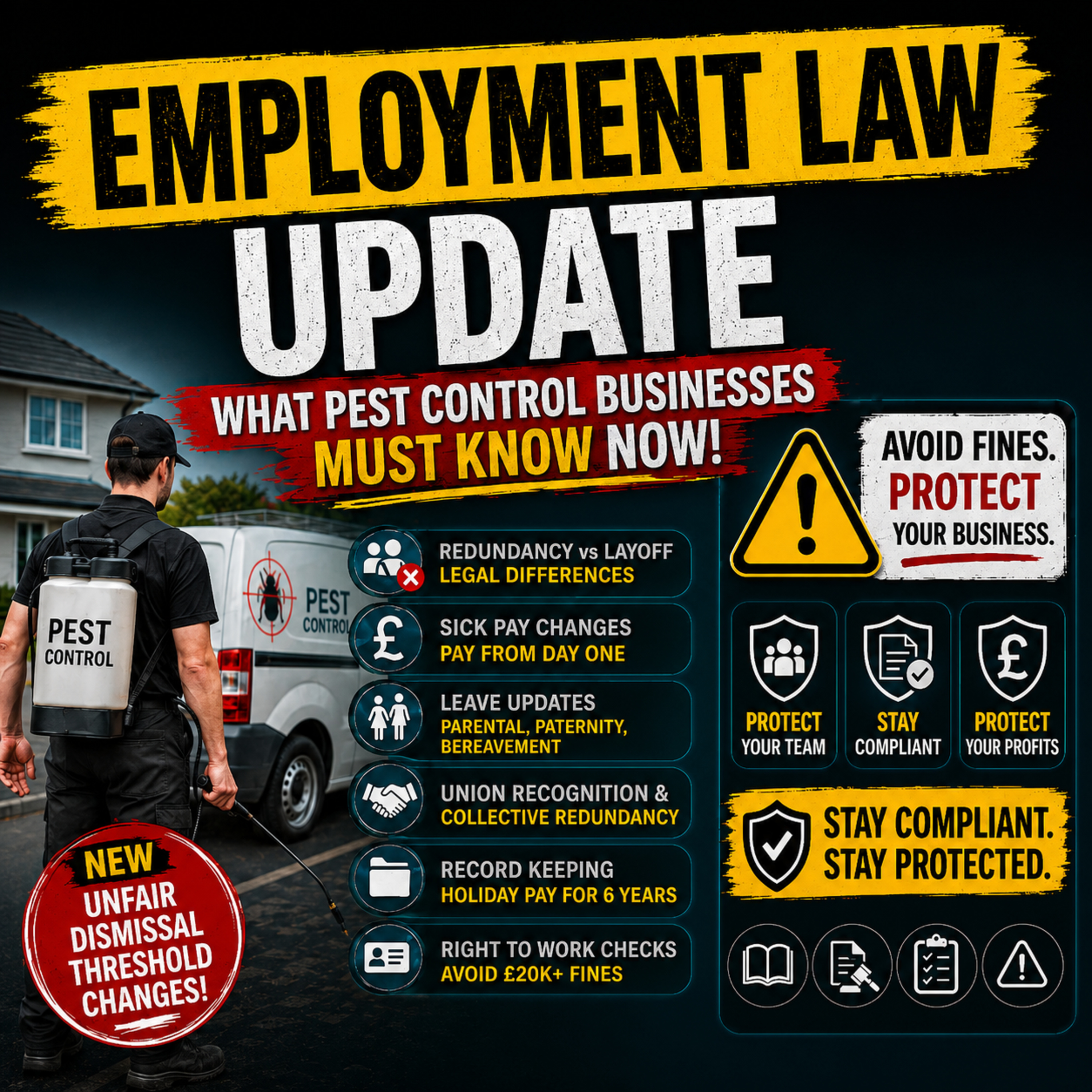
Employment Law for Pest Control Businesses: Redundancy, Layoffs & Sick Pay
Tonight's Episode
Employment Law for Pest Control Businesses: Redundancy, Layoffs & Sick PayPest perspectives podcast ep 63
Allison from Metis HR joins Shaun to unpack over 20 employment law updates that matter to pest control businesses. Learn the legal difference between redundancy and layoff, how statutory sick pay now applies from day one, new parental and bereavement leave rights, trade union recognition developments, record‑keeping requirements for holiday pay, and practical actions - right‑to‑work checks, contract clauses, training agreements, and absence categorisation—you should implement today. Ideal for small operators, managers and technicians who want clear, actionable HR steps to reduce risk and protect their investment in staff.
contact metis below
HR Consultancy | HR Services For Employers | Metis HR
Pest Perspectives Podcast is a UK pest control podcast hosted by Shaun Muller of Oakham Pest Control Ltd. The show features practical conversations with pest control technicians, business owners, suppliers and industry experts, covering rodent control, drainage investigations, bee removal, bed bugs, wasps, commercial pest management, compliance, business growth and wider pest industry topics.
Listen, watch and learn more at:
https://www.pestperspectivespodcast.co.uk
Intro and context — why employment law matters for pest control
Hello and welcome to Pest Perspectives episode #63 Crazy I'm at #63 but people are still loving the show where there was a good one last week with Trudy Martin. Thanks for coming on. That was well received online, LinkedIn and everywhere that was so far. It's doing well this week. I'm getting more and more out-of-the-box. Even though this is a pest control show, I like to kind of off the new technicians or you business owners who's listening, different skills or different knowledge you can use in your own business.
Even though I don't really employ anyone, just me and my dad, it could be loads of people out there that own firms and employees that have lost their jobs or are getting jobs. There's loads of new laws. So I'm going to read it here before, before I bring you in, right. When I, Allison originally reached out to me because I, I was asking about layoffs on LinkedIn and about redundancies. And to be honest, I was probably thinking about those terms interchangeably, which I suspect a lot of business owners do.
But it turns out that there's actually quite a different, it's quite different. And that led me into a wider conversation about employment law changes because there are actually over 20 updates either already in place or coming soon. So today we're going to break that, break that down, starting with the basics and then looking at what pest control business owners need to know. And I have on Alison Matisse HR Limited. How are you doing? I'm. Doing very well, thanks for having me on the show. That's fine and everyone could probably tell I was reading that because I kept making mistakes, but I don't care, you know, there we go.
Yeah, I was putting them out. I've actually got a few other people coming on. Not, not people of your stature, you know, like some people that have had to soon there's a couple of people had to lay off a family member. Now they're back and how they felt, etcetera. So I've I've tackled it from some different angles. I've got like 3 of I've made three podcasts out of that warm post. People, people wanting to come on. Yeah. Thanks for reaching out. That's good to hear. It's no problem. It's, it's been this year particularly our redundancy season seems to have extended well into April.
Normally in January when people are maybe approaching year end and the accountant saying to the new year old grades are a bit high, we we get a flurry of redundancies. But this year it's just simply not stopped. And whether that's to do with national minimum wage going up, employers in National Insurance going up cost of living or these new employment rights, enhanced employment rights that are coming in, I don't know. But some really sad stories because to me making people redundant, the hardest job, they've not done anything wrong, these people and you most employers realise that they're taking away that person's living and they're affecting the families and the home.
So it it is tough, it's not an easy thing to do. It would be because a lot of people take pride in having a team and thinking I'm feeding their family or paying their mortgage and then to think I'm going to cause some serious issues here. But it's nothing they can do. They've got to try and protect the business or they might be shutting the business down. That's it. You've got to protect the the wider team for the sake of those the few casualties, and the more often you do it, the smaller your team gets, the thinner your team gets, and the harder the decisions become.
Yeah, most definitely. Coming from the expert, you'd know you would. Unfortunately, that's how I I invented Metis. I got made redundant 15 years ago and and decided it was never a life ambition for me to work for myself. But I couldn't find the kind of job I wanted. So I decided that I was going to go for it, and it probably took me 3 years to actually think that was the best decision that ever happened or the best thing that ever happened to me. But it's tough. Anybody running a business knows it's not easy.
Right, it's it's good because obviously you, you've found what you want and as you said to me before in the pre chat, I don't think I could ever work for someone again. They, they, they say that and you have your own business that you, you probably couldn't do it again. It's just a couple of shout outs to people watching live. Thanks, Jason for watching live on Facebook and thank you for the praise. Darren. I have to give it to you, Sean. You do get the right people on you look at a wide catchment area.
Well, I try to try to be a bit out-of-the-box. You can't always have pest controllers on, but anything, anything on this podcast that that a business owner in pest control or the wider sector can learn from, it's just as good. That's how I feel anyway. That's what I try and do with the podcast. But thanks Darren for popping in. So have you got any like, say, people within the pest control industry, technicians? Have you got any advice for people that have been laid off for such where say or bosses that I'm probably not saying it right but some people are about to be laid off or have been laid
Redundancy vs Layoff — legal differences and employer obligations
off or. So we look at the so we look at the difference between redundancy and layoff because because they're they're different things. So redundancies are very specific scenario. It means that a job is is disappearing. So what shouldn't happen? We shouldn't be picking people to be made redundant. We should be looking at maybe we've got 6 pest control technicians and we need to reduce to four and we have to go through some kind of selection process to keep the best qualified, most skilled people in the business.
But it's always redundancy is always about we've got to reduce need for that number of people and it's a very legalistic step by step consultations letters. It's very well defined what you should do and anybody with over 2 years service is entitled to receive redundancy pay in addition to the notice pay when this happens. So, so redundancy is we're going smaller or we're getting rid of a line of management what however we're doing it. But we have to be very objective. So it can't be I don't like you or you know, if we have to have you, your ability to do X is less good than somebody else's ability to do X. So redundancies are often quite big things for companies to engage in and most business owners will do all sorts of things and look at cutting costs from all other places because as you said before, we've trained the team up, we've invested in them.
We don't really want to have them to lose them. So most of the time when people pick the phone up to me, they've already thought about the other things that they could do. Often I'll just point out often when companies can't cut the costs but if or not they cut pest control. I know. I. Do and. It's one of them things. They'll regret it soon. It is. It's not because it's not something that's obvious. They look for the things that they think are hidden. But having bought this building and done it up and had the biggest rat problem in the cellar that I've ever seen, it was an old bakery.
Don't ever cut you. Don't ever cut your pest control. So redundancy is a serious programme for businesses to take on layoffs. Slightly different in that usually it's a temporary thing. Maybe we had a contract to deliver a large piece of work and that's either disappeared or it's been delayed and we, we have to, we've got these people, but we've got nothing to no work to give them. But you, you can't lay off people in the legal term unless you've got a clause in your contract. If you don't have a layoff clause, it means that even though you've got no work, no money coming in, you're going to have to pay those people their normal salary.
To not pay them is an automatic unlawful deduction from wadies and you're heading straight to tribunal and you're going to get a claim that you can't defend. So the I until we had COVID, very few employers wanted layoff clauses in the contract because they thought it makes it look like I'm maybe the business isn't secure. But we all learned furlough was never around. We learnt that there were businesses going out of business because in all of these staff, they had to pay them money and they'd no money coming in.
So layoff can be used for all sorts of reasons, but it's usually temporary in in some respects. And if, if you are thinking as an employer, if you're thinking of making people, if you're thinking of laying them off, you have to have some kind of reason, some rationale for doing it. So if we're talking pest control, maybe we've got this big contract that was going to use 8 technicians and they were going to be fully deployed, but we've got 12 in total. Is it right to a fair that it's those eight that get laid off or do we share the layoff among the whole 12 of them so that if we share it out that maybe you're laid off for two weeks and the next person's laid off for two weeks and there's some kind of of rota?
OK. So, so there's, there are different ways of doing it and if you've got a layoff clause in your contract, instead of paying people when they're on layoff, you, you pay them statutory guarantee pay, which is it is
Statutory sick pay changes — pay from day one and how to classify absences
not a King's ransom, it's £39 for up to five days and if you so go on. Like is there also this thing where they companies, they're not going to lay people off as such, but they they offer people say they're really busy throughout a year and people can bank hours and then they could use them hours when they've got no work. Is that a route? Because my wife's company does this. It's. Yes, it's as long as you're contracted to do it, that's useful. But what it's not doing is it's not cutting the costs because we've still got to cover those.
So there's lots of different ways, but and I, I would imagine there's an element of seasonality in pest control because more pester around in the warmer weather. I don't know, is it seasonal industry? It is seasonal but obviously you can have sometimes have a massive wasp season and some years it can be dead. So yeah technically, but rodents are generally around since COVID. I'll be honest, I believe rodents around all year now. Used to be not as much in the summer but now they seem to be here all the time.
There's too many of them, yes, but sorry, Jason was saying that earlier. You know how you were saying you were made redundant? He was saying he was made redundant. The best thing he ever did is he set up his own business as a pest. Control. Congratulations. It's, I think once you've done it and you're in it's, I've worked. I work harder now than I've ever worked. And I've always been a grafter. But I think you finish your day job as Jason, as a pest control operator, but then you're running the business in the evenings and the weekends, doing all your bills and your admin and your ordering.
And so it's. Yeah, But I enjoy it. Every day is different. And nobody tells me what to do anymore, Sean. I choose. Myself. There you go. Sorry I derailed you there a bit. Sorry, no, no, no. So there are some because different industries have got different requirements. If you think of golf courses and you've got ground staff, the ground staff are going to be more busy in the summer than they are in the winter. So you, there's all sorts of inventive ways we can contract with our staff to try and minimise the, the amount of time they're in work and we've got no work for them.
And that's to the benefit of the the employer. Interestingly, if you put the people on layoff for four weeks solid or six weeks in a 13 week period, they can ask to be made redundant. So it's not something that you you have to be quite disciplined in, in recording your time that they're off and otherwise you're going to get people asking you to make them redundant. And that maybe was not the intention all the way along are. You never redundancy when, say, someone's worked at a company a long time.
Yeah. How much we've done, Is it like a week for every year of work there? Is that how it works or? It's it sometimes it's changes when you get to 41. So you get a week's pay for every year of service up to the age of 40 and over 41 it's a week and a half. OK. But you have to remember there's also notice pay. So if you've worked for a company for 12 years, you should get at least 12 weeks pay notice pay and 12 weeks redundancy. Now if you're over 41 that might actually turn out to be 18 weeks redundancy.
So making people redundants quite an expensive business when you've got long serving employees. Yeah, it does sound. It so that often means that employers are, when they're looking at making objectively making people redundant, choosing who should go or not. You would think that they might look at the cheaper end, those that have not been employed very long or young ones. But many people listening I imagine will remember things called last in, first out. So the last person you employed is the first one to go.
We can't do that anymore because that's potentially discriminatory. So we have to be careful about how we choose. I remember. Yeah, yeah, it very much was that way, to be honest. It was especially. It's changed now though, because it used to be if you're not worked there two years, you're going to definitely be. You can't do that now. Can your laws have changed? It you can do it, you still need to go through a fair process because there are discrimination laws that can catch you out. So you still need to follow a fair process.
It is a fact, a financial fact though that somebody under 2 years service at the moment doesn't claim, can't claim redundancy pay so they only get notice pay. You asked earlier about people that go through this process and then the employer doesn't pay them. Yes. Yes. So if a company is going out of business and they're insolvent and they can't afford to pay the people that are making redundant, there is an Insolvency Service that the government run that you, you get a number from the insolvency practitioner like a certificate number and you make your claim to the government and then they will pay the the wages that you were due and the redundancy pay.
So there is an Ave for companies what that have gone out of business. It's. Interesting to know that is. I, I don't know how it's funded, presumably via National Insurance, but it's, it's there as a safety net. Those that don't go out of business and don't choose to pay, that's employees are able to take a claim to employment tribunal, foreign lawful deduction for wages and they don't need any length of service to do that. But it's them finding them and getting them to pay that's the the issue. And often we're getting there used to be a television programme didn't there about the sheriffs.
So you can put your debt in the sheriffs and the bailiffs and they'll go and try and get your money. But that's that's awful when you've worked for a long time and you're just being left with nothing that's not right. Oh yeah, exactly. It's like I use that but only not. Obviously not. I've used it not for an employer, but it's like you can pay £50 for the courts and if you've got all the proof I'm obviously talking about. I've had to take a couple of commercial clients and I've got one because CCJ doesn't look good.
We're not talking big amounts of money, but there was more principle. They still owed it. I have one but talking up to £400, nothing massive. I've used, I've used small claims court for the same reason. If I've contracted with a company and they've not paid, I take the view. That's my money. I did the work. If it was a restaurant, you wouldn't. I want me to just eat the food and walk out. So the problem is what I sell is in my head. So I can't, once I've given it you, I can't really claim it back.
But I'm with you. That's my money, so I'll see you in small claims court. Oh, definitely. I mean it. It very rarely ever gets to where you actually have to go to a court. It's all done on the computer. If you have to go, there's something wrong. Yeah, to be honest. There is, yeah. Yeah, yeah. There is, but now I'm sure that will help some people that have had some difficulties or been laid off.
Anyone has been, you know? There's no cost to take it as an employee, there's no cost to taking a tribunal claim out. So Acas as an organisation is there to, you have to go through something called early conciliation. So you, you make an approach, you want to make a claim and Acas will try and get that. They'll work with you and the employer to try and achieve a settlement. But ultimately if that doesn't work, you get another number, not an insolvency number, but you get an early conciliation number and then you can go to tribunal.
But do. You have to be a member of Acas. No, no. No, it's a free service to employers and employees. Their their sole aim in my opinion is to settle claims so that they don't go to court. At the moment the tribunal services are so oversubscribed. The listing cases for 2029 and 2030. Wow. I don't even want to think about 20-30 yet, that's crazy. And that's the London, London tribunals are flagging that that already in 20-30. Can you imagine having to go to court for something that happened like 4 years ago and remember everything And yeah.
Because it, oh, yeah, you have to remember everything and you have to keep jogging your memory all the time. You would because it's, you'd have to write everything down. But welcome, Pete. Thanks for popping in, mate, and also who we've got here, Levi. Cheers for watching, Scott. Cheers for watching we go. We'll crack on again. A few more people, some LinkedIn people too. Yeah, there's some great information there for people that are employees. Now you mentioned there's some updates, some updates on on employers, a few.
So the Employment Rights Act came in, it was passed at the end of last year and it's coming through in in phases. So as of the 6th of April this year, the one of the major changes was around statutory sick pay.
Parental, bereavement and paternity leave updates
So previously if you had employees who were off sick, they had three waiting days so they didn't get paid for the first 3 days. But now from day one they are entitled to either statutory sick pay or if they're, they earn less than that, 80% of what they would have they would have earned. So for some of my clients that are minimum wage employers, it actually was quite a good saving. If somebody went off sick, they were saving three days pay. But that doesn't hang fire. Now it's you're paying them from day one.
So one of the things I would be saying to anybody that's listening, who's got staff, is now make sure that that person is themselves sick and unfit to work. It's not they're taking time off because a child is ill or a partner is ill because that's a different kind of leave and that's emergency leave and that is unpaid. So categorise your absence correctly to try and make sure you're not paying statutory sick pay when you don't need to. So that's one of the the big issues that that have come in. We've got changes to paternity leave you that's now a day one, right?
Although you still have to work for I think it's 26 weeks before you can get the paternity pay. So that came in, it won't surprise you. I had to write these down, Sean, because. I can't, don't worry. There's a lot that I know You're an expert, but these are all new and you've got to get it, you know? Right, You have. And the reason they're not new rights, they're just changing the, the entitlement that that exists. So unpaid parental, unpaid parental leaves a day one right. We now have some leave for parents of, of children that are born very prematurely or sadly for where parents have had children die, there is now bereavement leave for them.
Trade union recognition and collective redundancy protections
We've got collective redundancy protections coming in. Trade union recognition of this is, I find this an interesting one, but this is one that's going to develop over the coming months. And the consultant, the government's consulting on them at the moment, a piece of a code of practise, if you will, that's going to, if it goes through, it will allow on the face of it, unions to come knocking on your door and say, we want to come in and talk to your staff. And, and your ability to, to resist that on the face of it would look quite limited.
So it's quite interesting. And it's, I'm being a sad person. I actually enjoyed reading it. But the thought that people can just not just walk in, they've got to give you notice. But if you're busy doing something, then disrupting your work, is it paid time? Do you have to pay while they listen to a union person or so? That one's going to get quite interesting, I think. It will, because I know for a fact that most, most companies write in their contracts. We do not recognise unions where I used to work, used to, and a lot of American companies say it too.
They do. But. That won't be an option now. Well, you can. Recognition is slightly different than allowing people to become a member. So now if you recognise trade unions, it means you're into collective bargaining and it's usually only very large companies in the UK that are involved in collective bargaining now. But it's it's an interesting difference. So now if, if I'm going to pull you into a disciplinary, Sean, because you have been doing something you shouldn't do, you are entitled to be accompanied by a trade union Rep or a work colleague.
I don't have to recognise that trade union. You've got a statutory right to be accompanied and that's been around for a long time. So where there's a disciplinary issue and you're going to be in a hearing, you are allowed to bring somebody with you. So slightly different rules. We have some protection that came in for women returning off maternity leave that does impact redundancy. So it's giving them protection for six months after they have returned and if there is a vacant post then they can actually say I want that post.
So providing the qualified and there is no selection process, they're able. This protection gives them first dibs on that job and other people in a way are prevented from being considered for that role because we've got a category of employee that's got enhanced protection. So that's a bit of a hard pill to swallow for in some workplaces. Imagine it will be it's. It doesn't feel very fair. Yeah, you're supposed to have, you know, a level playing field for everyone, don't you? As much as you can.
It's about fairness, isn't it? And if there were two of you for one one job and the other one just got it, that doesn't it's what it leaves you feeling that I think that's the the key. You wouldn't feel very valued, would you? No. You. Wouldn't and we've got some changes to it's not a change because it was always an issue. So sexual harassment, you could already, you could bring that
Record keeping: holiday pay and annual leave for six years
forward as a whistle blowing complaint. Now it's explicitly said that it can be listed as a complaint. You have to now keep holiday pay and annual leave records for six years. I think we've never had anything written down that was so concrete. So start putting putting them away and labelling them because if the tax man comes a a knocking, you want to be able to produce your records. Oh, OK. Well, that's interesting that I didn't know that. So that everyone, everyone is a bit of sauna here. Listen to that.
Yeah. Yeah, put put them away and file them and on. So all of that came in on the 6th of April and the day after there was a Fair Work agency established. And it's not a new agency that the government have established, but what they're doing is they're pulling resources from lots of different existing agencies. And so national minimum wage claims will be looked at by them and the it's not operational. So it exists, but it's not actually flexing its muscles now. But we do think that this might be one of the ways of reducing the pressure on the tribunal system because this agency will come in and check things and deal with things and prosecute if we're not doing things.
And I do wonder whether the holiday pay annual leave records might be one of the things that
Right to work checks and fines for noncompliance
will fall under their their remit. Interesting that is is some more bits of paperwork for people. Yes, and keeping hold of it and remembering it. The most important piece of paperwork is, is not something that's come in now. It's been around for a couple of years and that's doing right to work cheques in the UK. I was highly offended. I I worked at my old factory. Are you on the back where they asked to see your passport? Yes, yes. I I I got quite offended by that, but I knew it was a lot. Everyone had to bring the passport in.
But yeah. If if you're if you're found to have employed somebody that doesn't have the right to work in the UK, the maximum fine is 60,000 lbs. Yeah, that's worth doing. That's a big chunk of change. Yeah. So there's lots of different, it's quite technical, but there's an easy on that gov.uk. There's a, an easy thing to follow depending on where you come from in the world, there's different, you want different kinds of of proof, but it's also keeping on top of you do have any employees that have got limited time.
So a visa of some sort or a work permit, just making sure that you're on top of them being renewed because it's quite easy to inadvertently get yourself into trouble. And we don't. Not many of us have got 60 grand stuff down the back of our setting. Is that is that like 60 grand per person? Yeah, yeah. So that's the worst, the worst case. And I think there's some naming and shaming of companies as well when that happens. So, but essentially if you take if, if one took a personal opinion whether we as employers we're doing the work of the Border Agency, we're the ones that are policing the right of of the working population to actually work in the UK, then it's us that's in bother if we don't check it.
Yeah, because we like, I've never ever had it before. I can't remember what year it was, but it was only ever done once. It wasn't. It wasn't actually at the point where I've started there at 7/19/19 and I was never asked for it until like 10 years, 10 years later. I was, can't remember when we came in or more. It was. So you once you, if, if you're Auk resident with Auk passport, we don't need to recheck those once you've done it, just keep it in the photocopy and put it in a file. Then you can prove that you've done them.
But it's people with different levels of right to work. They're the ones that you just need to stay on the top of making sure that things are being renewed. And if somebody loses the right to work, you need in your contract, you need to have the ability to to take their job away from them. Because if you allow them to continue to work without that right to work, you're going to again fall foul of the Border Agency. How would the problem is? How would you know? That's the thing, I'd say someone was allowed to work and they were OK, but then if it gets removed the government doesn't just ring you and say they can't work there more, do they?
So you get, usually you get a visa for a particular period of time. So it might be for two years. So they, yeah, they give you a share code. So the employee coming for the job gives you a share code and you can check online and you can check that the picture is the same as the person that's come for the the job. And you need to make a note of that visa is due up in July and you need to be asking them three or four months before that. What are they doing? Are they, is their visa going to get renewed?
And we have had not many, but we have had occasions where we have got very close to dismissing because again there's a backlog and the right to work hadn't come through, their visa wasn't renewed. So when you're offering somebody a job, it's very helpful to make it condition of that offer that they have got the right to work in the UK and that they retain that, they maintain that. Yeah, that's, that's fair because on I see on a lot of job postings on LinkedIn, especially in pest control, people from other countries are always asking a lot of them ban put UK residents only the sponsorship rules.
It's it's a bit difficult for UK firms to pay for it really. Yeah. So I have a client in the care industry and they're 63% of their workforce are sponsored workers. So and that's not unusual in the care industry. But what is interesting there is if, if they do lose their job, if it's they're dismissed, they only have a very limited time to find other work in the UK. And, and if that doesn't happen, then I think action is taken to deport them or that's, that's the impression I get. So we've had a couple of people recently where they've unsuccessfully complete, they've not been successful in completing the probation and we've been moved on.
But it's very, it is very expensive. Oh yeah. Yeah, I have heard. I used to have people messaging me. You can have a job. I don't employ people. I think, I think that's a very good ploy, but.
Sexual harassment risk assessments and employer duties
Yeah. Now the the stuff that's coming in in October, we're still waiting for details around this. We haven't got the the nitty gritty of what's going to happen here, but one of the things that we do think is going to come in. So I think it was two years ago the laws around sexual harassment changed and there is an obligation now on employers to risk assess the likelihood of sexual harassment by third parties. So I have a window cleaning client and because they're going on to people's premises, then they are having to risk assess what's the likelihood of them, their staff getting harassed by the the people in those houses.
And I assume similar in pest control because you're going into people's people's houses. So what you're at the moment, you're being asked to take reasonable steps as an employer to reduce the chances of sexual harassment taking place in October of this year. We think that duties going, the bars going to be raised and you have to take all reasonable steps to control that that harassment. And that's that's a really tough ask for a lot of employers. You think of a shop worker, for example, or somebody that works in a pub.
It's you're not in control of the behaviour of the public, but you're liable if your employee is harassed by one of those members of the public. Yeah, on that would like say companies that were like you say you had a contract window cleaner, would measures like I don't know, would DBS cover it or not? You would put in place a number of different things, so training your staff is one of the things, having the risk the the most. A barrister that I was speaking to, you said one of the most important things is to have a risk assessment.
You've written it down and you've worked out what are the risks. So it's exactly the same process. If you're doing risks of using a chemical or risks of working in confined space, what's the risk of my employee going into that scenario and getting sexually harassed? And we look then at reducing the likelihood of that. So we train them, we have the risk assessment. And then you start to think about, well, what else can can we do? Do we work in pairs or so Every organisation, every team will be different.
And that's what makes it so, so difficult. So how on earth an employer can confidently reach the I have done all reasonable steps. I think that's going to be a really tough bar for all four employers. It's difficult because what do you get to the point where you're making your staff wear body cameras like police do? Possibly. Possibly it's it's hard to know and and the for employers, the danger is that an employee who is harassed by somebody. So let's use sexual harassment as a an example. Then if you've not put in place any of these controls, then are they going to take?
So it's you've got vicarious liabilities employer. So you are responsible for this situation and again, you're going to find yourself potentially in a tribunal and that's big, big money, that kind of claim. So does it then become a way of people causing trouble generating money? I'm very cynical. My job makes me very cynical, so. I'm trying to think because I think I. See the word? No, because you are right, years ago used for them people would crash into you on purpose. Yes. Things like that. So I can't see what you're saying.
Always, there's always someone willing to exploit a whole, yes, sorry, a loophole in the law or something. I say a loophole.
We've got tipping policies. I don't know that people I've, I've never tipped a pest control operative, but I don't know whether you're in the industry tips are anything that you, you do find people giving you for doing that and carrying out the work. But there's legislation around that. Now the the biggie that everybody is unhappy. Well, I say everybody employers are unhappy about is in on the 1st of January 2027 the unfair
Unfair dismissal threshold changes and probation considerations
dismissal. Time limit is coming down. So at the moment you have to have been employed for two years before you can you have unfair dismissal rights. If everything sticks to what it's we're seeing that will come down to six months. So you employ somebody, you maybe they have a six month probation, you're still testing them out. And we were everybody's waiting to see how the law is written to actually understand if I need to remove them at six months because they've not passed the probation, how do I do it safely in a way to avoid unfair dismissal claims coming at me?
So we think it is, we think it's going to be paying more attention to your recruitment, making sure that your inductions people know the rules, that they're trained well. But we're actually having probation reviews with individuals. So we can we can start to catch some of those behaviours a little bit earlier and explain to people how those behaviours are not welcome and maybe look to end probations earlier than in six months. So it's too early to tell because we haven't got the detail. But that's the one that is causing a lot of issues for employers because you can't always tell whether somebody's good or got potential within six months.
If I have a six month probation and I extend it to nine months and then I think it's not working out. Have I unfairly dismissed you? I don't know. I'll tell you, it seems just to to keep making employees jobs harder and harder and harder. Yeah, it it when different governments come in, the legislation always changes. And so traditionally Conservative government passes legislation that's in employer's favour. The Labour government passes legislation that's in employees.
It's this is the biggest change we've seen in employment legislation for many, many years. We really have does. The government even understand it when they're writing it, that's the thing. Do they? Understand it well, it's the bit that fascinates me. So they pass the legislation and it was going backwards and forwards from the House of Lords to the Houses of Commons. But then it has to be written up in a way that we can actually enact. And then you've got Acas will develop a code of practise. But it's funny when you read these things, sometimes it's that that thing wasn't in the law, but it's now in this code of practise.
How did that happen if our elected representative didn't include it? So I don't know. That's not an area that I inhabit, but it's, the wording is so very, very important in these things to check what it is you're expected to do. So for my clients, it's our job to keep our eyes on this and to brief them on what they need to be doing. We've if people are running their businesses, it's very difficult to keep. How on earth do you keep if there's 22 pieces of legislation changing, how do you run your own business, make a success of it and spend every hour available to you reading bits of legislation and codes of practise and case studies and case law.
So that's. Like a new SO sounds like a new person's job. Yes it does. Yeah, or or outsource it to a firm. Like you absolutely, of course, of course. And then we've got some possible changes around 0 hour contracts and guaranteed hours. So it's a bit too far in the future to know for definite. But the suggestion seems to be that if I, if I regularly I'm working a particular pattern of 0 hours, then I, I don't know whether it would be a right to ask to maintain that or a right to be given that. And the same with the 0 hour contracts are meant for flexibility.
So I don't have any obligation to offer you work and you don't have any obligation to take work from me. But which seems at odds with more legislation around 0 hours, I think. I think zero hours contracts are really helpful for employees where you're, you know, your demand goes up and down and really those zero hour employees should get proportionately what the full time people get. And I think some employers don't do that. So the government have decided that they will legislate to make sure that people are treated fairly.
The zero hours person should get sick pay and they should get a proportion of holiday pay. To be fair, it is about time. I mean, governments have been promising, they've sought it out for a long time, previous governments too, but they've never done no about it. Yeah, but it's, if you imagine the hospital, the hospitality sector, they, they're the probably the biggest user of 0 hours contracts and the impact is thought to be going to be massive when it comes in. So I don't know. It's I have a crystal ball on my desk, but it's not telling me what's doing it that far ahead.
Oh, miss, it's like some of these things. It's like, sounds good, but is it? Careful what you wish for, because it won't be exactly how you think it's going to be. Yeah, and it won't go back. It'll legislation doesn't often go backwards. So it's almost like we're stuck with this. We have to make it work and then we use case law from tribunals to hone it. And I don't want any of my clients to be case law. Thank you very much. It's interesting. I was looking at what kind of cases go to tribunal from pest control companies and a lot of them, there weren't very many juicy ones.
A lot of them were around failing to pay notice, pay deductions from wages that weren't correct, but they're actually a couple around disability discrimination, the failure to make reasonable adjustments to jobs, quite a big company in the Northwest and this this chap developed type 2 diabetes and his long days were not helping him control his symptoms. And it was found that the company actually didn't. They were breaching working time regulations and they weren't allowing him to manage his symptoms in a way that reduced the impact.
He was very tired. And so we don't now get, years ago you used to get a green card if you were disabled. That's not the case now. A disability is any long term health condition, usually 1212 months that significantly impacts your daily life. So and type 2 diabetes didn't used to be disability, but it obviously is no no. I didn't know it was either. My mum's got that so I didn't. I didn't know. Yeah, the tablet. Version. Yeah. So I think the thinking was that type 1 diabetes, it's it's not reversible, whereas type 2 is, but it's still classed as a long term condition.
So that was quite an interesting 1. So what else did I have? I had, as I say, lots of people not paying what they should have been doing. Oh, poor handling of grievances, process is not followed properly. So if you as an employer, if an employee raises a concern with you, you need to listen to that and you need to investigate what's gone on and see if there's any, anything that you need to to put right. And failure to do that can create a situation where somebody decides I can't work here and walk out.
Was it like a grievance in such of how they've been tracked or was it like particular jobs that they couldn't do something right and they were being told to do it? Things like. That so this, this one, so this was in the Midlands, this one. And the employee raised concerns about the way things were being managed at work and it was it was impacting him and the company were found to have not handled that grievance correctly. They hadn't followed a proper process.
The employer in that case, they did actually win some of the cases, but they still had to pay out. So there's some quite big, big amounts. We've got one in the London, London and Southeast that was to do with dismissal and pay issues. So there was unfair dismissal. This one cost £10,000. The wages were not handled correctly and there's quite a few in your industry around whistle blowing where health and safety breaches have been identified. And if I raise with you a concern about maybe the way the chemicals are being used or I'm not getting PPE or anything like that, and I and you take action against me for raising that, I've made a protected disclosure to you.
And to dismiss me for that is usually automatically unfair. Would be you're only trying to be, you know, these chemicals are dangerous. You like, you don't want to breathe them in. So yeah, I agree with that. Yeah, it's quite, it's right. We we know in health and safety at workout, you know, Section 7 says I've got responsibility for my own health and safety as well as yours as as an employee. And surely it's therefore right, if I'm not being given the correct PPE that I raise, that you should listen to that and do something about it, not dismiss me for raising that that concern.
Yeah, I mean, it seems, yeah, a bit mind blown by that because like we have health and safety training, it's a lot of these courses are online and you should provide the relevant, each product tells you what PPE you're supposed to use. It does. Yeah. And you can't, you shouldn't be charging employees for that PPE either. That should be being provided by the the company. You might want to ensure it's returned when they leave so you're not in for fancy safety boots and goodness knows what else. But but then again I do have one client that says I don't want all these sweaty shoes, they can keep them.
I'm going to buy some new ones. Some, I'd imagine some people would do that. I would. But I am very impressed how you've done some research on pest control companies. I like this. Someone's done some homework. I tried to make it relevant years ago. My very first job was managing cleaners in the NHS. So at the age of 24 I was managing 105 cleaning staff over in a kind of Victorian hospital. And one of my jobs was pest control officer. So I was trapping, I was trapping feral cats, learning about Hoy Hoy cockroach traps.
And I, I enjoyed it, but I had people that went and did the doing. Like I said to you before, I'm not good with rodents. So I didn't want to do that.
It's a, it's a, to me, it's a vital service that you offer. And I, I was interested the infographic that I put out on LinkedIn today to see how quickly the industry has developed. And you were saying how little regulation? So, so here it's right, the way I my business set up, we be, you know, we're with a trade body, we've got accreditations we show no, we do things correctly and anyone could be with a trade body. However, within the industry, how it operates is you could do a one day course on rodenticide use and tomorrow you could go out and say you're the rat man, you're the rat catcher and you could do work there.
And then. I'm not saying that is how it works, but I think there's different levels to how you run your business. But yeah, a one day course in my, I'm going to say this, this is my personal opinion, not open pest controls, not the NPTA's. My personal opinion, you should have a few. You should really strive to get accreditation or be part of a trade body and do learning via CPD because people will get CPD for tonight that are on the British pass register. I believe you should have the more learning and education you can get, the better because every day is every day is a school day.
It is. But unfortunately, yes, you can just get a day course and you can be classed as a pest controller after that. You can, but yeah, it surprises a lot of people. It does. The, the pest, the pest perspectives I listened to a couple of weeks ago where you were talking about confined working and there was a lot of discussion on that podcast about how much training you is available to the industry. And you think one of the downsides for employers is what you're doing by training people is increasing their market value.
So you're making it more likely, more able for them to just set up on their own or go work for somebody else. It's. What happens? Yeah. So what? So it is possible, it's quite possible to contract in a way with your staff so that if they were to leave, you can recover that money that you've invested in their training. So you, you set out in the contract that you, you will, if you leave within a year, you're going to repay 100% of that, the
Training agreements, recovering course costs and protecting investment
cost of that course, 2 years, 75% to try and at least recoup the money that you've you've spent. Yeah. See, I didn't know that was an option because obviously these courses, I mean the one, the main one that is the RSPH level 2 awarding pest management, that's not a day course, that's a three day course. You're talking anywhere from 7 to a grand for that course. So someone disappears a bit quickly. That's a lot of money gone. So you are right, that could help people protect their investments. But I didn't know.
I didn't know that was a thing you could do. I didn't. Yes, absolutely. As long as you do it before they've gone on the the course and they've, so we have you either do it in the contract by having a like a global statement that this is what the deductions will be and by signing the contract they've agreed that or you put in place a training agreement that says very similar. But with something like that course that's more expensive, you, you might want the ability to put them on some kind of payment plan when they they leave because there's not enough money in their last ways to recoup all the, the cost.
So again, by signing upfront, they've already agreed to the the conditions of of that that training. So it's one of the ways you can manage your money and try and keep that investment inside the business. Yeah, no, I mean that's obviously for that particular course that's usually companies that hire trainees and train them in house and then set them on that way. But a lot of people just get jobs and they've already got that. But that would help people in protect because there's obviously there's a lot of different courses you can be put on as well.
You know, there's all sorts like you say, but evening, Darren, thanks for popping in. But yeah, that'd be interesting for people to know that Will. It's an easy, an easy cost protection if you will. You, you have to already have in your contract what you're going to deduct from people's wages when they go. If you deducted something that's and you've no clause to do that again, you get into hot water. So it's making sure your contract is written in a way that allows you to do that. I thought, I, I thought that it was also useful to, to, to think about the other ways that we can protect our investment.
So we talked about, so protecting the training investment, but going back to what we said at the beginning, getting your absence categories right. If I, if I ring you up and say I'm need a day off sick because my child is ill and you give me a day sick, then you're paying me statutory sick pay. But I am not sick. It's my child that's sick. So the leave that I'm actually asking for is emergency leave and that's unpaid. So paying attention to how you classify people's leave is another way of of reducing unnecessary payments to to people.
And I get that I'm going to say something obviously, because I'm not a professional in the industry. Once staff know that, they'll just say they're, I'll, they, they get. Paid, but then but then you that allows you then to monitor their their sickness absence. And we we look for patterns and trends. Is it every Monday, every Friday? Are they regularly off at such times? The average number of absences per year in this country per person is 6.5 days in the whole of the year. So if you've got somebody whose absence level is above that or even I would start below that.
But you're able to have conversations with people ultimately, if an employee has signed a contract to do to do 40 hours work, but they're never in work to do the 40 hours, we're perfectly within our rights as employers to have conversations about what's going on with you, what what's wrong? Is there anything we can do to help? What's what are the reasons? So if somebody's always off with the same thing backed back issues, for example, maybe we need to be sending them to occupational health to get a medical opinion on what it is and whether we can do adjustments.
But if it's it's food poisoning, I had somebody the other week who she'd have 4 bouts of food poisoning. I think she needs to go to a different takeaway. If we've got somebody that was off, had a cold, had a sore knee, hurt themselves at football, everything's different. There's no underlying trend there. So that makes you start to question and you can put people on monitoring. So we expect you to reduce. Your absentees and more approve your attendance whichever way around you want to do it. Yeah, OK, I'll be honest with you.
Before I got into pest control and my old job that I hated, I was one of these people. Monday morning was a Monday morning was the the theme with me. I never got sacked. I never got put on mornings, but they would just get me, told me off and then, you know, I kept doing it. But I stayed there for 16 years, so they kept me. Yeah, you can't be that bad. Yeah, so I used to hate my job. That was pretty much. I don't. I didn't tell them that, but yeah, I used to just not want to go on Mondays. But yeah.
But I understand obviously as a business you can't, you can't operate like that. I mean no. It makes it very difficult. I'm very rarely off ill to be honest. I think self self-employment is the best cure for the common cold. Yes, and what we call man flu. Well, I didn't. I didn't. Want to say that of course. I don't know, but I'd say that anymore. It might be a thing. I don't know who knows, but no, no, some some good information. Have we got any? Have we got any more information that might might be helpful to I, I?
Think just the thinking about the main things, the things if I had a hit list of things I would do so it'd be right to work cheques out. That's dead easy tomorrow get everybody to bring the passports in and the the visas and then you've done that and you're not going to get caught out. Get your absence categories right. If you you have to have employment contracts. People are entitled to an employment contract on day one of their employment. They can't take it to structure ibupro for not having one on day one, but they can add it as a supplementary claim.
So and that's quite expensive. So get contracts and make sure those contracts are, yes, they're respecting the rights of the workers, but they're giving you the wriggle room as an employer to be able to work in a way that your business needs to to work and gives you the rights to deduct what's what's yours. If they're leaving. And there's an an underused part of a contract that looks at how you restrict what people do after they've left. Do you want them going working for competitors just down the road?
Probably not. Do you want them poaching your staff? You might want some of them to be poached, but the good ones, you might want to not have that. So that post termination section of your contract is really important. I do know, I'm obviously mentioning no names, but I do know bigger, bigger pest control companies, they do do that, yes. So you can't approach the client, the client stepping services straight away, but you know ultimately they're going to try and do it eventually when they can. And it's, it is very expensive to enforce, but it's a signal that I'm taking it seriously.
And you sign that contract, You knew at the start what your restrictions were. It's got to be in place. You can't just do it after the fact, and you can't if it if it wasn't in writing. Yeah, yeah. So if you've not got contracts, get them. I would say Google's free for a reason. So make sure if you get anything off the Internet that you get some advice because you want it to work for you as to make sure it's giving you the right protection. And as these laws come in, you need to refresh and review your contracts and the policies that support them.
That's. Great advice that is, I've learnt loads but I feel like I'm going to have to re listen to the podcast as well, probably because because there's there's a lot in there. There is everyone else. I'd suggest that you get a notepad and write these particular bits down because most people will listen after the fact. But there's a lot of juicy information in here. Whereas as to your graphic as well, I would, I would say there's probably over what now? They're probably, there's probably over 1000 pest control companies.
The problem is when you search Google etcetera, because it's not, there's not a, a, a list where you have to go. I've got a business. So a lot of them aren't incorporated, but they just want people that just do a bit of some people just do it part time. And I would say you've probably got, I'm only guessing here, so don't, don't shoot me people. There's probably 1 to 2000 companies in the UK probably, but some of them people just one person by themselves doing it and that's it. So it is hard, it's a hard number to gauge, but they there is a claim out there.
I don't know where the technicians wise and people actually in the rolls. There's about 10,000 pest technicians in the UK right now that that is that I don't know how they gathered that data, but that's a rough estimate and we're we're tightly compared to other other industries we. Are when I was looking at trying to find that they group you with other it's so it doesn't have one just on its own for pest control and you're grouped in with other. It was something weird like construction or something so very I couldn't get anything reliable.
The only thing I. Did find out. It was, it's an like everywhere else, it's an ageing population and how do we encourage young people to come into the pest control sector and see it as a career? That is a fact and that is something it's true that did it tell you in the next five years? No, go on. Well. This is the case. It's five years. Half the industry is going to retire. Well, that 5 to 10 years is what they say. And obviously I'm a member of the MPTA great body. And they are trying to find ways to encourage young people to see it as a career because I don't imagine the teachers at the school recommending why don't you buy be a pest technician.
They were trying to find ways into we've all we've all we've the MPTA itself is the National Pest Pest Technician Association trade body. I've got a partnership with the Royal Society, Royal Society Public Health and they've got a careers hub and it shows you like they've had various companies sponsor the the project and it's like stories of how so and so got into pest control. What you need to be a pest control that all the different avenues. So there is websites out there. They're trying to, I think they're trying to get schools to plug into so they can see the options out there because primary schools are easy to get into, aren't they?
You know, they'll let anyone come and talk for you know what you do. But it's a bit different in secondary schools, isn't it? It is, but it's I can see the attraction of linking it with this is health or environmental rather than pest. I can see that that that's got potential there. Yeah, because they're, they're literally the, the three day course was talking about RSPH. That's it is their course. It's the Royal Society of Public Health. So and I believe the, I think the BPCA have got a careers hub as well.
They have as well to try and attract young people. Everyone's trying to attract young people into industry. And the NPTA has a deal with partnership with Syngenta, which you do with a chemical company where if you're an MPTA member company and you want to frame one of your, you have to be under 25 though when discrimination, I know I'm joking, I'm joking, but you've got to be under 25. Your member company can apply you, but you've got or actually the young person has got to have like it's like a interview candidate style just so you're passionate about the industry.
And I'm not involved in any of them conversations, but I've had a lot come through and or even if you're, you want to take a young person on and then you can have that person apply. We've had companies where they're going to get a guaranteed job with the NPTA member company come through the system. So that's a good way of getting them a job. But yeah, it's it's fun to 24 to try and track people in, but we're always looking for new ways to try and get people in. But you're right, public health does sound.
I try and work a lot of my stuff as often public health, it sounds better. Yes, Yeah, but. Ultimately, that's what it is, isn't it? It's it is making the environment that we live and work in a healthier place. It is, definitely. It is, yeah. It's been a nice conversation. It's and it's all work. It's not gone wrong. No, this is true. This is true. Oh, good. Yeah. Streaming arts, quite good. It's been working. Yeah, it has. But yeah, it's been a it's been a fun conversation. And I hope this helps any employees in the industry that are having difficulties with employers or they've been laid off or there's no at the minute, the pest control industry, the multitude of companies are laying people off, but there's also multitude of companies that are hiring too.
There is, there is. So it's it's like most industries go into it. It's a tough time at the minute and I hope this helps people on all different sides. Yeah, if anybody's got any questions they want to ask, I'm on LinkedIn. If they want to drop me a message, I'm happy to help. Do you want to promote your business? Because there might be some firms like I think we need some help. Would you like to promote your business? If, if you don't mind, that's very careful. So we a small HR consultancy in Lancashire, but we've got
How to contact Metis HR (MetisHR.co.uk) and final tips
clients across the UK and we work with small, medium sized businesses with no HR. But every one of us in the team has either run our own businesses or managed businesses for for people. You're not dealing with a call centre. And our strap line is we protect employers from their own employees. So our job is to make sure that we help our clients not fall foul of the law by making sure that they follow employment legislation. But they do it in a way that helps them run the business in in the way that they need to, to thrive.
So we're very down to earth northerners. We call a spade a spade and you can find us. We have a website, so it's www.metishr.co.uk. I have, I'm on LinkedIn. We do have a Facebook page, but I'm not very good at keeping that up to date and I gave up on XA long time ago. But anybody, if you've got any questions, just drop me a message on LinkedIn and I'm happy to help. I will put Alison's details in the Spotify links as well, so if you want to contact or or do business, you can because sounds like some people may need some help, yeah.
Sign up. We we sign up, we don't, we don't overload people with mails. But when there is something coming out, we have like a mailing list where we can this kind of thing that's coming out, new pieces of legislation, just top tips of things you can do. I know that's that's helpful for people. That is lovely. Yeah, No. Thanks for coming on, Allison. Thank you very much for having me, I'm enjoying. It very nice. Ian, was this your first ever podcast? Yes, I've been on the radio quite a few times, but I've never done a podcast and but this platform you used was dead easy, so.
Yes, it's the idea is, is you've got to make it easy because we popped on a you're on your phone, man. It was on my phone. You're both there or you're on your tablet. We tested it yesterday. That was quick. That that's easy. That was the thing that I was most bothered about because I I can talk till the cows come home, but it's the technology that often gets in the way. So no, I'm very grateful to you having me on. I've enjoyed it. Nice. I mean, I mean, here we go, right? Last week we had Trudy on This was Hurdle of First Life podcast.
This is your first live podcast. I have. I have done radio as well, by the way. But it wasn't live. It was a recorded interview that played on the radio about Wasps last year. Yeah. Have you been on live live radio? I said it's live. Is it? You're speaking and it's live on the air. Yeah. I've not done that yet. I've not. I've sponsor a business programme on our local radio and I go once a month and we we do it's, it's not a live phoning, but they're actually answering live questions that are coming through on social media.
So yeah, very nice. Very. Nice. Well, I'll end the stream now. Thanks everyone and I will see you next week. Thanks. If stay on the line for a minute Alison, not just end the stream. Yeah. Thanks everyone and I'll see you next week. Thank you.
Chapters
Sponsored by




 Amazon Music
 Apple Podcasts
 Audible
 Castbox
 Castro
 Deezer
 Goodpods
 Moon FM
 Overcast
 Pocket Casts
 Podbean
 Podcast Addict
 Podcast Republic
 Spotify
 YouTube