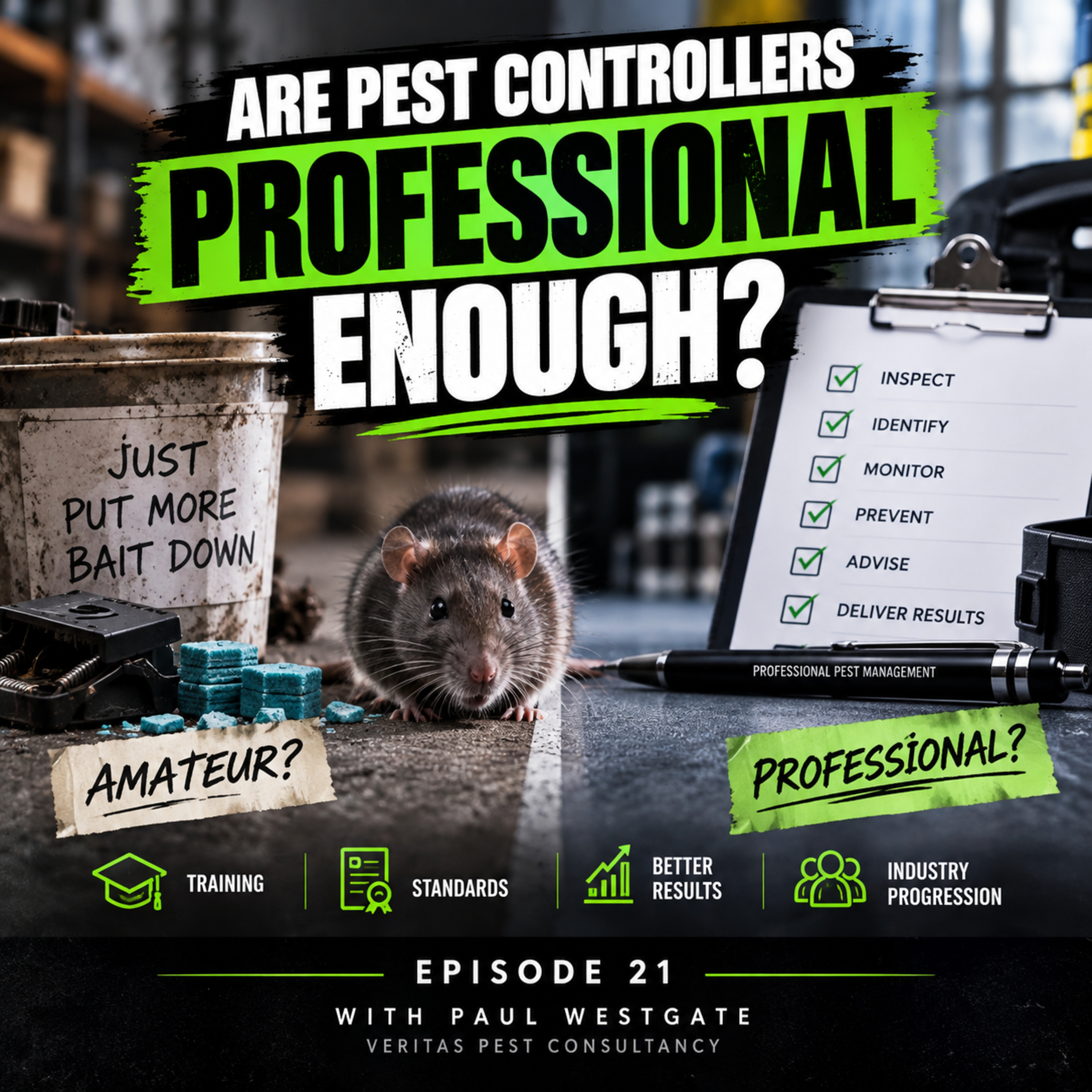
Are Pest Controllers Professional Enough? | Paul Westgate
Tonight's Episode
In Episode 21 of the Pest Perspectives Podcast, Shaun is joined by Paul Westgate, Managing Director of Veritas Pest Consultancy, for a wide-ranging conversation about professionalism, training, pest control standards and where the industry needs to improve.
Paul has worked across virtually every level of professional pest management — from technician and field biologist roles through to consultancy, training, food manufacturing, auditing and industry representation.
And he isn't afraid to challenge the industry.
We discuss whether professional pest controllers are doing enough to separate themselves from amateur pest control, why simply putting down more bait isn't professional pest management, and why knowledge, communication and understanding the customer's needs are becoming increasingly important.
Paul also explains one of his favourite principles:
“The more you learn, the more you earn.”
That doesn't just mean money. Better knowledge can mean better results, better customer relationships, more five-star reviews, fewer callbacks and ultimately becoming a better pest professional.
Topics include:
🐀 Rodenticide stewardship and environmental responsibility
🎓 Why pest controllers should never stop learning
👨🔬 The difference between an amateur and a professional
🏭 Pest management inside food manufacturing sites
📋 BRC, SALSA, Tesco, M&S and other auditing standards
🗣️ Why customer-service skills matter in pest control
🪤 Glue-board legislation and the challenges surrounding it
🔬 Field biologists, consultancy and technical pest management
📊 Why the industry needs better data and research
🧠 Resistance, pest behaviour and evidence-led control
💼 Building value rather than simply selling pest control products
🤝 The role of BPCA, NPTA and wider industry collaboration
📚 Training, qualifications and raising professional standards
🔮 Where professional pest management needs to go next
Paul also shares experiences from more than two decades in the industry, including working with major food manufacturers, carrying out audits, training pest professionals and helping businesses improve their pest-management programmes.
This isn't just a conversation about killing pests.
It's about what it actually means to call yourself a professional pest controller — and what the industry can do to keep raising the standard.
🎙️ Pest Perspectives Podcast – Episode 21
🎤 Guest: Paul Westgate
🏢 Veritas Pest Consultancy
If you work in pest management, food manufacturing, auditing or are looking to develop your career in professional pest control, this episode is packed with practical experience, strong opinions and plenty to think about.
Subscribe to Pest Perspectives for conversations with pest management professionals from across the UK and around the world.
#PestControl #PestManagement #PestControlUK #PestPerspectives #FoodSafety #RodentControl #PestProfessional #IPM
Veritas Pest Consultancy
Please do get in touch with any Pest Control, Field Biologist, Training or Consultancy questions. We’re always happy to help where we can.
https://veritaspestconsultancy.co.uk/
Hello and welcome to Pest Perspectives episode 21. It's hard to believe I've got I've got to episode 21, but I enjoy doing it. It's been such a hot day today melting. Can you can you? Can you hear my fan? Oh. No, no, no. That's what it's over there. It's not too bad. I can feel it, but I can't hear it. But this week we have on Paul Westgate, Veritas, Best Consultants. They got it right. Got it. Right I've. Been practising this. Yeah, it does because I, I don't want to say it wrong, but but yes, thanks for coming on.
Do you want to give people a brief, a brief of what you what, what you do in the industry currently? We're going to go through it all, but just a little brief 1. Yeah, so I managing director at Veritas Pest Consultancy, an organisation that just helps people to do pest control better. Who people who want to improve their pest control. We work with with individuals in the pest industry, we work with food manufacturers, we work with organisations, anyone who wants to review and improve of how they do things.
We coach people, we train people, we carry out field biologist inspections, we do consultancy visits, we do all kinds of bits and pieces. But the objective of our organisation is to is to do pest control better, to push those boundaries and make things more professional. That's good to hear. Nice.
Has has Sean left me? Have I left Sean?
Sorry, everyone, I was talking. You were talking and then you know how the paint it went blank and went reload. So I don't actually know what happened there. The internet's fine. Yeah, sorry about that. No, it's me. I think I'm a tinx when it comes to podcasts. I think. I think when they got the podcasts I break it. Bringing that beauties and beasties back when you're in Germany. But yeah, but yeah, that's a good, that's that's a good description. So if we roll back, roll back when you first got into pest management, how did you get into pest management?
Well. Yeah, so I did applied biology at university back in the 90s with a steer towards working in the crop protection industry. I started working with a company called AstraZeneca as it was doing trials on new pesticides. And it wasn't the dream that I thought it was going to be. I was a young man and I decided to go travelling around the world for a year, which I did. And I came back, landed back in, in Brighton down where I live. And I needed some money. And I saw an advert in the local paper for a pest control technician and it said about, you know, putting pesticides down and all that kind of stuff.
And I thought, do you know what? I've got my PA one, I've got my PA6. I know about a bit about this kind of stuff. I've always been interested in insects. They've always been my, my passion in life. And I thought, yeah, let's give this a go. So I work for a company called Pester Kill for probably about a year and suddenly realised I really enjoyed this this sector of something I knew nothing about. And I spoke to Dave Clements who was the owner at the time. I said Dave, I want to become a field biologist and he rightly told me that I needed more experience and I was young and of course I knew better.
And I, I applied for a job at Renterkill at the time who were looking for a biologist in my local area in Sussex. So I was taken on by by Renterkill. I've worked for them for a number of years before leaving Renterkill and moving across to another, another pest control company called Rokill Pest Control who I worked with for a number of years. Very much enjoyed that, did various roles, filled biologists, customer support, business development. I think got a bit disillusioned with the industry and what went before I left Renterkill, got disillusioned, went out and I did some voluntary work in the Amazon rainforest looking at frogs.
Oh, not them dead. Did you see any of them? Deadly ones? They reckon they can kiss you any dead. Ultimate yes, yes, wow, that's what we're about catching poison dart frogs. Poison dart frogs and. Brave man and all. Those kind of did you? Have to wear like seriously protected gear in cake. No you didn't. Oh wow. We, we, we did take some sensible precautions, but yeah, I was going out in the middle of the night in the rainforest catching frogs and giving them to the scientists to sort of catalogue in what frogs they were.
I travelled around a bit and then then I got my job with Rokil. I worked for them for a number of years before going back to Renterkil to manage the Tesco's account for a little bit back to Rokil to manage Sainsbury's. And then as these things do, Sainsbury's got re tended out to Ecolab I think. And I was due to go with the contract to work for Ecolab and decided that that wasn't for me and set up a small pest control company very, very aptly named Westgate Pest Control. I don't know where the name came from, but I ran effectively Veritas Pest Consultancy and Westgate Pest Control were kind of merged together.
I ran it with, with one of my best mates, Matt Hornsby, excellent pest controller. And in about 2019, I think it was just for COVID, we were sitting down having a beer together and he just said, look, I think we should cash in our chips, sell the business. And he wanted to buy a house, get married, have another child, do all those kind of things. And it, it felt right. Yeah, we sat down, you know, we, we were, we were just two blokes that enjoy pest control and we created a relatively large business.
I think there were nine of us by the time we sold. So we sold our business to Rokil because we liked them, trusted them, and that's really where Veritas was born from. So I kept Veritas, I'm going, which I've done since 2019. And yeah, that's kind of that's the journey thus far. There's been a few other kind of deviations in there. Obviously a BPCA executive board member for the last sort of 4-5 years when I head up one of it's called the Academic Working Relation Group committee. So it's objective is to link universities and pest controllers in a better way so that we can get some more data in the industry for the benefit of the industry because we're we're really poor with data.
I was involved with trying to trying to collect some data on glue boards when, when the whole glue board thing came about, finding, finding data on glue boards was, was challenging. And it it really Hanford our ability to defend our toolbox. So we've got some interesting collaborations with universities. So we're putting questions to university students to try and get them to answer some of the questions we have in pest control with the, with the ultimate aim to do something with behavioural resistance in rodents and things like that.
So it's quite, quite exciting. Do lots of things in the UK, overseas, get involved in some interesting stuff. I, I have a very unique perspective on things because I work for very small companies and I work for the biggest companies. I work for pest controllers, I work for food manufacturers directly. So I get to see quite a lot, do a lot of training for the BPCA. So I do lots of their training from yeah, entry level technician all the way up to field biologist. I do some training for Basis. So I work for Basis as well.
So I'm a a store inspector for Basis. So I go around the country, Sussex, Kent, London, that kind of part of the world, doing audits on Agri chemical stores to make sure they're safe. And I do training courses for people storing agrochemicals in that sort of things. And I do redempticide point of sale audits. So making sure that people selling professional use redempticide are selling it's kind of to the right people and understand the rules and regulations as to as to what that looks like. So yeah, I get involved in a few bits these days, OK?
Do you ever walk up to like, say, you ever heard of the store moles? Mole country store Yeah, have. You ever walked up to the shop and just tried to buy some identicide? What what to see if they they're asking for certificate? Yeah, I on one of my last audits last year. I can't get away with it so much now because people know me, but I spied a new I spied a new cashier at one of the desk and I thought I'm going to make this easy on myself. So I pick up a great big bucket and I plunk it on the desk.
I say I want to buy that. And the, the girl looks at me and she says that's a professional use only products. So I'm going to need to see some, some, some training certificates and I need you to fill out one of these declaration forms. And I said, I obviously explained at this point of who I was and what I was doing and, and, and proudly announced, you know, she'd asked the right questions. She'd. Asked for my certificates. She she got the form out and I said there's no need to do that. I said I'm for basis and the poor girl, the look on her face, she was terrified by this.
I said no, no, no, please don't worry. You've done an amazing thing. You've done exactly. And I called the manager over. I said, look, there's no rule that, yeah, obviously I had to check through some of the stuff. But I said, look, the test has been done. You have passed. And this, this your colleague here has done amazing, at which point she a big smile came over her face and she. So I think, I think generally companies get it, You know, they get it. Certainly the companies that are being audited get it.
These new changes are going to cause some challenges. So they definitely are. And yeah, we'll we'll have to wait and see how it goes because there was a big fight when these challenge changes first came in with the stores. So a lot of these people are selling to farmers. They're selling to people who, you know, might want to buy a few buckets because they've got some stables or something like that. Particularly in the farming community. They, they went through this before. They went through this whole kind of why have I got to do this and, you know, all the rest of it.
And to go through it again for them might be quite challenging and the fact that they can't buy off the back of their Red Tractor Assurance anymore from next year will be huge, will be huge. You know, I don't think people realise that the work needs to be done now to get your points added on, your points added on. Even as a trainer. I'm learning more about actually you've got to take each each three of the modules to get your 3 crew points. It's not a case of, you know, run a 3 hour course on environmental risk assessments and you've got your points.
You need to do the environmental risk assessment, you need to do the Burrow baiting and you need to do the introduction one as well. So it's going to be really, really challenging, Really challenging. Yeah, mate, if I cut off again, I'll come back on. I'm not sure what's going on, but I will just come back in. Just carry on talking, yes. Yeah. I'm not sure. I don't know. You said you were a jinx. Maybe something's happened. I don't know. I don't know. I don't know. But yeah, I mean, from what I understand, as of next year, you have to say you're buying of, I don't know, Lodi or kill Germ.
However, whoever you're with, CPD, body basis, etcetera, once you've done your points, you'll be able to download a certificate and send it to them. That's what I've been told you do. It is. And again, on your, on your, on your CPD card for, for next year. I'm, I'm with the understanding there'll be a little logo on there because obviously you'll learn your CPD points up to the end of this year and then you'll get a card for next year. And that card will have a little crew logo on it to confirm you've done the crew points as well.
Yeah, because it I'll be honest, it doesn't. The rest of the other points, sadly it's a by bait. It's only the three crew points that actually matter. If you do 20 points and then not crew. Yeah. After the partner certificate, cannot buy ridenticide. Yeah. So it's, it's going to be challenging. You know, we, we, we need to do something because clearly we're not achieving the objectives that we want to do. Well, I think as an industry we are getting better, 100% better than how I saw things sort of when I've been in the industry for 2025 years and.
Yeah, you've probably seen some sites. I can guarantee and. You know how we were trained. We were trained to open the boxes top not with bait, move on to the next one. As an industry, we were told the more baked boxes you sell to a customer, the more money you'll earn. You know, and that was us as an industry putting those things out there. So you know, we are not wholly responsible for redempticizing environment, but we still, I still see quite a lot of bad practise. You know, we are better 100% we're getting better, but are we where we need to be?
Definitely not, you know and I. Would say. Though I would say, I mean with all this, I would still say it's only my opinion just to be out there that the amateur used products are also adding to the problem as well. You won't stop it, but that is a contributing factor as well. Undoubtedly, undoubtedly, but you know, there's a difference between amateur and professional, you know, and it's a professionals aren't getting it right, then how can we expect the amateurs to? So you know, I spent lots of time I, I see a massive cross section of the pest control community and I often ask questions to people.
I say, OK, who's put rap bait outside? And people put their hands up and I said, OK, who's who's done an environmental risk assessment. And people kind of look at me a bit like, hang on, what's I'm not sure. Have I done an environmental risk assessment? Have have I documented that? And that's something that's a requirement. It's a requirement you do in ERA, if you put bait outside, you should assess the risk and manage those. And I would say a large portion of, of, of us as professional pest controllers and you know, I'm a professional pest controller like everyone else.
We're not doing them. You know, as part of our, our kind of safe use of redenticides, we should consider the resistant status of the rats and mice that we are there to treat. The number of people that I say, I say, who knows the resistant status of the rats and mice in their area. And people go, well, no, how would I know that? And you point them in the direction of the R, the RAC map and start explaining that. And they suddenly go, you know, you could, I see people in training courses and I see the moment that they go.
I've been using Bromadilac outside for the last 10 years. And in my area, there's huge resistance issues. And perhaps that's the reason that I'm not getting on top of some of these things. Perhaps that's one of the reasons that we're contributing as professionals to redent aside the environment, we're, we're definitely better. There's, there's no question that we're better. But my, my question is if, if the people that are being paid money are not doing the right things, then how can we expect people who are amateurs to use the product responsibly?
So I think I would love to be able to stand up and say, you know, it's everyone else's fault. We're brilliant, we're professional pest controllers and this is our standard. And, and sadly, as an industry, we're doing great things. Let's, let's not forget we are doing great things and we, we should be very proud and positive of the changes we've made, But we shouldn't be sitting here resting on our laurels thinking, oh, it's everyone else's fault. It's amateurs, it's farmers, it's gamekeepers, it's all of these people.
Because ultimately, you know, when we go to, I go to food factories where, you know, there's 60 bait stations outside all topped up with Brodifer Coombe and nothing's eating it except for the snails. And we're taking money from a customer. We're saying give me money for us to poison the environment. And that, that that's there's, there's work to be done. There's work to be done. I would say as an industry with redempticide, external use, I would say we are, we are AC Plus, if we go back to the old school ways of doing it as an industry, I just think there's so much more we can do.
And to be more professional, you know, to, to, to, to be separating the difference between an amateur and a professional, there should be miles between the two. And I'm desperately hard not to use my favourite analogy at the moment, which involves a very famous footballer. But I'm going to say it anyway because I can't help myself. You know, if we look at professional footballers, I use Cristiano Ronaldo. And if you stood Cristiano Ronaldo next to me, you would clearly see which one of us was the professional footballer.
And it's Cristiano Ronaldo. Despite the fact we have access to the same football boots, we have the same access to the same, you know, uniform, the same shin pads, the same everything, but the outcomes are hugely different because he hones his skill, he practises his skill, he does the right thing, he has the right behaviours and the right, the right, the right things to make him better at his craft, which is football. And I just think as professional pest controllers, I think there's some more we can do to separate ourselves from amateurs.
And unfortunately, too often I, I walk into accounts, I walk into, into, into places where, you know, we see things like, yeah, we saw a mouse. I, I chucked 10 bait stations down or I put a trap down. And it's, it's, it's, it's trying to to get us to a point to elevate ourselves to above. So there's clear gap between US and us and an amateur. So you know where these food factors are, these places that will actually are you talking more places that are audited as in requirements? Yeah, I mean, I, I spend a lot of time.
My natural habitat is a, is a, is a big food factory. That's where I spend a lot of money. So if you were to suggest a normal pest control, obviously perhaps this whole get it fixed, they would do it. So that's pretty basic, that is. Yeah, it's, you know, it's. They would pay for that because there is, you obviously know there is businesses out there that will not pay for that to be done. That's quite annoying. And, you know, when I go and see my doctor, he tells me to, you know, drink less beer and eat less curries.
Whether I do that or not is up to, is up to me, isn't it? To some degree. But he's going to continue to just say those things because they're the right things to say. And I think as pest controllers, we've, we've got to be making the right recommendations. We've got to be giving the right advice. We've got to be doing the right things and it's really up to us to influence the customers to make sure that they that they. Still with me? You've cloned yourself, Sean. How have you done that? I don't know what's going on tonight.
It's me. But but yeah, I think, you know, as I was saying, you know, we've got to make the right, right recommendations. Whether they do it or not is, is largely up to them. We do have an influence on it and I, I strongly believe that, you know, we as pest controllers need good people skills to be able to influence our customers, to try and get them to see the benefit of what we're doing. Try and educate. It's not easy. No, it's a learning. I'm learning. You got, you got to explain it more from the value point and the point of what will happen if you don't do X. Rather than saying you need to get this whole filled, you need to explain what will happen more because it's it because when you're in pest control, when you're doing these courses, they don't teach you this stuff.
You've got to learn it. It's. Not in the most courses to do the way you're taught to customers, I mean, I mean the way you put it across to them, that's what I mean. Not that you you shouldn't be proofing or whatever. I just mean.
Yeah, I, I agree with you. And I think the biggest skill of pest controller can have or must have is good people skills. And quite often in some of the courses that I do, we go on to, we go on to talk about customer service and how to manage customers and those kind of things. And I have, I have this kind of approach. I, I like drawing a number six on the floor and getting someone on the opposite side of the room to tell me what number they see. And they'll often say they see a number six and I'll tell them that they're wrong.
I'll say you are wrong. And from I'll say that's a nine. And we have a bit of a role play. We have a bit of a discussion as to say, well, hang on a minute. It, it really depends which way you're looking at the number as to which number it is. It's either A6 or it's a nine. And it's only until each person has walked the whole way around the number that they can fully appreciate that for one angle, it looks like a six. From 1 angle, it looks like a nine. And it's only then when we understand how our customers are thinking and how we are thinking that we can propose the right, the right solution to that.
And I have, I have AI have a really good example. I have a food factory that for many years didn't do any of the recommendations. So I'd write them big reports. I'd say you need to fill this hole, close that up, all the rest of it. And they never did it. And one day I plucked up the courage to speak to the guy and I said, why? Why aren't you doing the recommendations? Why aren't you, why aren't you filling in all the holes in? And the chap turned around to me and said, he said, look, you give me these recommendations.
I've got an engineering department and they won't do it because it's beneath them. They're here to fix machines. They're here to do those kind of things. And I said to this chap, OK, OK, I now understand. I've seen it from your point of view as to why you weren't doing the recommendations. And I said to him, would it be, would it be sensible if I got someone in from the pest control team to fill those holes in? And he said that would be amazing. And from that day on, that food factory gets a list of all the minor proofing, gets past the pest controller who comes in and fixes all of that.
And it was the reason we had success there was because we started to look at the problem from different people's perspectives. And it wasn't a case if they didn't want to do them and they couldn't afford to do them, there was a blockage. And it was until that we walked around the six to see it from different angles, to see that it could be a six to some people, it could be a nine to others that we finally went, actually, now we know what the problem looks like. Let's come up with a solution. Doesn't work with every customer.
Some customers, you need different approaches. But our skill set as pest controllers should be, we should have customer service training. I, I say to many people, I do customer service training for some, some companies that bring me in, They want to know about how to manage customers and that kind of thing. And I think it's, it's part of that journey from being an amateur to a professional. We should have customer service skills. You know, I say to people who come on my course, I say, has anyone got customer service skills?
Has anyone had customer service training? And a few people put their hands up and they say, yeah, I worked in a bank, I worked in a shop, I worked in a Cafe. And the first thing they taught us was customer service skills. Have you had any since you've been a pest controller? No, no. And again, that's, that's part of our, for me personally, we're at AC plus level to get to the A's, to get to the A's stars to get up to the Cristiano Ronaldo level. You know, customer service is, is vital. It's imperative.
It's the difference between getting a customer to see what you want to do and getting them to action it or it's getting those callbacks, it's getting those dissatisfied customers because you're not winning the battle. And, and we both know, we all know anyone listening to this knows that most pest control is actually done by the customer. You know, sort your bins out, clear up proof that, sort that out. You know, we come along and we monitor them. Yeah, we pick up, pick up the stragglers, so to speak.
And it's, it's the, you know, it's the customer that does all the work, really. Yeah, it is. I I'm going off my phone at the minute. I recognise the best because I don't know what's happening. It's really, and I've never had it before, but I tell you what, if this goes off on my phone, definitely jinxed. I tell you it's it's me. I'm, I'm. When it comes to technology, I'm. I'm cursed. If anyone can hear echoing and chat, let me know because I've never done it off my phone before, but I thought I'd try that.
But you got some, you got some great points there. I got, I heard the majority of it, but that's a good way. You are right. There's obviously blocks sometimes and it, it, it could be, you could say, do you want me to do it? And then you are right, it could be that it could be basically they're paid a lot more. They don't see why sometimes why it should be their job definitely, but it's a way of conveying it. But I hear the likes of because I mentioned like customer service to Alex Wade on the when I went on the beauties and beasties about I went.
I went on about dead animals because I made a poster course, a lot of controversy and I went on there and I was, I was talking about how I got into pest management and how when I first started, obviously I was working, my dad, still do now, but I was terrible at talking to customers. And I eventually got to the point where I was very good at talking to customers. I mentioned that in general, it's not something the industry teaches people. But he did say though, the likes of Renterkill, they do train all their stuff how to do customer service.
The big boys do, but most small to medium sized companies, they generally don't. Yeah. Yeah. And generally as an industry, we, we, we, we follow similar training patterns. We know how many poos the mouse does. And we know which law says that we've got to control rabbits on our land. And, you know, this is this is, this is what we say are the right things to do. And, and I think, you know, I think to myself, if, if Cristiano Ronaldo was a pest controller, would he be working on his customer service skills?
You bet your bottom dollar he would. He'd be, he'd be working those because he would, he would look at things and say, you know, ultimately I want to get the things that I need to, which is to, to, to get pests, to get, to get premises pest free. And in order to do that I need to influence customers. Yeah, you do. It's it. It's a learning skill. I'm getting there. It's not always easy. Sometimes we've just filled the hole for nothing because they wouldn't do it. I just did it myself. That's fine.
I'm not going to charge you because it won't get done. Basically. Sometimes you have to do that. Yeah, that's definitely and.
Oh, what's going on there? Hello. Can anyone hear me in chat? I'm not sure if it's me or Paul. It's Paul. It's him now. But yeah, thanks for watching. Susan Hudson. Paul is right. I do believe customer service skills on oh really needed. I do agree with that. I do. Thanks for watching on LinkedIn. It's something that we're not opera. I'm learning that skill. I am. It's it's not these. Where am I? Oh, there we go. Now it's you. Now it's you. I told you it's, it's my curse.
I forgot what I'm saying. But we were talking about, I meant I just mentioned sometimes I filled the odd hole for free because it won't get done. That's right. And I think the point I was, I was going to come back and I think that's really good. And it was to pick up on a point you made a few moments ago, which was about I'm still learning. And the first part of becoming good at what you do is knowing and recognising you know nothing. You know, I start every training course I do by saying I know that much about pest control because I feel I know nothing.
I know absolutely nothing about pest control. I've, I've, I've got this tiny little bit of information and I, I learn things every single day. Every single day I'm picking up new skills and I think it, that's really healthy attitude to have. It's a healthy attitude to say, I'm new to this. I'm a beginner, you know, and I'm prepared to pick things up and try different techniques and change the way we do things and find new ways of doing it. And I think industries generally are quite set in their ways, whether it's pest control or any other industry, we become set in our ways.
And as a pest control industry, one of the things that I'm keen to try and change is to break these boundaries of say, oh, I know this. So I'm, I'm a level 2. I've I've got here and I know what I need to know to go and do my job. And it's just like, well, knowledge is power. I, I, I generally believe the more, the more you, the more you learn, the more you earn. And whether that's earning money or it's earning early finishes, or it's earning 5 star reviews or it's earning praise from somebody for helping them out, you know, it doesn't have to be money, you know, But the more you learn, the more you earn and the more you'll get out of this job, 100% you'll get more out there.
Such a good term that the more you learn, the more you learn. Yeah. Yeah. And it's and Hudson and Linkedin's put every day to school. That's true. Yeah, absolutely. And it's it's the moment that we shut things off. And I remember sort of a while ago, I'm not very good with time, time passes me by. But I think when the first round of crew changes came in that people had to retrain. So people had certain certificates that weren't recognised by crew. And I remember working for the BPCA running training courses and I had a room full of 20 blokes and they all had done like old qualifications that were no no longer valid.
And they would sit there and they'd have their arms crossed like this, and they would say I've. Been a lot of them were grandfathered in no, but by a basis prompt a lot. Of them were, but there were some that weren't so. There were some that. Weren't. So I'm going back sort of a period of time, I want to say 10 years. Lots of these training courses that we were running safe used to identify training courses where people were coming on it and they were saying you can't teach me anything about pest control.
I've been doing it 20 years. I know what I'm doing. I love those courses. I absolutely love them because it was like great. You know everything, you know everything. So you know the. Resistance take over. Yeah, you know, you know the resistance status of rats in your area. And they were like, what do you mean? And we'd start exploring the map. We'd start talking about behavioural resistance, we'd start talking about how the chemicals work. We'd start talking about habitat modification. We'd start talking about some of these new, new, new things that, that we were doing.
And, and by the end of these courses, I had a room full of people that were leaning forward saying to me, I want to learn, learn more. And, and, and that to me as, as someone who does a reasonable amount of, I don't know what the right word is, education, training, mentoring, hopefully improving the industry was, was, you know, that, that really I earned a lot those days. I earned a lot of, I'm doing the right things. And it, it felt good to be pushing the industry forward, but it takes time. It takes time.
And I don't want to take away from the fact that as an industry, we're doing amazing things, you know, from where we were to where we are, You know, in the time I've been in the industry 25 years, it's been massive differences, massive, massive differences. It would be great that we carry on that and we become the people that are leading the way rather than other people telling us perhaps how we should do pest management. So I'm, I'm talking about audited sites, for example, you know, one of my pet hates is that Marks and Spencer's tell us how to do pest control.
Tesco's tell us how to do pest control. And I really don't think I think it should be. We're dragging Marks and Spencer's and Tesco Tesco's up to the level because we are the we are the experts, we are seen as the people that really are driving the process long way. So you say that is it actually Marks and Spencer's that right the pest control code of conduct then on the sides is it them? Yeah. So if you are manufacturing food that has got the M&S logo on it, mound by their manufacturing standard.
So do they have experts that tell them what should be done? Yeah, yeah, they, they, they have, they, they consult with pest control experts. I'm I'm sure people are are involved with it, but certainly there are people in the food industry who are very knowledgeable on pest control. Yeah. So as as standard, the last two factories that I've been working at in the last few weeks, one of them has 2 level 2 qualified pest controllers. And. One one of them has 60. OK. And one of the factories, there's a chap there.
He's, he's, he's an amazing good friend of mine. I've known him for many years. And if you are a new pest controller turning up at his factory, he used to have a trick where he had a flower beetle in a pot in his desk and he would slide the flower beetle across the desk to you to say, oh, I found this on on the factory floor this morning. Could you help me tell me what it is and tell me what I need to do? He knew exactly what it was. You know, when I see this guy, we speak in scientific names. He'll tell me that the Tribolium count is doing well.
Plodia's not so good at the moment. And we've got a few Stigobiums. This is a customer talking to us. And. What he's doing is he's sense checking the person that's walked into his factory claiming to be a pest control professional and there are two, there are two answers that he would accept. He would accept. That's a flower beetle he would accept. I don't know what that is at the moment. Let me take this sample away and get it identified with you. Then I'll let then I'll let you know what it is.
What he will not accept is someone bullshitting him. What he will not accept is someone saying, oh, that's a, that's a carpet beetle. That is, You might as well walk out that food factory straight away because he, he, he would say, what, why am I going to listen to you? Why am I going to take advice from someone that doesn't even know what this insect is and doesn't know how to behave professionally? Why are you walking into my factory telling me how to do pest control when you don't know how to do it yourself?
So there are some very knowledgeable people in the food industry when it comes to pest control. But to answer your question, Marks and Spencer's write the code of practise. If you produce Marks and Spencer's food, if you produce food that goes into Tesco's. So Tesco's labelled food and then you're bound by the Tesco's manufacturing standard, ALDI, Asda Co-op, Waitrose. They've all got their own. They've. All got their own. I've never heard of anyone mentioned the ALDI audit standards before. I've never heard anyone before.
There's organic standards, there's Red Tractor standards, there's Halao standards, there's well, standards, Subway standards, Mont. What's it called? Mondele? I've got a standard, standard salsa have got a standard BRC have got a standard. So you could walk into a food factory that's operating on 8 different standards and that's where it starts to get starts to get interesting. Is it all in your head or do you keep checking? I, I have to, I don't, I don't remember all of them. I remember some key things.
There's some key things I remember. So you know, just just to give examples of some of these standards in, in the Tesco standards, they say things like if you use break back traps for monitoring them, then they have to be checked at least once a week. And if you're using those for control purposes, IE someone's seen a mouse and you put break back traps down, they have to be checked once a day. So. Something like that would would obviously you'd have to do your risk assessment, which that would cost obviously them more money because it's more time, more manpower, more people.
And, and this is, this is, This is why the more you learn, the more you earn. Have some people go into food factories and say, Oh yeah, we'll, we'll service this package factory for 50P. And they've gone, well, hang on a minute. You know, I mean, you know, if you get one mouse in here on the M&S standard, if you get a mouse inside a food factory, you have to do a follow up every other day, every other day. So if it was today, what is it today, Tuesday? So if we had a mouse today, we'd have to come back on Thursday.
Absolutely, doesn't it? Absolutely. Monday and then one seven days after. So you're doing 4 follow-ups for every mouse in a food factory? So you've got to be charging so that, can't you? Well, you've got to have a system, you know, and, and this is where, this is where working with your clients is, is quite important. This is why some of these food factories have trained pest controllers so that the pest control checking requirement is not solely undertaken by the outside contractor. You, you work in partnership.
So you might say, actually we've got Barry here who can go and check that area on Saturday to save for pest controller coming in and costs being incurred and all of those kind of stuff. And then you've got that joined up approach of people working, working together. So it's really important that that standards are understood, really important, really important. My probably the biggest piece of advice I can, I can give to anyone who walks into a food factory is to understand the standards that people are working towards.
Because as a sector, we don't. As a sector, I see it every single, every single week of my existence as a pest controller. I will see a company that's going, yeah, we're doing a pest control and it's going well. We worked at BRC Standard and they go, oh, don't know what that is. I've, I've literally just made an appointment to go and help someone up in Windsor. I think it's around Surrey area and they've just failed their salsa audit. Salsa is a very basic level food safety auditing scheme. It's a very good one, but it's very basic level.
It's designed to help people into the into that sector. And they didn't have any trending, they didn't have maps that were signed off, they didn't have the safety data sheets. It's all in the standard. There's only 9 points in the standard I think and they failed on two or three points of it. So you know that that clients asked me to go in and try and try and rectify the situation for them, help them out, move it forward. Yeah, because I've read the BRC standards and yeah, I, I, I don't 100% get it.
I don't. I've got no BRC sites. I haven't, but I've read them. They're, they're generally if if you, if you take the time out to read them, though, a lot of it makes sense. Some of it's utter tosh, but a lot of it does make sense. And it's just taking the time. I've read the wrong bit, but the pest control bit was tiny. I read on that. I may have read it wrong. There may have been more. There's about. 14 points on the BRC 1, I think something like 1415 different points. So so yeah, it's not it's not huge, but some of it, some of it is is really important.
And if, if you know what the what the standard is like, I think I don't know this off by heart, but the BRC standard I think has something in it that says something along the lines of if you have a canopy where birds may perch and cause contamination issues, then you should get those proofed. So instantly when you walk onto a site and you look up and you say you've got a canopy here and under the BRC standard, it says you really should have that proof. Would you like me to help you with that? It's a very positive statement to be made because you are, you are helping the customer to be compliant and offering a solution.
So you're saying that's wrong. That's why it's wrong. And hey, here's a solution. And if that ends up with money in the pest controller's pocket, then I, I think that's a, that's a very, that's a, that's a good thing. What I dislike in sales is where we sell things that people don't need, want or, or or require that that's not good sales. In my in my book, good sales is where you're identifying an issue, coming up with a good solution and helping the customers out. Yeah, that's that's what it's all about.
It is with well it is, yeah, because that that's your job to sell what customer actually needs. Not yeah, that's what they're really isn't needed and it's just for extra money. They're buying. They're buying expert. They're buying your knowledge. That's what they're buying. You know, anyone can put baits down. Anyone can buy traps. And you know, I hear it quite a lot about amateur use products. And I have my own view on amateurs products that they should always be available for amateurs because, you know, it's, it's for the good of humanity, generally speaking, that amateurs have access to things.
And I, I always think of a story which we call a story where I had a lady phone me up in tears because she had rat droppings in her house and she'd phoned the local council up. This is when I ran my pest control business and the council were going to charge her £90 to come and get rid of the rat. And I thought to myself, if I was you, I would go with the council because I'm going to charge you a lot more money. And it turned out to be in my local town where I live. And her property turned out to be above one of the restaurants in the local town where I work.
And then I started to think to myself, do you know what? And you could hear in this young, young lady's voice. You could hear. Yeah, I may have been being mugged off, I don't know. But I could hear in her voice. I thought I could hear in her voice someone who was desperate and someone who was. These rats are pooping in my baby's bed I want rid of. Them she. Was not someone that could go down the shop and buy some traps and she genuinely couldn't afford the 90 lbs to go and put the rat poison. You know, to get the, to get the person in and, and we ended up, one of my colleagues at the time ended up going round and seeing her and sorting that out because he was in the, he was in the restaurant anyway.
So going upstairs wasn't too much of A, wasn't too much of a challenge. And so I, I think, you know, amateurs do 'cause damage they, they do 'cause environmental pollution they do, some of them do use it badly, but I think the vast majority of people are using it correctly. And if the amateurs weren't helping control pests in our local community, then I think we'd have a lot more work to do. We would, we're a lot busier. But which did read the lab? To be honest, the I don't think amateurs generally read the label.
I, I will, I will challenge any professional pest controllers right now to, to make a statement of when when was the last time we read a label. Yeah. Because, you know, I myself, I've been caught out with this kind of stuff before. You know, I, I, I, I remember a few years ago we did some Burr baiting and someone. Said no, I just mean basic things like, sorry, I just mean basic things like you've been given bait and it says put it in a box and it's chopped around the the garden loose. Oh, absolutely, absolutely.
But that's what I mean in regards to that because I've seen it and I've said you must pick that up. I picked it up and put it in a bag. I was like, this needs to go away. Yeah. That's not how you do it. I absolutely agree with you. There's some absolute you can't legislate for all people. But not all people are like that, obviously. I'm not saying. That and I, I sometimes challenge people and I like, I have a phrase, I like to positively poke people. I like to get people thinking. I like to challenge, challenge people's, challenge people's mindsets.
Because I often say on training courses, I say, OK, let's let's ban amateurs identicide. So what? What else? What else is dangerous? What? What about the plumbers? What about the plumbers? Are they going to turn around and say, actually, amateurs shouldn't be able to play around with the plumbing because they could flood someone's house, they could cause damage. Then the electricians are going to put their hands up and say, right now I can buy everything I need to rewire a house. Yeah, I could go down B and Qi could buy all the bits and pieces, the screwdrivers and whatever I could set by someone's house like that.
Can I go to the Halfords and buy stuff to change the brake discs in a car? I don't know how to do that. I could do that on my car and kill someone because I've done that. So it's kind of then looking at what else is going to be if, if you're stopping that in our sector, are you then stopping something else? I also say to people, how many of us paint our own homes? How many of us do our own decorating? Well, I would do it at my house, but yeah. I have to be very careful here because my wife is amazing at decorating my Mick.
Is doing decorating. I'm terrible. I'm glad you said that. Because I get a lot of stick for that. I'm terrible. Honestly, I am. Why are? You Why are you talking about decorating? You don't even know what decorating is, but how many of us pay money to get a decorator? In not many. Not many of us. Why don't we do that? That's the question, and it's not directed in any way. But why don't we do that? Why why don't, why don't we do that? Paint's dangerous. Paint's harmful. You know, think about it that way, Do you?
Why are we not spending our money and for me it would be because I can't afford it and then we're starting to put people into a position if we ban amateurish for dentosome. This is just my opinion. If we ban amateurish for dentosome, we then push people into doing other things and they may be things that are, you know, against animal welfare, which is saying I'm I'm very pro making sure we you know, I'm very respectful for the animals we control. I've got a lot of respect for rats, pigeon. It's always be careful what you wish for as well, wouldn't it?
Yeah. And it's like, obviously with the there's been a lot of people don't realise like, you know, when the the glue, but but, but board legislation came in. I had to correct a few people and say, actually the BPCA were a very vocal part of trying to stop a lot of what happened. And from what I understand, no expert in it. They basically ignored the pest control experts and steamrolled ahead. It's from what I gather, but a lot of but a lot of pest controllers that don't are not in trade bodies or which don't look at the latest things presumed it was the trade bodies doing it instead and it wasn't it was the government.
But to to be to the Bpcas credit they I think the MPTA helped but BBBPCA did have a massive they tried massively hard to try and keep it in a toolbox. Although it isn't a toolbox. Most companies aren't bothering anymore. It's just not worth it. And it's, it, it's a floor piece of legislation. And I, I, I do have conversations with Natural England on this. And, you know, it's, it's one of those things that, as you rightly say, it was, you know, I was part of the, the, the team, we were, we were all on the board given different sort of areas to look at myself along with Doctor Mike Ayers.
We were looking at the, the scientific, the technical, the geeky stuff as to find anything in the literature that would give us evidence. And that was where really the birth of the academic working group came from. We really struggled. We could find loads of scientific evidence to say how bad glue boards were. We really struggled to find any actually, these are really useful. So it was tried really hard, but unfortunately the voice of people who who want to support animal welfare, which the pest control industry also wants to support animal welfare, their voice was much louder.
And This is why it's so imperative as an industry, whether you are NPTABPCA, whoever, it's so important that as an industry we have a unified message. That is we need to work professionally, we need to be trusted with our tools, we need to lobby, we need to get into Parliament, we need to influence the right people, get into the rooms where the politicians talk to be able to influence stuff. And at the time at the BPCA, we had, we employed a contractor, a lobbyist who was who was actually working.
I used to call him the mole. He was working in Parliament. So he, he was somebody who could open doors and get into conversations with people. And a story that I'm told was that at the last minute he was one of the people that was influential in, in speaking to one of the ministers to say you need to put some licence in here. Because if this, you know, if you ban them outright, which was where it was heading, then there could be a situation where there are sick people that that are, you know, are caused problems by rodents due to a piece of legislation that you've passed as a minister.
So think carefully about what you do. And that's why one of the reasons the licencing came in, which we're very excited about. However, it just turns out to be a completely flawed piece of legislation. And I will state categorically, categorically that is done more harm to the welfare of rodents than it has saved. And I'll give you some some statistics. So I'm very lucky. I work with lots of different organisations and I was working with an inner city at London Council recently and I posed the question to the people that I was doing some work with.
I said how many of these domestic properties you turn up in London are the customers, are the clients, are the residents using glue board? And I got them to write down on a piece of paper. What percentage of people, Sean, do you reckon customers, clients, home owners were using glue boards? 90%. 90%. Oh, really? 90% of the properties in this part of London that the council were visiting clients were using their own glue boards. Were they checking them every 24 hours? Were they? Heck, were they humanely dispatching the rodents?
Not a chance. Were they using the correct size boards? Were they doing all the other things? No, they weren't. And the real thing that really gets me and this is this is one of my pet peeves, is this piece of legislation is that he's made me a criminal because the the legislation states that you cannot lay a glue board. I get that, that I understand where that's come from. The second part states that if you allow a glue board to remain in place in a manner that may enable it to catch a rodent, you also commit offence.
So I. Don't think you should get it. That's the bit I don't agree you shouldn't get in because it apparently you can go to prison for it. You can go to prison for the first part. You can go to prison for illegally laying a glue board. I think the second part is only a fine. But. I I turned up at food factory not that long ago and there were some glue boards in in a roof space that I happened to check maybe 20 glue boards. So, So now I'm already on a tight schedule as we all are as pest controllers.
So what do I do? Do I now spend the next hour removing the glue boards that someone else has laid illegally? Because otherwise that makes me a criminal. And I don't think, I don't think I've done anything wrong there because I've just poked my head up above the ceiling to check what's going on. And I think Natural England have got this massively wrong, massively wrong that the training is it's, you know, it costs hundreds of pounds to get a licence. You're not going to get a licence. It is, it is flawed, it is wrong.
And I have, I do some work in other countries. And one of my good friends says to me, if you can imagine a thick West Indian accent, he says to me, boy, in England, you is putting the mouse before the man you know, and and he's completely right. He he belly rolls on the floor and he says well. A lot of the American friends I have on podcast, they laugh at us saying you blank, you blank glue balls. They laugh. They do. What you doing particularly, you know, in places like London where you know, the mice don't go in the boxes, they don't eat the bait, they don't go on the traps and you walk into someone's house and you remove what is working the glue boards.
And you said, no, no, no, we've got to use these things. And it's just like, well, my kids asleep in that room and there's a rat running around and you want me to not put the glue board down? Sorry, that's not not how it works. I invited one of the chaps from Natural England to come out with me. When I do, I do on site training for these guys, girls in in in the City of London. And I said, you come out with me, come out with me. And you can tell the residents that they're they're breaking the law by using those glue boards.
And you can remove them. You can be the person that, that that walks out of someone's house having not removed the glue boards because, you know, you've left, you've left a disabled lady with no option except for the rats crawling over her feet. You've left, you know, a mother and their kids because housing repairs are all shot through the pieces. You know, and you've taken away the one thing that actually is making a difference because the rat might suffer. And please, please don't, I don't want anyone to ever think that I don't respect rats and mice and all, all the animals that we control.
I completely do. But we're here to do a job and sometimes our job is not, not particularly nice, you know, and, and there has to be that, that point where, you know, you have to try other things, you have to go through the process. And I actually think that the, that the PMA code of practise that we had, NPTACIEH and BPCA code of practise that we had was pretty good. The bit that was missing in my part was the enforcement of it. So all that needed to happen in my opinion, was for for Natural England or some enforcement body, whoever that may be, to come out and actually hold people who weren't using glue balls correctly to account so that it reinforced that message.
That was all that was needed, I think. Not a brand new piece of legislation that just created. It created a mess. It created an amazing mess. I mean, in all honesty, I've never, I've never had to use one. But we but but I would never like to use a tool when you toolkit in case that day comes and that's what happened effectively. So on your auditing sites do you because obviously you probably do some places that would qualify are any of the companies using them or not? Is it just? No, not. In the UK, not in the UK, OK, It's just just not there.
And again, it is very divided. You know, I did some work for a company where I went to see their with their team down in the West Country and I did a training session and we said glue boards, you know, we introduced the new licence, what was going on and they kind of went, yeah, doesn't really affect me. I'm not bothered. I did the same training course in the City of London for the same company. And that section of the training lasted about two hours because it was a very important thing, because they were really, this is going to, this is going to have a massive impact on, on what we do, you know, so it is location specific.
And I, I just think it, yeah, yeah. They're not nice that you can't, you can't, you can't argue that they are. But, you know, it's, it's a tool that should be used responsibly by responsible people. And the only people not using glue boards now are the responsible people who were following the code of practise. Some people are still using them. And those people that are using them, they're not, they're not imposing any animal welfare standards. But who? Who's been prosecuted? Who's been held to account?
I don't think now, I don't think the police know what to do, do they? Well, you know, and, and this is this is, I mean, I spoke at the Chartered Institute of the Government Health Conference and, you know, it was the question was who's who's enforcing this? And the answer is the police. And all these EH OS were on this call and they were like, well, hang on a minute. So if I find a glue board, I've got to phone the police. Yes. Now, don't, don't get me wrong, you know, you know, if it yeah, we were, we, we live in a democratic society.
And if they are the laws, they are the laws. And I myself don't use glue boards in the UK anyway, because it's against the law. And I respect the law. I, I, I abide by the law. But I do think, I do think at some point, I mean, I, I sometimes have crazy ideas, Sean. And my crazy idea is that we pick a day. We pick a day, let's call it, I don't know, August the 7th. And every pest controller places one glue board in their front room. Just one. And on the 8th, on August the 7th, all of us, every single pest control up and down the country, we all phone the police to report a crime, which is the illegal use of a glue board.
I'll be honest, I, I in all reality, and you know this and most people do, if you rang the police, they'd probably laugh you off the phone. We've got murders to be dealing with and all sorts. But. Absolutely. But wouldn't it be an amazing bit of PR to be out there to say this is ridiculous, it's a ridiculous thing for the police to enforce this. It's an utter waste of everyone's time. Let's get back around the table and sort something out. And it's it's very easy to sort this kind of stuff out. You have training courses for people, you give them an ID number.
Look at Scotland, look at what Scotland are doing with their traps. So now in Scotland if you operate a a break back trap, a Fen trap, a dock trap, AWCS. Trap. You have to have a special training course. I think it would cost 70 odd pounds reasonable and you get you get given an ID number and your ID number must be on your traps. Anyone. Any trap that has any kind of animal welfare issues associated with it, you can trace it back to whose trap it was and they can be held accountable for it. That's the answer, in my opinion, is that you have glue boards, you have barcodes, you have numbers, they're assigned to people.
And if there's any animal welfare issues with that glue board, then then that becomes becomes a thing that becomes an issue. And you actually allow the professionals to use them under strict controls rather than the ridiculous state that we're in right now. Jason Bird was saying I don't know if you know this, do you? Do we know how many lives have actually been granted in the in the UK or not? Is there not a number? Yes, we did. Anna did a Freedom of Information request to naturally open on this not so long ago.
And it was, it was minimal. I, I I don't have the numbers to hand, but I think it was it was certainly less than 10. Oh, OK, it. Was it was It was minimal and you know that that suggests what does that suggest it just? People have actually used them in general. Not apply for one of the licence. So, you know, and it's a, it's a, it's a yeah. And, and maybe Natural England are sitting there going, oh, this is successful. We've reduced glue board numbers down. That's an incredibly naive thing to think if that's what they do think because people are just going around, you know, I was in, I was in London the other day, walking up and down the High Street.
You pop into the shops and there's glue boards for sale, there's tubes of glue for sale. You can buy it all, you can buy it all and and what would you do? It's a big insect trap. It's a big insect trap and. During the CIEH conference, it was an online 1. And I said, I said to people, if you could just bear with me a second or two and I went online and I typed in insect trap and I said here we go. Here's an example. It was a lady called Susan. I knew that because that's my wife's name. It was, it wasn't my wife.
I'd like to point out she wasn't using an insect trap, but it was Susan had bought an insect trap and she left a comment, you know, you can leave comments on Amazon. It said this was fantastic. It caught the mice within a couple of days and it was just. There you go. Where? Where do you want to go? Should I, Should I now phone the police and report her because there's been a crime committed, you know, I mean. Exactly. Bonkers. Exactly. So where do you, where do you think the future of pest management is going to go towards?
Do you think there's going to be a big, a big drive towards digital remote monitoring? Do you think so? I'm currently doing a trial with Syngenta for the secure secure choice 24/7 boxes. I am, I'm new to all this but it's pretty cool when it goes off the the activations but for. For, for, for me personally, and I'm an old, I'm an old man. And for me, pest control is about the lump of meat that turns up in a factory, that turns up at someone's house. Eyes that see, knees that bend, a mind that works, a torch with batteries.
Go and look for the pests and I can guarantee you now. OK, I'll give you an example. I'll give you an example of how I see things. I I'm involved with the factory. It's got a cockroach problem or has had a cockroach problem for many years. There are 400 plus cockroach traps in this food factory. OK. It's a big food. Factory. It's 400 cockroach traps and one of the recent bits of data analysis that I did. We looked at the number of cockroaches that were caught and I reckon it was below 10. Over a 345 month period it was below 10 In that factory.
The staff conduct a daily check for cockroaches. That's really good, I think. Well, it's kind of. It's come about because they've had to. It's not. It wasn't. Let's go check with the cockroaches. They. Were kind of pushed towards that and they've between them during those searches they found many, many hundreds if not verging on thousands of cockroaches. So my point when it comes to little bits of plastic that sit down in certain places telling us what's going on, I think you need to be very careful.
I could go to many of my sites that I go to and I look at the routine visits and I say nothing's been captured. There are no pests here. When I can see the smear mark going over the bait box or the droppings in the corner or the door that's got a hole in it. And people will argue that if we have remote monitoring, it will mean technicians have more time to carry out their inspections. I disagree with that, unfortunately. I think that's that's a nice world to live in. If we have remote monitoring, technicians will have more sites to visit because that's how business works.
You think though in addition with with that you could also implement say Rio link cameras with the boxes so you can see what's physically going on that I, I think that's going to become more of a part of it I think as well there's. Some massive uses of technology, Absolutely. Let's go, let's go back to animal welfare. Let's put a pigeon trap down. Why aren't we putting cameras on pigeon traps to alert us as soon as the birds in there or a Fen trap? That side of technology I completely agree with.
I've done it before with squirrel jobs where the the net, the good nature ones. We've put a camera with it we have. Yeah. And I think, I think there are some amazing uses of technology. And, you know, I suppose my, my view is I was involved back in the early 2000s when I worked for Renterkill because I was based in Sussex, where Renterkill's head office was at the time at Fellcourt. And I was given things to play with. So I was given what was called, it was called Pest Connect. And basically this was a trap.
The mouse went through it. The trap sent an e-mail to say it had been activated. This was 20 years ago. Yeah. So I was sent out to trial it. And we put different things in different places and all this. And it kind of, I don't think it went anywhere. I yeah, I didn't hear much of it. It didn't, it didn't become this massive thing in our industry. And I think there is a danger that we can over tech, an industry that is all about service, it's all about the interactions you have with customers. It's vanished, yes.
Thanks for watching everyone. I'm sure I'll be back in a minute. I will. But yeah, we're just discussing the future of person management at the moment. I'm on my phone because my PC has been playing up. Hang on, there he is. Hang on. There we go. It's back again. We were doing so well. We had a. Great. You haven't been the amount of times that I've done it. Don't worry. Yeah. So, so I think, you know, as an industry, we are, you know, it's the value of, of the person and we can do so much more good by having good communications rather than a bit of kit.
I think kit is, is useful. It, it shows professionalism. Some of it is amazing. Some of it is, is just not hitting the market, you know, in my opinion. And I think, you know, if I, if I go into the food industry, you know, the number of people that are, that are, are saying to me, Paul, I just want a piece of paper with my results written on it. I don't want a portal. Well, I've got to click 7 buttons to bring up a graph. I want that information, but I want it in an easy accessible format. You know, it's huge.
So listening to our customers, understanding our customers and just getting down and dirty with pest control, getting into the spaces where the pests are, being inquisitive. They're the things that we need to go forward trialling different things, you know, having, you know, it's the equivalent of me buying the best football boots. I could buy the best football boots in the world. If I'm not prepared to train, work hard at my craft, apply myself, be dedicated, the results going to be the same. The ball ain't going to go in the net no matter what football boots I've got on.
It's about the, about the lump of meat that's here. And I, I think, I think some, some technology is great. I use technology, don't get me wrong. You know, if we've got an area we can't get to put a remote trap up there, put a talking trap up there. That makes perfect sense. But as a as an addition, as a bit of spice to a meal, not the main course. Yeah, no, I, I, I so far. I mean, I'm doing a trial because obviously how I got the trial was now how my mouth gets me on LinkedIn and stuff. I said digital's not for small businesses.
Next thing you know, I've got open a trial, but play with it. Yeah. You know, I think some of this is, some of this is good, you know, some of it. I think is, is is misdirected. You know, it's, it's, you know, I, I, I used, there was a, a fly killer where you could take pictures of the, the flies on the back of the, of, of the back of the sticky pad. And when I was doing my master's research, I used that to help me, help me do my research. It was brilliant. It was amazing. It was the right tool when I, when I spoke to customers about it and said, you know, I had a customer who this would be perfect for, absolutely perfect.
And he looked at the price and went, no, not quite the budget for that. And this was big food. This was this was places that did have, you know, it's just not quite. Maybe it was my sales technique. Maybe it was my.
It is quite hard to to put that across if it really is a lot a lot more, you know, but. But but yeah, I, I, I can't get away from the fact that pest control has been, is will always be about the pest controller. Definitely is, but that's one thing. But although although the box can tell you've had X amount of activations, you could still have a problem somewhere else where they haven't gone in because they weren't always go in a box, were they? And. Yeah. And and, you know, it wasn't in the UK, it was in a different country, but a company was doing some work and there were some rats in the basement and they were using these super duper boxes that told you if it went in and all the rest of it.
And we weren't catching any rats. And I suggested to them that we needed just to buy some, some rat traps, just some rat traps, Place the rat traps along where the rats are running and we'll catch some rats. And they were so against this. Oh no, we can't do this and we won't do this. It's got to be in a box in the end. In the end, they, they, they, they would beat them down. We'd beat them down and they put the rat traps in. And guess what started to happen? They. Would they? It was like a it was like a massacre.
It was, you know, rats were being caught, you know, for months that was caught. Now rats were being caught on a regular basis. You know it, it was a £2.50 solution where they'd applied a £500 solution. And what had happened there is the technology, as it often does in big companies. I've seen this myself in some of the organisations I've worked for. The technology comes in and the technology becomes a sales thing that people sell to people. Oh, you must have this. And this is what was happening.
Like I say it wasn't in the UK but the pest controllers were trying to say it's illegal for us to use a trap outside of our super duper Really impressive box. Is it? Is it? No, it's not. I suppose to, but as long as it's long as the area is is secured and no one can get to the area. But if it's sealed off and it's somewhere where no one can get to it is that it's fine, isn't it? Is that correct? I'm so long as it's safe, Yeah. I mean, there's lots of pieces of legislation that come into play, but anything you put in place should not harm other people or other creatures and should should not 'cause unnecessary suffering to the animal you're trying to capture, you know?
So if you put a break back trap down, so long as you position it in the right way, you use it in the right way, you check it the right frequency, use good quality traps, and you position it correctly, then then that's perfectly OK.
But yeah, technology got in the way. I think technology got in the way of this organisation of just saying no, we sell the technology to you as a customer. That's what we do. And we have to be careful of that because in some instances it's the right thing to use. OK? So what with regards to digital, I'm not on about actual monitoring now. I'm on about because we made the switch, because we were paper, you know, paper treatment reports and everything. We were and back last year, we went to Pestech and because I said to my dad, I want to go digital, I want to get pages to go digital.
So when you look around all the stalls and we in the end, we decided to go with powered now. And I tell you now, we started rolling it out to clients in in February last year. And I tell you what, my dad absolutely loves it now. I think it's so easy. You can talk to the tablet, it can write what you're saying. He thinks he's great and all. All of our customers like it too. Yeah. She thought that everyone would hate it. But we've also said, though, if you still want to print out the paperwork and having a book, you can, but we won't be doing it.
You can. Yeah. Because. But I think it's do you? Do you, when you audit sites, do you prefer people that you didn't have you found a lot a lot more company issues you use digital now as opposed to pen and paper or? Yeah. And you know, so when I had my pest control business, we had two systems. We had a digital system and we had a paper system. And there are pros and cons of both of those systems. Some customers absolutely loved, loved the digital, some customers love the paper. And I think it's important as we talk about customer service, I think it's important to listen to what your customers want and help them to make the right decisions.
In the food industry, I think it's slightly different. And I can tell you at least I want to say 70% of the places that I walk into, they say to me get rid of this digital. Nonsense. Really. That's interesting. That is, I thought they would be the places and be all up for it. No, the problems is in food manufacturing. Auditor turns up and I'll, I'll give you, let me, let me recount one story. Auditor turns up. Remember, BRC audits are unannounced. So the auditor turns up technical managers on holiday and anyone could be handed a pest control book.
I could hand anyone a pest control book and they could work it out, couldn't they? They could flip through it and see what they need to see. So now the food company the the manager of this food company is now trying to show the order to the online system. And. It wasn't very easy to navigate the, the online system. When I've audited sites that have got online systems, I don't know all the online systems. So I say to the person, show me, show me the Flycatch analysis. I was in one food factory recently and I said, I want to see the flycatch analysis.
And after half an hour, I lost my patience and went, this is just not working for me. You know, you're the person who, who is supposed to be looking at the results. You're supposed to be looking at it's an action and things and and you're doing that. It lacks some versatility. Some of the systems, so audit standards say if you put additional baits down, you should create a map of where they are. Now. Some systems I know will do that, but some systems, some systems can't do that. One I've got does powered now, although they are they're not as known in pest control.
I'll give them take my hats off to them. If you've got anything you want putting on or additionals or they you're not just a number, they will take your feedback 100% and do it. They will. And I'm not, I'm not anti online reporting. Yeah, I will say in the food manufacturing sector at the moment. OK. Most of the people I'm interacting with are give me a folder with a map with reports that I can action rather than an e-mail and some some challenges that that that are, you know, well, we've seen it ourselves with Internet connectivity.
You know, it's not always. The best I would say one thing though, I mean, there is a way to say you're on the system. You don't have to be online. You can just literally download all them documents and put them in a folder on a computer. You can do that as well you can. Yeah, yeah. And like I say, I'm not, I'm not anti. I'm. But then again, you've got to have all logins as well, ain't you? So say someone's on holiday. I'm I'm voicing the the feedback that I get from. The no, I love to hear. I love to hear the decond to it as well.
That's what we need to know. There was a food company I I was dealing with recently where she was printing off all the reports because she didn't trust the system. OK. One company I know recently changed their pest control provider because their pest control provider said we're not providing any paper systems anymore so they cancelled the contract.
OK. 11 Food Company came back to me and said something along the line which made a lot of sense, which is you've sprayed this area. I mean, I hadn't sprayed it. He was saying, you know what happens if we sprayed this area and you send the report to who does the report go to?
It goes to the technical manager. Well, technical manager's on holiday for two weeks. So now we've got part of the food factory that's been sprayed. Maybe there's an audit, maybe maybe someone's come in in that two week period while the report has gone off to the technical manager who's on holiday because we don't know if he's on holiday. These big food factories, you might turn up, do a spray, you send the report off, you don't know who's got that report and you get a challenge there. It it, it has so many benefits and for customers, I think small retailers, big retailers who've got sites all over the place.
Fantastic, fantastic. My habitat, as I said before, is the food industry. And at the moment the people in my ecosystem, the people in the food world are saying not I'm not, not really up for that. I'll, I'll give you one more with, with, with our, our system, we had an online system and we, we had a small bakery and the EHO turned up and said, great, fantastic. Just here to a visit. Can you show me your pest control records? And on, off the guy goes to his computer and he starts trying to search for all of the reports that have been sent through because I don't know if he's probably like me.
I get hundreds of emails a day. So they're all sat in his inbox and he's trying to find them all whilst the EHO is standing there for 20 minutes. During those 20 minutes the Ehos already written out an improvement notice that says I'm giving you an improvement notice. I'll be back in three weeks time because I don't believe you've read, you've actioned, you've understood that that customer was on the phone to me shouting at me saying you caused me a non conformance, you caused me issues with the EHO.
Why can't I have a book? So we gave him a book. I had other customers, I had a pub chain that I used to look after that were on the online system. And if I said to them, I'm going to give you a book, they would have, they would have kicked me off the contract. So I think online reporting for some people is amazing, absolutely amazing. I think in, in, in my world, it's, it's not there yet. And I don't know whether that's just because audits are done. Generally, I'm being, I shouldn't say things like this, I'm being terribly stereotypical, but auditors who turn up at food factories generally look roughly like this.
They are people who've been brought up on pieces of paper. Maybe the new wave, the new wave of auditors coming in who've, you know, who've had a, an iPad in their hands since they, you know, since they came out the womb, you know, maybe those are the people that change it. But certainly in food, there's validity in handwritten reports. No, I completely, I love the counter perspective from what you're seeing because I was expecting you to go, yeah, digital was great and everything. And I love that perspective from the sector you're in.
It's, it's the truth. People listening will probably, some of the pest controllers probably will know exactly what you're talking about. They prefer paper. We don't actually to our commercial clients that we actually do paper, paper reports. I think we've got one left. We haven't convinced them to switch over, but everyone else has, yeah. It, it was quite, quite interesting because when I had my business and I like I said, I sold it 2019, we found that the electronic reports to the domestic customers worked really well.
They, they really got a lot out of that. Oh. They love it. They do, yeah. You know, they don't want pieces of paper, but the food industry is very much you need to be audit ready in 45 minutes. You need to always be audit ready. And you know, we, we don't understand what it's like to have an audit of your food factory. It's like someone knocking on your door now and saying, I'm going to, I'm going to audit all your paper systems. I'm going to audit your van. I'm going to audit everything you're doing.
Show me what it is. And for years, people have pointed at the pest control folder. They've employed pest controllers who look after that paper system. Technicians are doing it, biologists are doing it. They're keeping it up to date and the customers can hand that piece of paper to the auditor and say it's all in there rather than having to jump on their computer and do, you know, do some filing and, and remember, you know, people in food factories, pest controls, not their only thing. They've got, they've got Hassop plans, they've got network detection, they've got allergens, they've got all these other things that they have to manage.
You know, the reason they bring us in is to make their life easy and making, making an online system that that that requires them to, to do the, the finding of the information can be difficult, can be difficult. I could, I know. No, I appreciate your your perspective on that because obviously I don't do any food factory sites. So I don't I don't know. So it's good to have your perspective on it. It is because people will, will there be there be people watching that go? Yeah. I know exactly what he's talking about, but I can't imagine that because it's like it's not just, it's not just a treatment report, but he's, he's ordered his sites.
There's a lot more to it than just like a treatment report in there. The vast majority of places we do the it's just a monthly inspection and there's not, there's not a massive amount. I'd imagine whether you BRCS etcetera, it's there's loads more to it than just yeah. So we can get away with it as such. We can, but we can. But I have tried to get audited sites before, but I've never actually got it. I wanted to have a go but but. It's something that I think I think small pest control companies are really well set up for them.
I think people shouldn't be afraid of going for audited sites. They should just make sure they read the standards carefully, clearly and, and invest a bit of time in saying that's what it says. How, how can I prove that I'm doing that? And that involves often involves a piece of paper. Once you've got your system set up, it's, you know, it's, I mean these, these are people that, you know, when we talk about business opportunities, these are people that will, will invest in pest control because they see the value in it.
They definitely see the value in it because you lose production in a food factory. And yeah. Shut down. That's it, Harry cost the business. I'm working with one at the moment that's lost over £2,000,000 worth of of of money because of a pest issue and. I've not even been not even been hacked and and. There we go. There's, there's, there's, you know, I'm, I'm an old man and give me a pen, give me a piece of paper and I'm happy. You know, when you look at people like M and SI just saw on the news today, M&S are confident that their systems will be back up and running in the next 4 weeks.
Who's? Big that though cut off as well. It wasn't just their online. It was like it stopped them ordering like monster drinks and stuff because I kept going to shop and not all the I wasn't after energy drink, but it was all empty. It was like, what's going on here? And I found out it was actually a system where they order as well to all their shops was was hacked. Yeah, some billion dollar, billion pound business. Now they spend millions and then they can still get hacked. Yeah, and it's, you know, how, how secure are these pest control, you know, systems?
I I don't know enough. About I don't know, I don't need to make. A sensible comment, but you know as as a layperson in the street, you know the argument was always what if they lose the folder and the argument now is what if they get hacked? What if they? Yeah, that's a perspective. You're correct. Yeah, you are. You are right there. Yeah, it's, it's, you know, I, I think it's like anything, you know, in pest control, there is not one-size-fits-all. And a good pest controller will be able to look at all the different options that are on the table, whether it's online reporting, whether it's E monitoring, whether it's a family killer that sends you pictures or it's a family SWAT.
And they'll be able to choose and recommend the right things for that customer. And it's important that it's important that we start looking through the eyes of the customer. And I, I remember something when I sold my business, the person I sold my business to said to me, cool, you've done really well to build up this number of customers in this period of time. How did you do it? What was your secret recipe? And I said, the only thing we did is we started looking at things from a customer point of view.
It was all customer focused. You know, we weren't managing off spreadsheets, we weren't saying oh, you've had your 8 routines so you should be happy. We were looking at it from a what, what do they want? What does the restaurant want? The restaurant wants, I don't know, no rats and the EHO to not 'cause them any problem. That's what they want. So we were, we were looking at it from a customer point of view, doing old fashioned customer service, being polite, being positive, being inquisitive, you know, looking at it from a customer point of view.
And I think in in today's modern age, though, those are the things that are going to set people apart in, in my opinion, our ability to give good customer service, be knowledgeable, be committed, train hard in what our knowledge and what, what skills we have, that's what's going to set people apart. There's some good, good advice there because I was recently had Mark Porter on and obviously I'm trying to get more commercial sites, etcetera. And he said, he said when you go around the customer don't, don't just say we'll give you X amount of boxes.
Just ask them what their concerns are. Absolutely. And I'm going to try that about what they want, not what you want. Ask them what they want. It's always about what they want. But I've never done that before, so I'm going to can't wait to do that. But you were right, it's the same thing. Think about the customer. So I will report back to you when I finally give it on that. Good. So I got a number 1. So when did you come up with the idea of your amazing quiz books to get CPD? It's a fun way of doing doing your CPDI think.
Yeah, no, I'm, I'm. I find traditional training methods quite boring and quite dull. I was very lucky in 2014, I think it would have been 2015, the BPCA were looking for new trainers and there was a lady called Mandy McCarthy who was the training manager at the time. And so I, I threw my hat in the ring and I said, yeah, I've done a few pest awareness courses. I don't mind standing up in front of people. I'm quite happy to do that. And she, she came down to watch me do a session and it was very PowerPoint.
It was very kind of me talking at people. And she said I love what you do. I love, I love how you present, if you come and work for the BPCA, you've got to agree to train in a different way. And I was like, OK, and she said something to me that it was probably two years ago this happened for me. She said, what will happen is you will not use PowerPoint for your training courses. You will have a box of tricks that sits behind you and you'll know which of the training methods to use in, in, in to get to get the point across.
And I thought, there's no way I'm ever going to go off PowerPoint. There's there's no way that's going to happen. And that's how I we do things now. So instead of lecturing from a PowerPoint slide, if we're talking about legislation, we give people little cards with little sticky things on and they work in groups to stick it on. And then as a trainer, I fill in the gaps of what they've got wrong on some of the training courses that I do. They have little cards, little pictures. They have to match things up.
In some training courses I do, they do the work. So in groups, people present back. They work out something in their groups and they present back the findings. In some training sessions, I have people walking around classrooms with bits of card in their hand and having to match themselves up into different pairs and, and, and this kind of stuff. In some sessions we have, you know, different identification activities. Sometimes we go outside, sometimes we do different things and it's just trying to always introduce learning by stealth.
We are pest controllers, we learn by doing. And it was just trying to get something that engage different people's brains in different ways. So when I teach the level 2 training course for, for, for BPCAI came up with a few crosswords. I'd give them out at the end of the day. And I said, look, if you like doing a crossword, here's a crossword on rodents. And it was, you know, just focusing them in on some of the things they needed to know. And then one day I thought, actually, I travel a lot for work.
I'm always on a train, a plane, a car or something. And I started keeping a book and I kept this book for about 18 months full of all of my little crossword questions and things like that in it. And I have an excellent person who works with me, a gentleman called Paul Condritz, who's absolutely amazing at all my, IT does all my e-learning that kind of stuff. He helped put it together. And then I have another fantastic person who works for me, a lady called Anna Mullins, who I'm sure you know, she came along and she did her magic marketing, brought it all together.
And the only thing I disliked her for is she made us put the word volume one on the front of it.
When is the next? One for me.
I've got to grow some hair back to lose it again doing that. But there is one I'm incredibly, I'm an entomologist and insects, I think. So the next one that I've got in my, it's starting to be developed at the moment. It's going to be very much geared towards insect identification and helping people to improve those skills which. Is. I think the insect cards are great as well. Yeah, again, Paul, Paul, Paul Conduits was was amazing support on that. He he, he helped me through those. We've got another set that have just come out which have got birds and mammals and poo on it.
Have to have a look and get. I haven't got any car. I've just got the book at the minute. But I'm, I'm doing a diploma. Well, I've got to start doing, I'm doing entomology A diploma online. I am. Wow. Fantastic. Yeah. 100 and 5000 and 50 hours. It's going to be there's no time limit on it though, but I I want to try and get better at insect identification. Yeah, I can generally tell you what you know the normal ones are, but I'd love to go yes, by looking at it. It's this exactly. I would love to do that.
And, and you'll be more than welcome. We do, we do practical insect control, insect identification courses. It's something that I'm really passionate about. And it was, it was funny. I was with a company recently and one of the chap said, oh, we found this insect. What is it? It turned out to be a biscuit beetle. He did the right thing by getting it identified. That process took a week. So it meant that his treatment was a week behind and he'd been able to go there with the skills of saying that is a biscuit beetle a week ahead.
And I think, I think that that that's really important. Making sure we get these IDs correct is, is great. And there are some, there are some, some workarounds that we can use to do that. Understanding insects. You know, I've studied insects all my life. You know, I've got a master's degree in entomology. I know absolutely nothing about insects, but the key thing is, is to be keen, be fascinating and accept. Me Is that PhD not a P? HD the one below below a PhD. Just below a PhD, it's a master. Jeffrey All, Westgate.
That's that's the next thing on the agenda. Hopefully my wife will never listen to this because that that's a big step going forward. I would love to do it. I would love to do it. I mean, I don't have, I don't have the time at the moment to to do that, but yeah, it'd be a very good thing to do. But yeah, getting your ID skills up, just learning about insects and just giving customers confidence. You know, when you turn up at their house and you say, look, this is AI don't know, this is a flower beetle.
So when we're looking for where the flower beetle is breeding, we're looking at these types of habitats as opposed to these types of habitats. It gives customers confidence. Confidence. That's what they want. A lot of the time in pest control. A lot of people I find need reassuring. They want someone to go. It's OK. I understand this issue. I've dealt with it before. You're in safe hands. Let's work as a team. Let's get this done right. Let's. Go, I'm quite good at that. When when I can say customers petrified, I am quite good with them.
I am.
Yeah, because it's a big skill. It's a big skill that's needed. I've learned that I can generally sense it because they're all panicky and they're like, oh, like be OK, They're in your loft. They're not in your house, but they are when you have, but they're in your loft. But I have learned how to. You can tell usually, and that sometimes they ring you 400 times a week as well to tell you. But you've got to try and reassure them you have. Yeah, in a while. But they you generally try and reassure them as I've done this a lot, I know what I'm doing.
Yeah, with insects, you can. You don't have to know everything. You know, I often say to people, I say, you know, one of the best things to say if you don't know what something is, is to say something like, you know, there's 24 to 26,000 species of insects in this country. If you're expecting me to guess what it is, you're wrong. What I'm going to do is I'm going to take this away, look at it under a microscope, get the ID right. Then I can give you a treatment plan. That's a brilliant answer. That's exactly the answer that a professional would, would, would, would give.
You know, at that point, you, you take your insect back into the van and start sobbing into the crook of your arm because you ain't got a clue what it is. But that's something you do in private, not in front of the customer. And there's loads of people that can help with insect IDs throughout. You know, most of the distributors will offer some kind of service to ID things. There's loads of support on different groups. And things you're after that you're after an ID thing in your company. Yeah, we we do.
We offer a paid service to to the food industry. But you know, my, my phone is littered with pictures that come through every, every day. Every single day I get an insect ID from someone and I, I'm happy to, to, to have a look at things. There's some things that you can go. That's one of those. It's quite straightforward most of the time. And the biggest tip for anyone is think about the pictures that you're taking. Because most of the time today it was a of an Ant. And in order to start identifying this particular Ant, I needed to look at the hairs on its antenna and I could just about tell it was an Ant from the picture.
So it's having good high quality pictures, preferably samples. Is is the way to go so? One thing I've got all one thing that gets me is not, not to slag the public off. But they everyone loves bees, don't they? You know, I'm going to say, don't you? I've got a wasp nest. They're swarming. And these are honey bees swarm on their house. Yeah, we are, because when someone says the word chimney, it's like they're honey bees. But yeah, they did that. Everyone says, I'll tell you, I blame Disney, Winnie the Pooh, because they make that.
They make that be bright yellow like a wolf, and that's what people think they are. I'll just tell the end of people send me a photograph. Send me because the stuff they're saying is not hard enough. Send us a photograph. And I've messaged them about that's a honey bee. That's a honey bee. We got, we got to the point where we would charge a call out fee. So particularly early on in the year, you know, he took in April, May, early on June. People have found I've got a wasp nest. It's like, no, no, you haven't.
What you've got is bees, masonry bees, voluntary bees, honey bees, hover flies, something like that. No, no, they're definitely Wasps. OK, fine. Pay me the call out fee. It's a non refundable call out fee. It wasn't a huge amount, but it it made the customer, you know, it was almost like, I bet you they're not, but we've. Changed. We've changed something recently where we say to the customer if you, if you if you tell us that it's a wasp nest and you've made the mistake and you because we're quite happy for you to send it to photograph for free.
But if we turn up and they are honey bees, you're still getting charged and we're leaving without doing anything because other many we're quite busy. We are. Absolutely. And, and it's a skill, it's a service, isn't it, You know? It's we don't cheat, then we'll send us a photograph. We don't charge them for that. We don't. But so I can't, I can't do that. And then you get there. And so you say I've recently implemented. So it's because, you know, but it's a part of learning though, isn't it? It is.
Definitely. And that's what we're here for. You know why? Why would we? You know, if if someone opened the bonnet of a car and said to me, point to the carburettor, it's not my thing, I wouldn't have a clue. I'd be like, it's that one, I guess. I don't know, You know, it's just not my thing. I would rather pay someone some money, come and do what needs to be done because I value that service. And at the end of the day, identification is, you know, is a valuable service you know as well. Exactly it is.
Do you, do you enjoy being part of the trade body, the BPCA on the board? Is it something you really enjoy? Yeah, yeah. Where has he gone?
He's gone. He's back. Hang on, hang on. There we go. He didn't really want to talk about that. He's all right. I'm gone. That was it. No, there's so much into it. No, I, I, I, I really enjoy it. I enjoy it. You know, I'm very passionate about this industry. I I I love the industry. I'm. Keen. I'm very keen for people to come in to see this as a viable job and that's one of the things we're looking at with the academic working group is to liaise with universities so that people leaving university who maybe have studied zoology, entomology, animal behaviour can see our industry as a viable industry.
Make a career out of like I have, like you have, like many others have done, and get a lot of value out of it. You know, I love the fact that I use science everyday. I love the fact that I'm talking about pheromones, I'm talking about insect identification, I'm talking about behaviours, I'm talking about resistance, I'm talking about chemistry, I'm talking about all these different things. And the bit I love is about taking those concepts and putting them into understandable terms. So I love the work I do there.
I love being involved in the discussions. I love seeing the passion and I'm sure it's exactly the same on the end PTA board. Well, I'm, I'm more, I'm new, see, I'm, I'm, I'm new to this, this world. I, I only pay a board member this year, but I've learned a lot because I'm obviously I'm a part of the Pestech committee and I've learnt, I'm learning a lot. I'm learning all the time. I've learned that certain things I can't, I shouldn't say online. I've learned my lesson there, I said. But in general, I say what what I like usually.
But you've got to be a bit politically correct as well. But I haven't learnt a lot. It's all about learning. I've learnt so much. I have, yeah. And I think, you know, it's, it's easy and it's easy to sit back and, you know, for those who are not involved with, with, with the trade association to kind of think, well, what's what's going on behind the scenes? And, and there's an incredible amount of work that's done, you know, board members, committee members, people who volunteer their time, energy and effort to try and make the industry a better place.
And it's open for for every all members of organisations. And I was really pleased with the new lot of people that we've just, we've just inducted onto the board in the last month or so. There's a lot more. One of the, one of the challenges I I put to the board is I was saying at the BPCII didn't feel we were quite representative enough to the smaller companies. And now we've got a lot of people from smaller companies. So we're hearing that voice and it's, it's important that we hear everyone's voice.
It's important we hear the small companies, the big companies. We, we, we hear from rural pest controllers, city centre pest controllers, manufacturers, distributors, consultants, all of those people. We need to have that that voice and we need to be strong because every single tool in our toolkit is under threat. And if we do not start really getting people to take us seriously. And this is what ties into the professionalism in my book. And this is I've, I've tried to stay away from, you know, the, you know, the, the, the changes in the academic qualifications that are coming through in the industry.
Because for me, at the moment, it's personally, it's just I've not got enough headspace to take all of that on. You are a seriously busy bloke and I just think. You know, upping our level to a Level 3, level 4, whatever it may be, will help us have our voice heard. At the moment we are, you know, our voice is not, is not strong enough as an industry, you know, and that I was very pleased with. I don't know if you saw the BBA got a new chief executive. Yeah, very strong background in, in, in the, in Parliament.
She's got lots of connections. She's got lots of, she's done lots of lobbying work in the past. And I think that will be be really good for the sector, for everyone in the sector, whether whether it's about glue boards or insecticides or, or, or, or just get in there. The pest control voice heard. And I think I like the fact that I'm part of it. I like the fact that I'm having an influence. I like the fact that, you know, I can air what I believe is right. And, and generally I, I, I don't think there'd be many that would disagree with wanting to be more professional.
I, I don't, I don't see how people would not want to do that. And I, I like the fact that I'm sitting there, I'm helping to make decisions, I'm influencing things in a positive way and, and trying to make the industry better. And, you know, I've had a great time in the industry. I'm not planning on going anywhere soon, but you know, I've, I've taken out of the industry a lot. It's given me a lot. And I'm fortunate enough to be in a position where I do have some time that I can dedicate it. It's, it's a big commitment.
You know, it's sort of, you know, going on board meetings every, you know, couple of months and travelling up to Derby and, you know, online meetings and, you know, helping out with this and helping out with that. And it's, you know, it's, it's, but I enjoy it, you know? It's good. It's like like me, I never thought when I seen it, I always wanted to be like some kind of on somebody within the industry. And when I went through it, I never thought for one minute that they would want someone like me because I'm, I'm quite, I'm quite outspoken and I'm not corporate.
I'm not, I'm from small business. I never thought of four minute that I, that I would get picked, but I did. But I told him an interview that if I don't agree with you, I'm going to tell you how it is. I'll say it nicely, but I'll just and they say that's exactly what we want. Good. And that was the point I was going to make as well. You know, there's nothing worse than people, you know, I think people who don't have an opinion or don't have a different viewpoint. And I, I, I, I like the fact there's positive challenge.
You know, it's something I, I do a lot of you know, it's, it's positive poking, I call it. And it was, I used to work with a guy, a really good guy. His name was Colin. And Colin introduced a thing. He was from food manufacturing and he said in in a lot of their meetings, they appointed one person to be the nightmare person who would disagree with everything and try and derail everything, every discussion. Yeah, because you suddenly had this kind of a group of people saying, yeah, I definitely think we should change our colours to blue.
And this nightmare person would say blue, blue's the worst colour in the world. It's terrible. It definitely should be red. And he was just there just to just to spice things up and get people thinking and challenged. And, and, and that's really important when you're when you're looking at strategy, when you're looking at direction of travel. I think that I think that's so important, so important. And you know, I think, you know, we are, if we look at our industry, I, I reckon the majority of pest controllers in our industry or members of NPTA or BPCA, whoever you want to look at, The vast majority of those people I think come from small businesses.
And we're talking less than 3-4 people within those, I think. And they're the people who are, are super important to engage with, to hear their voice, to make sure their voice is coming through and to make sure that they are supported. Because there there are misconceptions certainly with the BPCA that it is, it's only for the big boys. It's it's only this and that and there's. A lot of small companies, I know people that are in the BPCA that are very small one man bands. So there's also there is.
And I was when, when, when I started my business, you know, I was a member of both trade organisations, as Veritas is, Veritas is a member of BPCA and, and MPTA. You know, I think, I think that the, there is value in, in both organisations. I, I kind of used to think, oh, we shouldn't have two organisations, but it's good to have people looking at things through different perspectives and they're challenging different ideas and, you know, and, and, and going forward and giving people choice so that it's not, you know, it's not one organisation straight down the line.
And you know, so long as as an industry, which it appears we have done with this qualification framework that we, that we on the bigger topics, we come together and we say, right, OK, let's, let's, let's nail this, let's get this sorted because this is, this is vital for our industry.
He's gone again, He's gone again. He's had enough for talking. I'm joking. He's not. He's sure he'll be back in a second. But thanks everyone for watching and he he's bored of talking about the board. I've I've run out of 50 PS in the metre I've just. But no, you are right, it's all about that. We're trying to collaborate. I mean, I'm not that high up in the boards. I don't know about all the conversations, but I know that we're trying to collaborate as an industry. I think it's I think it's the way forward.
I do trying to be more collaborative and that just see him come back in just a minute, he'll be back. Hang on, Adam, there we go. There we go. But yeah, I think we should be trying to be more collaborative. But I'm not high up. I'm just new to all all this. I'm learning. I am, but I put my voice across and the message gets delivered. But we asked all the members, as all all the MPTA members and everyone about that qualification framework and there's people working on it now. I'm not part of that discussion, but I was, I, I, I did put my viewpoint across obviously in the I also in, in all consultations.
But it's going to be a thing that's not going to be overnight. It's going to take quite a while to do it is. For sure, for sure. It's going to be a challenge. It's going to be a challenge. It's the right direction to travel, I think. It is. It is definitely is. So I've taken enough, enough of your time. Thanks for coming on, Paul. It's been, it's been great, yeah. Absolutely. Well, I mean enjoyed having a chat. Yeah, it's been fun. So where, where if sorry, before I do that, who would you like to see on this podcast?
And do not say Anna because she's booked on I. Know, she said the other day. Oh goodness me, who do I want? To see on she moved, we moved hers back because of yours. She said we don't want to be too close together so she we moved her date back. I did. I can't remember what date it is, but it's in my calendar. Who do we want to see on there? There's this, this, there's so many people, isn't there in the industry. It'd be, oh, goodness me, put me on the spot there. You put me on the spot. Well. You know, but now you don't.
You don't. You can get back to me on that. You know, if you if you want, you can. Yeah, I think it'd be good, you know, good to hear some voices from, you know, sort of people who are running small companies. I think that that's always nice to hear. It'd be good to have people from industries that we don't hear so much about. So maybe pest controllers that are involved in the museum industry, for example, or zoos or the aviation industry. I'd love to find out more about what actually goes on in airports.
How do you manage pests in airports? How does that work? Prisons would be a really interesting one. What are the challenges in those those difficult situations to manage pests? It would be great to have from. From my point of view, it would be great to have some some customers on. You know, a lot of people have said that. What? What a lot are looking for, So, you know, tender writers, housing associations. It'd be great to have some politicians on. I think, I think, you know, go and ask the politicians.
Let's get some politicians on there. Get get the lawmakers on here. I'll get some. If I was to do that, I'll get some, I'll get have to get some back up with some people a little bit more clever than me as to Co post it. I would not. At all. Not at all. Not at all. Because the politicians are there to represent the people and we are the people, you know and and. Then you ask them a question. Then they will tell you something else. Yeah, absolutely. It's good to get, you know, to, you know, and I think stuff like this resonates with people, doesn't it?
Podcast is a great way of, you know, something I'm I'm new to, you know, it's not something I'm I've ever really done, done before doing Alex's and Sean's one and then this one. It's, you know, I think people like like this format, don't they? They get, they get allowed. To a lot. A lot of people listen, and a lot of people surprisingly listen from around the world. Yeah, yeah, yeah. So those are my people to people to get on. There we go. I don't listen. To it tell you one thing about you actually heard about zoology, A zoologist we once had the zoologist that kept telling us he was a zoologist.
So we did the wasp nest for him a few years ago, killed the wasp nest. That was it. The back they've moved to the front. No, they've not moved. No, I'm a zoologist. I know. So the zoology about insects. No. So don't try and tell us. Our job boss Nest. That was nest went dead, didn't it? Yeah, we've just moved. No, just didn't notice it. But he must have told us about 15 times. He was a zoologist. And that's why I thought everything I do by saying I know that much because it's there's a lot lot to try and know, but.
Oh, there is. But yeah, thanks for coming on. Do you want to tell people where they can find you and promote your business as well while you're on? Veritas Pest Consultancy, the world's leading pest consultancy business. No data to support that whatsoever. But why not the friendliest pest consultancy business going. Let's, let's, let's use that. So yeah, we're, we're online. Veritas Pest Consultancy, if people need any help then drop us a line. We've got a fantastic team of people. You know Anna who we've spoken about, Paul Condrets and and Sam, Sam Dumsday is an absolutely fantastic field biologist and trainer doing a lot of work at the moment.
He's the, the younger, better looking, more energetic version of of myself, putting me to shame as well with some of the stuff he's doing. So, yeah, I'm, I'm very lucky that we have a, a, a great team, really, really good team of people that, that we can help. You know, we, we do work in the UK and overseas and all over the place and always, always happy to help out where we can. And if you've got an insect that you want help with identifying, send me a picture. More than happy to help out. It may take me, sometimes it takes me a few days to get through things because you know, sometimes we're, we're quite busy doing stuff.
But always happy to help out where I can. Always happy to give advice if you've got any questions, particularly in food manufacturing. If you've got any questions, always, always want me or me or one of the team happy to help out. Yeah. No, no, thanks for that. That's quite helpful for big. But I will put the just website link etcetera in in the bio as well. Yeah, thank you. So, yeah, thanks for coming on and I'll let you get on because my phone's now down to 6% battery. So let's go before it dies completely.
So hopefully my next podcast, the PC look the player, I think he keeps coming up with a status break error on the browser. So I don't know what it is, but the phone worked out more. We've got there, we've got there, right? Thanks. See. You soon I'll. Speak to you soon. Thanks everyone. Thanks. Bye. Bye. Bye. There we go.
Sponsored by

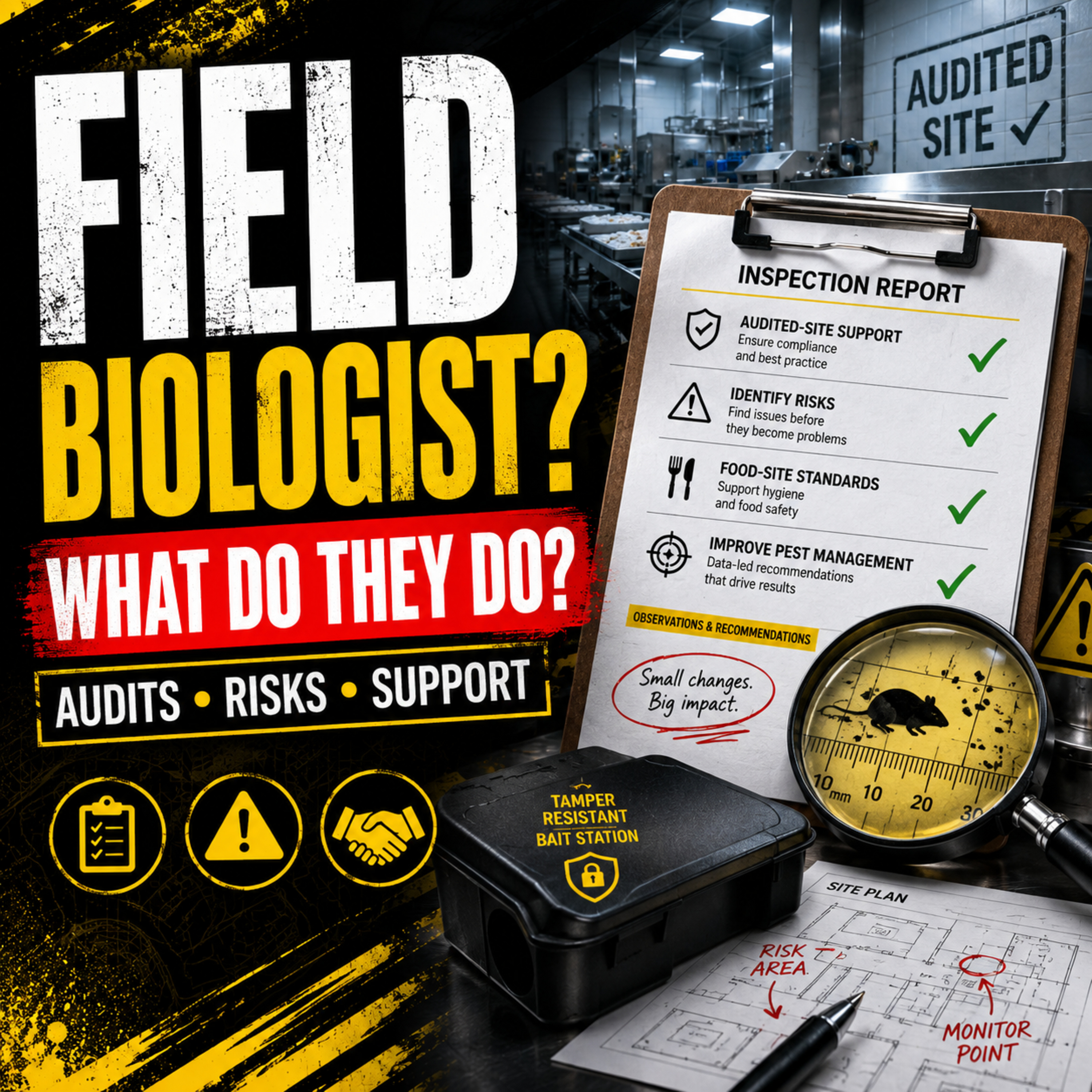
 Amazon Music
 Apple Podcasts
 Audible
 Castbox
 Castro
 Deezer
 Goodpods
 Moon FM
 Overcast
 Pocket Casts
 Podbean
 Podcast Addict
 Podcast Republic
 Spotify
 YouTube