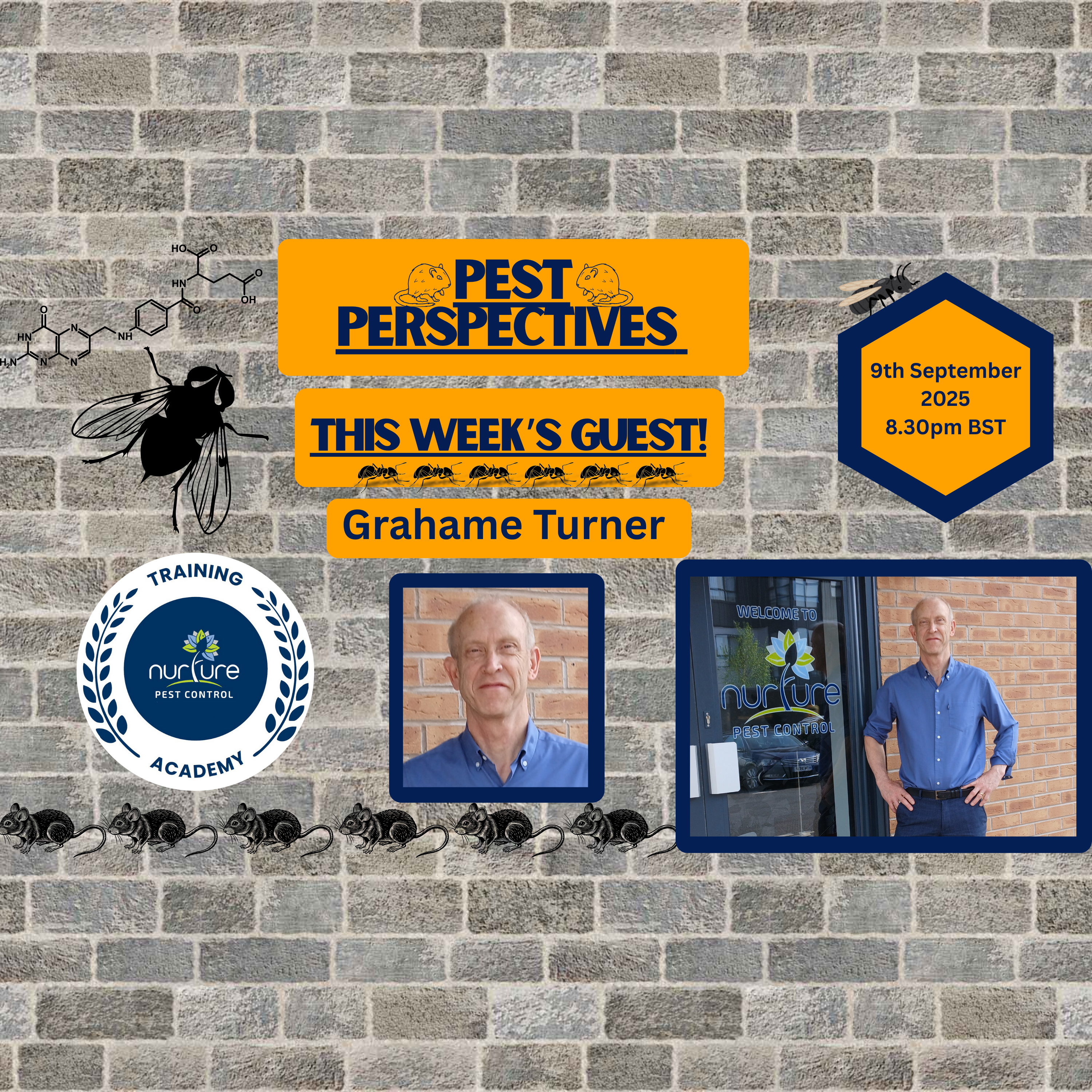
Pest Control Training: Raising Technician Standards & Continuous Learning | Grahame Turner
Tonight's Episode
Pest Control Training: Raising Technician Standards & Continuous Learning | Grahame TurnerPest Perspectives EP 31 – Grahame Turner: Nurture pest control academy
In this inspiring episode, Shaun Muller sits down with industry veteran Grahame Turner, former National Pest Technicians Association (NPTA) Grahame reflects on his decades of experience supporting UK pest technicians and shares why he moved to work for Nurture pest control academy.
Its focused on practical, technician-first training. From the importance of continuous learning to the challenges of regulation and public perception, this episode is a must-listen for anyone serious about raising standards in pest control. Expect honest insights, personal reflections, and a clear vision for the future of industry education.
Register you're CPD with The British Pest Register
Hello and welcome to Pest Perspectives episode #31 this week we have on Graham Turner, the Chair Pest control. Have I got it right, Graham? Not quite nurture pest. Control, nurture. Done it again. Goodness sake. OK, I've done it again. There we go. I was practising before and I messed it up live. I thought. I don't know why I have such a problem with it. How are you doing anyway? I'm doing very good. Thank you. Just busy as always, but most have been in some time for you Sean. Thanks for that. We booked, we booked it quite a while ago, didn't we?
Because I it was about two or. Three months ago, actually, yeah. I'll be honest. I'll forget about it by then, but. Yeah, it always. Comes around, doesn't it? I'll be honest, I've booked up till mid-december now so I'm quite booked up the podcast I am this week. I've got two. I've got 2 podcasts this week so I have got to go for Girl on Tomorrow as well from America. But yeah, I enjoy doing it and people seem to enjoy listening so it helps everyone learn. The idea is people learn, if they learn something then job done.
It is really learn. Something, aren't you? That's right. Exactly. So Graham, how did you get in to Pest? Now hang on, sorry. Do you want to give people a brief run through of who you are and what you do and where you've been? That might take a little bit though. I'll give it a brief version. I don't know if I can do it briefly, but where have I come from? I suppose I sort of, I had holiday jobs when I was at school of working on farms and that got me interested in in sort of animals and the pests.
I remember 1 school summer holiday is actually squeezing the wobble flies out of the backs of cattle, which is a bit of a strange, strange job. But that's one thing we did. Obviously those cattle pelts weren't really good, but I've had big holes in them. But anyway, so yeah, I was intrigued with with wildlife from that age. And, and then when I went to university for my first degree, I studied what was called applied zoology, but it was basically pest control because it was, it was zoology applied to agriculture and to medicine.
So we looked at pests of agriculture and pests of people. So lots of. So we covered things like, you know, mosquitoes and malaria and that sort of thing, as well as agricultural pests. And I liked it so much that. Yeah, yeah. Part of that undergraduate degree was I was doing an insect collection. So, you know, even back then I had to collect insects and identify them, go run through keys, see what they were, catalogue them. And so that got me more fascinated in insects. And then I decided to specialise in that for my masters and did an insect control masters.
OK, It wasn't, it wasn't public health insect control, it was horticultural. Actually I was, it was in connected with agriculture and horticulture. But I specialised in horticulture and then moved on to a bit of horticulture, you can call it after that, which is mushroom farming. But the thing that intrigued me most with the mushroom farming was the massive infestations we sometimes got of forward flies in the compost and Sierra flies or fungus gnats in the mushrooms. So both of those were in were intriguing and I didn't like the repetition of mushroom farming.
It was the same thing each week. We'd fill one growing cell with compost, we'd take compost out of another one, and we'd harvest mushrooms and another one. Whatever. So soon got boring, soon got boring. I moved on from that to working for the Welcome Foundation, actually doing research. And I was, so I was doing my main project there. It was only a temporary contract. Well, somebody was on maternity leave. My main project there was to develop a vegetarian diet for mosquitoes because they had a this, this branch of Welcome was, was testing all sorts of new insecticide products on different insects to see how well they worked.
So we've had colonies of house flies and store point insects and cockroaches and all sorts and mosquitoes and the mosquitoes we have been breeding on, on Guinea pigs. So you'd, you'd put a Guinea pig on top of their cage to feed them. And we used to use the Guinea pigs repetitively. It wasn't, you know, they didn't seem to notice. It didn't seem to be a problem for them. But the Home Office brought out a new regulation that we could only use them once because that was cancer as an experiment. And then we had to kill them and use another one for the next.
Few, but I'll tell my kids they love Guinea pigs. So that's kind of been expensive on Guinea pigs and and we didn't feel it was it was right. So I developed a vegetarian diet to keep the mosquitoes happy. It was a mixture of a baby food formula and lots of different amino acids and that sort of thing and that and that kept the mosquito colony going without having to use Guinea pigs. So that was that was a useful project. Then I decided that I fancied working in pest control, having been working.
So I was helping them breed the store put insects there and the housewives and the cockroaches. And then I got a job with what was national pest Control and they then became National Britannia, who became Ecolab. So it was. It was. Oh, OK, right. It was National Pest Control, a national company when I was working for them. So worked for them for a while and then saw a job advertised in ADAS where they were looking for somebody to do consultancy on pest control but also do the the phytosanitary inspections at the docks of the the grain going for export to look for store point insects in them.
That was interesting. Was it, was there any, was it quite interesting any, any funny stories involved in that or interesting stories? Not particularly funny stories. It was, you know, I remember even back then we, we were issued with Air Airstream helmets. So you know, grain and the dust from grain and insects, whatever it's, it's a hazardous environment. So we have to wear masks. And back then it was, it was Airstream, how much we were issued with because they're a lot more comfortable because we were spending a fair bit of time in the, in amongst all the dust.
And we were there with with Igrocs, you did regular spraying of the grain as it was going on the conveyor. So, yeah, all, all interesting work. But what I enjoyed most there was the we did a lot of training on the pest control industry. So Adas, I don't know if you've heard of somebody called Ed Allen. I work with him, with Jeff Sanderson, Kerry Coombs, a lot of people who very talented in, in pest control and together we, we did a lot of training of the pest control industry and we actually wrote the original, what's now the British press manual.
It was a dash, it was used to be the a dash manual. So it was written by a Dash consultants. I've got a really old old manual. It's it's like one of them, but it's like pages. It's like a folder. My dad got hold of it. It's a that That might be it, if I can find it on it that. Might be one of the originals. I have to look it out because he got hold of it. I don't know how he got hold of it, but give it to me. Let's see if I can find it. It might be that one. It might. Be changed since then, yeah.
Yeah, they have. Yeah, because I read it. Then I've done my RSPH Level 2 awarding press management and a lot have changed. Absolutely it does. It needs to be regularly updated. So yeah. So the BPCA bought it. I have worked on it since actually because I I I rewrote the the Bird chapter back in 2012. OK, very nice. I did. I did have my name in it for a while, but they then decided to remove it for some reason, along with all the other contributors and just had just that Adrian Mayer and and Ed Allen and and Karen So So I don't get recognition for it now.
I did. I did ask actually about. I will. Get this clip. Don't worry, I'll get your recognition for you. Don't worry, I. Did ask about four or five months ago if my name can go back in but they've been having an hour ring and haven't made a decision as yet. OK. I'm not quite sure why it's quite such a hard decision, but there we go.
Yeah. So that was, oh gosh, where did we get to? We got to work. I then I then saw a job advertised with what was called network pest Control systems and which was the manufacturers and distributors of bird proofing equipment. So went to work as their technical manager designing products for them. I went through the whole range of products that they already had and improved them and came out with new ones. So invented things like the Avishock electric current. Very nice. I didn't know you're an inventor, Graham.
You're a dark horse. I did not know. Wow. That's cool. That's cool. Lots of, lots of the products are my design of the bird proofing products. So, so I worked for them for quite, quite a few years actually that you know, they were then bought up by PNR Systems that became Pelsis. Then I moved on to what was Mighty. Heard of Mighty a lot. Mighty, we're getting a bit more recent now. Mighty became Terminix after what Rent to Kill bought Mighty, but the Competition and Markets Authority said no, you can't keep, you know, kind of the biggest company buying the third biggest company.
So I'll just put you back up. So they became Terminix, and Terminix has now become Virgo. Terminix is gone. Yeah, Terminix is gone. Well, not in America, but. Has has in the UK. Yeah, because in America it's called Rent to kill Terminix, isn't it? Or Terminix rent to kill 1 and 2. So Rent to Kill bought Terminix in the UK, but Terminix bought Red to kill in America, I think. Is that way around. Yeah. So I, I moved on from there to set up my own consultancy called Pesticuity, which I did for a couple of years doing mostly field biologist visits and it's obviously to the food industry on pest control.
And then I moved on from there to the MPTA and I was with the MPTA for a couple of years, took 2 1/4 years before moving on to nurture this cycle. So that's a pot of history. It's a long career in pest control that seems from many different angles. You definitely have. It's, you've worked for a lot, a lot of different companies. I thought I didn't know how long you're with the MPGA for. I thought you're with them for a lot longer than than than that or I I didn't know how long you've been there.
2 1/4 years I took her from John Hope. When John Hope decides to even set up his own training consultancy. They've advertised for replacement and I moved in then. So that was January. 2 1/2 years ago now. OK, OK, see, I didn't know how long you were there for because I, you know, I thought it was a lot longer, but. We did a lot in that time. Oh, you did. So yeah, we sort of changed the accreditation process to make that more stringent and more beneficial for members, introduced a lot more training, interesting courses, so, you know, focused on things like some of the health and safety aspects and the science of insecticides and that sort of thing.
So yeah, moved on from from what it was previously and it's even, it's moved on so much more now that Kevin's there as well. Yeah, the particular new board to keep suggesting stuff, but. The new board, like yourself, helps as well. Absolutely. Yeah, but no, it's been a it's been literally you don't have to have a board meeting to get something to happen. You can suggest it, certain people like it and it happened. It's like the new CPD quit is each month. That was me by the. Way. Suggesting it, suggesting it.
And that's happening every month. Each technical trainer is going to make at least one CPD quiz a month so the content can be built up, built up for members. So there's nothing new I'm sure, but it's just content for the website for Pepper members to log in and just do some CPD. Well, you can, you know, a quiz. You can learn quite a bit quite quickly because, you know, you have a question and you think, well, I don't know the answer to that. I'll look that one up. These quizzes have got videos, though.
They've got videos accompanying videos. They're kind of like how you did the Crew ones for the MPTA, kind of like that. Yeah, so you get a video with the answers 1st and then you and then you try and remember them for the quiz. Well, you see if you can remember them. I haven't done the new ones yet, even though I should have done because I said, you know, but but yeah, so well, with your well, there's so much I could ask you really, isn't it? So obviously you're a technical trainer. What's your best ways?
Because obviously learning is like, because some people learn in different ways. What's your favourite way to teach people? What do you, which way do you think the best way is to teach people? Obviously. Face to face, obviously. Absolutely. I I find. Well, I find doing, doing training via Zoom or, or the likes, I find incredibly tedious because you're not getting the proper signals back from the audience. You know, quite often they're turning the cameras off and it's, I find it tedious for myself and I find they don't learn so much that they're not, they're not quite receptive to the learning.
It's so much better in a classroom. And so I will do training wherever I can. Do you do that and you knew in Surrey, do you do that and your new role, is it all in house? It's not online in a new role. Is that all? Well, we have to do somethings online because we're a national company. Oh yeah, we can't be. Travelling everywhere, but we do do a lot of face to face. I've certainly made sure of that. So for example, we're having meetings with all our staff that originally every quarter so that we, you know, we have a sort of day with them so that we can teach them some new things, do a bit of health and safety and and also cover a bit on other aspects while we're there on state of service and that sort of thing.
So yeah, I do think it's important for for people to meet face to face, especially when they're out on the road on their own all the time. It is important to to meet up, not just to here training or watch training whatever or participate in training, but also to talk with each other because you can learn a fair bit just from speaking with other pest controllers. You can, it's like obviously I, I do work with my dad so it's not as lonely, but I do speak to a lot of technicians that are on the road by themselves.
I speak, I've become friends. So I'm going to meet some of them, some of them actually at Pestech this year and it's. A good place to meet people. It is. I'll meet you as well. Say hello. I didn't get to see you last year. Bye. I was busy in the doing the the seminars for the whole day last year. I came down at about 4:00 and yeah, that was sort of the end of the day, really. Yeah, we've thought it's something I've sorted something different out for this year. We're sorting the rota out so people can rote around because obviously I'm I've that's a massive learning curve.
Hashtag as you, you've been through it all, you know, it's like, but it's not like I thought it's a lot harder to put together life, I thought, but it's fun. It is. But yeah, we're going to do a rota so someone's not stuck in a room all day long and it's going to be rotors around. So if people get a chance to do different things and have a look around and network with people rather than being stuck in one place, so. Well, I think the excellent thing this year is the is the cafe is going to make a big difference.
That'll be a good networking place and to get sponsorship from different pest control companies and they like to to help pay for your free coffee and things that that sounds excellent to me. It was. Yeah. And one of the sponsors was, wasn't it? Wasn't it? Who? The chore. Nurture, you might get it right eventually.
Yeah, we're actually going to take some but. But because we've got a big department that does house plants and likes as well. We're going to take a, some house plants along to, to put around the cafe area. And we're also taking a, a bug shelter with which is a place for silver likes of Mason bees, solitary bees to, to, to make nesting. But, but one of our divisions makes a lot of those with different companies around the country for their, for their name signs outside the, the company offices and the like.
We're going to take one of those along. That'd be good to have a look at. I will, absolutely. I'll come by. Oh, here, you've got a stand. Is that right as well? We have a stand as well, absolutely. Yeah, that's to, that's to promote our training and and maybe to, to do some recruiting as well because we're a massively expanding company. We're we're, we're taking our new contracts right, left in the centre. So we might get some interest in people joining us at the. You might do, it's a lot of people go usually well over 1000 people.
So you you might get some interest there. You might. Yeah. But, but my main role in nurture is, is as the training Academy manager. So, so we're, we're, we're working on RSPH level 2. We've had quite a few external candidates. So we're not just doing for our own company, we're doing for external candidates as well. Yeah, because the MPTA them advertise it through through yourselves. They do as a course people can do. Absolutely, Yeah. It's on the MPTA website for people to do RSPH level 2 training.
We're also starting doing RSPH Level 3 training for anybody and this is relatively new and would be of interest to some people. Is that a nurture offering field biologist training? But also the MPTA have developed a certified Field Biologist qualification. And so you can now do the certified field ball of disqualification from from two different. Providers. OK. I didn't know about that qualification. No, that is, that is news. There you go. Yeah. So there is now an NPTA certified field ball of disqualification.
It's not quite exactly the same as the BPCA one. It's it's in my view. I'm, I've never done one of them before, but it sounds interesting. It's good to have a different one because I think I might be wrong. You might get people that have got the BPCO version want to do the MPTA version as well. You never know, you might want you. Never know. I can't quite imagine that, but I think I think there will certainly be a lot of interest in the MPTA one. It's, you know, it is a, it is a great qualification because you, you learn about insect identification, you learn about what's important to the bigger food manufacturers because that, in my view, that's the, that's the interesting pest control where you start to identify insect species and work out where they've come from and how to, how to do your well.
The best thing is to do to to make sure they don't become a problem. So that course sounds like, although it is a field biologist course, it could be very, very good for people that want to do work at food manufacture as well. In general, it could be absolutely. Yeah, absolutely. So, so the course I'm the course I'm offering it. Nurture is a is a 2 day course. It's not. You can take. Place it's, it's one day and then you go away and you have some homework to do and some practise your, your scientific names of insects and that sort of thing and come back and we have a second day.
And then the exam isn't held directly at the end. It's an MPTA exam. It's not a nurture exam. So that will be whenever the MPTA hold their exams and that will be that will be regionally in different locations. OK, yeah, that sounds good. I didn't. You knew more than me on that front. I've seen it. I've seen it in a document, let's put it that way. But I hadn't seen it talked about elsewhere. I hadn't yet. But you spilt the bees. That's some. Hot off the press. News for you? It definitely is, but I'm sure a lot of people will want to do it because it's sounds quite interesting.
It does, to be honest. Yeah, So I'm I'm slightly biassed, but certainly I think the training that Ioffer is is interesting. It's a big. I haven't actually done any in person training with you, but I was on a food manufacturing course on a on a zoom call once You did a good, you did a good job then, but I can't comment in person. I imagine it's even better. I would have thought, could you? MPA. Well, you're MPTA, you know you've been MPTA, so you must be gold standard. There you go. Absolutely.
I I I did enjoy working for the MPTA. I have to say great recommendation to work with. That's that's good to hear that is so with all your experience with obviously your you've done accreditation, you've worked through all the paperwork that actually probably know a lot of pest controllers, not always in line with what they should do. If you were he were to say somebody was to set up a pest control company, what would you say was some of the tips you could give to make make their job easier in regards to getting ahead?
If it's like compliance or your paperwork, is there any tips you could give to for somebody to get everything right on, you know, the, the, the, the early startings? I certainly. I think I think the biggest tip would be to join an organisation like the MBTA where you've got advice on the end of a phone, you've got lots of example documents to use, specimen documents. So you get a lot of support because if you're starting something new, well, you can never know everything in pest control. Even I don't know everything in pest control.
You know, people have been in it for a whole lifetime. They don't know, they could never know everything in pest control. So it's always useful to have somebody else to bounce things off. So I do recommend joining a trade association. I do think that's that, you know, the first thing anybody should do probably. And in terms of documentation, one thing I noticed a lot with seeing, you know, doing field biologist visits on all sorts of different companies and, and doing audits on companies is the thing that lets them down or one of the things that lets them down is their health and safety.
A lot of very poor safety documentation. I've heard of people saying cautious assessments. What I don't need to do that, Why do I need to do that? Or, or saying, you know, if somebody asked them for cost assessment, they just give them an MSDS sheet. Well, that's not a cost assessment. That's not a cost. You should have one in the full edition right of what you're supposed to. There's, there's a lot of lack of knowledge of those and there's a lack of knowledge of how to do risk assessments, I find so, and that's why I developed the course with the MPTA on, on basically risk assessments, crush assessments and safe systems at work.
And it's a, it's a whole day course. So it, it goes into a lot of detail on what a hazard is, what a, what a risk is and what a control measure is and, and basically how to do a risk assessment because it is something that so many people are naive on. And I've seen so many very poor documents. So I do think that is something critical. It's a legal requirement, OK, if there are fewer than five of you don't have to have them written down, but 5 or more you do. And I recommend you, you do for certainly for any more than one, you know, it's much better to write these down so that you, you know, what the, what the company policy is.
So I do recommend that. So that's one thing. And the other thing is to get your foot, your report format looking good so that that they're so that when you write reports, they're clear, they're concise, that the client can see exactly what you're recommending. So, so that format is good. And there are, there are lots of different software options these days. So although it's not my, it's not my Forte to say, you know what the benefits of each system are. I would look around at those and start with a, a software system straight away probably rather than than handheld forms.
Those are the those are the things that have passed, really. That's funny you should you use, do you use handwritten ones? Funny you should say that because I had a chat with Paul, Paul Westgate was on there and then he'd tell us telling me that although it's good, he was saying he does obviously audits on food manufacturing and he reckons that food manufacturers don't generally like digital, they love paperwork because he says sometimes you can't get access to the computer and they'd rather have it physically in the big folder of paperwork.
He said that food, a lot of food manufacturers don't like digital. That's what he was saying. In his experience, they've had no end of problems with with digital systems they have. They they do like folders, but I think you're fine. They'll prefer it if the report was was typed. So it's been done on a digital system and they just print it out. That that is that is what they would prefer. They don't want to see handwritten ones. That is in my view, that's something of the past. And especially when you know people's handwriting is, is barely legible.
Fine. If you're just doing a domestic, that's. Probably what he meant, but he meant you don't like paperwork, so it's all in the folder. Maybe that's what I mean. Print it off. That's what you probably meant. Is what they would normally do. Yeah, absolutely. So, and that's to your question. Sorry, sorry. Carry on. I was going to say it's, it's much better. It's written out clearly. And so you've got your your findings, your recommendations, your actions and all prioritised so you can see exactly what what he's doing or the client can see exactly what he's doing.
And As for your question, do you do you think I use paper or digital? I think you'll be digital. We are now we we were hard before. We were pen and paper, diary paper. But we last tech we went and seen the team at well loads of them. My dad decided because he's the boss he is, we were going to go with the powered now system. So we use that now. We do. And we started rolling it out in February because it took us a long time to get used to it because we're just not used to it. But now, but dad loves it.
We love it. It's so much easier. And we've just, we've, we've just just transitioned the last customer to digital because what happened was he wasn't reading the treatment report. I was writing in the recommendations if you as well, if you'd like to go digital because we are now, please e-mail your because I didn't have the guy's e-mail address. I had the phone number and in the air he says, I'm so sorry. I only read the top of the sheet. I don't read. I don't read it all. I eventually got him onto digital so I'm hoping he reads all of it now.
Let's. Let's hope so, yeah. It's not a food compliance place. It's just a, you know, it's very small contract. But he was the last one to go over to digital. And what we found was because the reason, one of the stipulation was that oh, well, people won't want to do it. People won't want to do it. They won't give me e-mail address. And what we found was everyone was loving it. They were like, oh, I think this is great. And he couldn't believe it. He said everyone was handing over their e-mail address left and right.
He says he thought it was excellent. I said, oh, it worked, didn't it? So. That's the way people are these days. They it needs to be emailed to them, otherwise it gets lost. You get something on on paper, you know? I can actually hand some an invoice to somebody in their hand and they will still say I lost it with this. It's on the portal so they can redownload it or look at it whenever they want. They can. But what I like about the, the, the digital reports is that A, you can put photographs in so you can show exactly what the what issues are, what you know you're wanting them to do, and B, you can colour it so you can have rag ratings within the report.
They can easily see what the most important things are to do. Because what you don't want is a whole load of recommendations in there and it just seems a bit mind boggling to them. You've got to give them something to focus on, tell them what the priorities are and and that will help get the partnership going, help them decide what to do first, etcetera. Well, our system has been updated now to an extended pest control report because it was a little report and now it's up to 50 different reports you can put in it like.
So it's really, really big now because people are complaining there wasn't enough pages in there, as in recommendations, it weren't enough. And well, they've upgraded, they've done what the people wanted to be fair. So it's a work in progress. It is. So what Also what would you would you say it's the future of the industry then Graham, what would you say apart from everyone going digital, what would you say is in the in the in the future of the industry the next five years? Say what? What can you see coming?
I, I think are for it to be cynical, I could say, well, we're going to lose all the poisons. We're going back to just having dogs and ferrets and cats to do our pest control. Don't. Push it into existence.
I was absolutely gobsmacked that glue boards were stopped because that was, in my view, if they're properly used, one of the most humane methods. Much more humane than using poisons where they go off in pain to die in a corner. So I was surprised that that glue boards were stopped and I wouldn't be surprised if they if they get reintroduced if they're if we're allowed to use them again at some point, but only as professionals. I think the key thing is to is to stop amateurs using the products. They called me.
It's a lot of people buying them from abroad and selling them as different things. That's the problem. Find them from abroad. Do they? They're on the Internet here and. Insect, Insect traps, Graham They're massive, though, like rat boards, but you know, for insect, they're for insects. I think it's Scotland, they're planning on banning the sale of them as well, but whether they get whether they can still get through by being called insect traps, I don't know. That'll be an interesting one to see.
In terms of the anticoagulants, I think we're going to get more stricter controls as it were on on using them. So we've had, we have the 2 updates to the stewardship. Now if we see the levels of residues in, in Barnells stubbornly stay as high as they are, I think we'll need to possibly introduce further requirements. So one thing I had hoped with the, with the new qualification framework, I had hoped that we could persuade the, the BPCA who are, who are leading that qualification framework review to split the insect and the, OR the invertebrate, I should say, and the rodent qualification so that you could have a Level 3 for insects and Level 3 for rodents.
And I think that would have been useful for two things. One, to have a separate Level 3 qualification for rodents would mean the people who now are stuck at level 2 safe use to identicize because they only do rodent control, They would have something else to move on to. And I do know people who do that. Their only work on farms, they only do rodent control. And so all they've got is level 2 safe use to identicize. So I think it's a bit short sighted on that front. And the other one that I think would have been really useful is I think we're going to have to get even more stringent in the use of anticoagulants in particular, but generally rodenticides.
And if you had a Level 3 rodent control and then that would give something else for crew to say, look, now we're going to change it from you have to do a safe user identicize to use. And the cracklins, if you're using them for, you know that that safe use for denticide certificate might only be valid for, I don't know, six months, 12 months or something. And after that, if you want to continue using them, you could have had to use Level 3. But with it being only one qualification with the Bridge Brits as well, it's a bit of a shame because crew can't specify that now they'll have to come out with another qualification.
I get Level 3 which gets confusing again. But anyway, that's that's where we are so. Well, they're in the survey, ain't they? A consultation about anticoagulants at the minute and I'm hoping that the trade bodies fight HSC off enough because to have only Calico cipheral. But what I'm saying is if we just have like I'm saying it wrong, I know it Calico Cipheral would be because you know, you have in domestic situations, it's very high risk to be used because of pets. It is, although it's good for the what environment, there is that risk to pets as well.
And we've also got to put that in there and it's higher costs. And although there's risk factors and also all sorts, it will be devastating to lose them all. You need, you need different tools for different jobs. Absolutely the curly Castor has its place. It's great that it doesn't cause secondary poisoning. It's great there's no resistance to it. But you're, you're right, big worry primary poisoning and some dogs have died already. So you have to be very careful using it where there are dogs. And certainly it's something that that nurture we don't do.
We don't. If there's a risk of dogs getting it. We obviously don't use curly Castor for all. We have to use the the anti coagulants in those scenarios. All traps or whatever you want to do. Yeah, as we know, traps won't work in every situation. So, but at the moment there's no alternative to the anti coagulants in my view. So I think what the what both trade associations are doing is is spot on. Is, is, is getting member support to go back to the to go back to the government and say, look, we just can't lose these.
We'll lose we'll we'll lose the ability to control rodents if we. Lose it would be like it would be like imagine if we lost them. Could you imagine the, the, the rat populations in in this country? It would skyrocket upwards. It really would it would become drastically bad. I I believe I might be wrong, but I think we're not at all. But now what you'll get is, is pest control will go domestic. Everybody will just have to go out and buy their own glue boards, which this can still do with because they're not, they're not doing it freshly.
And they can go out and buy the glue boards and stick them down, can't they? Off the Internet? So. I can't see them doing anything to it because they've already mentioned HSC. Don't want to remove the use I'm. Pretty confident. What I mean is the the reason HSC don't want the public to stop buying it in small doses, it's because they believe there should be an alternate, a cheaper version of people doing their own pest control. So if they remove them, they've got to remove the domestic market stuff too.
So I can't see that them doing it. But I'm not in charge. I don't know but. We have to have an alternative to curly cast it right? It's a great product, but we do need an alternative in some situations. So yeah, I can't see them stopping it. I, I highly agree with that. I back that statement 100% and I hope that I know, I know the trade bodies. I know, I know the trade bodies. We fight in their corner because we don't want another glue board situation. We don't we as many people to fill in as many surveys as they can to help get the most data to destroy them.
Yeah, I'm not sure where the BP share up with with this, but I know NPTA have sent out a survey for members to complete and and not members. So you can get, you can fill in that survey and every, every vote as it were counts. So it's it's 17 questions which are really relatively straightforward as to with all the different materials. I want to point out with that survey people has been a little bit of kick off about the way the questions are worded. Now there's a reason for it. When you see the final report that gets sent out, it's to put the data in.
It's the the questions are there's a method in the madness. So just try and answer the questions as good as you can. There is a because a few people have mentioned the way they're worded and it's to get the data to put in with all the information that they've collected. And it it does look, it will look good. It's just some of the questions people felt that there should be a box where you can write your version of events in it and all sorts. But it's it's worthy for that way for a reason. It is.
So please spell it out. It's going to allow analysis of the of the answers and so I'll be able to be be formulated into that response that's needed to go to Defra. Absolutely. But you're on the technical committee, ain't you? I'm on the technical committee. I'm on which technical committee you referred to. I'm on the I'm on various committees. I'm on the the crew working group for best practise. I'm on the Pest Control Training and Education Forum group. I'm on the Qualification Framework working group I'm on.
And PTA technical committee. Well, yeah, I suppose you could say that as a director. Oh, you are as well. Oh, I thought you were on then the technical committee. That was all. And PTA. I think I probably have. You probably are. Yeah, Yeah, you are. But yeah, no, it's. So what's your favourite pest then? Graham, you've got a favourite. Pest that would have to be microbia roofopes. I'm probably saying it different from. It's that. It's that the Latin way of saying it? Funny you should say that, yes?
Because I have no idea what you're talking about. It's. It's a little beetle and it's, it's a meat eating beetle and it's incredibly bright colours. So it's sort of vivid, sort of greeny and and red Sheens that. Yeah, it is a it's a beautiful looking beetle. So that, that one in terms of looks, though not particularly nice in the fact that it's associated with, with carcasses and that sort of thing with meat. But yeah, I find any insects fascinating really. So I don't like that, I suppose. I don't like the smell of cockroaches so much.
I don't like being bitten by bed bugs. There's good reasons. Have you ever been? Have you ever been bitten by bed bugs though? I haven't, no. I haven't either. I must admit, when I go to, you know, some people say every time they go to hotels or whatever, they'll look under the mattress and behind the headboard and whatever. I can arrange it. Just give. Just give Doctor Richard Naylor a call. I'm sure he could. He could. He could sort it out for you. No, I don't think for that. But yeah, I never bother looking.
But I think I I did one LinkedIn post this year on on mosquito bites because I've had a lot of mosquito bites this year. In England. In England? Yeah. In England. Never seen them. Have we got ever? Seen them in England? I've never really noticed them. Wow, OK. They're not. They're not Dean depressed though, are they Here? Yeah, you could say they're a pest. But the people do. I mean, I might be sounding stupid now. Do people do mosquito treatments in this country? Yes. I did. I didn't know that.
Honestly, I've never had anyone talk about it like mosquito treatments ever. It ever come up. I haven't. It's not, it's. Not a, it's not a particularly big thing. We had, we had an invasion, what we call it an invasion. We certainly had some, some mosquitoes of the which ones was it the Asian tiger mosquitoes? I think it was a couple of years ago, the one down in Kent where there was a, there was a scare of those that there was an infestation for one. But we managed to managed to solve it. But, but mosquitoes are breeding in various places.
So people will use, they typically use something on the surface of the water. It's going to stop them breathing or it's going to is going to kill off the larvae basically. But I've seen them, I've seen them breeding up in the north of the UK, have been there for a while, but they're going to be coming more of a problem with global warming. When I need to look into this, I am. I'm not happy. I didn't know, I'm going to look into this. So yeah, we've I live right down South now obviously I live which is which is the main reason I switched from MBTA to nurture was the fact that the office is about 5 minutes bike ride from my house.
Oh wow, fair enough. Yeah, cycling and. You've got to come down to Nottingham, long drive to Nottingham. Well I've been 21 years working from home so it was nice to have a change and go into an office and and see real people. Yeah. I mean, yeah, I did go up to Nottingham, but it was a bit of a track every couple of months or so. I've been once on my first MPTA meeting, I went up to, I went up quite at the tour, Yeah, excellent. I'll probably go back up at some point, but I do most of it remote now.
The meetings I do, yeah, I'm not that far. I'm an hour an hour and a half from from there, so I'm not that far.
So, so yeah, we're, we're you know, I'm right down the South Coast and we're obviously a little bit warmer here than elsewhere, but they've been a regular thing. Even even last night I was buzzed by mosquitoes. I managed not to get bitten last night, but you know, you hear that buzzing just going around your head at night time. It's, it's a horrible. Thing. How do you say that though? I've got a flytrap, right? And I actually put it into one of these IDID section things on your phone and it did say mosquito, but I thought, Nah, it's a false positive.
It's wrong. So you're telling me now that it might? It probably was, yes. I just thought that the app was wrong. I thought it kept saying it and saying it. I thought that's wrong. There's something going on there. We don't have some a few species of mosquito. In I'll be looking into it now, Graham, you've got you've got my, you've got my brain my my thinking. I didn't know no, no other pest controls ever talk about them in general about doing treatments or anything never comes up. So you don't. And obviously there are much bigger problem overseas where you have more diseases that are spread by them.
It scares you. Malaria. Malaria. Malaria, dengue, chikungunya and all sorts of things overseas. We haven't got the mosquitoes in the UK at the moment that will spread those. We have got mosquitoes that will spread West Nile virus and luckily we haven't had an outbreak of West Nile virus, but they've been outbreaks over in America. It's the same as disease. With deaths from it, yeah. So we've got mosquitoes that can carry that species that can carry that. From memory, I think we've got about 13 species of mosquito in the UK.
I can't be totally sure on that, but yeah, so we have got species, but what we do get is we get occasional ones coming in on aeroplanes. I know they, they're quite often sort of do treatments on aeroplanes to prevent them coming through. But you might get the odd ones coming through with people on, on planes sort of around airports. And certainly the ones that came to Kent, they they possibly came in, I don't know if they came in on vehicles off, you know, that came on ferries across the channel or something.
But that's but we could, you know, we could start getting more mosquitoes. OK, Well, I'll be looking into this now. I will be, absolutely. I will definitely will be. Who is once. Yeah, it's a quick no, sorry. Carry on. I was going to ask you another question about something else. I was. I was just, I was just going to carry on saying that we're getting more insects in the UK now. We will, I think the the yellow legged Hornet or Asian Hornet, whatever you like to call it, Vesper very Tina. I think that will become endemic at some point and that will be a thing that the pest controllers do, not just a unit.
I think within the next 12 to 24 months, I think they'll make defeat and say let us do it because we're more not being funny, but we're more qualified in what's Ness. And I know it's not the same, but it's the same method. I believe that they will hand it over because it's going to lose. They're going to lose control. They would have I think, but. I don't think that'll be down to their skill as pest controllers. My view is that they know what they're doing with getting rid of these Hornet nests.
They're, they're, they're obviously outside so that they've, they've been using Vulcan for a couple of years now. They they, they sort of spike into the nest and, and distribute the poison throughout the nest. They are very good at doing the control. So I wouldn't put them down on. I will say that though, but if you look at other countries that have lost control, they're following exactly what all the other countries did, and they all lost control. They did, but they're, they're doing the same thing, aren't they?
New Jersey lost control. South of France lost control. They all lost control, didn't they? And they're all doing the same thing. I don't know. I don't know that we would do it any different from how the National Union is currently doing it. To be fair, no, you're, you're right. To be fair, it's the same method, isn't it? So there's, there's no way you could do it any differently.
So yeah, I'm wrong. Sorry people, no it's not. That you're wrong, I think, but I do think you're right in the fact that that they'll lose control and it'll become an endemic pest that we have to that, you know, pest controllers are tasked with controlling. Be more problematic because it won't be as cheap as a wolf nest because some of these nests are like 8200 foot high ain't they? Like in trees and stuff. But quite a lot of them are quite high up, so you might get. High in trees, they have secondary nests as well, So and, and and the vicious animals.
So yeah, you need specialist equipment to to get high enough in the trees to do them, Yeah. They're not always on trees, sometimes they do end up in houses, but I've seen some videos and a lot of them are very, very high up. They are. But yeah, it'll be new pest for us at some point, Graham, I'm sure you'll want to have a go at taking down an Asian hornet's nest, won't you? Did you get European? Hornets up with you. This year probably fruited 4 nests, not a lot, yeah, not we don't generally get a lot.
1 year, few years back we got about 15 in a year and that's a lot that is. 15 European Hornets. That's good, but. That was the first. That was a few years ago though. That was they share property. For the rest there was nests. Hundreds. I think it's a bit in some ways a bit sad killing off European Hornets because that they, they don't generally harm us. It's only if you disturb a nest and the nest are generally out in the woods and that sort of thing. Problem is the nest. The nest where I've treated have always been right near the house.
As in endangered proximity, it has. They don't like to bother us, but if they do, they are they can pack a big a big punch because they're. They are like animals, aren't they? Because I don't I tell people they are like softly natured but they're not like a wolf who will fling for you unless you unless unless you attack a all its nest or attack a hole in general they won't go for. You the wolf, will they? Can they can, yeah. Did you see a lot of European Hornets in your neck of the woods then? We do, yeah.
So my next door neighbour had one this year. I've never been fortunate enough to have one. I did in 23, so last year I had. This year I had one wasp nest, last year I had none. The year before I had five in my house and garden. Did you treat it? Didn't treat any of them, no. If I get a wasp in the house, I put them outside. Oh, she just leave them alone. Yeah. What's next there? Sorry. Do you leave the wasp nest alone on your house? Yeah. What happens if it gets to the danger point where they're coming in your house and they're in the plaster board?
We get it done then if.
They're in a plaster board or something. Yeah. If they were bothering us, I would, but generally for me, they're a beneficial insect because they, they'll go and take the caterpillars off my cabbages and whatever else. I do a lot of vegetable growing and well a bit when I get time and and and they're a predator of of other insects, so. You're right, they are. They are. They are nature's pest control. I do know they are beneficial. I get enough people on my own post tell me they are to the public.
I'm always nice to people. I say I know they are. I just do it for public health reasons. But. If they're in the wrong place, yeah. Absolutely. Yeah, because I've got an awful coming on. At some point she wrote a book on Wasps. We I think it's a Beautiful World of Wasps. Serena Summers, Summoner. I'm probably saying it wrong. Yeah, she's coming on the podcast soon. She's like a wasp PhD in it, basically. Yeah, she wrote a book on it, but she's very clever in the Wasps department and she loves Wasps.
But she will come on the Pest Controllers podcast. It's been on the booties and Beasties last year. He's agreed to come on mine this year. To watch won't. It it will be for people it will seeing as everything's changed this year with regards to what you can use as I've only had a few callbacks this year so it's not been too bad for the change. We have had. Have you had callbacks in previous years? Has the rate of callbacks gone up a fraction? No, no, that's good. In general. I didn't really get many many with ICAM because of how good it was, but I've had a few with because I'm using at the minute deadline.
Pi does pro I am and so far it's so far I've had good results. Few of them I've had to go back, but I wouldn't say it's been tonnes. I'm using Deadline Pydus Pro. That's a natural purethrin that's far less harmful to the environment than than Ben Dyacarb was. So that's a that's a positive thing. But yeah, it's being a natural purethrin. It'll breakdown quickly in the environment. Yeah, it's, it's been all right so far. But then some people say it's crap, but I don't know. Some people saying yeah, it break, not many call back.
Some people saying oh it's rubbish, I suppose it's the way you applicate it. I don't know what to say, but it's been good so far. It has. The key thing do you do you aim to get into the nest? Yeah, I aim to get into the nest if I can. Obviously, obviously, obviously you can't always and 5050 whether it works, but a lot of the time it generally works. But but yeah, it's been an interesting year. But I don't moan about different chemicals. It's the way it is. We're going to have to get used to chemicals being removed and you're having to use other products.
It's just the way of life, the way of the pest control industry. There's no point whinging about it. It would have been nice if Vicam D stayed, well, stayed, stayed around for life, but it is what it is. It is move on and you and you adapt. You adapt, you adapt, you do. Over the years lots of much more harmful chemicals have gone by the wayside and I'm very thankful for it. You know, the likes of the, the organic phosphates that are highly, highly poisonous to people and we can't metabolise them at all.
So it's led to a lot of nerve poisoning of people, especially the likes of farmers. You've got chic dips on the, the skin, that sort of thing. So yeah, we've, I think generally it's a benefit to move on and use the, the less harmful products. I know we could metabolise Bendacar but it's still, I imagine it was it was withdrawn for reasons that it was a bit more toxic than other products. I think, I think they tried, they tried a few times for HSE to try and get it through and they just said if you try again, we're just not going to let it through.
Don't matter. This is what I heard on the Grapevine, that no matter how much money you spend on lawyers, you're not going to get it through. So I don't know if that's true or not. I don't know. I just hear hear rumours. But they decided not to proceed and just just remove it. There's no vicams left on the market now, is there? The Vicam W is gone, Vicam D is gone. There's no other vicams about, is there? There's. No other vicams though. That's it. The Vicam has gone from England. No more been done.
Yeah. So it doesn't amaze me. There are so many different synthetic peritroids and they all have, you know, they could be resistant to to 1 but not two others. It's amazing that, you know, we just got so many all so similar. But but where we can, I mean in in nurture, one of our main sort of reasons for being raised on d'etre ethos, whatever is that we try and do things as environmentally friendly as possible. So we're, you know, we're we'd go for like yourself, the natural perithrines where we can instead of going for the more toxic products.
And that's what we aim to do, as much non-toxic control as we can. Yeah, Yeah, it's a lot of bigger. No, because you're obviously a national company. They do. They do generally try and go the eco approach anyway, but I think in general a lot of pest controllers are trying to be if they can. More eco friendly if they can, but obviously the situations where you can't use that product and you've got to use something else. But it's case of they try to do their best, don't they? And if they you have to use a certain product, you have to use it.
It is the. Key thing is to avoid using products where you can. So you get your clients doing the proofing, doing the housekeeping as with you know that is that is the biggest issue often with press, isn't it? Is the is giving the the client to do their part, to play their part in it. Or to pay for the proofing to actually be done. A lot of them don't, but I'm not. I don't want to pay that. So it's not a lot you can do. I'm not the best salesman in the world, but I do try. I do. But yeah, I won't don't want to take any more time up.
I know you had about an hour tonight, but it's been, it's been good to have you on. It's good, been good to good to speak to you again. We will meet in person in November in at Pestech. We will. I shall definitely be at Pestech, absolutely so. I will be there for two days. I will be. I'm staying in hotel for two nights, so I'll be there. I'm doing the meals too. It's all new to me. It's all new to me. Never been to any of that. Before that's a very good networking event is going to the the PCN dinner.
Yeah, my wife's coming with me as well. Yes. Oh, right. Yeah, she'll be helping too. Yeah. We will. She'll be helping you say. Yeah, she'd be helping with because you know, Martin on the on the board, his wife helps as well at the paste. Sorry. Yeah, yeah, I, I thought you meant she'd be helping at the Pestech dinner at. The no no, not helping time I'm. Waiting to get the tables or something. No, no. I meant, I meant in the day at Pestech, sorry. Absolutely, yeah. It's good to have you on. Do you want to, do you want to plug the do you want to plug the Academy?
No. Yeah, if anybody's. Interested in in any aspect of training then the way I'm running the Nurture Training Academy is to offer training not just our own technicians, but to you know, we've got spare, spare seats at the table at any of our courses to to make him to make more more viable, more interesting. Then I'm inviting external people that whether that be to safe use for denticides. Level 2 in pest management, as it's currently called Level 3 in pest management and field biologist training.
So that the the Level 3 pest management. I think we've got three external people coming on our next course and the field bologist course I'm running in, in a few weeks time. I've got two external people coming on that. So yeah, it's, it's, it's open to all. If anybody wants them, wants to join us, then do get in touch. And it's not just held at at Ringwood, that's a great training venue, but held in other places such as the MPGA office at Nottingham. Yeah, they're starting to use that now. They are the office for training.
So what just just a quick one. So when you're not doing courses, actual courses, what do you, what do you do other kinds of training or do they have you got other roles you do as well or? It's, it's just training, just training a lot too. Training to develop a course is a lot of work. I do, I do other bits of training for other people. So it's not just internally. So for example, and I can't remember what it is about two weeks time I think it is I'm doing a presentation for the site of food hygiene technology on pest management for them.
I do the bits of work for the likes of high field training, so you. Still do work for them. Nice, yeah. So there's the, you know, I wrote the the pest control chapter in in hygiene for management, that book that, you know, the food industry uses a lot and hygiene supervisors. So I do bits of writing. I do training for for other people. I've been still do the odd field biologist visit. So last week I was up in, I did meetings for our guys up in Nottingham and Leeds and Newcastle. And while I was up in Newcastle I did a couple of theobiologist visits just to keep my hand in.
So yeah, it's, there's plenty to do. It's a, it's a growing company and there's, I can always help out with helping out, sort out policies, procedures as well as, as, as well as training. There's, there's, there's. I'm not going to get bored, put it that way. That's good to hear that's what you want. That is absolutely nurture, nurture, pest control. Is that correct? I've got it right. Yeah. Brilliant. I am sorry, Nurture, I'm terrible with names. I've got it in the end. Nurture Pest Control Academy and Nurture Pest Control.
I've got it. But people know I'm real. I don't mean to say it wrong. I don't. I say other names wrong as well when I'm not used to saying a certain name. But thanks for coming on, Graham. It's been great. Have to have you on. I really appreciate it. But thanks for watching everyone and we'll see you next week. But yeah, thanks Graham, and please share the show out, give the review on all the apps, Spotify, Apple podcast people. And thanks for Graham for giving up his time. It's been a it's been a good one.
So thank you. So if you say I'm putting the second grammar or in the stream, I will. Alright, thanks everyone. See you next week that way.
Sponsored by

 Amazon Music
 Apple Podcasts
 Audible
 Castbox
 Castro
 Deezer
 Goodpods
 Moon FM
 Overcast
 Pocket Casts
 Podbean
 Podcast Addict
 Podcast Republic
 Spotify
 YouTube