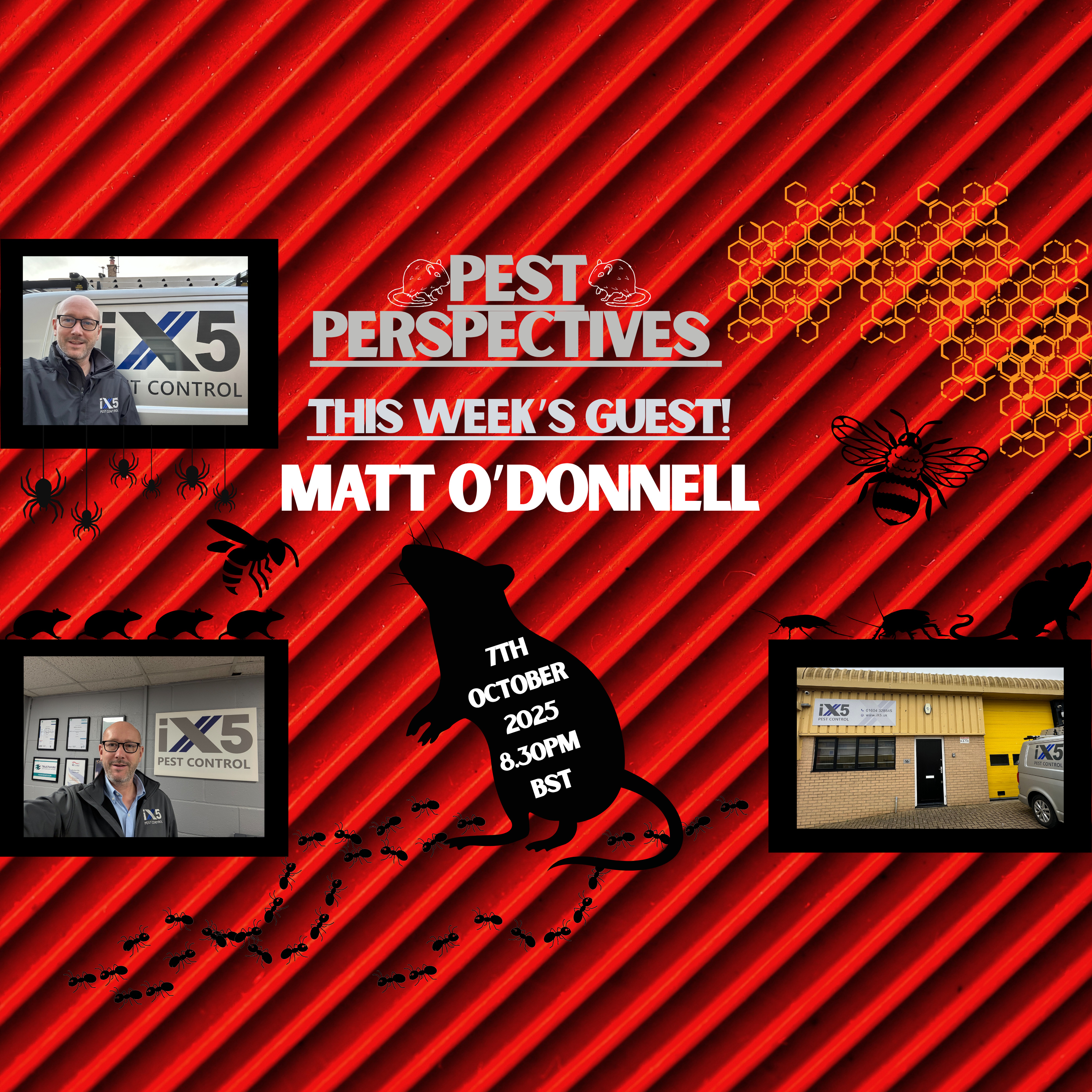
Bee Removal in Pest Control: Public Health, Relocation & Specialist Work | Matt O'Donnell
Tonight's Episode
Bee Removal in Pest Control: Public Health, Relocation & Specialist Work | Matt O'DonnellIn this episode of Pest Perspectives, we sit down with Matt O'Donnell founder of iX5 Pest Control and seasoned public health practitioner. Matt shares his journey from environmental health into pest management, revealing how his public sector roots shaped the values behind iX5. We dive into the full lifecycle of bee removal, from initial survey to safe relocation, and explore why continuous training and CPD are vital for technician growth and company excellence. Whether you're a solo operator or managing a team, this episode is packed with insights on professional development, ethical pest control, and building a business with purpose.
Register you're CPD with The British Pest Register
Hello, it's Perspectives episode 37. We are live direct. We've got it all sorted because I didn't know that Safari doesn't work with Stream Yard. But we got there, Matt, didn't we? We did last minute, but we got there. Yeah, thanks for agreeing to come. Come on, Matt, because I had someone pull out and I sent you a message and you, you, you, you answered the back hall. Bad signal. Yes, yeah, Well, I know we spoke a while ago about coming on, didn't we? We did, we did. So thank you so much. No thanks for agreeing This week.
We've got on Matt O'Donnell from IX5 Pest Control, another person who's technically kind of local to me over in Northampton this time. See, that's good to get people on that are local. Yes, yeah, I know. We've almost bumped into each other out and about. We have. We have. Near your area doing bee removals and things. Oh, no, most definitely. So how did you get into the pest management industry? Did you fall in or did you want to be in it straight away or? No, bit of a, well, I guess an indirect path really.
I mean my background. Many, many years ago, I used to work in hospitality, catering, that sort of thing. I thought I'd better do something a little bit more sensible after quite a few years in that. So I got myself caught as a chartered environmental health. Well, it was an environmental health practitioner, but our mental health officer spent many years working in local governments and then in around 20/17/2018 I, well many years ago, I used to run a small business. I ran a pub restaurant for a couple of years and around about 20/17/2018 I just fancied having a little sideline alongside my local government role.
And yeah, fancied running a small business again. And I was looking for the sort of thing I could run alongside my local government work and pest control seemed a a good fit. Just sort of there's a big demand evenings and weekends and things like that. Obviously I was working primarily as a local government officer, 9:00 to 5:00, Monday to Friday sort of. And yeah, just seemed a a good fit. So I sort of tested the water a little bit and yeah, sort of grown from there really. So I run the business part time alongside my full time local government job for a few years in 2022.
So 3 years ago I took the jump out of local government and went full time in the business and it's grown from there really. Oh, that's good to was was it was it taking that step from part time to full time? Was that jump little bit scary because you were you were you on? Did you build it up to a point where you've bought you'd be all right? Was it? Was it like that? I, I knew the business was in a position where it needed more of my time anyway. I for various reasons. I think I'd really seen enough of local government in Northamptonshire.
We all the councils merged into two, two large councils and knew when that on the cards. I never really wanted to be part of that because you become a smaller cog in a bigger machine. So I had the business as a sort of Plan B and I, I gave unitary a go. Didn't particularly like what I was seeing in local government. We've been through lots and things. Anyway, there were lots of changes and yeah, I really decided at that point that it was time to get out of local government and chance it going full time in in my own business.
Tested it, but yeah. That's fair play. Unilateral. We're Rutland's having that at the minute. We're not happy. No. But let's not get into politics. But it sounds like you went through it voluntarily. Well, they did it automatically. Sounds like yes it. Did he was on the verge of bankruptcy? Oh OK, so I haven't the. Answer was then the government gave gave him an option of going unitary with either well anywhere between 1:00 and 3:00 councils. Yeah. One and three not being an option. So really the the government was telling us that there'd got to be two unitary authorities in the county and it's sort of forced on us.
Yeah, enough. There. But no, it's a nice, it's a nice story. So with IX5, why IX 5? Well, number of reasons. At the time I hadn't realised BMW actually had a, an X5 because cars and vehicles don't bother me at all. So I, yeah, I really the main driver as well. I wanted something that stood out a little bit rather than say, I don't know, John Smith Pest Control or Countryside Pest Control or a lot of the generic type names out there. I wanted something that stood out the primary driver though. I wanted a very short web domain and a very short e-mail address.
Well, you tell you what, you've got it in one there. It's not I, I, I understand what you're saying because even with Oaken pest control, it is quite generic, whereas yours is IX5. It's it's different. It's almost like like, you know, when the big nationals go through or able go through and they put like Northampton Pest Control, Corby Pest Control, they can't do it, can they? They can't they. Can't. They can't. So it's good from that perspective, isn't it? It is. One thing I I did and I would recommend everybody does, as soon as I realised I I actually bought the web domain.
It was only afterwards that I realised shortly afterwards that I realised BMW had an X5 model and they were prototyping or or rolling out AIX 5 model. So OK. That, but they'd already trademarked IX5. So when I realised that I thought, right, I better get on this. So I actually trademarked IX5 Pest Control and for the same £700. I'd recommend anybody out there, doesn't matter what business you run, what you're doing, get your get your logo and your name trademarked. Are you done the right thing there?
You did, yeah. I bet you now there's not many people in pest control in, in UK that have done a trademark like like that in that, in that way. I guarantee that probably probably 2% of companies probably have and a lot of them will be the big boys as well. Yes, yeah. Well, I know there are at least a couple of companies that have identical names and two of them have very similar logos as well with the same name And dangerous territory because if one of you goes and gets trademarked before the other one.
Then there was a load. There was a load of football a while ago. Weren't they on the forums about two companies that went to court in the end? We won't mention it, but that situation would have stopped it, wouldn't it? Yes. Absolutely. If you've got it trademarked, you're protected. Well, you definitely are, you definitely are. So with obviously your background in I've looked it up, you've actually got, you've actually got a degree in what's it called? Where was it? I've got a yeah, I've got a undergrad degree in environmental health.
A charted into a charted environmental health practitioners with a master's degree in public health. Diploma done mate. Done a few qualifications in my time so I've got a undergrad degree in environmental health. Did you ever do AH Owen, did you ever go and food places is so that is that what you want? Yes. I spent around about 15 years or so in local government doing food hygiene inspections, health and safety inspections. We have the same powers as HSE inspectors. In local government, enforcement is split.
Different businesses are enforced by the local government or, or the HSE. OK, yeah. Used to private sector housing as well. So yeah, various things, public health work. But yeah, I spent a lot of time working in and with food businesses, which is a great grounding for pest control. Oh, it definitely is. I mean, well, you said local government. I didn't grasp that you were an EHO to start with. Yeah. So what was it like being an EHO? Were you the enemy? Because a lot of people I hear because some some of the places aren't obviously go to they're good.
But it's one of the one of the chefs says to me or when the H OS in the area, we all ring round each other to to let them know. Apparently the one round here when they turn up, they turn up to a load of them. They go not the same day. So I mean. They'll all have their own spectrum frequency for each, each different business here. Maybe you're in the same area, you you will go and inspect them the same day or whatever. But no, we used to try and Ehos do try and work with businesses. Ultimately, we're there to verify that the business is operating safely.
And. If they've got controls in place, they've got absolutely nothing to worry about. So a lot of businesses used to welcome our visits because it's reassurance they're doing all the right things. It was the forming businesses, all those that don't comply with what they're supposed to, that are the ones that may say you as a threat or the enemy or whatever else, but the role is to protect public health ultimately. So we're acting on public behalf. Really. Well, no, it definitely is. I mean, I've never, I've, I've never come across DHL on any of my visit.
So I had to, I had to, I think my dad had to speak to one once, but it was a disagreement between a place we do a contract for and the farmer, right. Farmer was moaning about rats on his land, but we were doing everything we were meant to be doing. But I think the farmer was trying to get us to help his side. And we wouldn't be allowed to now, because that would be deemed an open field. That would be and that that food business isn't his, isn't his building. So we wouldn't be allowed to do anything on that front.
But no, there was no, there was no issues because they, I don't know what he was after. He was trying to get something out of us, but he reported us to the HO and they come out and checked everything and they said that now they're doing a good job. Yeah. We're there to work with businesses, yes. Exactly. You can use if, if they're not doing what you what they should be or whatever else. But a good business will want to do the right things and will want to to work with you. Oh, no, it's definitely true.
Because it's like I said to most people, it says I, I put these recommendations down here. Whether you take them or not is, is not up to me. But I said if you, if you get an inspection, an EHO or auditor, because we do a task site as well. If you don't do the recommendations, it's on you because they'll be saying, well, he's wrote this down, why haven't you done it? I said it's not down to me, it's down to yourself. I can only recommend but it says they do read stuff like that. If I've recommended something, you don't do it, they'll they'll ask, they will.
And you'll absolutely, absolutely right there. The content that you put on your visit report is key, isn't it? All anticipation? Is this on hygiene or cleaning bins? Whatever it is, keeping areas tidy, whatever, it's all relevant. It's always mystified me about either ever. You can clear this up because you're in that field. Obviously you still do, of course. Isn't that for them when it comes to flying machines? You don't legally need a flying machine, do you? As in electronic fly killers. In, I mean in, in a food business because I've had them, but I I said to the customer you really need one.
But I says the EHO probably won't say anything because you haven't got a family problem. But when you've got a family problem, then it would be why haven't you got a flying machine? Is that correct? Yes, it's it's. Emily, it's a recommendation that have them or or fly screens or whatever else we could. We could only take enforcement action if we walked into a food business and they hadn't got one, for example, or they hadn't got fly screens and there's a family problem in there. But until that point, it's only a recommendation we can make.
So got it right then, because I said it's not a problem until it's a problem. Absolutely. Basically. Manage you in other ways, That's fine. Get a fly screen, keep the doors and windows closed, whatever it is. No, they won't. Do you know that when you go and they Chuck that back door open? Absolutely. They have got chains. To be fair, they have. But. But yeah, I just thought I'd ask you that one because I didn't know what the actual thing was on it because I don't. I do try and sell flying machines, but they never, they always buy these.
They've got they, they buy them 50 LB ones. I mean, we could buy a decent one, but then I'm not the best salesman in the world. So I try. I do a. Technique in itself isn't it selling. It is, they teach you to be a pest controller but they don't teach you how to sell unless you work for a big national and they usually teach you how to sell because they want to make more more upsells all the time they do. We should all be learning from that, shouldn't we? Yeah, exactly. It has been a thing I talked about on the beauties and beasties when it went on there.
But the dead animals episode and he mentioned how I got into it and because when I first got into pest control working with on my dad, I was terrible at talking to customers. I wasn't confident at all. And now I'm very confident. I am I'm. Well, in lots of areas, haven't you? Well, I try. I do. Yeah, I do. I'll try anyway. I do. Well, we can. We can. So. So when you built up to a level where you could give up your local government role, yeah. Was it just you on the tools? Was it just you yourself dealing with the whole business or did you have someone to to help you as well or?
It was just me, but at that point I decided that I was going to focus on business growth and growing reason, So I knew fairly quickly after that I was going to be bringing other people into the team. OK. Yeah. So very shortly after that I took on a commercial unit. So we've got Office Space warehouse and well there and everything that's. Pretty fast to be fair, that is to get to get a commercial premises that's pretty fast. So. Oh, The thing is, if, if you want to grow your business, you've got to get the foundations in place, haven't you?
And if I wanted to employ people, I had to have somewhere for them to, to be based. So somewhere for somebody to sit and do admin, somewhere to stall the kit and everything else. And I'd, I'd outgrown my storage capacity at home and I didn't really want people coming round to home sitting there working or whatever anyway. So I thought if I take on a commercial unit, we've got room to grow the business from there. So it's all about those foundations. Yeah, no, that's, that's fair. That is, I mean, obviously we haven't grown to the point, but we're basically all, it's me and my dad.
We're both family. But yeah, I'm, I might eventually grow. We'll have fully take over. I may grow it to a point where I need staff so that it might, that'd be different then. But yeah, that's a fair, fair. Isn't it business growth really intrigues me because we all have different perspectives on what we want from our businesses. Some people are happy just staying us up, so a one man band just earning a good salary from what they do. Other people want to grow and there's nothing wrong with any of it.
No, exactly. I mean, I obviously in my lifetime I would like to grow a bit, but I mean when I'm actually the head honcho proper, I know, I'm I know he says director and I most of what I said I say goes basically, but almost, almost. I got the website. I got the website you see. Really. You did? Yeah. Logo. Workwear AP Well, yeah. No, we had that already. We did, Yeah. No, we've had that for quite a long time. I just ordered some more stuff. I have, that's all. Yeah. No, no, we've had that for quite a while.
Because it it doesn't look right. If you wear normal clothes, you should wear something with a logo on then. Then you look professional. You do. You've got to get your branding out there. It's all about getting in people's face, isn't it, with your branding and everything. Oh, it definitely is. It's. Brand awareness. With that, they'll come to you when they need you. There, especially with that that smiley wasp on our van. Yeah. I'm surprised you've done, but you've seen it once, didn't you? You rang.
You rang the number. It was my dad. He got the photo. You're the wrong. Person you got through to the wrong person. I did. He don't he don't know anyone. My my dad says, oh, you want Sean? Probably he knows everyone. Yeah, but I did the same with Elliot last week. Elliot Moakes did you? I was heading into Leicester last Friday evening, driving out in his van. He was driving the other way, so I called him because I've been of contact with Elliot over the last few months. Yeah, other, other local pesties and everybody is there's enough business out there for all of us.
Oh, definitely get. On with everybody, really. I met him. I met him a month or two ago. I was on the roundabout going through Oakham and he was ringing me and I says I was, I was behind his van and I says do you want to meet? And he says, yeah, we'll pull into the, we'll pull into the Co-op car park and the metric down and all that. Yeah, it's a, it's a nice bloke is. Yes, yeah, he is. He's into the beat removals like yourself, he's. Started them now, hasn't he? Yeah, yeah, yeah. This year, I think, didn't he?
He say sorry. I think he started doing them this year, didn't he? What? This was his first year. I might be doing 1. No, I think he's been doing them a couple of years now. Yes, yeah, I think, I think. That's good strength of the business. Well, he did it because he told me because he looked for an area, which is what he said you should do in most businesses where you look for an area that other pest controllers ain't doing as. And then you, you do that and you can help. It helps. It helped him grow.
He's by himself, but it helped him give him a good, a good flow of work that where other pest controllers that don't do bee removal would recommend him. So that's kind of why he did it. Specialist areas, isn't it? It is, it is. So talking about bee removal, did you get into that? Were you like a beekeeper already or was it someone just fascinated you? Yeah, well, I I started keeping bees around probably just before I got into pest control, shortly and almost as soon as I started getting into pest control, I realised there was a big gap in the market around here.
There was nobody else doing it at that time. I started very early on. Yeah, yeah, that's, that's really how I got into it. So started keeping bees and then it was a a perfect adjunct to to the business. And really it's just grown a bit of a monster over the last few years. And it's year on year on year. We get far more inquiries and we can actually service to the point where we can't even keep up with enquiries on the phone and emails at peak season is goes out crazy. And that's pretty much without any sort of targeted advertising or anything.
So when you so when you overflow, do you try and pass the work over to someone else? No, I just can't do it all. No, I mean when you can't do it, did you do you? With with bee removals, some of the work falls away anyway. So you you'll get an initial inquiry from some panicking that they've got bees in the building and bees have just arrived or whatever. But within a day or two those bees might move on. They might disappear off out and might decide their that chimney or wherever they've moved into wasn't for them.
So an initial inquiry might drop away from that. It may be home owners don't consider it such a problem once to be settled in and stop causing chaos down in the habitable. Whatever some home owners choose to live with them, we've be removal work. We always try and set the scene for customers from the outset, from the initial first point of contact. We're trying to get the scene that getting bees out of buildings is major work and with that it is not cheap work. So obviously instantly that will rule some people out.
And we've actually got on a website about the prices of bee removals and things like that. This year we we've gone a bit bolder with our our pricing and stuff. Did that help stop people calling? The ones that can't probably couldn't afford it? Did that stop them ringing? I think we, we only did that. I did a blog and or an article web page quite late this B season really. So we haven't really gained much from that. But next year, hopefully we can point people to that initial point of contact or they'll go there first and it just sets the scene.
It's not, not to absolutely rule anybody out because we will always have a conversation with somebody and give them advice no matter whether they can afford to use us or or not. But with with B removals, there are big risks in it. There are lots of expenses in it scaffold and building, bringing in building team and reinstatement works and things like that. So there is a a fairly hefty price tag by comparison to routine day-to-day sort of pest control work. Definitely. Even even compared to a wasp nest.
Absolutely. So setting that scene at the outset, you can sort of philtre some people out, I suppose that know that they simply cannot or don't want to afford it. And gradually as you go through the process, we go and do a survey and we charge for a survey. We offset that. If they go ahead with work, we discount the cost of the survey off the final job just using the survey fee philtres some people out because if they don't want to or can't afford to pay for a survey, again, that sort of philtres out.
And I don't really not in a a crude way, but that sort of philtres more people out. So as you get you get further and further down the line, the work gradually drops away to a smaller proportion of good quality customers that we will work with to get bees out of their building. OK, No, I didn't. Yeah. I just wonder how it work because, you know, I remember some of the time everyone gets them. You know, when the bees start moving, you get cold saying I've got a what? I've got a wasp swarm. No, you ain't got a bee swarm.
Yes. And most of them I just say leave them they'll be fine. But as I said, if you need help I've because I don't I recommend, I recommend Elliot. I do I got him a lot of work this year. But I said like someone's a few people have rang recently but everyone stopped doing bees now. But it says they have. Yeah, and this is one of the issues that it's only when people want to start using their their fire, they suddenly remember, remember, Oh, I've got bees in the gym now. I need to get some sorted and it's too late really to get them out.
It is. It's but like, yeah, we sometimes get them where they go because we always put now on the app. We do. We put when we do wasp nests. If you're not sure, take a photo or video and send it to us. Because if we turn up and they are not wasp like you say, you'll be paying a call out fee and then I'll be late and I'll be leaving without doing any work because I don't. We don't, we don't do bees. We don't. That's fair enough. Because we will, we will. We will send it for free. If they send the pictures and videos, yeah, we will send it.
But if they say, oh, what? No, they're definitely Wasps. But we know our lesson. We did like more last year. We had a couple of them and I was like, you're joking. You thought the minute he said they're up there on that chimney, I thought it's please, they're please, mate, you know, So we changed it this year. So we made everyone aware that we're now charging because it it can just, it can cost you too much in wasted time. It's your time and your money and getting there, isn't it? And your expertise telling them what it is and.
Giving exactly know what, How did you know that? I said I know. I said I know what bees look like. I said bees. 99% of the time it is bees. He says if you look, I said send the customers a lot of time if you look at their legs, they have their legs and they hang down. Absolutely. And because sometimes when I can't see that great, what I do is get my phone out. I take a video and you listen to watch the video. And even if you cut, it's not the best quality. You can see the legs hanging down and that's when you know.
Yeah, it's one good way a drone is the other good way getting a drone up there. Yeah, I've not got one of them. It's it'd be, it'd be great for you because I know Martin, Martin Belcher who's on MPTA, he's, he's just been removals and he's, he's got one of them drones. Oh, they could. Yeah, he he sends me some videos sometimes some of his surveys he does. It looks cool. Honestly, it looks cool to use a drone. You can tell at ground level though, can't you? From the time of year, the activity, everything else, that they're bees.
You can. You can because I, I always make a joke with a lot of customers saying I think someone's been watching too much Disney. They laughed. More Winnie the Pooh, I said, because they make their bee look like a wasp, don't they? In colour, it's bright yellow, I says. I says, well, that's not a bee. They're quite dull in colour. They are. They always laugh when I bring up the Disney thing. They said, oh, you are right. I don't know if Disney still do that. I'm not going about Winnie the Pooh for many, many years ago.
But yeah, it's so with it. See I was due to have Clive on it. I had him on but I deleted the podcast because we had about 15 minutes and it just he was on site and it was the signal was terrible. So could you tell me how you do a bee removal please because I have no idea how it works. I don't. Yeah, absolutely. Well, it starts with a survey because the survey is the time where you go and you look at the building, work out exactly where the bees are in that building, whether it's wall, cavity, roof, Roy chimney, whatever.
You look at the structure of the building from inside and out. Talk to the customer about how long the bees have been there. If I'm not confident in what the customer tells me because customers very often are a little bit economical with the truth or or otherwise they may forget how long the bees have been there. So we usually do some intrusive investigations as well where we can, where we can act. So actually drilling in around where the bees are, getting into cameras in things like that, working out exactly where the bees are, exactly how much comb is in there.
We also very often if we if we're not sure, sometimes pop and have a chat with the neighbours as well and just say, oh, bees in a chimney there, how long have you? Lived. Yeah, it's a good idea. They've been there, and neighbours are very often much more honest than homeowners or occupiers. Oh. They will be, yeah, you're right there. Yeah. So, yeah, having a chat with a neighbour is always a a good idea if you can. So from the survey, we can usually take drone footage as well if we need to, if it's up high or whatever else, because then we can pop that over to scaffolders and builders for for quoting purposes.
So we've come away, we'll look at all the information we've gathered. We'll then work up a strategy for the removal. So what equipment we need, which section of, I don't know, brickwork or plasterboard, whatever it is, we're we're dealing with it, We've got to dismantle or open up for each, each year a honeybee colony has been in a building, whether it's in a chimney, flu or cavity or whatever else they will do around about a foot to a foot and a half square foot or a square foot and a half of cone for each year there's.
So if you've got a colony, you know, it's been in chimney for say five years, you know, very roughly you're looking at probably 5 feet of comb down the depth of the flue. There's a very rough ballpark. Obviously various things can affect that, but there's a general rule. So once, once we've got all that information, we get a quote from scaffolders, we get a quote from our, we work closely with multi trade company who can provide flat roofers, builders, scuff plasterers, whatever we need to carry out the works with us and do the reinstatement.
One question, sorry, one question. So if the people want the work doing and you have builders but you need bricks removing, aren't the builders scared to take the bricks off? Or do you give them AB suit to put on while they're doing the work? How's it work? Well, it depends. I mean some brickwork, I'll do a little bit of brickwork myself, but I'm not. So I will only take out if it's only a small section of brickwork that I, I know I can reinstate tidily. I'll, I'll do that. But they, all the companies we work with the scaffolders and the, the building company that we use, the multi trade company rethink sheet that we give them.
So if ever they've got anybody new coming to work with us on bees, then they have a briefing sheet of how to work safely around bees and what our our safe methods are and things like that. We always provide PPE. So whenever scaffolding is going up on a job, always long while the scaffolders are there. Partly to make sure the scaffold is to the right design in the right place and everything else. Partly to make the customers happy with everything that's going on and just play that game a little bit.
And also to make sure the scaffolders are safe and if they need it we always have bee suits in the van for them at that time. OK, I just thought. I thought I'd ask, that's all, because I did wonder. I would always provide PPE for anybody that comes to work with us. As I say, we've got documented safe systems for all contractors that come on board. And then, yeah, from there we work up a postal quote. We set out a long document that sets out what we're going to do about getting the bees out for the customer, how we're going to do it and the costs involved.
And obviously we we get that over to them and it's simply up to them from there whether they want to go ahead or not. If if a customer wants to provide their own scaffold or their own builder, again we would work with with their nominated contacts as long as the scaffold is safe and legal. Yeah, I've seen some dodgy ones. I'll send you a photo later if I can find it. But yeah, but that's been up to Wasnes an inaccessible place once. Yeah, it's right. It's my heart was in my mouth. I don't do, I don't do ladders, not to that degree.
I've got a picture of scaffold that I'll send you. He's probably on almost home to home this wooden one. Wow, wooden. Me to remove bees from a building once few years ago and he said I'll sort the scaffold. He phoned me up a couple of months later and said I've sorted all that. The access man said well can you send me a picture so I can see what it is? He built platform over his garage roof. I said no, no. No way, no way. So I walked away from that. Oh. Yeah, definitely, definitely. And I make this clear to customers from the outset, we will only take on bee removal or any other work if we can do it safely.
So we've started doing a lot of solar panel work recently. Oh. I OK. Panel proofing, things like that. And again, I'm not going to put myself on somebody's roof without the scaffold around it to save them a few quid. Why would I do that? I won't do. It stuff I see. Stuff I see. Yeah, just jump up on the ladder. I see people walking on roof tiles. One slip your life's over. Absolutely. You'd be lucky to survive. Why? Would I put my life at risk to save my customer a few quid? I wouldn't do it. Exactly.
But am I wrong or am I right? What I've heard is if someone's doing some work at your house and if they were to fall off and die or hurt themselves it's the home owners fault for not checking. Is that not right or is it I've I've heard something about that on LinkedIn. It was. Yeah, this is the difference between civil legislation and criminal or civil criminal law. The HSE if it's a domestic property, the HSE have powers to to take action against people working on domestic properties. With regard to home owners, the I suppose the employer would have a a civil claim against the possibly have a civil claim against the the home owner.
I'm not sure. Just something like, I read it but I didn't know if it was true. But you've not really, you've not really heard of it, so that's fine. I know, I know not to believe it. Now of course it was a bit far fetched. I know a lot more about rather than civil, yeah, yeah. But no. Where were we? Sorry. Oh, I've got to deal with all that. Quotes. That was it. And. And you were saying that you let the customer sometimes do the scaffolding as long as it's safe, you make sure everything's absolutely standard.
Yeah, if. They've got a contact that they know they can get scaffold cheaper or whatever as long as it's safe and legal. We'll, we'll just take care of the bee removal side of it and not, not worry about the scaffolder or not worry about the the building reinstatement or whatever. If, if they want to arrange that themselves, yeah. Otherwise, most customers really want a turnkey solution, though they're happy to have us as one point of contact to organise the whole job do. You do like when it like because obviously with scaffolding it's not a cheap process because they can name their price these days it seems.
Do you take X amount of fee upfront like or do you take it all upfront for the whole job or what do you do like that? Do you? All all B removal work and other high value work we take always require 40% payment upfront. So the time, the time we confirm a date, once the customer comes back and says yes, I accept your quote, that time we will agree a date with them and and scaffolders or builders or whatever. Once we they would then invoice them for 40% of the job cost. OK. And that's one of our terms of business.
Yeah, I just wondered, that was all, because obviously scaffolding is not cheap. Well, no and. I was on the set. Oh, I was on the set. Killed you in what this year? It was last year and there was a scenario on one of the tables they were given. And then what about say it was an inaccessible Wass nest in 2025 and no Vicam. So they that's the price they come up with. I couldn't believe it how much they thought scaffolding cost. Everyone was like, have we not hired scaffolding before? And there were like scaffoldings anywhere from 4 to 800 lbs.
And they were looking, yeah, they were looking gone out. Absolutely. We get everyone we know which tables never hired scaffolding before. Well, you imagine building a platform around the chimney as well. Exactly. It's not cheap. No, no, but yeah, I mean, I try and do everything in the business to to protect the business as much as I can to prevent things going wrong. So things like deposit, to me, it's just sensible business. We do the same with commercial contracts, all our commercial contracts.
Basically we do business on our terms. And if people don't want to vote to our terms, we'll have a conversation with them about what they think is fair and reasonable. But all our commercial contracts, we charge quarterly upfront, quarterly in advance. That way we get to the end of the quarter, we invoice them for the next quarter and if they don't pay, we can in theory just stop going and we're not out of pocket. So we set the business up to try and safeguard ourselves against all these sort of risk as much as we can.
I know. You are right. You are. It's yeah. I mean, if we can, we usually do we, we get this a lot where we can get yeah, but front or six months in front we do. We had, we had someone recently that we've, we've removed all the kit from. It's not nice. It's not nice when you have to take someone to a small claims court. But most of the most of the time that's enough to get them to give you money. Absolutely. Yeah, it is. Yeah. I mean, we're better to go down that route two or three times. But yeah, usually we yeah, people pay up as soon as they get either the final letter saying you're going to put it into a small claims court or once they get the the court papers.
Yeah, yeah. It's just a crap Better Business. But we try, we try and keep it. We say six months and then six months or a year at front. What is the pricing that your exposure? Isn't it your risks? Because you don't want to get taken for six or 12 months worth of work, do you? I mean, we've got old customers where we allow monthly, right? And that's people that we've had for years and that they, they always pay, they do, but not many people we we let do that. We don't. But from what I'm talking to other pest controllers, a lot of people invoice Courtney in arrears.
So they'll do three months worth of work, and then they'll invoice for that three months worth of work at the end of three months. I'll never do that. I wouldn't. I'd punch with. Well, no. And then another few weeks after that or maybe a month after that or even if you're on 30 or 60 or 90 day terms, you might not get your money for another month or two months or three months by which time you've incurred another three months worth of debt with that company. That's. Fine. Yeah, we'll, yeah, we, we try to, you know, you sometimes you think you're doing the right thing, but then we've learned now that's not happening again.
That's not. Yeah, that's not. Always the job's where you're doing somebody a favour, isn't it, where you come and do that? It is it was one of them where we we chucked in a kill off in not you know, but but I stopped being too nice and giving you know, it's really you think you're doing them a favour. It's. It's difficult though. It's because you want to help people. My my natural instinct is to try and help people. It is, but we learnt on that one. But we did. So where are we? No, it's that, it's that all of of bee removal.
How do you actually remove the cone and stuff like that? How how, how does that work? Do you have to calm the bees down without steam or don't you do that? I just watch videos. A lot of people will use smoke. I don't because yet again it's introducing another risk that you don't particularly you imagine thatched roof or anything like that, poker and embers and all the rest of it. It's just something we don't do. So sometimes we will use a bee vacuum some, most of the time we don't. We simply cut the comb out.
We need to reduce the numbers of flying bees for public safety reasons or to get access to the comb we'll use AB vac, but many we don't do that. So what we do once we've opened, say a section in a wall or whatever it is, you expose, open up all the wall section, expose all the comb. And then from there you really want to be working outside in and so top and bottom down because bees generally have a tendency to migrate up into dark spaces, sideways into dark spaces. So if you can move it in gradually, so you're working from the outsides in and try and prevent them migrating up at the same time, either protecting, get proofing up, up above or whatever else.
Try and stop migrating up if is is a cavity up and basically just cut out sections of cone and you can talk to different Beaver removers. I'm sure we all do it slightly differently. Different people have their own preferred ways of working. But yeah that that works for us and what we do. A lot of the the come with honey and gets put into buckets for recycling. We never use the honey from removals. I believe there are people out there that do use the honey, being a food officer, food hygiene inspector, EHO concerns over that, over chemical, physical and biological contamination of that.
My personal view is you probably shouldn't be doing that, but we'll make our own decisions on a lot of this stuff. It's not something I recommend. So we, we recycle some of the comb and what we do once, once you get towards the centre of a bee colony, you get rude comb. So that's where the queen is laying her eggs and you get the brood, the larvae in there. So when we get, get down to the brood comb, we cut out sections of brood comb, transfer that into frames in a hive adjacent to where we're working, suspended with rubber bands or, or string in some cases, usually rubber bands and that that goes into a, a hive adjacent to where, where where we're working.
So once we've got all the comb out, you've got brew comb in the hive. We, as I say, sometimes we'll vacuum bees, sometimes we won't. Basically once you've got all the comb out, you clean up the cavity and you try and get that hive as close to the original entrance as you can. Because then through the course of the rest of the day, you have to leave that hive on site until dusk, which Midsummer is about 10:00. At night you go back, and by that time, if the plan has gone accordingly, all the bees are in the hive and you simply close up the entrance to the hive, take them away.
OK. Most cases we go back the following day and carry out the reinstatement. But again, it's a each case on its own merits. It depends. Obviously if it looks like it's going to rain, it's a flat roof or whatever, we might do it the same day. But yeah, in many jobs we we go back the following day and carry out the reinstatement works. OK, thanks. Thanks for that. So you cut, cut it out. So on the walls, say a chimney, do you get any remedy, any bits of honey on them? How do you get that off or? Yeah, I mean, we're the best one in the world.
Very often you won't get everything off. I mean there are various awkward. Sorry, do you sometimes get Wasps coming in to clean it all off for you? Local Wasps. Midsummer onwards, absolutely. Wasps started robbing really early in the season. OK. Usually it's more towards the autumn time, but yeah, you will get lots of Wasps. They, they detect all the honey there. There's sweet, sweet odours in the air and you can get loads and loads of wasp activity which in some ways can help clean up. What we'll do is scrape down as best we can.
We'll, we'll wash down obviously depending on the materials we're working with, but usually washing down with the bio side as well to try and remove all trace odours and things. But one of the key things with the bee removal is considering from the start what you're going to do about stopping bees getting back into the same location next year because pretty good at working out where previous colonies have lived. Do you know even when you've removed it? If you don't carry out proofing properly, they will, yeah.
OK, but they know, they know that that that a hive's been there. Yeah, I mean, usually it can detect the trace odours from previous colonies or in cases we we don't eradicate colonies, but where some pest controllers do eradicate colonies and they leave the entrance open, obviously all the bees die off. The cone is still there. So bees are attracted straight back into that cone. Yeah. If you can't clean up properly, which you can't with some building materials, there will be odours there that will linger until the following year.
So proof is really important because what you don't want is same customer having same problem in the same location. So what do you do? Do you like to use them them stack things where the air can get back out still? Or do you have to seed it up? No. How do you do it? It depends on where where the bees are now. If it's just a say, if it's a hole in a brick wall, just a single hole and the rest of the wall is absolutely sound proofing that hole up. Doesn't matter that it's still a cavity inside. If that hole is filled then that won't stop bees getting back in.
Usually what we do though, we try and do 2 approaches. So we will try and proof the outside to stop bees getting back in, but also where we can and where it's safe and we're not going to cause ancillary problems with say damp or whatever else in a building. We'll fill the void as well. So just for example a cavity wall, instead of there's a cavity, you can pack it out with insulation and by removing the void, even if the entrance hole is still there, the bees can get in the entrance, but there's nowhere to go, so.
OK. So usually where we can, we do a combination of both. But yeah, air brick covers all those sorts of different techniques. You like heights as well then? No, I hate heights. I've seen you on some of these video pictures and you you're at high or you're just thinking about the money. Is that why you're all right? Yeah, isn't there. And the pound notes motivate you, don't they? A. Few people that do bees said to me I hate heights. I was like, what? He says. I like doing bees. I was like, what? But you know what's your own if you plan it, and you plan it if you get training.
So we've done some rope access training and things like that. In fact, Gareth is on rope access training tomorrow. Yeah, Matt, Matt and my other colleague who's also called Matt and I went on rope access training earlier this year. So we know how to access some locations safely with ropes, harnesses, things like that. I wouldn't. Well, well, some of the guys do rope access, bird netting and things like that dangling off the side of buildings. But even just working safely on roofs with scaffold, if, if I'm up on the on the apex, I've got rope harness onto a secure point, things like that stop me tumbling off the other side or whatever.
So there are safe ways you can do it. And as long as I know I've planned it safely and risk assessed it and everything else, I'm OK. I can deal with the the fear of working at heights. That's fair enough. It's, it's, yeah. It's not. It's not. Yeah. But yeah, you ought to go. There's a good place to go and do roof work, training, working on roofs safely. What is it called getting over your fear as well? Well, yes, yeah, really, really good venue up in Swadlincote where you can learn how to work on roofs safely.
Can you? Yeah, really good training, well worth doing if you're, yeah, even just get over some fears and things. Well, people that listen and watch can can can hear this as well. Obviously they can, Yeah, but yeah, but yeah, no, thanks for explaining it. Because Clive, Clive was meant to come on, but he, he didn't happen. But I'm sure I'll get him on at some point. I will, but yeah, but if. Clive's always happy to talk, I'm sure. Yeah. Come on. Yeah. Yeah, because I know he's a busy guy, He just said.
He just said he'll let me know when he's free. So his seasons are over now. So I'm. Going to say Clive will be sitting at home with his feet up now because the B season he. Will be He might. He may watch it. I don't know if he watches this, but he'll. Be home. Yeah, he'll be spitting feathers when he hears to say this. Yeah, he will. Well, I'm obviously oh, I seen your podcast last night. You were talking about me
because you also do from something something that's very different. I don't I don't see many other pest controllers do this or any environmental pest firms because of your EHO background experience. I see that you do training for Ehos, is that is that correct? You do courses? Yes, it's such unique, Unique, I tell you that is. It's a, yeah, it's a bespoke course specifically for environmental health practitioners, the only course in the UK that I'm aware of. I put it together, I don't know, maybe three years ago, two or three years ago.
And yeah, it's just something that we do several training courses each year, usually to, to local authorities or, or local authorities have their food officers, usually within a county have what's called a food liaison group where the various local authorities, I mean, we used to have 7 local authorities in Northamptonshire, we used to have a food liaison group and they coordinate all the, the food inspection activity, things like that, CPD training and stuff. So yeah, it's something that I do several times a year, I advertise it.
And local authorities can either either pay for the course for their officers. So we've delivered it to quite a few places now, down in Kent, some of the London boroughs, Cambridge, Warwickshire, yeah, you know, I'll go anywhere and deliver the training and it's very, very well received. Ehos really do We get some fantastic feedback at the end of the day and they really do benefit from it. I'm pleased to hear because I, I don't know, I just hear what people say on different podcasts, but I believe that you could probably clear this up, but it's different now.
I hear that when you train to become an EHO, there's like a day or two, if that on pest control. It's really basic. Is that right or not? Is it really I? Mean I can't remember exactly how much but when I was when I went and did my undergrad degree, which is quite a few years ago. I think there's a couple of modules on pest control in the first year. Obviously pests do feature throughout the course in various ways because it's all about things like that. But specific modules on pest control, I, I did an undergrad course which was over where it's three years plus a year out in local government getting training as well.
So it was over 4 years. Ehos on a, on a masters course, I believe do it in a year now. So it's really condensed down. So yeah, it is superficial training. The the thing with being an EHO is you're not really a a specialist in any particular area or generally speaking, EH OS are not specialists in any particular area. So they don't, they don't have in depth knowledge in any specific area of their remit. They will have a general overview of of knowledge. It's only sort of post post initial qualification.
If they want to specialise in, I don't know, whatever it is, whether it's a particular area of the work, whether it's noise pollution or, or whatever it is, you can go up with diplomas in different, different aspects. But generally Ehos are they are known as generalists or or certainly used to be. There has been talk about changing the curriculum so they specialised more during the training and there are moves towards all of that. They're not expected to be expert or or specialists in pest control or anything else.
OK, a good grounding, a good overview, but this ties in. This is where I thought providing some training to them with because I've got a foot in both camps. I'm environmental health practitioner and a pest controller. I'm perfectly it's to to take industry knowledge. My knowledge and expertise of dealing with food businesses is closing food businesses for pest activity and linking that into the pest pest side of it. Yeah, together a package that really does benefit them. No, no, it's, it sounds great what you're doing.
I didn't realise you'd delivered it all over. Well, a lot of the country, London, Kent. I didn't realise that, yeah. Absolutely, yeah. If any Ehos are listening and interesting, I'm happy to travel anywhere and deliver it. So yeah. The EHO please let me know. I'll be really impressed that you've watched this podcast, so please drop a message if you are an EHO and listening. Oh, I, I will beg. I've been very impressed. Share. It on my LinkedIn so I've got a lot of EH contacts on there. Yeah, I will.
I will. I will share the clips. I will. It wasn't going to be live on there, but it went wrong because we we were a little bit late. But it doesn't matter. Doesn't matter. We got there. It's most of the most of the traffic to be honest comes from Spotify, Spotify and the podcast platforms. Most of it it does. I, I love listening to podcasts if if I'm basically I've got my own informal personal policy. If I'm driving for more than 30 minutes anywhere, I will put a podcast on. OK. Less than 30 minutes.
I often don't bother, just have music. But yeah, More than podcast goes on. No you are right, sometimes I have half an hour to 45 minutes drive and when I'm by myself put podcasts on I do, I do waste. Of your time, isn't it constructively valuable time? Definitely is there's been an uptake in people applying for the CPD though on the British by the by the people on the British press because I have to press I have to press approve. There's been an uptick recently and people I can't actually tell if they've actually listened to the podcast.
It just, I can't I, I just presume they have so well, well, yeah, but there's been an uptick in that. I just nice that people people listening and they they benefit from it. Yeah. The way of learning it is. Oh, everybody brings something to learn from, don't they? They definitely do. So with your see, I was thinking this when we were chatting about me potentially trying for my field biologist next year. Yeah, you with the the qualifications you've got, surely you could go and audit sites with that with that degree, surely you could audit a site of your own if you wanted to.
I guess you, you, you sound more than qualified. You do. When Christian from BPCA came down last, I think it was November, December time to do our annual audit here, testing all to look at getting qualified There's a. You'd you'd you'd find it probably too easy. It's too easy for me. If I'm, I'm happy doing CPD training and and short, short courses and things like that. But I burned myself out with qualifications and things a few years ago and yeah, I'm quite happy focusing on the business where we are now and things like that.
That's fair enough. It's a big commitment. Yeah, if any of the team. I know Gareth's Level 3 qualified. If any of the team now or, or anybody else that joins us in the future wants to go off and do anything like that, I always try and support them. And yeah, we'd use it within the business so. Yeah, and that's one of my questions because I, I know your thoughts would be great on this because do you think obviously we all see on the forums, I say forums, Facebook groups and people moaning about having to do so many CPD and crew points a year and now crew points.
You obviously from what I'm speaking to you on here and speaking, you know, we speak a lot. You're all up for continuous professional development, keeping your team and yourself up to date. And even during new training courses, if they benefit, they benefit the company, I mean. Absolutely, yeah. I'm big advocate of ongoing training, CPD, all that sort of stuff. Matt and Gareth were both down with Pest Fix earlier today doing because as BBCA member we get 6-3 days training with the Pest Fix and Matt and Gareth were.
Down what are you doing too And PTA got the same deal. Do they? Yeah. But I, I, I won't go. Yeah. Yeah, they were down in in Chichester training drains. No, they they did David Brown's drain training a few weeks ago. Oh, sorry. I I was thinking of there's another company that was saying they were doing drain, drain training. It wasn't them. Sorry. Carry on. Sorry. Oh. That's all right. Yeah. Did David Brown's through kill Germany? Did David Brown's train a few weeks ago? They were down in Chichester.
I put them up in a hotel overnight last night and they they were down at Best Fix today doing bird proofing training. Gareth, tomorrow is off on. As I say, it's working on roof safety course, rope access course. Yeah, we're off to Pestech. I get it right, Pestech in Milton Keynes in November. And yeah, I, I encourage them to do training and I pay for them to do training. And I say to them if there's any training that they, they're interested in doing that will, as long as there's a benefit to the business, absolutely, we'll get them on it.
So, yeah. And to be honest, year on year I always do far more CPD points than I need with BPCA requirements. Yeah, I know. I mean, I mean, I love to hear this approach because I hear because it's just making yourself better and better at your job or trying to be better at your job. It's trying to better yourself. It is a new company. It is a lot. Of stuff, business development type stuff as well. I'm always things like that. Yeah, yeah. Do you do you go to these like network these business networking events because I've been invited but.
I don't know if it's my scene. Do you go to them business networking events? Do you or not? No, I haven't, but I'm, yeah, I've been to a couple in the last few weeks. I've got one on Thursday or Friday this week. I am over the winter. That's my real business development time of year, OK. The next few months, a real focus on business growth, business development, getting plans together or building on the plans. We've got all that sort of stuff. But yeah, but CPD is, is something I've, I've had to do for years as a environmental health practise.
You're a chartered member of the, the CIA H I've always had to do CPD anyway for them. And I still have to do that now because I'm a, a member of them. I used to be a member of IRS and used to have to do CPD for IRS as well. OK. All right. Yeah, so CPD is just something I, I do, but I do for me, I, I pick courses and and training that I want to learn. Yeah. And make sure that fits the boxes and I need to tick for BPCA or CIH or whatever else. Yeah. I mean, I think they have the same, what is it 20 points for three crew points for BPCA, same as, same as other than that is it, is it, is it the same requirement?
Yeah. Yeah, yeah. But we we all get more than that, don't we? I've got 70 odd. Yeah. I mean, I think we, we talked before, didn't we, about claiming points, podcasts and things like that. To be honest, I don't because I don't need them. Well, that's fair enough. I don't. I'd just like to say at the end of the year, I've got this money. OK, that's. Good. But but yeah, no A. Good thing in my book and I understand people that may be getting to the end of their career or whatever else that might not want to learn or don't feel they'll they'll learn anything.
But I don't hold that view myself. Yeah, no, I mean I am seeing, I know we see it on the forums more so much towards these new crew points that it's free of charge to do. It is not a money making scheme. They're all free, all the courses are. There's there's a lot of negativity on forums. Oh, there is, but I don't reply I've I've. Yeah, it makes me, makes me cross. I try and. Help as much as I can when it comes to But when I replied with the information saying because I quite often tell people because they bring up the public, I says, well I've said this multiple times through this mandate is the pest controllers, the farmers, agriculture, HSE is the public.
There's no mandate. I said you'll never get anywhere unless you can convince the HSE to stop, stop it. I said you won't, but I don't reply anymore. Other people reply now I'll get I'll get stick if I reply because I'm part of the I'm on the board of directors for MPTA, but I try and help. But you know I. Don't engage with it, you see, tearing each other down. We should be building each other up and supporting each other and encouraging each other, not not tearing each other down or moaning about stuff.
Well no, the only thing I've noticed recently is the people moaning about I don't know what to do for next year but the information people is everywhere. Just Google it it's literally there. It's not BPCA have put information out and PTA have absolutely podcasts have talked about it. It's literally every you Google it just type in what you have to do for next year on this book crew. It tells you it's everywhere the information is. I was talking to another local pester I have very regular contact with and talking to somebody on his doorstep earlier today who didn't know about it.
But that's because he's not a member of any association. He doesn't use the Internet, so he's not on any Facebook. And but the information is there and even the suppliers are sending out information. So yeah. They are, yeah. A lot of bubble in your own little world, yeah. Oh, some, some, some people are doing a different route. I know people that are just going to redo the like Hill Germ basic courses every five years, so they're in CPD, but if they want to do that, that's fair enough. You can do that.
That's part of the I don't think people are going to redo the levels. The RSPH level 2 awarding best minds around every five years is too much. It's too much to do. The rules are there. We've all got a follow up rules whether we like it or not. So there's no plan. You can just crack on and do it. And yes, if the rules say you can do your your one day each five years, if that's what you want to do, that's fine. Equally, if you want to do more than that, that's fine too. Exactly it is, but. Get in and change them, don't you?
Get on the committees, get in organisations and have some input. Yeah, yeah, you kind of input. That's why I join the MPTA. It wasn't to do with crew, but I just wanted to give it a go. And so far I've learned a lot. It's been fun, but let's just say it's not how you think it is when you're actually behind the closed doors. It's not. I enjoy it. It's fun because honestly, it's really a lot of changes I've I've suggested have been implemented by MPTA there. They have. You don't always need a board meeting.
Some of the stuff is like, yeah, and it got approved straight away, but. If you're going to moan, put yourself up for for election or get get onto the boards, get onto the committees. I think the PCA and the MPTA have various committees now, don't they that? We we have BPCA, have always had committees. Committees is a new thing for the MPCA. So we've got the UK committee, we've got a women in pest control committee, we have got an Ireland committee, I think we've got a technical committee and I can't remember any of the others.
I'm not, I'm not in any of them. I'm in the board of directors and the Pestech committee. Yeah, but. You're getting input on that level, aren't you? Which is. Great. Yeah, yeah. But I get obviously being at the board directors, you get feedback about what all the committees are doing. They do. So you still hear what we're talking about. Absolutely. You do, you do. It's all about better and trying to better the industry. Basically there is. That's in everybody's interest, isn't it? It definitely.
Is yeah, so with with your company, where would you obviously? Well, where do you want your company to go? Do you know like just grow or you just. Funny you say that. I had a meeting this morning with like I'm working very closely with at the moment on business planning, forecasting, all that sort of thing. And yeah, we've got some aspirational growth plans over the next few years. So I think I'll make no secret of it. So to the team here or, or anything else that really I want to be in a position in around about five years time.
And I openly say this sort of stuff because I believe it only happens if if you verbalise and and get out there what what you want to do. That is the way to make it happen because it's almost an open declaration that you're making to yourself, isn't it? Yeah, in it's only a a rough 5 or 6 years. I want to be in a position where I'm not needing to work in the business day-to-day. That's. That's that's what a lot of people are supposed to do is yeah, it's a good goal. It's a good goal to have. To get there, but I've been from day one, I've been building the foundations.
And this is where I think a lot of people, if they want to do it, you've got to get solid foundations in place. So before I started taking on anybody, as I say, I took on commercial unit. So we've got somewhere to work from. I made that commitment at the same time I got AHR consultant on board, got HR policies, contracts, all that sort of stuff drafted up after the procedure manual. So pretty much everything we do in the business is down in the procedure manual from answering the phone, dealing with e-mail enquiries through to what we do on a Wasps nest job, on a rat job, on a bee removal.
So all of this is written down. So it's not just in my head, it's actually on paper. So we've got a, a booklet now that staff get and that works really well, that it's the handbook of what Weir's IX5 Best control do. And obviously that helps guide people. So rather than having to keep asking me, they can have a look at the, the staff handbook that we've got. If they forget something or they haven't dealt with something for a while, it's in the handbook, hopefully in the handbook and we review this, I'll try and review it on an annual basis.
But also it can act as a, not that I've needed it, but act as AHR tool. If somebody deviates from our documented procedures, you can use it in, in that way as well and get all these foundations in place to grow from. So we've got firm foundations to, to grow from. But now we're working on business planning, forecasting and things for for the next 5 years now. That's good. Then it's it's. Exciting times. Yeah, it's a lot of hard work, but yeah, I enjoy it. I enjoy the challenge. You might get, you might get some of your hair back.
You're both. I think I'm bolder than you, I reckon. I shave. It's a. Little bit longer, but yeah, it's about as long as. I I, I try and shave it off as much as I can. I do because I, I, I get told by some of the family like my my auntie, you look like a bunk, A monk. They call me when when you know, you grow it and he is, it looks terrible. I think just for me when he. Gets long. Yeah, yeah. But yeah, it's been fun to have you on. Thanks for thanks for coming on. It's been a good conversation. I've learned, I've learned a lot about a bee removal and I'm sure a lot of people took a lot, a lot away from this podcast.
But yeah, thanks for coming on. Thanks for coming on, Matt. Oh, you're welcome. I've thoroughly enjoyed it. So yeah, it's been good. Have you got, have you got anyone you'd want to come on the podcast in the future? Yeah, following on from this bit of a theme in our conversation today, isn't it about business, both business development. I think a lot of pest controllers need and and not just pest controllers, other small businesses need support from people that have insight into business growth, business development, that sort of thing.
So anybody, I mean, there are all sorts of coaches out there and I I've had some business coaching and stuff before. Some of it has been really useful. Yeah, some, some more than others. But yeah, anybody that can help with sort of business coaching or business growth, getting down to the nitty gritty of putting together a business plan for that sort of thing. So maybe I don't think you've had him, but I'm in the back of mine. Somebody like is it Sean Taylor from Pest Force maybe or because he. He has watched the podcast.
I've not actually had him on the podcast but I have to ask him. Somebody from outside pest control gets involved in that sort of thing and I may have. I can have a look around for a couple of contacts if you like. Yeah, no, sure. If I asked him, he would. He has listened. He has listened before when some of the pest force people have been on. Yeah, really, I have, yeah. But yeah, anybody that's got that sort of experience, they're not not specifically talking just about pest control, but more the business side of things.
Yeah, no, it's good. It's good idea. Thanks for that. I'll look into it. I will, yeah. And if you've got any ideas or send me the over, I'll see if I can convince them to come on. Yeah, yeah, it's good. But yeah, it's been really enjoyable. Enjoyed every minute of it. Would you like to mention your business or anything on the back end of it? Would you like to mention anything? I guess we'll we'll get a flush of the there there. You go. Pens and Yeah. Pens. Logo behind me, Logo right? Logos everywhere.
It's brand awareness, you see. Open ears. It's Matt. Absolutely. Yeah.
But thanks for coming on. You're welcome. And. We'll have to meet up for coffee sometime. We keep saying it, it's been for a long time, but we we definitely will at some point. We keep going through and. We'll do it over the winter because that's my business planning and everything else time. So yeah, we'll catch up over the winter for coffee. Yeah, definitely. So yeah, thanks Matt. I'll end this. I'll end this stream now. Thanks everyone. Take care, Sean. Thank you. Cheers.
Sponsored by

 Amazon Music
 Apple Podcasts
 Audible
 Castbox
 Castro
 Deezer
 Goodpods
 Moon FM
 Overcast
 Pocket Casts
 Podbean
 Podcast Addict
 Podcast Republic
 Spotify
 YouTube