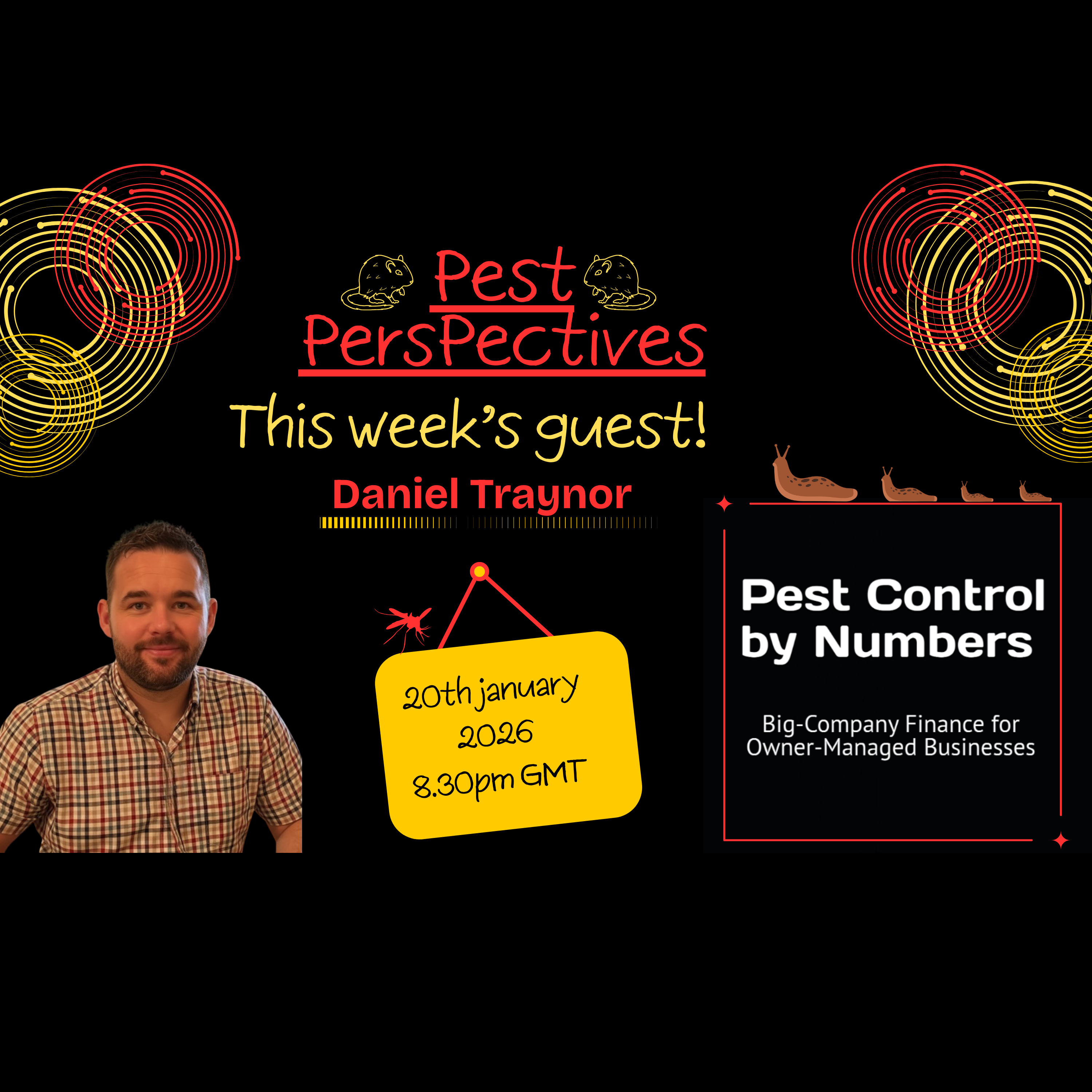
Tonight's Episode
Pest Control Business by Numbers: Pricing, Profit & Growth | Dan TraynorPest control by numbers is a book published by Dan Traynor sign up on the Link below
Join the waiting list now and:
✅ Get chapter 1 straight to your inbox
✅ Get notified when it hits Amazon
✅ Get access to free tools and templates as they're released
The corporates don't react to problems - they see them coming months in advance. They know exactly which customers are profitable, which services are dragging them down, and what their business is worth at any given moment.They're not firefighting. They're not guessing at margins. They're not waiting until after year-end to find out what went wrong.This book gives you that same visibility. The playbook they use, adapted for owner-managed businesses.
Link below
http://www.pestcontrolbynumbers.co.uk/
In this episode of Pest Perspectives, we shift the focus firmly onto the business side of pest control – an area that doesn’t always get the attention it deserves, but is vital for long-term success.I’m joined by Dan Traynor, who is launching his new book Pest Control by Numbers. The book is centred on understanding the numbers behind your pest control business, with a strong focus on finance for owner-managed pest control companies.We discuss practical, real-world advice around:Understanding your costs and marginsMaking better financial decisionsUsing numbers to improve efficiency and profitabilityBuilding a stronger, more sustainable pest control businessThis episode is less about theory and more about clear, actionable insights that pest control business owners can actually apply day-to-day.If you run a pest control business – or are thinking about growing one – this is an episode well worth listening to.
Hello, welcome to Pest Perspectives episode 49. We are back. This is there wasn't a podcast last week because the guest I don't know what happened. Actually, I don't know what happened to the guest. So if only if you know David Bird, don't ask him because I have no idea. He was all booked in. I've not heard of things since, but doesn't matter anyway, he's probably busy. It's life happens if you never watch press perspective. It's a podcast that's aimed to educate and maybe entertain. It's for people within the pest management industry.
It's quite an extensive field. If you're in the UK, you can earn the CPD from all these podcasts on on all of the CPD providers this year for basis prompt. Please give me a chance because I haven't sorted them out yet. I've actually got to e-mail them because my CPD organiser account, it's not working. So if you do use the British pass register, you can just go on and use the code that I'll give you at the end of the show and that you'll get your CPD. If you want last year's podcast, you have to do a little quiz that goes to the CPD training area.
It's all going to be in there for now on. This year's is just the codes for this year. So I've been working on that. It's took me quite a while. So I met them with SO40 on the quizzes. I've just got nine. No, no 30. I've got about 9:00 or 7:00 or 8:00 Today I have, it's took a long time, but this week we have a guest on who I met on LinkedIn a while ago. We we have Dan, it's Rainer. Is that how you say it? That's it. Yeah, that's the one. I wonder if it would, if it would stand for it. But I'm going to say this.
It's going to be wrong. It's quite right. Awesome. It's going to be said it. For me it is. No, no, you got it right first time. Oh. That's good. Sebastian's off now then it is so. So how are you doing? I'm. Good. I'm good. Thanks, Sean. Thanks for thanks for inviting me on. That's good to hear. Yeah, No, thanks for coming on because I believe it or not, the the guest I had booked for this week actually couldn't make it. So I was like, who can I get hold of it? Like Dan? But she she was a you know, she she was, it was Lulu.
I'll get her on eventually. She was going to the Arsenal play in Milan. So they're in the freezing. It is, but, but yeah. So you're, do you want to explain who you are basically as in what you do? Yeah, of course. Yeah, absolutely. So I'm a chartered accountant by trade. I've been doing this for 20 years or so or almost 20 years now. I started started off in practise. I was a client's accountant working, working with small businesses before moving into kind of more corporate and strategic roles.
And now I operate as a what we call fractional CFO. So providing kind of CFO level support to small businesses? That's a that's a great description. So after you actually get into the pest control side, you don't have to mention companies you work for, just just like you got into this industry as such, because you said you're as you're an you were. Well, you are an accountant. You are. Yes. So, yeah, so I think I mean, it was totally by chance to be honest, but the kind of short version of the story is not about the time of the pandemic starting.
I think it kind of it opened everyone's eyes a lot to how kind of vulnerable everyone was to, to external factors and things beyond our control, totally reliant on the supply chain. A lot of my clients at the time were construction, retail, hospitality, basically everyone who had to close and and stop trading. So I was kind of, I was looking for really, and I hate the term future proof, but that's more or less what it is. I was looking for a kind of an industry that was, you know, could withstand these kind of things, something that kind of, you know, interested me as well.
So I looked at a lot of kind of online creators and e-commerce and software stuff and nothing really that interested me too much or that I felt I could add a lot of value to it. And then by pure chance, one day I ended up speaking to a guy who'd just saw the pest control business and he was looking for a CFO on a short term basis. And I was looking for a client in a new industry. And it kind of, you know, it was, it was a, it was a good match really. And it was kind of like, you know, light bulb when you have pest control.
Wow, I know, you know, I never thought of that. That's, that's the one. It's that's the industry I've been looking for. Well, yeah, I mean, I'll be honest, at the start of that pandemic, we weren't exactly known as I hate, I hated that word. By the end of it all, key workers, we weren't actually when it first came out, we weren't fully recognised as that. But we were in the end, you are right, we are. Technically, if any disasters were to happen, we're still needed. Yeah, absolutely. In general, because I know, so obviously I know a lot of the big firms got hit because they, they, a lot of them, they all, they all on pay monthly and they, I think most businesses just shut down their direct debits.
They did, yeah. It happened to me as well. Is, is what happened? I mean, you can take people to court and whatnot. Is it really going to, are you really going to get all that money back? It's doubtful, you know, especially that level. Then when you've got hundreds of companies, it's a bit different, isn't it, you know? Yeah, yeah. I mean, my client base wasn't wasn't that big really. But you know, I think it was panic stations for everyone, wasn't it? You know, first thing you need to do is preserve your money.
And, you know, the first step towards doing that is cancelling, cancelling everything going out and then, you know, kind of weathering the storm. Oh, it definitely is. It's definitely true. It is In general. The reason I've got got got you on this podcast this week is because I've been getting a lot of requests for somebody who understands more of the businesses side of like pest control, because admittedly we're not the best at running businesses as in how to be efficient, how to run, you know, a plan of action.
And I'm not some of them might be great. I'm just saying in general, a lot of us are good at the trade, but not good at the pest controls, not good at the the business side as such as being like other businesses would be. It's like I've just gone to, I think Rutland scheme where they help local businesses funded by the council and the government and there's some, it's funded somehow by the council and someone else. I don't know if it's the government or not. And I had, I went for a sales forecasting seminar day and that was really I, because it says that basically you need to be sales forecasting all the time, even if you don't think you should be.
It is vital to your business because you've needed a business plan, you have to have a sales forecast or say you go for a loan or something to buy extra kit, you need a sales forecast and all these plans. And I've never done any of that stuff. And there was, there was people in the room mate that was on 2 or £3,000,000 revenue and they've never done a sales forecast, but they were going to implement it and they were making good money. But everyone was there to just to learn. And don't get me wrong I haven't done the forecast yet.
I've got loads of bits. It's littles baby step to is to get through a lot of this. But I have been asked by a lot of people to try and get the one that understands the businesses side of pest control or a little guide or little tips of what you could do to try and help that from that perspective on best perspectives. Yeah. You know what, you'd be surprised that I work with businesses and, you know, sometimes really big businesses and they're exactly the same as as what you've just described. It's.
Really. Or even big ones. Really big ones I've got, I've got businesses that that, you know, I'm working with, you know, in the last 12 months and, you know, absolutely massive with thousands of employees and they still don't do things as well as as well as they could. It's yeah, it is interesting. It's crazy really when you see it. But I suppose it's really, it's like what you just said a minute ago, everyone, people start a business because they've learned a trade, they've got really good at it, decide to go on their own.
And then all of a sudden you're a business owner with, you know, you can't just think about the trade and going to the sites and doing the job. You've got to come back and do the finance, but you've got to do the HR, but you've got to do all this other stuff. And a lot of people aren't prepared for it. So it's, yeah, it's, it's no surprise really that some people, you know, kind of aren't familiar with this, this type of stuff. Oh. Yeah, I mean, I just like, sorry, I've had a few guests that actually say, can you get like Matt O'Donnell from IX5IN Northampton, They're not far from me.
And he actually said if you could get someone on that's business related, that'd be great because it's, yeah, we don't get a know it's. So it's all well, it's all good And well, the old pest control show should be about pest control seminars. But he says a little bit of business could be mixed into these. He says, because it is what the industry lacks a lot in it is to an extent it is. It is. But have you got any like any tips for people such as to what they could? I'm not asking you to reveal your whole book.
You've made just like a little little guy without without baffling the people with all the big names you know. Yeah, Well, I can talk about the book. It's, it's fine, really. It's so the book itself is really designed for giving people this information of what you've just said. Is, is is missing from from a lot of people for some reason. I don't know why that is, but pest control as well seems to be something that's completely overlooked by people in my industry. In my world, with accountants, financial advisors, whatever it may be, it doesn't seem to be anyone specifically for or certainly not in the UK anyway, for for this industry you look at any other.
You found a niche there. That's what you're supposed to do. Yeah, maybe maybe it is, but it's it's kind of baffling really when you think about how big the industry is and how vital it is. And you know, any other industry you're looking construction, whatever it may be is could be retail, anything, anything else. There's books on Amazon to tell people how to do it. There's podcast, there's YouTube videos, but there's no one really talking to pest controllers about this. You are right. I mean literally the only of there's not many pest control books.
There's one for America I've read, but that's literally on how to sell. That's not on the business side, but there isn't really any the pest control books on the actual business. It's just a normal business book. You know, there's not like you say, yeah, plenty of this, how to sell, how to grow, how to build 1, how to do this, that and the other, what materials to use and how to structure this certainly. But nothing really about teaching a business owner how to, you know, manage the numbers and and use the numbers to to grow and develop and, you know, build a build a successful business.
Yeah, that's so, yeah. Do you want to talk about it? Yeah, of course. So, I mean, the book itself is broken to three main sections. We've got one that focuses on planning, you know, how to take your business ideas, your ambitions and your goals and turn that into a plan that you can you can execute in your business. Second section is all about visibility and essentially how to measure yourself against that plan, how to spot problems very quickly, how to identify opportunities in, you know, in enough time that you can capitalise on them through, you know, good reporting that that actually tells a story rather than just gives you kind of walls of numbers.
And then finally, the second, sorry, the third bit is all about, you know, when you're getting ready to sell the business and when you're ready to move on and what you can start doing now in order to, you know, make your business more valuable and more attractive to, to, to any particular buyer. Yeah, no, it's a fairpoint because in the UK there's been this buying frenzy recently. I don't know what's caused it. American companies and big, you know, equity companies, they're all looking for to buy.
People buy companies up there. I don't know what. There must be a lot of money in it, obviously on the high end scale. Well, I think, yeah, The thing is with pest control, again, this is kind of why, what attracted me to it, the problem, the problem you solve is never going to go away ever. It's only going to get bigger and worse and there's going to be more demand for your services as we, you know, develop areas and the population increases and things like that. But when you think about, you know, pest control, it's a recurring revenue, But recurring revenue you're a legal requirement for a lot of other industries.
You know, they have to have you for certain, you know, to get the health, health certificates and things like that. So it's really something that, you know, a buyer, an investor, even an outside investor can, you know, they can see a good return on this straight away. And then you've got these big companies, the big players who the the big, you know, their main growth strategy is to acquire smaller businesses because it's much easier to buy your business than it is to put, you know, a salesperson in your town and try and get market share over the next, you know, six months to three years.
It's, you know, make you an offer and buy your businesses, you know, makes more sense where you even get. Emails asking don't have a don't always e-mail back. Sorry, not interest. Yeah, really not. I'll, you know, I'm in this for the long game, you know, maybe, you know, when I retire, you know, but even then, the idea is I want to pass it over to my son. Hopefully it's still going by then, hopefully. But yeah, I understand why people want to want to jump in because, you know, I'm hearing numbers of millions to billions and all sorts quite mentioned in, you know, value.
I would say, though it's big, I'd say pest controls could be bigger than America because obviously you've got residentials. It's big in residential as well, isn't it? It's still big here. I just say I reckon the market's worth more in America. Are you it? Is it is worth more in America? But like I said, it's because they have a different climate, they have different pests. They have. They do, you know they have. Even. Different areas of the country, there's different, different things going on. So it's, it's definitely bigger elsewhere, but it's still a massive industry in the UK.
And when you think about it, you've got probably, I mean, we did this some research a few years ago, which probably a bit out of date now, but it was, we estimated around about 35 to 40% of the market was the, the, the top ten in, in the industry. And that then meant that, you know, the bottom 2/3 was, you know, it's businesses like yours. It's, it's all SMEs controlling or not controlling. We only they've, they've got 2/3 of the market. Below the top. 10. Yeah, I can believe that stats, right? I can, but now it's with business, it's more well, what I've learned, obviously you've got to create a plan with set like what do you think is that if someone wasn't doing their business properly, what, what things could you tell them to do today that they could look at implementing?
Well, I would say first of all, start with a plan. So a lot of a lot of the typical typically what I see businesses and you show me the business plan, more often than not, people are starting too late. If you, if you think about financial year, most people start usually too late. They leave it too late to start as an example, you know, two or three weeks. So you saw on LinkedIn or I did anyway that, you know, people are in the office and they're doing the plan for 2026 and it's amazing all fired up and it's brilliant.
But really, you know, you're too late. It's that could be, it should be, I think maybe at least two to three months before year end. You need to know what you're going to be doing next year because implementing stuff and getting ready for it takes time. If you're going to have a successful year, you need to take a big run up and simple as something as simple as perhaps putting a new system in to do, I don't know, automate certain things. You've got to find it, you've got to move it over. You've got to get your data and you've got to learn how to use it.
You've got to fix the problems. If you start doing that in January, it's going to be April before you see the benefit. So that's. True. It's, Yeah. I've been looking at more and more of this stuff and it's like, there's endless things. It's like. But I'm enjoying the learning process of it. I am, yeah. Yeah, it's, it's great. You know, when you Start learning about this stuff, you start, you know, you get more interested in then you still learning more and you get more interested in it's, you know, it's, it's great.
It's a great process to to follow. So what you mean? There So say if you want to launch like a new service, you should have it a plan of strategy on how you're going to do the service, how it's going to look, how it's going to be priced, how you're going to implement it, everything, basically everything. Everything, yeah, I would, you need to think about all the, all the different variables that go into it, the resources that you need, the money that's going to, you know, you have to fund it with touch or tie everything back to cash, which is always important.
And then, you know, give yourself enough time and, and make sure, you know, like you say, you plan it properly and you can execute it as well. There's a lot, a lot of the ones that I see. Let's say there's, you know, very, it's a very vague business plan. You say, OK, I'm going to grow 10% next year. That's the plan, but there's no real plan on how to do that, you know, and if you don't, a lot of people don't consider the kind of wider picture. So if you grow by 10%, you've got 10% more work. So can you deliver it?
Do you need more stuff? In which case, when do you need to hire them? Can you afford to hire them before you grow? Can you do you have to put a strain on the existing stuff while you're growing without this, this new person? No, there's a, there's a whole bunch of things that you need to think about when, when you know, you're making a plan. It's not just the higher level stuff, it's really getting into the detail on it. No, it is true because the minute I was like you get this for the scheme and to think the thing I learned was, he says what's your 12 month plan and what's your 5 five year plan?
His life. How do you? Want your life to be in five years? I said I didn't. I said I don't know what you mean. How much would you like to earn in a year or take home? Would you like to move away from the business and be less on the out in the field and think these all these variants I was like and these are the kind of things people won't even think about that are listing now. They won't. But it's all that there is also part of a plan, isn't it as well? It's yeah. Well, you need to. You need to start with the end in mind.
You need to think as you just said, you know, where do I want to be? What's about five year plan? My 10 year plan? Work that back until you figure out what you need to do in year 1 that moves you closer to where you need to be in year 2, and move that forward. And then work that all the way back until you get to the point where you know what you need to do tomorrow to start ticking things off the list. Yeah, it's definitely good advice. Thanks to my mate Vijay for watching on YouTube. But yeah, it's a few people watching, I can see.
But now it's it's a thing. I've been looking at the plans but you need to plan more people what you want to do. I'm not saying what you obviously know my business growth grants about. I don't want to reveal it to everyone yet, but I've recently applied for a grant. I've been successful when going to introduce a new service at some point this year and I'm working on a plan on how to implement it and everything and it's going well. My good friend ChatGPT has given advice too as well as we all use that can give you different ideas you probably didn't think of as well.
Not always right though. You can't get 100% but they they have a good idea to do so. So with that, is there any other any other advice you want to give apart from the planning? Yeah, I suppose. I mean really what you need to once, once you've done the plan, you need to break your kind of goals down into gaps. This is something I do quite a bit with clients. And what I mean by that is let's say you want to increase your profit for whatever reason. What one of you want to hire someone, you want to do whatever, whatever your goal is.
A lot of the time, the automatic response, and a lot of people do this, myself included in the past, is you start going, OK, well, I want to an ebol profit, so therefore I need more revenue. But in actual fact, the answers often lie within the numbers that you've already gotten What what I call this is kind of breaking your goals into gaps. Now what that what that means in practical terms is instead of chasing turnover to increase profits, have a look at where else you might be able to do some savings or some some improvements that generate that extra money for you.
So I'll give you an example, and I don't want to kind of confuse people with the numbers, but as a kind of high level, if you've got, let's say a business, if you're a business that's doing £1,000,000 in revenue at 30% margin with 100 grand in overheads, they're going to be left with roughly 150K after profit after tax. If they wanted. To increase that to 250K because of nothing else change, all the other numbers stay the same. You'd actually need almost half £1,000,000 in revenue to generate that extra 100K, right?
But an extra, it's almost 50% increase on your business. It's just going to be more staff, more vehicles, more maybe more premises and you'll end up, you know, almost back where you started from. So if you instead, if you took that 30% margin I mentioned and increase that to 40%, you'd actually only need 80 grand in extra revenue instead of half a million because you're keeping more of every pound that you've earned. Now, does that, does that make sense? I know it's, you know, late in the day and idle talk about numbers.
Yeah, the whole point is, yeah. So the whole point is, you know, instead of going chasing after the revenue, you look at where else you can make the savings, where can you be more efficient? How can you keep more of the money you earn instead of spending it? And quite more often than not, you find that you create very, very small gaps in different areas, make a massive difference on the bottom line. So before people, you know, before you go out and say OK, we need to chase half £1,000,000 in revenue, yeah, have a look at what you could actually do elsewhere to to bring that, you know, the revenue requirement down.
Yes. So like obviously you're talking about maybe saving with your materials, with your vans, you could do savings some you can usually make a saving somewhere you can. And that, yeah, there's a lot of people, to be honest, they don't look at, they just buy it and they don't look at how much it all costs. Yeah, everyone's guilty of that. They are, you know. Yeah. But. Everyone is that could. Be a good tip for people that could thanks Jason for popping in from Ask ask press control. Cheers mate. But yeah, so it's trying to make some savings here and there.
It's obviously the most efficient way would be to, I'm not is that like get all of your costs? Will it cost you to run the business and like write it down and then work it from there? Would that be the best way for people to do? Yeah. I mean, it's a good, I've got a, what I could probably share with people is that I've got what I call a trigger list. So for all the different gaps that you're trying to create, there's a whole bunch of things. And this is part of the planning process. And this is what what I do with clients is we say, OK, well, let's say you need to shave or rather increase your margin by let's say 4% and you need to reduce your overheads by so much.
And then we just work through a list of things where you say, OK, well, if you want to increase your margin, what you know, what do we you can increase your price. You can look at the waste, your waste on site materials. You could look at what jobs that you do which are low margin. Perhaps you could drop those. You could look at unprofitable customers. You could look at improving, you know, first time fix so you don't have to keep, you know, call back to sites for for the same job and improve cost and accuracy.
So there's a whole, a whole bunch of things. And how we kind of work through this as part of the planning process is we go, OK, well, these this is the target that we're trying to, you know, the gap we're trying to close. We could do one of these five things. Let's pick the three things we think will give us the biggest win or the quickest win. The biggest results are the easiest to implement and we'll focus on those and that'll be our, let's say quarter one project will be to try and close that gap.
Yeah. And then move on to the next one. So chop it into stages. Little pieces to start with, yeah. Break it down so it's so small, it's not a big task. So something I talk about in the book is, you know, something that most a lot of people do is OK, we've got this great plan I'm going to do Thursday mornings is going to be business plan morning. And some people aren't, aren't even this good. But Thursday morning is going to be business plan morning when they spend 3 hours working on the plan. I'll do that every week.
But you know, usually by Thursday, something happens, custody or someone rings in sick or a customer needs an emergency call out for something and that Thursday then gets shifted into something else. But if you can, if you can break those three hours down until I say, you know, it'll take you a bit longer, but OK, well, let's do half an hour every day. The first half an hour every day or 1520 minutes is just doing something on that plan. If you break your task down small enough, you can tick something off.
Yeah, before you do anything. You're making very slow but very steady progress towards towards the goal. Yeah, I think that's the way, I think that's the way that most, most of the people who are watching this could do it. They could probably do a little bit each day and eventually work through it. I could, yeah. Yeah. It's like baby steps. First, it's, you know, it's a learning process, isn't it? It? Is. Yeah, and a lot. Of people don't know how to do these, this type of thing as well. And, and like I said before, no one's talking to you about it.
But if I said, OK, well, Sean, right, the first task we're going to do is your business plan. We're going to look at your most profitable customers. That's your job for the next two weeks. That kind of, you know, if you think crazy, I don't know where to start with that. But first of all, the first thing, all you need to do is print a report off your accounting system that shows you how much revenue by customer last year. It's a 2 minute job. That's that's step one. And then you've you've, you're on your way then to to Step 2, which is, you know, another very, very simple, simple thing if you use.
Digital accounts and software, that is. If you know you meant you don't know. You mentioned that before you're a bit is everyone kept? Telling me all you need to by law. And they said, hey, don't, not if your accountant delivers it by digital. Yeah, you see, then that's how we do it. But I am looking at it. It baffles me. It does, but I am looking at it. But the counter, as long as the accountants deliver it in digital, it's fine. Because it's the law. You'll be done. You won't be. If your accountant delivers it all for you, it's fine.
Yes, that's. That's that's true really, but I suppose I mean for yourself, it would save you a lot of time with, you know, I don't know how you you work at the moment writing invoices out and sending them perhaps or I don't know, I. Don't know, we got to pay the door cars machine in hand. Oh, there you go. So that's well, you're almost digital then, aren't you, if you card machine? Well, I've been car machine for a long time. Yeah, I'm probably good at getting money off people. You see, you've got to be, you've got to have like policies we have because like one point and what we found was when you let people pay at the end, a lot of time they're not in.
If you make them pay first, first visit, they generally make sure they're in for that next visit because they pay for it. Yeah, that's a. Good way of thinking about it. 2% Oh, don't you? Trust me, it's nothing to do with trust, it's just a company policy because we've felt that a lot of people, whether they push more, it's when they don't pay a lot of the time. Next time you come and you're not here, you haven't paid yet. So just a company policy, that's all. But yeah, I am looking at X0. Yeah, 0.
00 It's actually called. Zero. Yeah, like the. Number. All right. Yeah, I I have been looking at it. Someone told me it's free if you don't send invoices. Is that right or not? No, I don't. Think so. They have no. I could be wrong on that. Do you have different versions based on, you know, different requirements? I'll have to. Have a plan with it and see what see what it you mentioned it to me it easy my plan to do it because it will be much easier. It is part of the plan. It is to do that because but we are digital in sense of reporting.
We can send invoices digitally already through our a system we use powered now, though sometimes we do do it that way as well, especially when it comes to estate agents and people like that. We now everyone, you can be shocked now I actually convinced these state agencies to pay before we go and they do. So if you're listening, try it. I've got a fact that you're looking at 6 to 8 weeks sometimes. Yeah, I can't be dealing with it. It's a lot, isn't it? Because especially when you think in those six to eight weeks.
It is standard practise but we don't tolerate it anymore. We're like, we don't want to work with us and fair enough, but to be fair, a lot of them have still been in pain before, which surprised me. It did a Robert Charlton, he says. I pay about 1950 a month fix for zero. That's not too bad then, if it makes your life easier. Yeah, you'll find out. I'll send. I'll save you more, you know, more time than £20 worth of you know, business owners time is. Which is obviously I think social media do everything.
I do this podcast to do all sorts and the minute I'm ramping up the SEO on the website myself, that's not easy. Chat, chat helps me. It does, but but also, yeah. So there's another bit of advice. If you want to make your digital easy, get get 0. A lot of people aren't because a lot of people don't have accountants, you know, whereas whereas we do find this a little bit easier, pay them, but you know, if anything goes wrong, it's still your fault. Not their fault. It is. It's always the same, doesn't it?
It is. Yeah, yeah, absolutely. But. So have you got any more Nuggets you can give us to help people out? Yeah, I think so. We've we've talked about the planning bit and that's, that's really important because like I say, you need you need a solid plan. You need to know what it is that you're doing. You need to know where to start. Once you've once you've sorted all that out, though, you need, you need something really that you can measure yourself against. And that's, that's kind of what the second part of the books about.
It's all about getting visibility over, over your plan and over your performance against the plan. A lot of the reporting, you know, I talk about reports and numbers, people kind of switch off usually, but that's, that's because most of the time you can't, you're looking at, you know, wall of numbers that you know, your accountant provides you. And I've done the same in the past. But what I'll talk about in the book is I've got a format which I can send to people if, if they're interested. And it's, it's designed to so you can spot a problem in 60 seconds and you move on.
You know, in the client meetings, we don't spend much time looking at the numbers. We go, we take a look if there's a problem, we figure it out. If there's not, we move forward. And it's all about, you know, it's all about looking forward and really kind of translating. What does that actually mean for your plan? You can have a good month or a bad month, but in isolation they don't really matter what. What really matters is what does the next six months look like and are you going to hit that target which you know is going to keep you on track with this five year plan that you mentioned a few minutes ago?
Yeah. No, you are right. It's like, yeah, I mentioned that sales forecast in seminar and that's what he kept mentioning that you've got your, you've got your sales forecast. You've got to keep checking it. We've also got to compare it, say monthly or quarterly or weekly, however you want to do it and see what your actuals are, whether it's matching your sales forecast. And then if it's not matching it, you need to look at changing the plan being, you know,
changing that plan if need be. If it's not working, sales forecast is just a, it's just a plan, isn't it? Another name for a planning tip, Is that right? Yeah, pretty much. I mean your plan so. In kind of. Technical terms, your budget is what you thought you was going to do, you know, when you made it this time last year, your forecast is now what you think is going to actually happen. And those things, you know, your forecast from you, sorry, your budget can be able to date within two or three months as things change and things that happened that you know, you didn't see coming or maybe a customer leaves or whatever it may be.
But your forecast is, you know, it's an ongoing thing, which, you know, we update every month and say, OK, well, this is where we thought we'd be. We're actually here, this is what it looks like. And we do that every single month and move forward. And it it gives you a bit more control over over the journey I suppose. Yeah, it definitely gives you faith and thought because it's it's a lot of that I didn't I never thought about. But like, because obviously when I did this seminar, there was obviously I was with other business owners and they put you in little groups and you talked about it.
But we found a lot of it was hard because we all come from different backgrounds, like or sat with somebody that was, you know, in finance, somebody was sells mortgages. And like they were saying it's all outside factors. It's all based on your your sales forecasting is all based on because it one of the questions was, is a sales forecast predicted or is it just a good guess and everyone came or a different answer. But a lot of people said it's hard to say because it is your best guess or what you want want it to be.
But outside factors of markets can affect it. But it was really, really difficult. But because everyone was so different, it's not like I was sat there a lot of pest controls. I wasn't. I'll tell you why. It's one of the most nerve wracking things I've ever done because although I'm very confident on podcasts and going to pest control shows, etcetera, I'm used to that. Everyone knows me. I go in the room for the serious business people. I'm not the most sharpest on business. I'm there to learn, but so is everyone else.
But they're really nice. But working with people I've never on little task I've never met before, it was, yeah, most nerve wracking thing I've done in a long time. But it it, it helped me learn. It did in general. Yeah, that's what it's all about. Anything, I suppose new is it's kind of nerve wracking, isn't it? It's, you know, if you've never done that kind of thing before, I think that's what puts a lot of people off doing this kind of thing in their own business because, you know, you hear about it or, you know, people might be watching or listening now and you know, you can.
I'm talking about and it sounds really good. But if anything now, I don't know where to start with that. I'll just don't bother. Yeah. I mean. It's an advice to anyone if you're got I'm not sad. There is these groups where it's like a club and you have to pay. I've been invited a couple of them. I'm not, I'm not a fan. I'm not. But if you've got anything in your area, look it up to do with business support for your local accounts when it's free, but always try it. I ended up getting a business grant out of it.
So the first thing he mentioned was start thinking about a new service you could implement because or towards marketing or something, because we've got a business 5 grant and the basically the guy that does the advisor, he knew he'd write the plan here, but he knew exactly what to say that the council wanted to hear. So him he'd make sure the wording was just right. So and then I didn't, he wasn't exactly telling me the same. Just change these couple of words here. That's how they wanted to sound.
But yeah, it's very helpful. But yeah, I suggest anyone that got anything like the area and it's free, give it a go. If you don't like it, you don't have to do it again. But it you'll find generally the people are not snobby and they're just trying to learn like you are because there's a lot of people in there. There was someone in there with quite a bit of revenue per year, a couple of million, and they had never done the sales forecast in their lives. So it just shows you it does that. Not everyone's start.
He's making, they're making good money. But he'd never done one before. Because I'll be, I'll be doing this now. But so it just shows you not everyone knows everything, yeah. I mean, forecasting is, is such an essential part of it because people don't, you know, they look at the numbers and great, OK, you know, even the ones that get numbers and a lot of people, a lot of people don't, they look at them and go, OK, OK, we didn't do so well, or maybe we did better than we thought. And then they move forward, but they're never really looking forward.
Now, I I use an analogy which is kind of like, you know, if you think about your business like driving a car and you're almost spending the whole time kind of looking in the rear view mirror. So you're looking at, if you're just just relying on reporting, it's you're looking at this is what happened. This is, this is what's behind us. But really what, you know, the forecasting bit is more like a sat NAV. So you eyes on the destination, you're looking at obstacles. You know, you've got enough time to change course.
Yeah. And you can see things coming up and then you can start doing things about it. So if you're, you know, talking about a sales forecast, if your biggest customer leaves or let's say you know, whatever it was a couple of years ago, wasn't it when 2024 it was bad weather and Wasps didn't get going and it took a long time, didn't it, before they kind of went through and 80 Watt. Nest that year it was terrible and how? Many do you? How many do you normally do at?
Least 500. Yeah. So you're down on bio box last? Year, I think it was four or five. And I'll be honest, I mean, that's another thing I need to do. I need to count, yeah. Count each job. Yeah. I just, I'd say roughly, yeah. So if you, if you look at that, like I said in the rear view mirror, you can maybe sit with your accountant of, you know, could be even a year later and you know, they're saying, OK, well, revenue was down because of this. You know why? And if you can remember that by that point, you'll, you'll tell them.
But with the forecast, you say sorry, sorry, carry. On Yeah. So, so, but with the forecast, you can say, OK, we'll actually call, you know, by end of May or beginning of June, you can say, well, call outs are down by 70%. That's what we based about, you know, 70% on last year. That's what we based the budget on. If we, if we forecast this out through the rest of the year, we know that August and September when we're usually busy is going to be much lower. So our sales are going to be down. This is what it means for the annual plan.
And then you now as a business owner, Sean, you've got two or three months to do something to try and recover that revenue in August and September because you're forecasting and you're seeing what the impacts will be, you know, months ahead of time rather than after the fact. That's true. Funny enough, when there was a downturn in WASP, moles ticked off massively. It did. The winter was very busy with moles. I mean, I've never seen so many moles. I'm, I'm joking. Everywhere he drove, there was molehills, sides of roads, all the fields, everywhere.
Was it sorry? No, it wasn't that year. That was it was that year. Sorry, it's no, it wasn't that year. It was last year. Oh, I'm getting confused. There was a big mole year a couple of years ago. Was it last year? Oh, God, They I need, I need to have all this stuff wrote down. Yeah, I don't that's. I mean, but that gives you opportunity then to look, you know, if you if you've got capacity now because you was planning on Wasps, but you're focused in that you're not going to get them and you can start looking at this, OK, well, there's OK, let's say there's moles.
Can we start doing a bit more to to try and generate this, this instead and we can deal with that or think at the same time bedbugs were exploding all over the place, weren't it was, you know, all the way of six months leading up to that, bedbugs have gone through the roof. So, you know, if businesses that can forecast when they've got they're going to lose revenue, you can start looking at maybe other opportunities to to recover that through other things because the forecasting. Yeah, we try. Not to rely on Wasps, obviously, but but it is a general revenue booster each year.
But obviously what I'm getting is business growth. Grant. I'm hoping we'll push the business forward. It will. It's a new service and it's potentially another two services I can bolt on, but it's all trial and error. We'll try the first one first and see what happens. We will. But you're right, you should like obviously work out what your seasons are when you're busy and predict for what you think is going to happen. And that's what I'm going to start doing. Like say, see, we're I'll be honest, we're bedbugs.
We hardly get any work. We're insects wise. Vast majority of ours is Wasps, rats and rats, mice, schools, to be honest, it is we do do fleas, etcetera, but we just don't get a lot like other people do. I don't know whether that's because we charge too much, I don't know. Or we don't charge enough. I don't know really, but we do more on the, we do more with you know rats, mice moulds as well. We did quite a bit of that. So I'm going to start to look at predicting what I think we're going to get. But then you see also mentioned in the sales forecasting, if you've got historic data, you can look back on them periods in within the year and you can usually give it a good guess at what periods you're going to get say because I said, obviously those people who sold products there etcetera.
But as I say, you've got a service what periods you're going to get more of this and then that and then you can use your historical data you can to to work on inside it. Yeah, it's, it's very, it's, it's really good pest control for this kind of approach as well. Because like you just said, you've got your seasonal stuff through the winter, then that kind of drops off and then the other summer stuff picks up. And it all kind of follows a similar pattern apart from, you know, when the weather is terrible and things don't develop, but it's, it's usually very, you know, you can forecast very, very easily.
You know, you're recurring revenue from your contracts and what you're going by or what you're losing by. So that's very easy to see. And also, you know, your seasonal, you know, your seasonal demand for different things as well. So should be, you know, it's quite, quite, I say, I'm not going to say an easy task if you don't know what you're doing, but it's, it's easier than you would think to, to forecast this kind of stuff out and get an idea of where you're going to end up when I did. That that sales forecast.
So he was going seriously deep. I mean, I think he was talking about people who do products as well. Like you should market research, see what the see if any walls are going on and stuff like that, you know, tariffs and the amount of stuff that were coming up. It's all important to a products business. Yeah, it was that much data, the basis, much data as you can get to do your sales forecast, is what he said. Because there were companies coming from all kinds of different angles. Some of them have to keep an eye on their competitors to make sure that they stay ahead of the game with their products.
Because other people, if you stand still, other other companies will go past your products. They were, yeah. You've got to try and factor in as much within reason. I mean, it's you can keep digging and keep digging, but there becomes a point when you kind of a bit overkill. But we never had jobs in the past where we even monitored the weather because in it was working. It wasn't pest control. It's a different industry. But we knew that when the, you know, when it was sunny, people would go out and start, you know, they'd be sat in pubs spending money.
And if it was, if it rained, they'd be doing things in, you know, they go to cinema or indoor stuff. So we can actually forecast what what revenue we expected to collect in based on what the weather was going to be like in you know weeks time to be. Fair, I mean in certain periods that would factor into a forecast of pest control because it can happen where you have a massive boom. I remember what year it was a massive boom in Moss nests because if the heat is too high a lot of the nests can burn out and die by themselves.
So you've got less nests. So I'll say it rains all summer, although the light rain Wasps nests, people notice Wasps nest when they're out enjoying the garden. They do not, they won't go out there if it's raining. So you'll probably get them Wasps nest. But later in the year when it's they're nearly coming into the person's house, they will. So that would affect the pest control as well. That would to the extent it would. So it's all included. So have you got any other other tips at all or? I've got a book full of them, Sean mentioned the.
Mentioned the book mentioned the book because I'm going to put a link in all the descriptions for you because you've got a sign up link or something to to show it off Yeah, the minute. So I've got so the book itself is, I don't know what you would call it pre production. So it arrived last week. It's a pretty meaty book actually. I've not it was actually I didn't expect. I didn't even plan to write this. Tell everyone. How it started out. So we started off as a, so the reporter, the reporter that I mentioned a moment ago kind of spot problems quick.
I put that into a client's business and I could tell that, you know, they didn't quite understand how to use it to, to start conversations. So don't worry what I'll do, I'll fill it out with some guidance and show you this is how to use it and this is what this means and why it's important. And you know, that day like that, that was fine. So then I turned it into a lead magnet. I thought, well, I could send this to other people and say this is what I'm doing. If you don't get this, you'll have a conversation about it.
And then so yes, I sent that out a few times and then I tagged in a couple of newsletters because people ask certain questions. I said, I've got a newsletter about that, I'll put that in as well. And then I kind of realised it evolved into this thing, which kind of, well it was, it looks like it was, it been cobbled together by, you know, by an thrown together by an amateur, which you know, which is exactly what it was. So I kind of decided I thought, well, I'll rewrite it properly and make it make sense.
And that's when I started doing a bit of research and saw that there was wasn't really anything like this for, for pest control businesses. And, you know, I saw a gap that needed fill in and thought, well, I've got, you know, a lot of experience to share and there's a gap for it. So I guess it looks like I'm writing a book about a better time away from off the radar for the next 4 weeks. I couldn't write this thing that I didn't intend to write. Well, to be fair. I mean it, it fits in because they do say that that's his saying in sales that if you write a book, you'll be known as an expert in your field.
So apparently it helps towards authority online and searches and AI and everything apparently. But it's like it's always his thing. If you write a book, you'll be known as more of an expert. But I read your PDF to start with, didn't I? And then put that on Old Short. It's going to be a book. You are. Well, that's. What, because I sent it, I think you or other people I sent it out to as well, I don't know, 30 or 40 people. I just kind of sent it, you know, have a look at this. What do you think? And yeah, because people came back and said, OK, well, I've, you know, this is great, but I've, I'm selling a business, you know, what can you tell me about this?
So I said, oh, I've got a newsletter, so I'll take that and resend it. And that's how it kind of ended up evolving into this thing that, you know, didn't really make sense. And it's kind of all over the place. So. Yeah. So I sat down. I thought, I want to rewrite it. If I'm going to do it, I better do it properly. And yeah, that's, that's that's what it's turned into now. So it's almost ready to go as well. It's only a couple of small changes that need to be made to this. And it'll be online. So yeah, there's a waiting list at the minute.
If people want to join that, I'll send them the first chapter. Yeah. And. I'll drop the link in the description as well. How much would the book be? Not a lot, it's probably £15, you know, I'm not doing it really to make money off it. It was just, it was an experience for me and like I said, I have an experience to share, so it's not going to be. Expensive. OK, so is it self-publishing or somebody publishing it for you? No, no, it's a self. Yeah, a self published 1. So it's done through Amazon and probably some other websites as well.
But it's yeah, it's entirely self written, self published. I did. Have a. Kind of hired someone to just have a look at it because I'm not a writer, but I hired someone to have a look at it. I didn't really like what they what they were doing. So that didn't last long and just, yeah, just kind of did it myself. Well, yeah, they probably, I don't know, well, they try to change your book, basically why you didn't want it. They were. Just messing about with it, you know, reformatting this, that and the other and putting things as no, what I should have done really is if you're going to do this kind of thing, you probably need someone who knows about finance for business, you know, and I just hired A freelancer that I saw on LinkedIn and said, OK, well, this looks good.
We'll have a look at this. And they were just putting things in the wrong order. And so I was like, well, no, the process, the annual process is this, we do this, then we do this, then we do this. It's got to kind of follow in that order. And in the end, I just said no, I'll do it myself. Yeah, well, that's fair enough if that's the way. You want it you. Want it the way you want? Because that's your process to teach people. Yeah, obviously I have read it and it would obviously I give you a blurb in the book, but I wouldn't.
I still need to read it a few more times. I do. I do keep having a look at it. I do. It gets stuck in the brain, you see. Yeah. Well, I think most people will really don't, you know, it's not something you're going to ever read cover to cover. But what you know, what I kind of say in the front of it is if you start, you know, read the introduction, get what it's about, read the contents page and look where you know, skim through the different sections and then go back to the bit where you know, which makes more sense to you at this time.
So if, if you've got a decent plan, but you don't know how to report on it, start with the reporting. But if you're not sure on how to build the plan, do that bit first. If you're looking at selling your business in the next few years, go to that, go straight to that bit and see what you can learn from that instead. Exactly. Yeah, you're right there. I, I might purchase a physical copy too, because look, because I could like, look, my name's in this book. I'm actually in the book. There you go, I. Might send you one then, Sean, I'll send you for once it's published.
Oh. Buy one, mate, You're all right. Don't worry. Oh well, I'll buy one. You're self-publishing all my amber. It's fine. I will purchase one. I will. I could go. I'm in the book. I never know. I might make a book one day. You never know. I definitely would. Need help writing that. Yeah, it's a it's a good experience, but it's I'll probably never do it again. I didn't intend to do it in the first place. I'm quite proud of it, somebody. 'S proud of this. I mean you could have been in New York, NY.
Best times seller. I don't know about that. I mentioned it to my wife the other day. She said, oh, we've got to have a launch party. I said no, we're all right and the executes to have a party in our house, but I'll see, OK. Yeah, that's fair. I think it would do well. I think. I hope people will look at it. I know this there's quite a few people that messaged me when I when they found out was a business. I'm all business focused podcast is what people have been asking for. So it says I've done my best, I've got the man in and see what you think.
But I'm pretty sure it will help people. It will and people can buy the book, obviously. Is it pre? Is pre-order Currently you can read the first first chapter first in the list. Yeah, if you. Go to the web, so the website pestcontrolbynumbers.co.uk there's a, a waiting list that you can join and I'll send you the first bit straight away and then I'll let you know when it's when it's actually gone live. Also, what I'll probably do, what I will do is the various tools and things that I've mentioned in in the book, things like customer profitability and all this kind of, you know how to assess different things so you understand your business a bit better.
I started building these little tools out as well as I was sending them to people as, you know, as and when after the book comes out and as and when I build them. So hopefully people should get a bit more, you know, a bit more value off that if you get the name on the list. Yeah. That's nice. That is that is nice. So the obviously get your name on the list. Does it cost or do you just send a link out? What once you can buy it or? Yeah no. I'll just send the link out. Always get yourself on the waiting list.
It's I'll send you the 1st chapter. I'll send you, I'll let you know when it's when it's ready and then you know, you can go on Amazon and buy it if if people are interested. So how's that work? Do they? Do they just print based off what numbers come in? Yeah, pretty much, yeah. It's printed the orders. It's no. It's no. It's a print to order, so there'll never, there'll never be any inventory of it. It will be, you know, if someone goes and that's why, you know, you don't make a lot of money from it because the printing costs are so high, which wasn't really the point anyway.
But you know, if I went, if I went off from printed 1000, I could probably make some money off it. But I just people want to buy it. They buy it and they'll get printed and sent to them straight away. Well I could always book someone in a pest tech this year. Yeah, there's no idea. I can't see many people queuing up for that though, but I'll yeah, I'll bear that in mind and. That was a joke, but you know you could. Have you ever been to Pest tech before? No, I've not. I've not.
It's good. It's it's good. As a visitor. I was really busy last year helping. The day went like a blur because I was helping and the walkie-talkie on I felt, well, important. I.
Did but. Yeah, it's been good to have you on. I just say the code everyone, if you want the be one point on the British best for just to go to the CPU training section and it will present you with a once I've finished the podcast, give me a chance.
It will present you with 3 or 4 numbers. If you pick 4040, you'll get your points allocated to you as it sort of I believe it's automatic. You'll get them straight away. That'll be 1.1 point towards your yearly CPD allowance or however many you get. But yes type that in and that will get you one point that will the best perspectives. And I will drop the link in the description once I've got the link after the show. And all the links will be on the podcast feeds. So I'll update them all. So if anyone wants to look at it and you're watching the podcast or YouTube or Facebook or in Facebook, have to put it in the comments section, I will.
But it will be there. So just look out for it. And but yeah, thanks for coming on down. No problem. Thanks for. Having me, Sean, if you stick around for a minute, I'll just, I'll just say stick around for me. I'll just end the stream, but thanks everyone. And I tell you, I can tell you who's on next week. Let's have a look. So next week we have, we have Jim from Protex in London. Yeah, he does a lot of jobs that are very high up where you need the climbing equipment. This company does a lot of jobs where you have to be high.
And we're all yeah, job. I would never work for him. I'm not good with that voice. I'm not. But but yeah, thanks, Dan, and thanks Jason and everyone for watching. I appreciate it. And I will see you next week. Thank you.
Sponsored by


 Amazon Music
 Apple Podcasts
 Audible
 Castbox
 Castro
 Deezer
 Goodpods
 Moon FM
 Overcast
 Pocket Casts
 Podbean
 Podcast Addict
 Podcast Republic
 Spotify
 YouTube