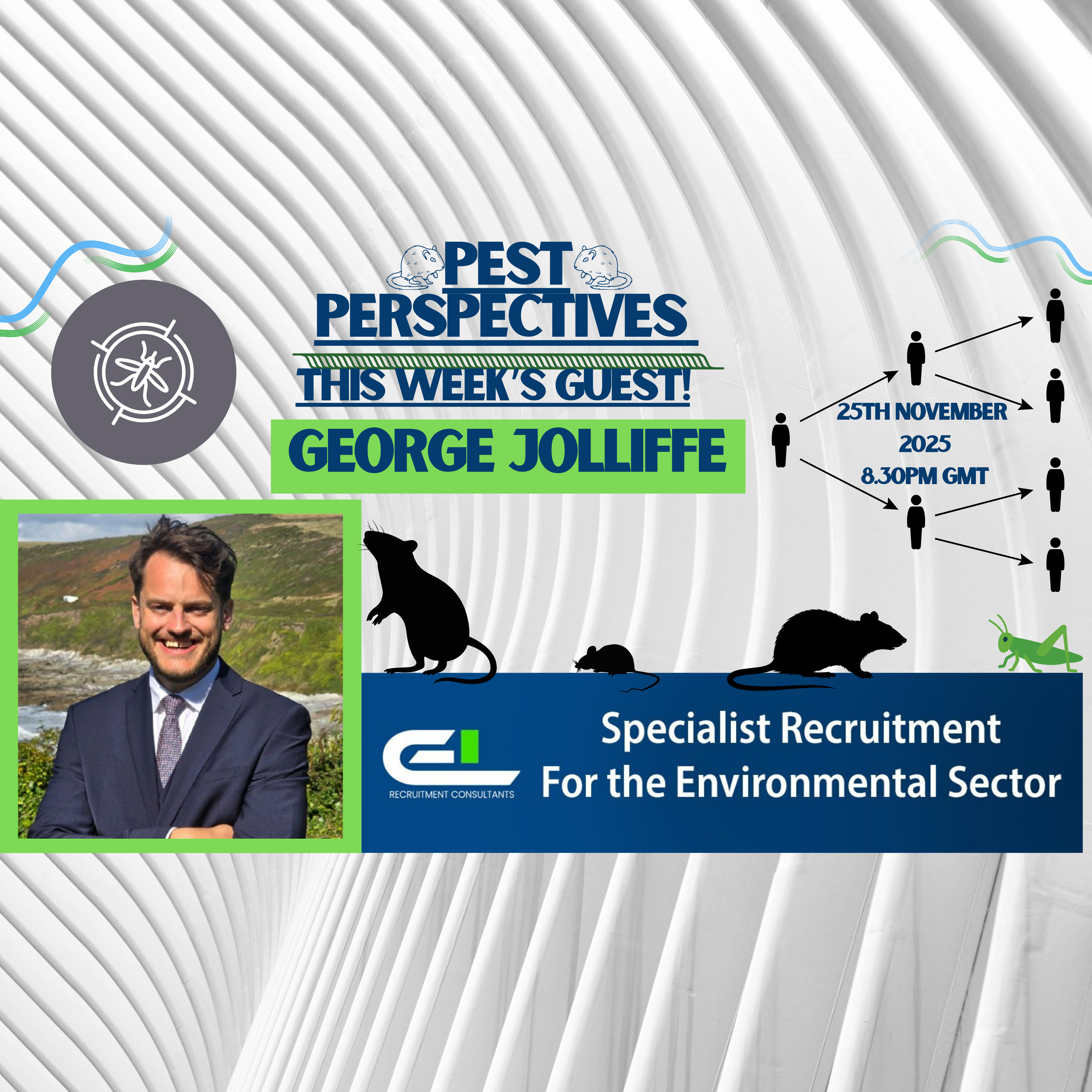
Pest Control Jobs & Recruitment: CV Tips, Hiring Technicians & Getting Into the Industry | George Jolliffe
Tonight's Episode
Pest Control Jobs & Recruitment: CV Tips, Hiring Technicians & Getting Into the Industry | George Jolliffe🎙️ Pest Perspectives Podcast EP 42 – George Jolliffe (G&L Recruitment Consultants)
In this episode, we sit down with George Jolliffe, pest control recruiter at G&L Recruitment Consultants, to explore the world of industry recruitment and career development in pest management.
We cover:
✅ What you shouldn’t put on a CV
✅ What you must include on a CV to stand out
✅ How to get a job in pest control and break into the industry
✅ How employers can attract better technicians and build stronger teams
Whether you’re a technician looking for your next role or a business owner trying to recruit top talent, this episode is packed with practical advice and insider tips from one of the industry’s leading recruiters.
Pest Perspectives Podcast is a UK pest control podcast hosted by Shaun Muller of Oakham Pest Control Ltd. The show features practical conversations with pest control technicians, business owners, suppliers and industry experts, covering rodent control, drainage investigations, bee removal, bed bugs, wasps, commercial pest management, compliance, business growth and wider pest industry topics.
Listen, watch and learn more at:
https://www.pestperspectivespodcast.co.uk
Hello and welcome to Pest Perspectives, episode number 42. Not #43 like it says on all the feeds, a couple of weeks break because I couldn't do it last week, but I basically, I guess couldn't make it. So it doesn't matter. You know, you've had 4041 episodes this year, you've had two podcasts a week sometimes. So there's plenty of that for you to catch up on. But this week for episode 42, I have George Joliff from GL Recruitment Consultants. How you doing, George? Very well. Thank you, Sean. Thank you very much for having me.
I've been, I've been following your journey with this for some time. So it's very nice to be here. Thank you. No, it's, it's it's good to have you on because in our obviously in pest control, it's obviously I, I run the company. I've never had the had to employ, you know, we get someone, yeah, maybe in the future, but I just thought it might be a good way of talking to you. So other people, other business owners or people that are looking to get a job. Sorry, it's a career, a career in pest control.
You could help with ways to help them get into the industry or ways to make you know help companies find the best technicians because some of the adverts are paid out there. Yes, workflows benefit. I think, I think it's challenging Sean, and it's challenging on both sides in respect to the fact that for companies who are looking to grow, finding and attracting and retaining the the team members to support that growth is is challenging in general. And particularly challenging in pest control at the moment due to the fact that there's quite an acute imbalance in, in terms of supply and demand of technicians who know what they're doing really.
So what I mean by that is there's significantly more jobs open in general than there are people in general who who meet those levels of experience and qualifications etcetera. So for employers, it's quite a difficult landscape to navigate, excuse me, in terms of identifying, attracting the people they need. And for people that are looking to either further their career in the industry or even get into the industry, it's challenging for them to to, to find the right positions that are going to be well suited to them.
Because again, it's it's very case by case for each person. So for for two different individuals, the the best, the best route for for their career is likely to be at two different two different companies. So it's not really A1 size fits all approach to that. So in terms of the job that I do day-to-day on both sides, really it's it's helping the companies to find and attract the people that they need to support their success and growth as businesses. And for the for the people themselves to and ultimately to be looking at it on the basis of what they want as a person and what their motivations and goals are.
And then establishing where where it would fit in with that. So yeah, a trick, a tricky, A tricky landscape to navigate. And then you throw in the fact that for job seekers, a lot of information that they'll see about jobs and adverts etcetera might not be all that informative because it might be,
you know, just some of the commonplace job description stuff. And everyone knows what a technician would would be doing within that role, but it's not necessarily furnishing that person with masses of information to decide on on where it's best for them to to work at. So yeah, good fun and quite, quite interesting. Very day-to-day.
I thought. I thought it is. It's like I know nothing about. That's why I got you on. Good evening, Jasmine. Thanks for popping in.
But yeah, I'll tell you what we should start with because we mentioned how complex it is. So what do you, what's the recruitment industry like in general? Because I read a lot on LinkedIn, I'm not on about the pest control industry, about a lot of jobs abroad. The reckon is there's recruitment agencies that actually put jobs out there that don't actually exist just to get you on the books and stuff. It's a bit roguy, that is, you know. There's. No job actually there, but someone's a ploy and thinking there's a job it's.
So I mean there's a few few points to unpack there. There there is, there is a concern around scams and and fraudsters online and I think that relates to it often seems to relate to to fraudsters who are offering a job often to international applicants that doesn't actually exist for the purposes of, you know, fraudulent activity. So that is something to watch out for. To be honest, it's generally fairly easy to spot if people are asking for information that they're just, you know, there'd be no need for them to have around personal details, etcetera.
I've read 1 recently. I look at a lot of stuff on LinkedIn and apparently it was a red flag. This person told this lady she makes resumes. Yeah. He messaged her and said someone can't write it and she said well what's up? She's it was basically your resume is not in the right format. Pay £400 for this company to get it in the correct format for our system. Yeah. It's a scam basically. Yeah, I've heard of all. I've heard of all that sort of thing. So I mean, just to keep things very simple in terms of the kind of ethics that I encourage and how we operate.
So there's no charge to any job seeker ever at all, full stop. And the ultimately the, the fees are paid by the hiring companies. So it's often businesses where perhaps they don't really have the, the year round need to employ somebody within their, within their HR function or, or operations function to do the, the recruitment side of things. So will will work for them as required case by case and recruitment as an industry, I think. So I never intended to get into recruitment. I, I went for a job interview when I was, I think 21 and the person who was in TMA, I wasn't really that interested in the job that they were offering, but what they were doing was really interesting and, and, and got into it from there without really much found the planning.
It wasn't a career that I've looked at through school, etcetera, and decided to go for and, and 13 years later, still still at it now. So I've learned a lot along the way. I think it's, it's not an industry that has the best reputation. I think it's kind of up there with second hand car salesman in terms of the public's perception of recruitment in general as an industry. I think there are probably like any industry, different, different types of operators within that and some of whom are quite salesy and pushy and some of whom are quite more of a consultant rather than a salesperson, I guess.
OK, OK. Yeah. It's just it's not something I've ever had to deal with. I just read a lot of stuff on and I know it's obviously a big concern in the that's the management industry for lack of people or for people retired in retiring. That's right. That's right. So I think in in the UK and past at the moment, I think we've got something in around 8000 technicians in the UK 7 to 8000 I think something are in and around half of those people are are self-employed owner operators, which which by my reckoning leaves a pole of, excuse me, perhaps 3 or 4000 texts in the UK.
Yeah, but that's across pest control, bird proofing, falconry, different specialist roles within that. But that that's probably the sort of pool we've got in the UK and it's an ageing workforce. So there are definitely more people retiring than people joining the industry.
A lot of people say that's a disaster and a crisis and I don't really share that view. I think it's a good thing. I think the bigger the bigger the constriction on the supply, the more that all the pest control companies can charge customers and the more that all the people in the industry can get paid. So I think it's a good thing if there's a skilled shortage in a labour process. Supply and demand, isn't it? Yeah, it's everybody in the industry in a more favourable position as regards supply and demand in my opinion versus if we do succeed in bringing in 2000 trainees straight away, all we'll all we'll achieve is to put depression in depressionary pressure on the the pay and and what you guys can charge etcetera.
In in my view of course you've got a balance down. We do need fresh blood in the industry, but I don't think it's a crisis or a big problem to the industry that we're struggling for workers. I think it's an opportunity to elevate pest control and on par with all the other skilled trades that that customers deal with. I definitely, I definitely agree. It's obviously it's a challenge for the industry, but I'm sure. I don't think it's panic mode though. I think I think we'll be fine, but just look at ways to try and attract more people to the industry.
But Jasmine's got a few questions for you. She has it off LinkedIn, she says. Did you find recruitment as a whole has changed massively since the COVID times? It has for me, I think specifically as regards working remotely being very normal now, whereas I think previously prior to COVID and you know, most of my working life had been in offices, I had asked etcetera and I think COVID changed that in terms of how people work in certain roles and where etcetera. I I think it moved the world on about.
They reckon they moved the world on about 60 years, they reckon. They reckon remote working was in the future. It pushed the world on a little bit. Correct. Yeah, I think so. And then, yeah, there was an absolute sea change over COVID because the government printed a lot of money and threw it into the economy and then there was a huge boom. And you know, around that sort of time, I think there was so many jobs about, there was so many employers hiring etcetera. And and then you know things are things have probably settled a bit from there in terms of businesses finally a little bit harder with some of the tax regulations etcetera coming in and and increasing their costs on that etcetera and customers tighten their belt.
So it probably has been after straight after COVID, a boom and then a steadier period where businesses are a lot of them taking stock, I think, rather than growing at quite such rapid pace. And, and, and, and in the UK, you know, massive amounts of, of, of mergers and acquisitions. And, you know, I'll say the other day to somebody, I'll look through the list of what were the sort of medium sized pest control servicing businesses that we're dealing with week in week out a few years ago. And almost all of them have been bought now.
They've almost all been bought by, you know, whether it be various groups and investors from around the world. So that, that's been a huge change, I'll say over the last sort of five years in, in, in the industry has been that change in companies being acquired and merging and, and all that stuff and new companies springing up as well. Yeah. I mean, I'm not the biggest fan of all this buying, buying up companies. I'm not the biggest fan of it, but it's the it's the business. It is. It's what it is.
Some of the. Big yeah, exactly. I don't think necessarily that many people really understand it. So it depends who's doing the acquiring. If it's the the private equity houses they're working on, I would imagine a deal cycle of something like three to seven years to to buy these businesses, make them more valuable and flip them again. And but then you've got others who are actually, and they're true and. Making these groups and letting them all run as they were, you know, all these different names and stuff.
Yeah, rather than stacking them all into one company the same. Thing yeah, possibly lessons have been learned in the industry from I think it was rented Gilbert terminates in North America and it was a disaster because and specifically because it didn't plan the integration correctly and they didn't execute the integration correctly. So it may be that the people who are acted by UK pest control companies are working on that in the background and and want to get that right before they bring things under 1 banner.
But I don't know, I might, I might be completely off the mark on that. Well, they managed to do it in America, but here they had to. The CMA said no, they said it was a monopoly, didn't they here? Yeah, that was a specific issue when rent to kill was by Mighty which became Virgo. And actually I think a nonsense to be honest, because even if you put that rent to Kill and Virgo together, this this slam and go monopoly anyways for the, you know, not to the extent of the competition, the market. So authorities need to worry about in my opinion, but I don't make the rules.
No, exactly there, but you know, Mighty still exist. I've got a mate who messaged me saying not a pest controller. He says I'm working for a company called Mighty doing Cleaning I. Think yeah, yeah, they do that Mighty. I messaged him back saying, you know, they're a pest control company there. I said there, I didn't know there were facilities companies. Yeah. Mighty have been and our multi disciplinary business, they'll have like one of the one of the businesses was the pest control business, but they've got numerous other service lines.
What's what's the I've ever seen on the road? I've never seen a might anyone from mighty or the name about anywhere? I'm still relatively new, see. Yeah, I mean, they're more mighty. You'll see them more in, in a general sense on, excuse me, the large government sector and commercial sector and facilities management contracts and stuff like that. A lot of their work is with it. OK. But yeah, no, that's, that's, yeah. It's that, that, that, that's been a significant change for sure. The the, the rate of pace of companies in pest control being acquired and, and I think that cycle will continue now because what I'm seeing is you know some very, very Kel capable people starting new businesses and those businesses will then be grown and then sold again on the next cycle.
So that's just how it how it gets. Yeah, of course cool. But I think a good opportunity and a good time in the industry for people to have that entrepreneurial spirit and, you know, developing growing new companies and existing companies. And where there's change, there's always going to be opportunity within that people to to do well. Well, it definitely is, but at the minute everything's up in the air, isn't it? A lot of companies are scared to take people on as well because of. Yeah, I mean the.
Way the way the economy is and the way the government keep bringing new taxes up and open everything, a lot of them, but you know, supermarket usually take on a few, a lot of people at Christmas Day attempts. But. Not a lot of them ain't taking any on. So let's do with so much do with the, you know, the rights that temp workers have and. That's a full time. Workers, they've got the same rights, so a lot of shops have been stuck in what to do. Yeah, well, they're, they're making, there was something called the Agency Workers Regulation, which was that basically ensure that temporary workers were afforded the same rights and protections as PAYE permanent employees.
And what we've got now under the current Labour government is because this is the thing, so to present people, everybody who starts a new job is in practise and reality on a 2A2 year probation period. Because under the employment unemployment law as it stands, and employers only need to give an employee one week's notice within their first two years. And and that's been changed now to give people a lot more, excuse me, a lot more rights as an employee from day one. So whereas before employers could, could hire people and, and kind of, you know, check them out through a probation period, now they're, they're incurring quite a lot of responsibilities towards that employee from day one.
So that that'll be a change. That's probably it. That is but. Yeah, it's still, it's, it's still, you know, the majority of pest control companies above a certain size that they're still ploughing ahead with wanting to hire more people. And it makes sense. It makes sense because the kind of margins that they're making on technicians is, is significant. So if you look at like the construction industry in the UK as a whole, typical margins, typical margins for companies, low single figure percentages, a pest, a pest control servicing business run correctly, 35 percent, 40% potentially.
And so it's an industry where it makes sense, you know, makes sense to people to keep hiring more technicians as long as they can provide them with sufficient work and get them going because, you know, it's profitable to to those companies to do that. Oh no, you're definitely right. It is if you've got the right, you know, if you've got a lot bigger. But then some of the big boys don't make as much as you think as well. It's weird, isn't it? Yeah. Do you mean the companies in terms of their financial results?
What do you mean? Yeah, they yeah. Yeah. But it's it's, it probably looks not a lot to us, but the dynamics at least billions it is. Yeah. And that and that can vary as well. It depends what your motives are in terms of are. Are the motives to make a business saleable and get the best price to sell it, which could be very different to other motives to. You know, to make it profitable or make it, you know, a good place to work or make it anything, really. It depends what the motivations are. That's a trend, yeah.
So Jasmine's got another good question that I that I think
it's a hard right. So here you go. Is there a set percentage of annual salary that pest control companies should expect to pay for recruitment, or does it vary too much to say on that? Yeah. So that's a good question. So, I mean, within the recruitment industry as a whole in the UK, the figures would generally be within the range of 10% to 20%. And the, there can be some variation outside of that, but that's broadly speaking the, the range in the recruitment market as a whole. So it, it would fall within that.
But the exact, the exact figure and arrangement will be based on a few different factors, such as
the, the nature of how they want to work, if they want to retain a recruitment partner to work as an extension of their team, or if they want, you know, something with less commitment where perhaps they may or may not want to hire somebody at some point. And so there's different, different considerations within that. But it yeah, it would broadly be within the range of 10% to 20% in recruitment in general and in pest control in the UK, probably more like 10% to 15% typically. OK. OK. So what do you think?
You know like the average RSPH level to awarding pest management? What's the average salary then for a tech? Or does that vary on the company? Yeah. So that will vary based on a few factors. One of those factors would be the geographical location. So within the UK itself, there's quite a lot of regional differences and variations. So for example, a salary that's a good salary and good offer in Liverpool. And you know, no disrespect to Liverpool, I haven't picked that particular city out, especially other than it's in the north.
A good salary in Liverpool that's highly attractive and you'll probably get decent people interested in London. There will be, you know, not a very good salary and not really of interest to people. So I mean, broadly speaking for for qualified Level 2 tags, there has been, there has been quite considerable salary inflation in recent years. So at present, I would say outside of London, you're probably looking at something within the range of 30,000 to 32,000 as a baseline to start attracting kind of good Level 2 tax.
And some of them will be, some of them will be on higher than that and you get some that are on lower as well. But that broadly speaking, outside of London, that would be the sort of range. And then in London itself, you're not really getting any decent level 2 tax for less than 3435 K as a minimum so. Expensive to live there as well, isn't it? And travel around there? Is that part of? Is that why or? Yeah, I think salary is an interesting one. I think they're ultimately, in my opinion, LED solely and wholly by supply and demand.
So it's a direct reflection of what that person can get for their labour in the market. And I think where a lot of companies have perhaps struggled over the years is they've been looking at, you know, some sort of formal schedule of rate or historical salary bandings, etcetera, and looking at that as the basis of, of what they want to pay or think they should pay, etcetera. And it's just explaining people explaining to people that in the nicest sense that that's utterly irrelevant. And the only thing that is relevant is the supply and demand today.
So companies will they'll they'll know whether they're paying not very well, reasonably or quite well. And the reason they'll know is if they're excuse me, if they're, you know, if their job offers have been been accepted, being accepted pretty much all of the time without fennel, then they're paying probably a bit a bit high. If they're mainly being accepted, then they're paying probably about right. And if they're having, you know, a lot of job offers not, not accepted, then that'd be the indicator that they're probably not really offering something which is piquing people's interest.
And I guess it relates back again to the, excuse me, the more more jobs than than people situation overall in respect to the fact that, you know, there's there's not many good, there's very few, actually very few good level 2 techs who are sat at home waiting for a job and can just start the job straight away. So, you know, in most cases, if you're going to hire a good level 2 tech, you're going to hire them by attracting them from other employment. And you know, there, there's a difference there between what will attract somebody who just wants a job right now versus if you're trying to attract people, you know, who have already got positions, etcetera.
Then, then, then, then, you know, people can afford to be more selective about what pay they're wishing to work for and, and move for etcetera. So, but I think yeah, outside of London to the north, starting from 30 up to 32 in London 3435 and then around the rest of the South perhaps 323334 be pretty normal. OK, do you reckon I say obviously job adverts on on the Facebook groups, do you think the jobs that don't actually put the wage get a lot of interest? Because I've noticed a lot of them, they don't put, they don't put how much you're going to get paid.
Yeah, look, it's hard to get it right all the time, constantly. I had a thing today where I, I think I actually need some more information about a position before I put put a salary on in haste. But but I mean, that is a rarity, to be honest. And I think, yeah, people, I mean, this has always been a bit of a, a quandary for me to get my head around. And I remember, I remember a client I was working for hiring, hiring company saying to me about a candidate that they were money, money hungry or money motivated.
And I said, well, yeah. Well, what do you think is the sole reason that we all go to work? It's money, yeah. Exactly. I mean it's. Afraid your family is. Yeah. So and, and, and in terms of experience, what I encounter, it's exceptionally rare to come across somebody who genuinely is not actually money motivated at all in, you know, in respect to what we do. People are rightly so they've got a there's a cost of living crisis out there at the moment. And I think, yeah, I can empathise with people who take the view that the job itself is relatively similar from company to company to company.
So you may as well work for whoever will pay you the most. I can, I can totally empathise with that. Yeah, no, I can't. I can't. I mean, obviously, obviously if you were to live, you know, I live very rural, but a lot of people live in cities and I bet there's a lot of companies paying, you know, I'm not. Some might pay the same, some might pay more. There might be competition for staff technicians you know to. Be honest, people get really worked up about this and and and, and I'm not one of them.
And I think the reason for that is people are free to do what they wish to do and there are a lot of people who are not paid particularly well, but actually they've made absolutely the right decision to get into something perhaps and, you know, reap the benefits of a career down the line. It's not all about short termism. And I think actually, if people, especially earlier in their career tracks earlier in their career trajectory, the the pay in the immediate term is probably probably not going to be the number one thing that it would benefit them to consider.
Because there are there are dead end jobs where you can't really do anything beyond it that will pay more than a trainee job in a field where you can actually further yourself and enjoy your working life. So in those situations, it's worth it for people to not take whichever job pays the most immediately. But on the other hand, you know, I think especially in this day and age now, people are pretty, the information is, is relatively easily accessible for people as regards, you know, roughly what what sort of pay is on offer for people who do my sort of job in my sort of area.
It's not, it's not half people to come by and learn that. So, yeah, I think, I think that again, has led to companies probably improving what they're offering people because, you know, they're mindful as well. I think that people need to earn that money under the current circumstances and that, you know, people won't stay at a place if they're being paid significantly less than than similar positions elsewhere. Oh, that and you've probably got them out. I've heard it a few places. Or you've got to make them feel valued where they look, they like they like working for the firm.
Absolutely. Or company benefits or something I don't know is gym. Membership. Is gym membership thing in pest control giving people your staff gym membership? I haven't come. I haven't come across that in pretty many cases. I have in some cases, but I think there's a, there's a broader point there around and some, some companies are really, really effective at this in terms of the what I would look at as team and staff retention, which isn't always solely about pay. Yes, of course, it's, it's really beneficial for the purposes of retaining good people to pay well.
But people there's, you know, the, the, the emotional, the emotional drivers that lead people to stay in jobs or move jobs, etcetera. And not linear and not black and white. It's all about feelings and how valued someone feels. And so the, the really savvy business owners will be, you know, highly effective at making their team feel loved and valued and on board etcetera, etcetera, etcetera, in ways that in ways that are not necessarily a direct expense to the employer. You know, and it's more about the, the, the personal side of it and, you know, encouraging people and retaining people through having that good rapport as well.
Yeah, no, I mean, I've obviously I work for, you know, commercial clients where I see some of them do stuff like they take them out on like you know what they call these these fun days out things. Like that? Having barbecues and dinner time and, you know, things like that to get them engaged, things like that. So great idea. The yeah, I think one of the best examples I came across of that was a company who every year have a BBQ and the like, the managers and the owners, they serve the tax, the food and you know, they're they're doing the serving.
And then a lot of those companies are also the really successful ones where they're all about the fact that it's the technicians who are doing the day-to-day work and representing the company, etcetera. And that they're the best asset the company has and to look after those guys and keep them happy and all that is, you know, crucial and really important things focus upon. Well, it is a lot of times if a lot of people walk out the door, you've got these contracts just kind of you can leave. What I'm saying is if a load of people leave, it can put the business in danger, can't it?
To a certain degree sometimes if you've got contracts for Bill, but keep them happy, I suppose it's. Not easy. No, it's not easy. It's not easy, no. And it's very easy for me to sit here and say, you know, do this, do that. Of course it's not that easy. It's not. But what? But my point is people, what motivates people to stay in and or leave jobs? It's not it's not solely black and white about money. It isn't. I mean that that is, that is often a factor, a big factor. But and when people are phoning me saying I need a different job etcetera, it's quite rarely, it's quite rarely because they are grossly underpaid and it's more commonly because of other factors and things that businesses can address to improve their retention without necessarily incurring additional costs directly.
That's. All the thing I've found with the everyone you know lots to back on these big companies, right? But one thing I've noticed about them is they offer amazing free training like level 2 up to level basically any course you want to do they'll they'll they'll they'll do it for you. They will training training is a big thing with these big, big firms. It is it's not cheap. Is it these these? These places, no, there's, it's interesting, there's a few points that I've picked up on there, Sean, and one of them, one of them would be something that I've learned over the years in terms of the day-to-day.
Because what, what I base my day-to-day and, and learning about the market on is feedback from technicians and, and there's no correlation at all between size of company and what it's like to work there in terms of whether the feedback is good, bad or indifferent. And what I mean by that is there are companies at the very biggest end of the spectrum route. I get great feedback about and companies at that bigger, bigger spectrum, bigger end of the spectrum that the feedback is consistently not so good about.
And then that also applied to the smallest companies. So, but in terms of training, so I mean, typically what I what I tend to see a lot of is those big companies being excellent for people entering the industry and, and gaining qualifications through that, gaining experience through that. And then their their career paths could, could be internally or could indeed be externally another business. So, yeah, I mean, I mean it's interesting again, it is, is it actually that considerable an expense to the employer when you think about the margins on on attack and the benefits of the business of having a well qualified tech?
Probably not to be honest. No, I. Believe you if you can get like if you can get someone and upskill them to something and they can do that work and you get extra revenue, a lot more revenue than it it's it's worth anything that makes the business potentially more money. Yeah, this is a willing to do. Yeah, 100%. It's interesting. I had this recently again and, and it's, it's specifically Ranskill that applies to actually in terms of how rapidly they do that training and it all it confused every time it happens.
It confused me a bit because I think, well, there's a kid here that's got 18 months experience and he's telling me he's a Level 3 field biologist. Well, it's not possible, but actually on paper they are because they they've joined Rent to Kill and they've done, you know, the normal route of safeties for identicides, level 2 best management. And then they've done the the certified advanced technician or BPCA field biologist stuff in a really short time frame, which I mean, yeah, I think there's aspects of that that you can hold the certificate, but there's no substitute for field experience over a lengthy period.
Like that's true. I reckon most people of a certain like academic intellect could pass these tests, but whether they're actually hands on expert or not I think is a different matter to be honest. Yeah, I didn't know it was that rapid. I think that was that rapid. Yeah, it can be. I know it can be there. I've not really come across that in too many other companies instances, but I know with rents that would do that in in some cases, which is great. I think a lot of the people in the industry have succeeded in various different fields, whether that be running their own businesses or whatever areas have have come from a starting point of joining one of those big businesses, benefiting from getting that training and certification experience and going from there.
So. OK. Yeah. But you have some interesting points, George. Cheers for that. Because you, you know far more. That's why I've got you on there, so people can. I don't know about that. I'll try and learn. Yeah. I mean, I just, I just listen. I just listen to people, to be honest, I think. And that's, that's the good thing about what I do day-to-day is the opportunity to learn a lot about different parts of the industry from different people. Well, you have a different perspective. Different perspective.
Best perspectives. Yeah, exactly. And I build that. I build that. It's interesting. So I build up quite a good picture over a long period of when I'm constantly speaking to technicians and all you worked there, what's it like to work there? You work there. What's it like to work there? It's it's quite informative because that the other part of the job, this end is every, if I pay to the employers, what's it like to work at your company? They're they're all going to say without fail, it's fantastic.
And it's this and I'd say the same about my company, right? So there's nothing wrong with that. But again, it's when I say it's case by case for each person and which job and which company would suit them. And you know, it's good to know that and understand that because some people like like certain parts and aspects of the work and other people like different things. So. Yeah, no, that's a good point. Ask pest control. Jason, thanks for popping in. I know the answer this form maybe, but Jasmine's got another question to ask.
I think it's more in America, isn't there much temporary usage within pest control? I know in America they they do seasons where it's busy season than they like and they take take them off. But it's not a thing here because I obviously don't know about that kind of thing. Is is temporary work as in pest control a thing? Yeah, we, we did this Once Upon a time, specifically in relation to seasonal WASP work, where companies throughout that height of the WASP season had a requirement for more workers than they would do throughout the rest of the year.
So yes, in relation to that more broadly, technicians being employed on a temporary basis as opposed to a permanent basis is something that I'd quite often see amongst councils and local authorities.
Often because they'll get their funding for a set period and it might not be for permanent headcount, but they do need a worker. So they'll have someone in like a temporary contract basis. But no, like broadly speaking, no, the overwhelming majority of of positions that we deal with will be permanent and year round and full time. OK. Yeah, it's still a good question. Question Jasmine to ask is, so if someone wanted to say they were looking for a job, what would be their best way of, you know, writing ACV or if you're in America, a resume.
Even though we say resume, what would you put on that? What would you put on that CV to try and give yourself the best chance of? It's a particular. Style. Yeah, I. Know, I know, you can go on canvas and get all these fancy ones. Now, is there any kind of way to make yourself look better than other candidates? Other candidates. Yeah, so I think there's a lot of varied information about all this stuff online, so I'll try and keep it as simple as I can. So in terms of the actual formatting and the layout, I'd strongly recommend very Simple.
And what I mean by that is not using a lot of pictures and tables and graphs and columns. I'll keep it quite quite basic and and simple in terms of format in terms of what to put on there. So if you're somebody who wants to get into the industry and will be looking to join as a trainee and hasn't worked within the industry before, the number one thing I'll say to put on there is to actually put that on there that you specifically want to get into this industry and actually put that on there. That I'm looking for an opportunity within the pest control industry.
I'm interested in the industry because of XYZ and etcetera. And the reason I recommend that is when you're going for trainee jobs, you want, you want the reader to read that CV and think, here is somebody who actually wants to be a trainee pest control technician as opposed to, as opposed to here is somebody who's just clicking every single trainee job they can find. You see what I mean? So that, so that's the key thing there is to tailor it. And there's a CVACV doesn't need to be solely a list of experience and qualifications.
It's ultimately your, your own personal sales document, if you like, around why it would be good for employees to give you a job. So if you go in for a trainee pest control job, put it on there and be really specific about you actually want this industry and the reason that you're interested in it is XYZ and make it tailored and specific for people that are, you know, already experienced professionals in the industry who are moving jobs or considering moving jobs. And I think the best advice that I could give on that would be to look at your CV as not just a list of your duties and responsibilities, but actually your achievements and what you've done.
So that could be anything. It could be I dealt with a very complex domestic wrap job which required me to use drainage investigatory tools and cameras. Or it could be I, I, you know, I dealt with some bird proofing work and had to install various, these various systems. Or it might be, you know, I did heat treatments for bed bugs or whatever. I think it's, this is, and I'd imagine this applies around the world that people are fairly aware of what a pest control technician job involves in terms of list of responsibilities.
So, you know, like say you're a pest control technician at one of the major pest control companies. You don't need to put the the duties on there that everyone knows, you know, that's what you'll clearly have been doing. You can use that space, you know, achievements and what you're proud of. And but I think it's also about getting, getting key information onto ACV. So I'll often speak to people, they'll have qualifications or certain skills that they've not included on there. So that would be, you know, it's quite commonplace for people to put their pest control, their main qualification on.
So they may put level 2 pest management. But then I'll speak to them and realise actually you've got IPAF as well and you've got plasma and you've got marksman and you might, you know, maybe you've got a firearms licence and you can shoot foxes and deer and whatever it might be, get all that on there, get all that on there. And then in the actual bulk of your CV, you know, I'll include if you're someone who's got specialist skills, whether that be moles, whether that be bird proofing, falconry, rodent proofing, if you're someone who can pull kitchen units out and proof behind it and put it back, whatever it might be, put that on that.
Because I think a lot of people, you know, they don't, they do themselves a disservice perhaps by not including some of their own attributes on their CV. Really good advice because it that would make you stand out, it really would rather than just. Say. I've got this level 2 and I've worked in and that's it. You are right, that's a much better read that would be. Yeah, exactly. And that'll then open, open up the next level of, of jobs, I would say, because in the job market, there's kind of 2 levels of jobs.
There's your jobs where you just need level 2 to be willing to kick boxes and there's your job crack on. And then there's your other jobs where it is actually about root cause analysis and problem solving. And can you can you be a stakeholder manager with, you know, clients or whoever it might be, this sort of stuff? And yeah, you know, there's I think for people that are looking to develop, it's good for them to include on their CV, you know, the, the different skills that they're they're proud of and that they enjoy.
And people should also perceive what they enjoy. I think, you know, if you're somebody who and really enjoys 1 aspect of the of the sector, go for it and and seek to specialise in that, you know and. You are right because there is companies that literally deal in, they've got a lot of big bird divisions or big bird proofing. Some people absolutely love just bird proofing all day. So you're right, the plants specialised. You can, but it's there's hate treatment. Specialists just do hate treatment.
There's there's. Loads. Yeah, the bird work is, I think, and you know, really, really good area. It's definitely a profitable area in terms of margins compared to other aspects of pest control.
And yeah, I mean, and it's interesting because some of the biggest, some of the biggest pest control companies can't service their own bird work but don't have the bird proofers. So they sub it out, which I was like wow, when I realised that I thought why do they do that? Yeah, I got I. Got. I got. I got told a story when Mark Mosley came on, you know, but he's been on The Apprentice. I'm not, I'm not saying the company name. I'm not saying the company name. They paid somebody X amount of thousands and then the bigger company charged 100 grand and the guy, the guy found out what I charged 10 grand.
Yeah, I. Mean, you know, I don't know. I don't know about those figures. But yeah. Well, The thing is, if you're what you've got to bear in mind is if you're Mr Klein and you, you know, you how many times have you ever had to price a big bird job? Like never. So you don't, you don't know if it's 30 grand or 80 grand. It could be, you know. Oh, sadly, you are, you are. But there's all these specialist areas of, of pest management. You don't have to just do general pests, do you? Definitely not. Definitely not.
And I think, yeah, like I said, different people enjoy different parts of that they do. And that's where it's case by case. Like some people really like the proofing work, some people don't. Some people, you know, all they want to do is fly Harris hawk and that's what they want to do. And then it's, you know, the jobs there where it's solely doing that or are they also going to do some pest control and are they happy with that? And these are all the considerations that come up. Exactly. Is there any massive mistakes people make on these CVS that you've seen?
Is there anything you shouldn't put on there? Like she's like basically, you know, because I don't know this, but you don't with a pest control job. If you're a qualifier, you don't need to go back to your school days to put all of that on there, do you? You don't need to go all. The way back, no, you don't, do you? I wouldn't say that you do, no. Filled out their last CVI filled out was my first job at 19 dead end job and next one was to be on the board of directors, the MPTA. So I think I've done all right because I. Got on the.
Board, but but that I had to ask a few people what to do. I had to. Pay for that I think, yeah, I think to be honest at the moment in the UK if you are already a technician and you're qualified and you're experienced, you don't need to write ACV particularly thoroughly to get job interviews. If you just put on that you are a qualified technician and put your experience, you know you're going to get the job interviews anyway I'd say. But where the CV kind of details information is more important, I think it's for trainees if they're trying to stand out, if that.
Well, it's not actually been the case this this last week too. But generally speaking, if you advertise for trainees, you'll get a lot more applicants. And if you advertise for qualified experienced people, just because the pools are bigger. And so the reason I say that is if you're going for trainee jobs, you might end up with your, your application being one of quite a few different applications. And that's why I say if you make it clear on there, you know why you're applying to that particular job and to just just spell out on there that you you want to get into that specific sector and that'll be quite advantageous for people to get loads of opportunities.
OK, that's good. Thanks Adam for for popping in. He says you obviously. Yeah, it says nationals will take on anyone on there literally don't care as long as they can give you a few boxes about the majority of the time. He's previously worked for a national before. He's he's, he's a good guy, is. Again, this is, yeah, this, this is, you know, it's not, to be honest, it's not applicable to group all the nationals together because within that you've got some that are, in my opinion, and very high service standards and some that are perhaps not as high.
So that that will vary. But yeah, I mean, I think there is that side to the industry for sure, which is the the jobs which are, you know, commercial contracts that have been won based on competing quite heavily on price. So therefore the only way that you make that pay is to get A tag to smash out quite a lot of volume per day. We're just fine. That is what it is. But obviously that then is a different job role and boat list to somebody who is interested in fixing the problems and doing the root cause analysis as opposed to thinking I need to be back in the van in X minutes to get on to the next job.
So there is there is a difference there. And it's not to say that they can't marry up together because they obviously do. But yeah, I think on the other hand, this is the other thing. There's a lot of the lot of the guys who I was going to say moan, which would be unfair, but who working those working those box kicking jobs, do they actually want to go and do the the domestics? They actually want to go and do that And and you know, probably not to be honest, in a lot of cases, no. No, you've got a good point.
But also equally with that question, I think we briefly touched on it earlier. If if, if a pest control company wants to find a good good technicians, good staff, what could they do to position themselves the best apart from just paid the highest money, you know? Because. Wording their jobs better like the job descriptions wording how they actually because a lot of them look the same. I mean I read them. I'm not obviously not looking for a job, but I just read them I. Do so, I mean, personally, I would look at that from the reverse standpoint, which is who are the people that they're targeting?
What's their target audience, which is good technicians basically. And and a lot of those good technicians are going to be in jobs and not going to be active job seekers. So they probably want to be thinking about firstly, how, you know, how is this opportunity of employment going to be brought to the attention, the people that we need it in front of? Are we going to restrict that exclusively to the people who are applying for jobs online and searching for jobs online? You know, does that, does that run a risk of attracting more of the people who are kind of regular applicants and job seekers rather than being a bit more broad with the view of who you're looking to recruit and attract?
But I'll be thinking about what are those people's motivations, the people that we want to that we want to attract, we want to get on board. Obviously, yes, they want to earn good money and, and the pay. And I know you mentioned earlier about being transparent around that, but it's also, you know, thank you, sorry. Jasmine. Sorry, Jasmine did say this. I didn't. I do believe in salary transparent. It's. Transparent. As otherwise it could be wasting someone's time, she put. Yeah, that's right. I mean there's there's nuances even within that that I've observed over the years, such As for example, company A might say the job pays maximum 32,000 for example.
And then person comes along, entities for the job, the company really wants them. They want the job too. But actually they can only take it if they want to pay 33 1/2. And you know, it's often commercially viable and sensible for the company to pay that, even though they'd said it was 32. So it's not, it's not always exact for those sorts of reasons, I think. But yeah, they, they should be, there should be, you know, open around that and and the bandings because there will be different levels for people based on how, how much experience they have etcetera as well.
But yeah, so I mean, when they're when they're thinking about their employer brand and attracting people, there's loads of stuff within that. There's you know, if they're especially if they're quite a sizeable business, they're going to have quite a sizeable team of staff already in the in the business. Those those guys will have, you know, their own networks and friends etcetera. Perhaps. So there's somebody they can recommend as trainee to join. He wants to get into it that sort of thing. But you know, when it comes to when it comes to I think experienced hires, employers, you know, they've got a few different options and routes that can go down.
Some of them, some of them seek to do do what what I do themselves, because it's not, you know, it's not rocket science. Ultimately, all I'm doing is phoning technicians. And if you're prepared to sort of sit there and, and, and spend the time phoning people and, and building lists, etcetera, then you know, it can be done by companies themselves. A lot of them don't really want to do that because it's time consuming. Yeah, very time consuming. It's like anything, I suppose. Like, you know, if if there was a leak, I potentially could get some tools and sort that out.
But I wouldn't, I'd call a plumber, you know, because that's what they do. I think. So it's similar. So they can, they can get, they can get support from specialist recruiters. But if they're doing that, I think it's important that they're working with recruiters who are able to delve deeper into the pool of people overall. Because in in this day and age, you know, companies are normally well capable of putting a job advert out and fielding the applicants, etcetera. So if they're using recruitment companies, they need to be using recruiters who are able to go above and beyond that and actually attract people who are, who are not not applicants and not job seekers.
You potentially. Yeah, I'm, I'm not the only, I'm not the only recruiter about we're we're in quite a fortunate position at the moment. I think where touch words there's, there's there's not really a shortage of work. So which is great. It allows me to be really open and honest with, with clients and, and not necessarily just put, you know, the client on the pedestal and, and, and do as you're asked. And, and that, that boils down to things like, you know, can you fill this job for us, George? It's this, that and the other.
And if the answer is, well, actually with respect to attract the people that we want, you need to be paying a bit more. I can tell them that, you know, if they don't, if they don't like that, then then that's fine. There's plenty of other jobs to to recruit for but. You You're in asbestos too, aren't you? Yeah, so we do, Liam myself do asbestos consultancy, which is people that do surveys for asbestos. Do you get them jobs? Then? Yeah, yeah. Like do a pest control just. Asbestos as. Well. Exactly the same.
So it's recruit, it's recruitment consultancy for the asbestos consultancy industry, the pest control industry, and then within that the bird proofing and the falconry. Because obviously the jobs are very distinct and separate and different based upon whether a company needs a pest control technician, which could be in a van or could be on foot and a bird proof or a rodent proofer, a poll Canary, etcetera. So there's lots of different and special specialisms within that. Yeah. I mean, ultimately, ultimately where I can typically help people is and companies when they're hiring is any instances where a more proactive approach to identifying and attracting the right workers as required, which is often often perhaps where companies have tried putting an advert out and not necessarily had the right results from that or whatever it might be.
Or indeed it's cases where. Pest control company owner is ending up spending that long trying to source and and hire staff that they would have made more sense for them to get on with running other parts of the pest control business and get get someone else to do the donkey work of phoning technicians.
So it's not easy. There's, there's no, there's no, there's no, there's an absolute solution to it at the moment. But I think, and I mean, in respect to the fact that, that there is a dearth of workers in the industry and that the, the demand for skilled people cannot be met by the current supply. But on the flip side, if you're you're a technician or whatever you, you know, whatever job role you're undertaking in the industry, it's, you know, it's quite likely that, that there'll be demand for your skills.
You know, and it's very often the case that the recommendation I make to people is actually, I'd recommend you stay where you are and stay in your current job, you know, Interesting. Yeah. Interesting take because obviously that shows how how authentic and you, you care because a lot of people are just like, yeah, yeah, no leave. You need this job. You know, you've got quite, you've got good morals when it comes to getting the person the right job and just saying stay in the job you're in. There, yeah, there's, there's a few considerations with that.
I can't, I can't recommend to people to go to a new job unless I can recommend that in good faith. And I genuinely think that. So there's that. But also it's that, you know, the, the, the problems associated with somebody taking the wrong job can be quite significant. So it's important and I think I think in this day and age now people do change jobs quite Willy nilly and it's not quite the big decision and consideration that it would have been in previous generations etcetera, but actually. Does that happen a lot in pest control?
Do people jump from job to job sometimes? Do they? Yeah, I would say so. It's not uncommon, but yeah, it's certainly not uncommon for someone in pest control to have worked for three different pest control companies in three years or four in four years or five in five years. It wouldn't. That wouldn't be uncommon. OK, it'd be unusual, but it wouldn't be uncommon. Would that be red flag? Would would that be red flag on the CV though? I would. Wouldn't it wait? Wait, it wouldn't be honest. Yeah. I mean, no, I'm not going to.
I would never. I would never outright with no consideration or thought, you know, discriminate against somebody because they've had several jobs, because for all I know, company one may have closed down, you know, company 2 may have been acquired and whatever. And there can be obviously different reasons for that etcetera. And it's not necessarily always fair to look at somebody and say, right, you had a short time, so that must be your fault. It might not be, but yeah, like if I'm honest, yeah, it's not good.
As if if people are really jumpy and they're constantly moving jobs and with respect, it's unlikely that it's the employer every single time and there's more likely a different common denominator there. But take people as you find them, I think, and different people will leave different jobs for different reasons. And it's not to say that they're not going to succeed in the future if they've had a lot of short, short employment stance. Ray just might not have found the right place. You might not have fit in and you know.
Yeah, as well there's. Also that there's that, but you don't, you might feel that you don't fit in or I don't know. But yeah, you are right. True to everyone that they, they might be, they might, you might take them on. They might settle at your place, might be your, you know, you might take them on and a bit of tech for years to come. That might be the one they like, you know? Yeah, you do, I do. I do still see obviously a lot of people who have those long 10 years at companies and it's not, to be honest, it's not necessarily the best thing for me to have noticed.
But I think more recent generations are moving away from that long term employment mindset and that job for life mindset and they're much more willing to move jobs more freely and easily than would have been the case in the past.
So, yeah, but I suppose what what I'm coming back to on that is for me this, you know, what we're dealing with here are really important considerations because for the employers, you know, it's, it's enormous. The, you know, the, the impact of how successful they are in hiring is, is, is huge for the business and for the person and people moving jobs and taking up new roles, etcetera. You know, it's their career that you're dealing with and it's their life that you're dealing with. So it needs to be something that's carefully considered and that they're taking with a view to it being something for the long term.
So that's probably where I'll end up, you know, saying to people, and it's more often in a case of where they're saying to me, they would like to leave their employment because of one particular reason. And then I turn around and say, well, have you actually talked to your, have you actually talked to your boss about that? And just, you know, put that out there and been open about it. And the amount of times when actually that that's then being resolved and that person, the best thing for them is then to remain in their in their employment.
They're probably a bit scared. Yeah, well, I think, oh, they just, they just get rid of me. No, that's right. That's right.
So sorry. I've lost my train of thought slightly. It's been rather a long day. But yeah, I think, I think, I think, you know, it's a different consideration if somebody's out of work, for example, and they and they're just looking for a start relatively swiftly, then then in those instances I would recommend to people pick up wherever employment is there and crack on. But you know, when it's people who are a bit more careful and considered about the direction their careers taking and they're not really like a full on active job seeker, but they would like to understand and hear about opportunities externally, those are more more the people I'm typically speaking to day-to-day.
You do sometimes get people who are simply out of work and want a job and they're they're, they're rare, to be honest. OK, that's it. There's some good information they're giving out tonight. You've helped a lot of people. Thank you. Where would where would you like to see pest management go? Have you got any thoughts on pest management? Yeah, anything in general. Right, in general. So what I honestly think in general is that pest management is a, you know, massive, like massively diverse and really interesting skilled trade and just a brilliant opportunity for any, I was going to say youngsters, but people of any age who are perhaps changing career or indeed starting their working life and to, to get into and to pursue a career within.
I think what would I like to see? I'd probably like to see a bit more respect, to be honest, for pest management. And I'd probably like pest management to be perceived on par with all of the other, all of the other skilled trades basically. And you know, on all aspects of it from pay, I'd like, I'd like, you know, pest control tax to be paid as much as brick layers. I'd like you know, or, or electricians or whatever it might be. And I don't actually see why they can't be because from my perspective, pest control technicians are playing a critical and the whole industry, you're playing a massive role, really important role in protecting public health.
You're protecting the environment you're dealing with, you're dealing with materials that are potentially, you know, dangerous and need to be dealt with in the correct manner,
though, you know, this is, this is a skilled professional trade basically. So I would like to see a little bit more perception change perhaps from, you know, away from that kind of archaic, the rat catcher type thing and more towards like a modern modern science professional, which is where I consider pest pest management sits. Yeah, I know. You are right, but I was talking about a while ago to another pest control of America, about why we are on the same level as builders, gas engineers. And you know what you said?
It's because we're not under the eye of yeah. Like, you know, when you're building, you're in someone's house, you're under the YEAH of compliance. The regulator. Regulator says you've not got them breathing over your neck.
It says if they were, if they were, we'd get paid more. This is a lot. Of that's correct that that yeah, that's correct. So. Just like I know. Yeah. We we did. We did a job where we had to go and we sort the mice out and it was to replace the pipe on the washing thing. Yeah. I couldn't believe it. It was £400. I was like, what? Yeah, what is? It one visit. So that I think to be honest that that relates to that relates to like a barrier to entry in the industry in terms of you know how hard is it to start a pest control company, how onerous are the regulatory requirements etcetera.
And then, and then that then leads to how much supply there is in the market and then from there what the prices are etcetera. And like it's only my personal opinion, I think the bar is too low in pest control. And the reason I think that is like for example, if I really wanted to start a pest control company, I can get a safe use course, get a website and crack on basically. And I think is that right? Necessarily when there's an opportunity there given the fact that the the substances and actives being dealt with can be risky etcetera, etcetera, etcetera, is that an opportunity to actually raise that a bit and constrict the supply as a result and get customers paying pest control in line with other skilled trades as a result of that it is even possible.
I don't know to be honest, but. It's people much higher up than me. I don't think it, I don't think it will, I don't think the situation will change significantly on that to be honest because I mean, I know there's obviously been been, you know, some changes recently etcetera around that and but. It's not that much of a big. Deal. No, it's not. It's not to do. Them. And it's just a bit toothless, isn't it? Because if you don't want to do it and you don't want to do any of that CPD and you just want to get a safe use course once every five years, you can.
And it doesn't. You can. Do that. As long as you're not part of a trade body, you can do that. Yeah, exactly. But if you're. Just if you're just in a yeah, you wouldn't even need to bring your CPD body. You are people out there. Just do that. But I mean as it, but I mean as it relates to an actual barrier to entry to operate in professional pest management in the UK, there is almost no barrier to entry whatsoever really other than a safe user which is very simple to get. So would it be beneficial to raise that barrier to entry and therefore constrict the supply and raise the prices and get pest control on par with other skilled trades?
And could you do it? Maybe. I don't know. I don't think it will happen. You have a good point there. I think this might be be connected Adam's just put in the chat. What's your take on actual wage structure for technicians George? Do you think they're totally undervalued with them with how many risk associated whether it be on site, serving, servicing products, diseases etcetera? I was on 16 KA year when I started. I was doing silo clean all over the country, egg nest removals on high roads etcetera.
So many risks associated. Just interested to see a view from a recruiters above a recruiters perspective.
Well, I think the first thing I'd say on that is every single technician who goes out there and does the actual hard work has my respect. And I think they earn every single penny that they get. I really do.
Yeah, I agree with anyone being paid 16 K, absolutely not. I think that probably relates to some years ago, to be honest. I know that. Yeah, it. Was a few years ago it wasn't, Yeah. Yeah, I think the minimum wage now is probably I think full time something around not far off 25,000 now maybe it's a bit more than that. No, look, I think I, I, I don't personally worry about this. And the reason I don't is I think the market thoughts it out. So nobody's compelled to remain in a job at all. So anyone who's not particularly happy with their pay is, is absolutely free to, to, you know, if they think they're underpaid, they're absolutely free to go and get their real value elsewhere.
That's true. So, so I don't, I don't worry about that too much. I do come across instances that are just egregious. Like there was someone last year who I spoke to this person and they told me what they'll be. They told me what they're being paid. And I won't go into the specifics, but it was very modernist. And I said to this person, I think we should be aiming for an increase of 10,000 on a salary from from like low. I think there were maybe 24K there or I don't think you should be aiming for about 34.
And they and they and they managed to get that, but that that's an, that's an unusual situation. It's quite rare to come across people who are actually egregiously underpaid in the market. There are some companies that still do it, but I think it's counterproductive to be honest, because you're just never going to, you're never going to attract or retain the people that you actually need if you're going to pay rates that just don't really pique anyone's interest particularly. So no, I think I think employers incur a lot of risk as well.
And it's fine to say, you know, the employer makes money and I should get more of that in pay. And in some cases it's accurate. But on the other hand, I've known that for a long time that if, if you want, if you want someone to pay you, if you want to work for somebody else and you want them to pay you a pound, you're going to have to earn them 3 lbs, you know, and that's just how it is. So I think my answer has probably changed, especially in recent years coming finding now there's a lot, a lot more of the technicians now are better paid, I think and more fairly paid than was the case even even 345 years ago.
So now on balance, I'll have to say no and solely because it's a free market and anyone who's not happy with their with their pay is absolutely free to go and get their real value elsewhere. Yeah. I know, but I've added in because I haven't mentioned it. We also put yeah that 16 K job, it was was years back because I generally think if you want to bring youngsters through who show genuine interest and stick to it, they need to help the waste structures even for starters. Yeah. I mean, that's, that's, that's a problem actually, that's a specific problem as it relates to pest control And that is that, you know, there's no, I don't think it's particularly viable really to pay green trainees much more than no, I think paying the minimum wage or in around that and makes sense.
And, and, and that person at that point, they're not necessarily doing the role because it is the highest paying employment they can get, right then it's because it's a career. And I think people do, people do get that they're going to start on the lower pay as they're learning and training and increase that as they gain more experience and qualifications. But it's. Like doctors, a lot of them start off low, then eventually some of them will be on a lot more, yeah. Yeah, look, I think it had to be honest, it, it has, it has for, you know, some considerable years been been an industry where, you know, the, the, the pay perhaps hasn't been the best in, in amongst other industries and sectors.
And, you know, people I think choose pest, pest management for other other reasons and other considerations rather than rather than specifically the the pay. But yeah, we're definitely benefit us. And it's a good thing that the salary inflation. I know it's a pain for employers, but it's it's a good thing. Because if we didn't have a situation where the decent techs are now all on, pretty much all on something starting with a three, then, you know, we'd be losing more and more and more of them to other industries.
So, you know, that's. Yeah, that that's a good thing. Like I say, people in this industry, it's, you know, it's challenging and important work and hard work and they deserve to be well paid. And I'm pleased to see it increasing. Yeah. I. Know it's good to hear it. It's good. It's been really fascinating. I mean the chat, I've had loads of comments tonight. A lot of the time I don't I don't get anyone talking, but I've had the chat going loads. But yeah, it's it's an interesting topic. It's something different and then I hope everyone's gained something from it because I certainly have.
Is there anything else you wanted to mention? No, I. Think that's all. It's just nice to come and have a chat and I know it's a different, it's a different perspective to others. Good. It's what I want.
Yeah. But no, look, Sean, I I absolutely love, I absolutely love what I do in the job. And it's, it's great and it's challenging and difficult at times. But ultimately I'm speaking with, you know, people who were further in themselves, whether it be, you know, taking on a new opportunity and and developing their employment career. Or people who are growing a business or even growing a business to sell a business and you know, they're, they're going to bring it all to fruition. And, and that sort of stuff.
It's it's great. And yeah, I think for me where where we've probably had success over the years has been, it's not bums on seats, It's not one-size-fits-all. It's very much for the, for the candidates, it's about, you know, what are their motivations and what would suit them as an individual. And for the companies, it's about how can we go above and beyond just the churn of the same job applicants And how can we how can we identify and attract the people who might not be job seekers, but they might be the people that we need to take this business forward.
So it's a constant challenge and really enjoyable that's. Good. It's good to hear that. Do you want to give your business a plug for people? If anyone's interested the lessons. Yeah, thank you. So the, the business is, is simply G&L Recruitment Consultants, which is G George and L Liam who I work with.
And I'm quite, I'm quite active on LinkedIn and Facebook. And if anyone wants to find me regarding their own career development and jobs or indeed regarding their own business and team and adding technicians or indeed surveyors or other other individuals to the team, then probably best to find me on that. Yeah, No, he's been, he's been good. He's definitely active. He's you can always get older, George. You can. I've got the phone, I've got the phone chain chain to my wrist the last 13 years in this in this line of work.
Definitely. But yeah, yeah, also everyone, if you're want to log your CPD with whoever you're with with basis prompt, you could, you won't be able to get a code for this specific episode, but everywhere else where you can self register, you'll be able to self register points. So yeah, thanks everyone and thanks George. Thank you very much, Sean. Thank you. Thank you. And I'll speak to you soon. Definitely. Thank you. Cheers. Cheers. Bye bye. Bye.
Sponsored by




 Amazon Music
 Apple Podcasts
 Audible
 Castbox
 Castro
 Deezer
 Goodpods
 Moon FM
 Overcast
 Pocket Casts
 Podbean
 Podcast Addict
 Podcast Republic
 Spotify
 YouTube