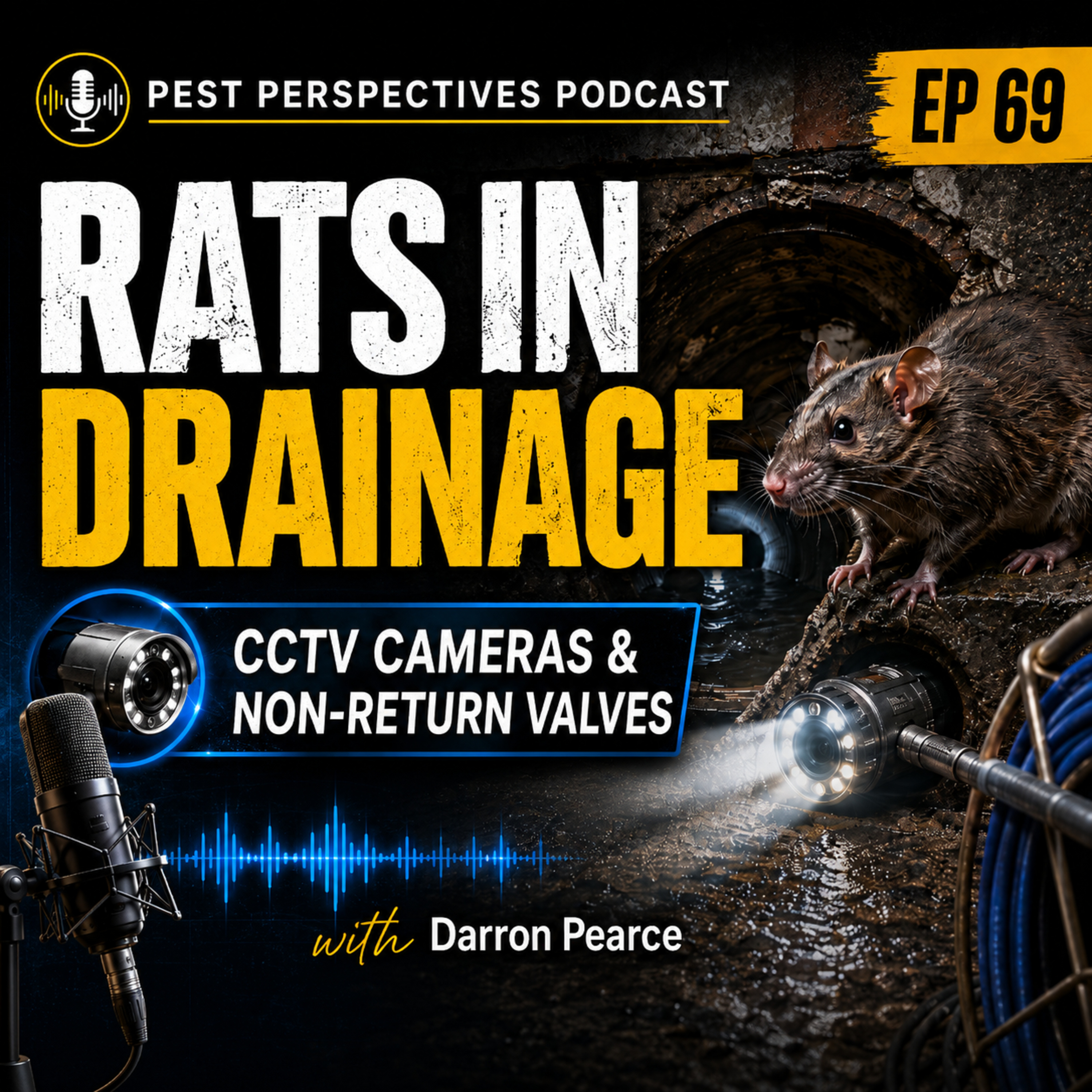
069:Rat Control in Drains: CCTV Drain Surveys & Non-Return Valves | Darron Pearce, RATTRAXS
In this episode
Rat Control in Drains: CCTV Drain Surveys & Non-Return Valves | Darron Pearce, RATTRAXSIn this episode of Pest Perspectives Podcast, Shaun Muller is joined by Darron Pearce from RATTRAXS for a detailed discussion on one of the most overlooked areas of rodent control: rats in drainage systems.
Darron brings years of hands-on experience from both the pest control and drainage industries, sharing valuable insight into how rats can use drains, damaged pipework, surface water systems, hidden chambers, flexible pan connectors, old gullies and building extension work to gain access into homes and commercial buildings.
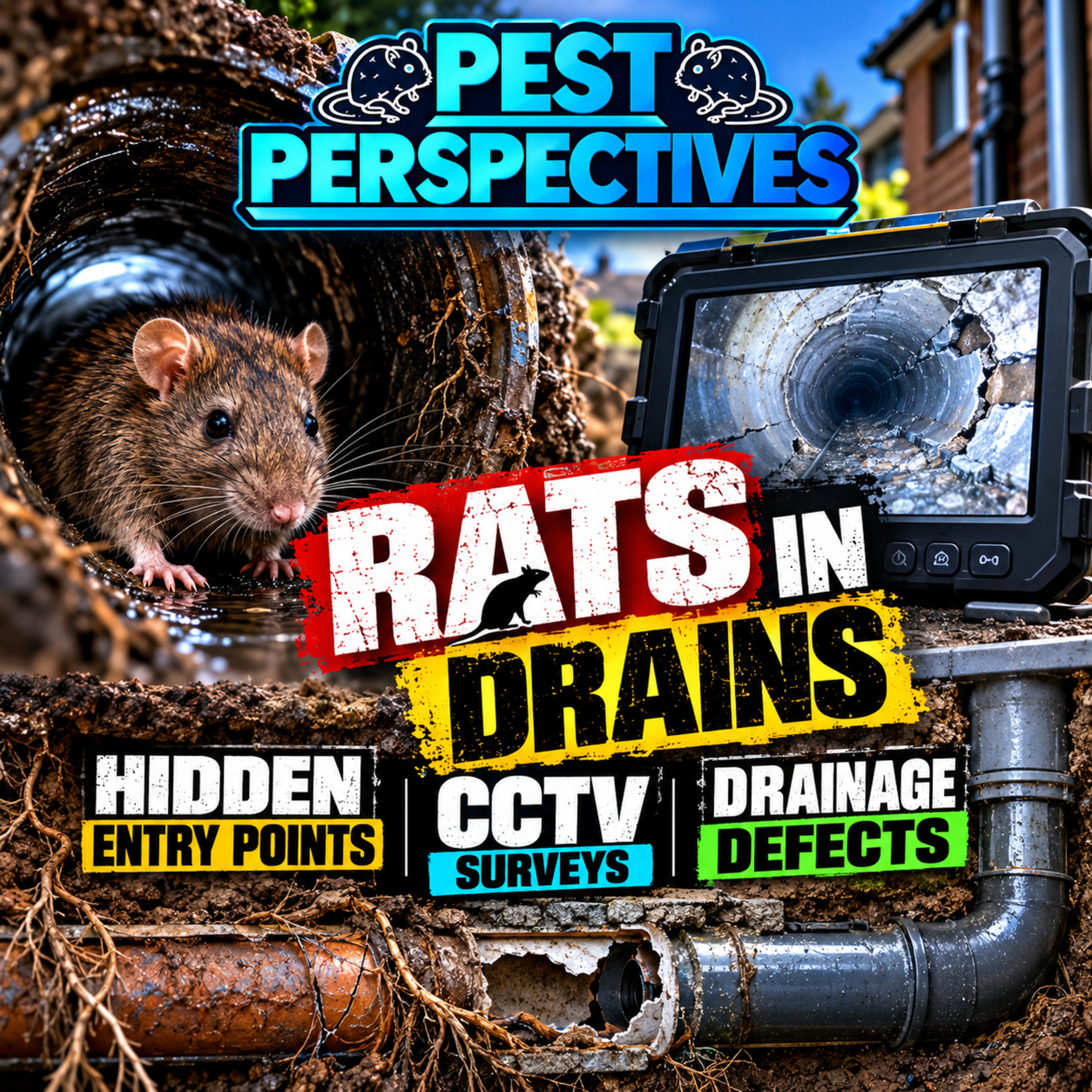
The conversation explores why recurring rat problems are not always solved by baiting alone, and why evidence-led investigation is so important. Shaun and Darron discuss CCTV drain camera inspections, how rats exploit defects or open drainage routes, the importance of understanding foul and surface water systems, and why pest controllers should know when to involve specialist drainage professionals.
They also cover the use of non-return valves, including when they may be useful, why they must be fitted correctly, and the importance of flow testing, monitoring and understanding ownership of private drains versus public sewers.
This episode is ideal for pest controllers, drainage professionals, facilities managers, landlords, housing providers, commercial clients and anyone dealing with repeat rat activity where the true source of the problem may be hidden below ground.
Topics covered include:
- Rats in drains and sewer systems
- CCTV drain inspections for rat ingress
- Surface water drainage and SUDS
- Foul drainage defects
- Flexible pan connectors and rat entry points
- Rats climbing internal stack pipes
- House extensions and hidden drainage issues
- Build-over problems and inspection chambers
- Non-return valves and rat gates
- Working safely within your competence
- Why pest control and drainage knowledge should work together
A great episode for anyone who wants to better understand how rats move through drainage systems and why proper investigation can be the difference between temporary control and long-term resolution.
https://rattraxspestcontrol.uk/
#PestPerspectives #PestControl #RatControl #DrainSurveys #RatsInDrains #RATTRAXS #RodentControl #PestManagement #Drainage #NonReturnValve #CCTVDrainInspection #UKPestControl
Pest Perspectives Podcast is a UK pest control podcast hosted by Shaun Muller of Oakham Pest Control Ltd. The show features practical conversations with pest control technicians, business owners, suppliers and industry experts, covering rodent control, drainage investigations, bee removal, bed bugs, wasps, commercial pest management, compliance, business growth and wider pest industry topics.
Listen, watch and learn more at:
https://www.pestperspectivespodcast.co.uk
Transcribed automatically
hello and welcome to pest perspectives episode 69 this week on i have darren pierce from rat tracks but before i go on to that this podcast is sponsored by powered now they have helped upgrade the podcast so i've got a better microphone they've paid for this software for a year just little upgrades to try and push the podcast further and help us out um if anyone basically what powered now do they're a job management company uh you can schedule schedule your visits pest control reports all sorts um and even do your tax and your bidding information etc for your customers we thought we find it very good but yeah if you want to try it out you can i haven't got a code for you just google powered now um but also just let you know if anyone else wants to drop a sponsorship to support the show they can just drop me an email at uh pestperspectivespodcast at gmail.com but um welcome darren how are you doing very well thank you very much good evening yeah very well thank you good to hear yeah yeah it's good four people already you're bringing the you're bringing the people you are all right martin how you doing mate uh six people now it's going up but um so do you want to tell people who you are and what you do and then then explain how you got into doing doing drains
within the industry right yeah my name's obviously darren pierce my company is called rattrax pest control i specialize in surveying drainage or or looking at drainage for how drainage how the rats use the drainage to get into the dwellings commercial buildings and everything like that that's pretty much all i've done all of my working life as regards to the pest control side of things i yeah i started i got into the industry very early pretty much just after school without being too boring i was one of the youngest in my years so i couldn't get gone to the yts schemes or anything like that so i had a little bit of time mucking around and then i got took on by derby city council for a very very short period of time i think i was there literally two weeks two weeks that's not long no it was uh i went it was literally putting blocks of poison in loft spaces you didn't even look in the loft you just dropped them in that was it you didn't even have stepped ladders to get you to the loft height you literally had a walking period two steps high lift up the loft out to put the poison in move away oh wow that's okay we are talking 30 or 35 years ago so practice is a pain oh i know but i still would have thought you would have had a little look
around with your torch but no okay okay no no there was none of that on my when i was doing it anyway um okay it was mixed up in the days when you was pest control morning and a tuesday and then you was working on the parks thursday friday saturday so oh it's a bit of a mix and then i got involved with a company which is it was well known in the time um they were a very very good company at the beginning but they got very big very quick it was a company called pronto uh based up in derby um and at the time they had massive coverage literally from lands end to john of groats in drainage in the drainage industry and then they set up a pest control industry side and when i went to them i well i got involved with them and basically got involved on the drainage side and I was working there for two or three years and then I moved over to a company called Dial-A-Rod in Derby and that's when they set up so again specialised in all drainage and that was where I was doing the mortgage surveys the build-over surveys house purchases the odd rat survey it wasn't really big into that and then from there I moved over to a company called Quick kill and that's when i took my drainage experience to the pest control side and i was there with a
short space of time i've done two or three rounds with different companies and then i set up on my own uh several years ago i kept under the radar for a while just you know just doing what i was doing and quite happily doing what i was doing but then obviously you get involved with more pest controllers pest control the thing about pest controllers or now i'm not going to say now, or now, I am going to say now, because I don't think it's always been like it. I think there's a lot more support for each other out there now.
I think people tend to get on with it more, whether it's down to social media, whether it's just down to social media or the people, the new people coming into the industry, the better people coming into the industry where they just tend to get along more. I would agree. I mean, obviously, you've still got the people that act like it's the old school days. I had one guy at, what's it called? It was a kill germ day or something. And my dad said, oh, where are you from? And he was like, warm your competition.
And he was like, I'm a mole catcher. He said, we're probably far more expensive than you, mate. I don't even know his name. He's like, he wouldn't talk to us. It was well weird. I was like, you know, that's the only time I've really had it. but I know generally most of the press controls in my area and we get on, to be fair you are right it's changed, a lot of it was you're my effing competition, I don't want to speak to you, but it's a bit different now. You used to go into people other people's jobs and people used to call you work and that regular and slag you off and things like that, I can remember that many years ago, but thankfully and gladly, now there seems to be a lot more, you've still got your healthy competition of course, and you've still got your competitive nature, but there's no point being an enemy about it is there you've just got to get on with it really exactly exactly darrett uh i mean jason welcome thanks for popping in mate he has a train camera he was definitely looking forward to seeing this podcast he was he was just jason is it jason yeah mcfee he uh he's the one that always pops out the camera you know i'm sure he's mentioned it when he'd been on the beauties and beasties before he has but um but yeah sorry carry on yeah you're right we are seems to be more collaborative than it used to be i think a lot more of the on the road days from various trade bodies etc more people seem to be talking to each other than they used to be everyone was like you're on that side you're on that side we're not talking to you we're in our group that's it but a lot more people talk to each other now i completely agree i think it's changed massively whether it's the
introduction of social media more and people just want to get out there and be seen more but i mean like um i'm thankfully i'm very thankful for this pest control companies ring me uh for help and advice and i go out and do surveys and help them out but then when when in your job you get talking to people um you get talking to the technicians you know and where they're going out and doing like big bird jobs or they're going doing this and somebody takes a dog to go ratting and somebody goes this all the parts of the industry which i never see because i'm literally my head's down i drain all the time you know what i mean so you know so even though i've been in the industry a very very long time my what i know of the industry is very knowledgeable in my part of the industry what i know about the other parts of the industry is very small yeah these people who do these big bird net jobs and things like that i have nothing but admiration for them yeah they are i don't go and price up something which is eight stories high and 15 which you know 100 and 250 meters wide i have no idea you are right because i get i get told we don't do that kind of work but i've got uh whoever got coming on jim england coming on soon and he was like
you can't actually just ask us to do it for you and they put a markup on it and they come and price it up for you so if you ever get so if i ever get a big big job i'm gonna say jim let's let's uh come and sort it out what i do now if any if i'm doing a job somebody asked me about something else i'll say right i know a person i know a company i can trust and i you know i give that pass their number on i wouldn't even dream of doing anything and wouldn't even start doing something like that myself yeah because birds is a it's a big area isn't it there's a lot of different technologies and nettings is everything i don't understand it all but i do know that some of the jobs are massive and must cost a lot of money it must it must because imagine without netting you're supposed to really have you should really have on the maintenance plan just to make sure because you know how they're getting nowadays with a lot of the media a bird gets caught oh that's cruel etc so you've got to make sure it's all maintained and all in place isn't you i imagine that's what your whole life like you think you're being watched by a camera anyway nowadays i mean you're saying you've got to do everything correct do everything properly
that's right that is so obviously obviously you've been what so what made you want to set up a company you're like right i've had enough i'm doing it myself i think i can do it i could give it a go i got sick to death of working in with limited stock in the back of your van and 12 jobs on a job see today i'm just gonna be honest with you um you never felt like you were solving the customer's problem never and even though i got all this drainage in from background knowledge I understand our drainage works.
I understood our rats worked and got the companies I worked on later on. They weren't interested in getting the drain camera in the ground. They were just interested in you walking around, filling up boxes and ticking the boxes. You know what I mean? That was me. You know, some companies thrive on it. Some companies make very good livings out of things like that. And you've got the countries, good companies have massive, massive contract basis. I just wanted to deal with Mr. Smith, Mr. Jones, go there, solve the problem.
So that's what made me set up on my own. the initial bit, I just basically wanted, I knew that I could do it, I knew I could do it properly, I knew I could do it competitively and so obviously, you know, like everybody, when you start off it's very difficult getting your name out there and things like that, but I fell back onto a lot of the people I knew in the drainage industry who, you know, would say, we'll get this guy in, because there is a big difference for surveying a drain for a root ingress or displaced joints or this, that and other, than there is for surveying for rats Massive difference I don't know what you're on about, Darren I'm joking here, I don't know what you're on about Darren, there ain't no rats in the drains what about that that's what they all say isn't it ain't no rats in the drains yeah the waterboard would be great for that yeah but no, that's a good reason because it gives you a bit of purpose doesn't it it gives you a bit of purpose, that's your main business is that is solving the actual issues via a drain survey now do you do the actual repairs or do you contract a company to do the repairs i contract out to reputable drainage companies um okay the i have i now in the last three years i've worked solely with a company who i've known for decades and who have got every single
certification going over the thing but now in the last three years i've mainly gone down the lines of the NADC web registers and things like that, making sure that I'm doing, it's all going in the right direction. I'm a great believer in no disrespect to Bob's drains down the road, but I don't want Bob, who's been doing drains for 55 years in the back of a white van, doing anything to do with my work. It's got to be. No, I totally get that. Because I'm talking. For anybody, any old tradesman, any old boys in the industry for a long time, I've got no disrespect.
but unfortunately the way it is now everything has to be certificated everything has to be done correctly and i wouldn't dream of recommending to my my customers anybody who couldn't do the job properly exactly because then it then it damages your reputation too oh he recommended them and they were crap i still got the issue yeah you know it chocked a bag in the drain instead of actually fixing it you know i don't know i don't know if that happens it does i've got footage with the constant dream yeah it does i said that on purpose though to be fair i did but um but yeah no no it's a good it's a good way of having a business so obviously i reckon a lot of your work does a lot of your work as well come from um pest controllers recommending you uh or working with or working with them yeah i've got about more than more than a dozen companies now who pass regular work um and i work alongside them all i do let's just say for you was to ring me and darren i've got a problem i need a drain survey this that and the other excuse me i never comment on your work i never comment on the pest control side of it i'm being brought in poorly to find out how the rats are getting in yeah um i then do the survey and um i then supply you the with copy of the report and
the customer the copy of the report you know it's all signed for at the beginning to make sure that that everybody knows who's getting what information. I never put any recommendations on anything other than what needs to be done. That's basically it, really. I don't comment on the pest control side of it. So it's all the drainage side of it, which I comment on. That's nice, because it is what you're there for. Hi, Jackie. Thanks for popping in. Hi, Jackie.
Just because I had to make it quite clear at the beginning, because some people are obviously nervous, that you're going to start taking customers and things like that. I'm not interested in any of that. You call me in, I do the survey for you. I've got all the equipment, the sonar tracing equipment, the mapping equipment, all the LIDAR equipment and everything like that. I come in and do that for you. And then I don't comment on your pest control side of it. I just basically supply you with the report.
That's nice because I can't understand the fear. Because say, I don't know, you're going to, I don't know, e.g. a commercial site and it's a big site and you've got to deal with the drainage and you could say oh this pest control is shit I can do it so you can yeah I can see why they're saying that the biggest problem I have and I and I've said this several times when I do the talks with the BPC on the forums and things like this and and the thing for 1EMV the the biggest gripe high I have is when you go to the customer when i've been called in by a pest controller or or a pest controller is recommended not so they're not recommended we've recommended to the customer that they get a drain so they carry it out and then i somewhere along i get i get involved somewhere along the line then and then you've got the awkward thing there where you know that the pest controller's not done it wrong because every everybody's got a different pair of eyes but you get there on site you think to yourself why has that been done and the customer's not laughed the customer's not stupid they pick up on the fact that i've gone there and solved the problem in one visit and the other person's been there nine times you know that's only because i've got the equipment and the knowledge of the drainage exactly that's the doubt that's the
bit i struggle with because i don't want to be seen to be calling anybody i think it's very unprofessional you know what i mean so you've got you've just got to keep you keep your cards close to your chest so to speak oh no i totally get it's about being professional and then you wouldn't want someone to lose work or say well exactly not yeah so so with regards to if you know just a bit of knowledge on drains and how it works how does now if someone was i'm i'm not on about your level camera say someone was to buy a drain camera what kind of things do people need to look for in drains when when they're looking for the road ingress what kind of things you look for well obviously i mean it's already it's easy to that's it's a bit of a open question that because yeah you've got drains don't have to be defective for you to get rats inside yeah okay so every if you're not going out they're purposely looking for a fault then that's not always the case so on certain on foul drainage it's foul drainage is technically a hydraulic system it has to be flushed from one end and it flushes out you know what i mean so flushes you're on your bath you know that's technically a hydraulic system so it starts at
the head of the system then flushes out that should be a sealed unit under four gases legislation so if it's got any defects in that drain if there's a defect in the drain then the rat will take advantage of that defect so nine out of ten times if you file system you've got to have a fault in a file system for the rat to take advantage of that you haven't got to have a fault in a surface water system the surface water system we can construct it as it was and still not be rat proof and we're getting a lot of this now on more modern day drainage um okay um without getting too technical and too boring under what's known as the sewer transfer regulations of october 2011 in july 2011 um you get what's known as the way the the wastewater transfer act some drainage built after 2011 may not be adopted by the local water board oh okay and some of this surface water drainage or a lot of it's mandatory now in scotland and it has been for several years so a lot of the surface water drainage will go to things like suds sustainable urban drainage which is big ponds you see inside of oh yeah i know what you mean now yeah like that now that system is an open system it's open at both ends it's open with where the
water comes in from into the sod and it's open at the gutter end of the house and it has to sometimes sometimes it's all depends on the construction of the the permit the permit if you've got permeable drainage um other words soaking into the ground and going into the sod or if you've got heromone systems or what's known as aqua cells the rats can use the aqua cells and things like this to get from the sod to the house okay and that and there no there no obstruction in the way and that the circle to drain and that as it been built and the rats will use it all day long but the drain people a drain surveyor will go out there and look for a defect and you're not necessarily looking how the rat will work oh so that's thinking outside well you know your stuff but that's kind of an outside the box like let's look at a different way so there's no way of actually proofing that is there yeah of course there is so you can you can use um once you've done your investigations to confirm to confirm i mean obviously there's several things i use methods i use where you put the temporary barriers in the way and if the rats chew through the temporary barrier that's you know you know then it's going in things like that you have got your things love them or hate them
things like non-return valves and things like that oh yeah sorry i forgot about them kind of things the non-return valve is a valuable tool if you're using it as an investigation tool um a lot of controllers who don't normally the pest controllers who don't use them and the pest controllers are scared of them are the ones which could give them the bad rep but um if you know and if you know about your drainage and know how drainage works and what you should do before you fit a non-return valve and how you should monitor the non-return valve then they're a valuable piece of equipment they are and you've got to obviously buy a decent quality one because there are a lot of them on the the market a lot but i'm not very good yeah the only ones we ever fit is when we do fit them it's not often we fit the uh the rack gates we find are the best quality yeah they've got a big pole too you can like push it in and we uh they're the ones but plus there's a safety cable you can lock in as well yes but that's the one we use i'm not sponsored by anyone just the ones we've found that seem to work the best.
There is loads of others as well. There is. I mean, me personally, I don't touch serrated ones. I'm not a fan of serrated ones. They create more problems. And anything with a central flap, which is in other words a flap which hangs, I don't like them because they tend to have a bit of pushback on them. Okay. But you've got to make sure that the valve you fit in sits in the drain correctly. Make sure that the drain isn't holding any water before you fit the valve. Make sure that you do a full flow test before and after the valve's fitted.
And if there's any risk at all that it's going to drag anything, remove the valve. Just don't fit it. So there's always another way. There is. But, yeah, it's always a controversial topic. I have no issues with people fitting them. But, yeah, there's also people that fit them in the main line, don't they, when they're not meant to. Which, no, because, again, if you're going back to your sewer transfer regulations um obviously this isn't need to cross the board but in 95 of the cases once it passes a boundary or you're juncture or take waste from another property in england and wales it's going to be the responsibility of the local water authority in ireland it's extremely complicated and in scotland there's only one water board scottish water and they may sub they may have different policies for different parts of the country yeah but the the grants in the grand scheme of things yes once it passes a boundary or takes somebody else's waste it then changes from a drain to a sewer and then you shouldn't it's not yours to work on the fact of the matter is it's not yours to work on exactly i had one a few years ago there was someone we didn't really fit them and this plumber he said he said he said his own house and he was all it is about plumbers they love plastic and he had a plastic version of it I said it won't work they'll chew straight through it but a lot of them are obsessed by plastic pipes they are they love them but no we get a lot of jobs where you know where the rats have came into the bathroom and you've got that white
flexible pipe the multi-quick fitting terrible stuff isn't it is it like they see the light and just chew through it is that what it is pretty much so because i've heard people that now paint them black just paint them and then pull it back on because it's dark then it also gives them a biting point as well because it's technically concertina they just sit there and bite off it anyway and the problem is if that's fixed in behind any units the cosmetic bathroom where you can't see any pipe work the rat will chew a head height so it won't necessarily chew down looking down it'll chew a ball so your water will still flush out your rat infestation will carry on you will never know and unless you're checking them multi-quick fittings and then flexi pipes visually taking the shelves off things like that you'll never you'll never find the source of infestation no you're right we've had a lot of them we have and yeah they chew out there and uh i'm not exaggerating and i'm not making i'm not i've shown pictures of it on my thoughts i've got one where i'm not exaggerating at all it was four stories high and the multi-quick had been chewed and i i honestly thought in my in when i first looked at the job i thought my question to the customer was have you brought
anything new into the house have you brought a box from a garage in or you know this and the other and did it have anything in and it was a no so we changed it for another multi-quick and just to monitor it and we put a live camera next to it an action camera and two days later you saw its nose coming out of the side of the multi quick as it was chewing in again four stories high wow that's big that is so you're saying he went four stories high right up the pipe yep right up the stack pipe and then coming to the one up there so again if you think at this time that rat has gone up in excess of what 45 foot that's a lot you can only guess the apartments below had fixed pipe work yeah you know he said i mean that's purely a guess or he just found the root and he stuck to that root and you know but literally honestly i honestly thought at the beginning so she's brought that rat in in a bag or something in a box yeah so how do you solve something like that then solid pipework get a plumber involved yes yeah yeah in that case i think the toilet had to be moved forward i think the the system had to be fastened onto battens and the toilet had to be move forward about an inch and then they could get actually a solid solid connection in okay
yeah that's interesting now 45 yeah they can't climb or anything but 45 feet yeah straight up into internal stuff do you reckon sometimes the rat was climbing and then they flushed the toilet and they say the rat was going up and they flushed the toilet do you reckon the rat would go flying back down again i would imagine so yeah that would make a cool video it would but if it's an internal cast pipe into the cast pipe is going to get third up in time yeah you know what i mean so what what it would originally been 100 mil is going to go down to like 95 90 mil because it's third up on the inside then you when you think about it that's only that diameter that's not you know a rat will easily scale that yeah i just find it amazing how we put the multi-quip back on thinking is this actually going to happen again and we put within two days it was back it does it keeps happening there's been companies that have local to me and i put a post online i speak to them now and they said it happens all the time and i haven't asked what they've done to to stop it i'm guessing they did that i don't know yeah with that one i'm sure the plumber i remember the brief conversation with the plumber i think you had to move it out
by about an inch and put just screw the system on some batons onto the wall and you have to move the pipe work and everything like that so but um at the end of the day it was either that or they'd keep on having rats yeah yeah so the biggest one that that when i when i did a course or on trains was was this ex the house extensions that blew my mind that did the extensions you know the way the rats get in and the way again because again customers think they own they own it they don't Yeah, this is another thing where, again, I've got to be careful because I don't seem to be calling anything.
But in my opinion, you shouldn't have builders do drains. I actually agree with that. I wouldn't ask a drain company to go and build me an extension. And especially now, with your building regulations, 2010 Part H and everything like this, everything's got to be done spot on. Everything has to be done right. and me myself yes you are you are going to get builders putting in ground drains on building sites and groundworks and everything like this but if you're having an extension done yeah you've got to be careful how that build and again i'm sounding like i'm bashing the builder you've got to be careful how that builder caps off that drain whether he caps it off correctly whether he moves the drain properly whether he thinks in his ignorance oh nothing's going to come up there i've put i've put a roof tile on it and concreted it at the end of the day if you're creating a dry line for that rat that rat may sit up there for years before it breaches but at the end of the day if it's a dry line that that that gives the rat a place to nest it gives a place for the dry line straight into the sewer to feed and get water and then it will come back to the dry line obviously because it's a rat latin rodent to nor it's going to sit there and it's going to chew its way out and that that could take six months it could take six years and that's when people say to me oh no it can't be anything to do with the extension it's 15 years ago that was built relevant it's like saying you drive your car every day to sainsbury's it never breaks down
one day it will exactly it's uh it's not gonna happen straight away is it for a lot of cases it's gonna build over time but yeah i i do think that drainage can and i think i don't know how the rules work but i think you should have you know drainage contractors then a proper you know just survey before and after just to make sure everything's done right surveys then you're supposed to have a pre-survey and a post-survey and that's it yeah and if it's going over um public asset then you've got to have a contractor who's approved by you know your local water board whether they do it or whether they get an approved contract you get an approved contractor in i mean like i like i constantly say and people who know me will hear me say we should respect each other's industries drainage for a pest controller to go out and buy a drain camera with no drainage experience, with no surveying certification, that's like asking me to go and put a bird net up.
You know, you're taking it out. It's going to be a bad job. You know what I mean? And that's why you shouldn't have the drainage guy running around with the camera, putting bradifacoon contract blocks on a wire if he's got no safe use of rentericide certification. I've heard about that. I've heard about that. All the time. He's criminal. I don't even do that in drains. I don't even do that. I don't. It's criminal. But again, we should really be respecting each other's industries, because if you think your pest control legislation is that, your drainage legislation is this.
See, I was talking and everyone says it, but I got told that the drainage industry is very unregulated. It's not as regulated as you think it is. no to go out to go out and jet to drain you don't need i mean years ago when i first started it was a company called your certification and it was voluntary it wasn't mandatory it was optional and it depended on what you work for but you used out you i'm sure it was called bfg british flow plan group and they did a they did a very very basic jetting course and it was before the times we had feeder hoses and before the times we had any kind of any form of this what you see now all the legislation changed massively back in 2011 when the sewer transfer regulations when the water boards had to take back responsibility for a lot of their drainage they had to bring in the health and safety work act they had really had to really really enforce it so you couldn't stand next to a panel without a hard hat on without it being signcone and buried back in my day on emergency call out they'd send one man out in a van to the leads in the pitch black to jet a drain down an alleyway wow okay you know where was your where was your health and safety workout then what legislation was you working to then you'd go and dangle your hosing pop it in run back to the van and start the jetter off you know that's how bad the industry was back then but now you've got
you have got the likes of the nadc you have got the likes of drain safe and things like this which again they are these these are parts of the industry which have to be respected you've got the jet courses if you're going to be using a jetter high pressure water jetter which you know on a pin nozzle forward and reverse nozzle if you if you were back in the day going to get your hand too close with it i'm not going to be gruesome and say it's going to you know cut your hand off or anything because it's not but it's going to it's going to hurt you and it's going to take into your flesh if you get it wrong you've got other things like in the drainage industry like rothenberg's and you know you've got um i mean i don't know if they use them anymore because i've not used one for years but you used to have like flails go down where you and you used to smash off you know hard material for the side of your pipe and everything like this.
You got that wrong. You was in big trouble. So thankfully you have got bodies now which are trying to get the industry regulated. Yeah, so a lot of these groups, the NADC, are trying to push for tighter standards. Yeah. But is that when you join them that you're part of that? But that's not a full standard, is it? It's not like you have to do this, is it? Are they pushing for it to be a standard? No, but what they do, it all depends. Let's just take the NADC for an example. I'm a certified domestic surveyor with them.
That is it. I've got no jetting qualification with them. I've got no confined spaces qualification with them. I've got nothing else within the CIP lining and qualifications with them because I don't need it. You know what I mean? Again, because, again, the pest control industry legislation is this, drainage is this. if I want to go and learn if I can jet to drain or I can jet to drain by my old standards tomorrow I can go out and buy a jetting machine from a place in runcorn sticks in the back of my van and go jet drains out there's nothing at all to say I can't do that what it is saying is I'm not doing it properly by today's legislation if I don't go on the courses go and get my dental certification exactly the same as in the pest control industry you can drive around and sit with someone in a van if you've got the safe use of redenticides but you're not supposed to go out and put it out there until you've got your level two.
Ah, I'll tell you something now. No, you're wrong there. You can actually go out there and do it all with, you know, say, for use of denticide. That's all you need. Yeah, but that doesn't make you competent. Oh, no. No, I fully agree with you. But the way... That doesn't mean you've got a certificate. And that's what I mean. That's what I'm saying about the jetting side of it. I can go and buy a jetter. Anyone can go and buy a jetter in the back of the van, but that doesn't make you competent to use it correctly.
You've got to have the certification, the training to do it. You're dealing with high-pressure water. you know what i mean so under extreme case could kill you if you get it wrong you can it can seriously maim you if you get it wrong you know what i mean and but you've also got just little things like when you go to you go to somebody's my house they've got the drain you go look down the drain you don't know what that customer's put down that drain before you've got there you go there they've got a bad smell so you don't know if they've got untipped half a bucket of caustic soda down there you go and if that drain opens get a splash in your eyes then you've got problems on your hands haven't you or you've got more problems in your eyes so you've just got to all these little bits on the outside it's not just about lifting a manhole up and pointing at some ratchet on the benching there's a lot more oh there is there is i mean i i've seen a new relatively new houses now i'm no drainage expert but the drains i see yeah they uh whoever did them they didn't know what they were doing they didn't uh when i lifted them i had to actually we had to bring the guy that owns the area and tell him the block he goes what do you mean the blocks i says we've opened up the manhole and there's eight foot of water oh
so but we said to him they'll block again and he went why is this when the lady ran a a toilet paper the toilet the water was disappearing faster than the toilet paper was yeah but I mean in all fairness without being graphic without being graphic when you go to the toilet in the morning and you drop the kids off at the pool it doesn't enter the sewer by the time you under one flush oh no it builds up over time depending on the length of the drains the fall of the drain and everything like that It was literally coming off a road and this was up a hill.
So, yeah, I'm no expert, but it didn't look right at all. It didn't. But, you know, I'm not the expert. If you've got newer sites and things like this, they're using plastic pipe a lot of the time. Yeah, it was all plastic. It was all plastic. And, I mean, if you're using Osmo drainage and things like that, it's fantastic stuff. It's pretty much impossible to put it in wrong unless you just don't know what you're doing. You know what I mean? So getting your levels and everything is something I did many, many years ago.
Not qualified to talk about it now, certified to talk about it now. But back then, you literally put one bit of pipe in, slip collar in the middle, another bit of pipe in, put it on some pea gravel, covered it over, dropped on.
But yeah, things have changed, haven't they? They have, obviously. so what what what what advice if you to say somebody wanted to try and do drains what would what advice would you give them about you know because obviously it's all based on experience of using your camera as well every time you use it you get better and better take your your scenario there what you said when you did about when you went on the other course your course and you're on about extensions and things like that yes yeah that was a mind-blowing into me that was go the one of the pieces of advice i can say is look at your the other house is either side of you yeah and look how their drainage is you know what i mean and then try and work out how where your drainage would have been so one of the favorite ones one of the favorite ones if they move the extension if they have an extension people tend to move the kitchen around more than anything else Yeah.
Has the kitchen gully been moved? If it has been moved, has it been capped off correctly? Okay. Okay. So how does that kitchen gully go into the system? Do a full flow test. Do a dye test if need be. Again, flush your toilets. Has your toilet been moved? Mrs. Smith, whereabouts was your toilet? before you had your extension bill mrs smith whereabouts was your kitchen when he was washing your pots which window did you stand and look out of or looked out of this one okay but your drainage is over there now so what happened there can you see if they've got any photos from the builders when the builders changed the drainage around that will give you a good idea and things like that if you can't get into the manhole of the inspection chamber and with under the extension is there a chamber upstream or downstream you can work from it may be a public asset chamber but there's nothing to say you can't whip your camera up there and have a quick look um you know what i mean just even just to get your and rough idea where where it is um a lot of the time you're surveying drains and you don't know you're in a public asset until you're in your two your cameras in there anyway so it's part of the investigation you know you've got to look at where can you get your camera in yeah yeah that's fair i mean the one thing i've always like when you when you tell customers about sometimes i was there was a customer i was very reluctant she bought this house and we said to her you're gonna have to she had an extension she was obviously all built
you know she bought it that way lovely tiles and i said and she says that's the uh drain cover it's a tile oh that's not coming up i can't do anything that's not coming up okay um and she says in the end she had to get it broke off get a proper manhole cover because she was having issues she was um but a lot of customers don't realize that they have to have that uh bit of paperwork to say a build over the build over they don't know about it they're like I didn't know about that. Again, you see, if it's built, it's called an inspection chamber for a reason.
It's a chamber you need to be able to inspect. And again, cosmetically, yes, the customer might want some tiles in it. Or a rug over it. Yeah. The chamber's got to be airtight. If it's inside, it has to be an airtight chamber so you're not getting any sewer gases or anything coming up into the property. And yes, there are some insect chambers which are designed where people do fill them with concrete and put some tiles on them. But you've got to be able to get into that chamber. That's the fact of the matter.
And that's not your problem as a pest controller if the customer or the previous tenant, the homeowner or whatever, has gone and done that. If that customer wants that problem sorting, you've got to get into that chamber. Exactly. It's true. And in the end, she had it all done. But, yeah, it was. If you was to go and do that now, if you was to go to that customer's house now, let's just take this scenario now. and there was an inset chamber inside of a kitchen extension. Yeah. Would you lift that chamber up?
Now you're asking me that. Now I'm not sure. Now you're asking me. If it's screwed down on the four corners and you want to do them screws and it wouldn't come out very easy, how would you get that chamber up? I wouldn't do it. I wouldn't want to risk breaking anything. We don't do stuff like that. Not so much the breaking is if you get it up and it doesn't go back down right. Oh, right. you're in somebody's kitchen and it doesn't seal right and it's not airtight and you've got the sewer system going through that kitchen and you're going to get small parts of it venting so no now i know i know i wouldn't the answer is no i've learned something i haven't done that by the way and this is why this is why you get the right people in to do the job yeah you know what i mean so you get there because that manhole cover has got all that inspection chamber cover has got to go back down sealed.
It has. It's in somebody's house. You can't have it all wobbly around the outside and some chip tiles here and say to them, oh, stick a rug over it. That's fine. Can't do that. Yeah, the rug bit, I just meant it looks unpleasant. I know, but I'm just saying, I'm just saying, you know what I mean? A lot of us, pest controllers would do because we want to provide that service for the customer. There we go. That question's helped a lot of people. Yeah, you want to get that problem sorted for the customer.
But again, respect each other's industries. you've got yes you want to get into that chamber i'm sorry mrs smith i'm the pest controller i'm here to sort your rats out i need access into that chamber if i break into that chamber it doesn't go down right then i'm in breach of your four gases legislation on your building regulations section h 2010 which compromises me compromises the customer compromises me don't do it get the people in to do it it's not your fault that they've covered over that chamber yeah well that particular lady did actually bring a different company because at the time we didn't have we didn't have a camera and and they they actually the company the drainage company actually broke in to get it done um yeah but they uh they had to get somebody if you go to that house that same house and you can't break you've understood now you can't break into that chamber how would you solve that problem that would just not solve the problem how do you how would you go to start to put a stop to the immediate issue until that drain covers the repair.
Again, I'm not going to recommend anybody unless they're covered by a government with a certain certification. That person could be busy for another month. So how do I start? Morally, how do I solve that customer's problem for her?
You find out there's a chamber downstream, but within the boundary. And if you can work from that chamber downstream, which is a private asset, can you then use a non-return valve as part of your investigation to put that non-return valve in to stop the rats from getting to the hidden chamber on the inside where you can't break the chamber lid out. There's a lot more to it, isn't there? Exactly. And this is why you should respect each other's industries.
Yeah, you're right there. You got me stumped there, you did. If you've got an inspection chamber downstream but it's within the boundary, they're within the curtilage and it's still a private asset, you can stop the rats from getting to that defect under the floor by putting a non-return valve in. You're not putting it in there as a fixed object. You're not using it as a permanent fix. You're explaining to Mrs. Smith, we're going to put this non-return valve in here now until you can get that floor lifted up there.
Yeah. Yeah. So if you're a pest controller who doesn't like non-return valves, then you're not going to sort that job out, are you? Exactly. Yeah. Yeah, you're totally right there. You are. I've only ever seen it once in the kitchen, actually. I know it wasn't me that recommended the company She rang someone and found someone else Just a bit of a word of advice If you've got an inset chamber in someone's kitchen Or inside the dwelling and you've got the four screws But it's grouted, if it's grouted around the outside The chances of that being lifted up and going back down safely Are nigh on nil You know what I mean you're not going to get it down flush it's not going to be safe now again we're talking on the outsides we're talking on the very very extremes here yeah a you're going to create a tripping point b it's not going to be airtight yeah again you're on the extremes of things here but you've got hydrogen sulfide methane carbon dioxide and ammonia in that draining system what if that manhole that inspection chamber is connected to three chambers upstream and four chambers downstream and you've got eight houses worth of sewerage going down that drain at peak times at six and seven in the morning again at eight and nine at night that's some hell of a lot of sewerage gases in that system and you've got to put your down right you're in trouble aren't you i think you've probably just scared every press control listening no i'm not saying no or again you respect each
it's learning though it's learning though isn't it yes it is learning but um but yeah it's it's interesting is i haven't used my camera i haven't actually used my drain camera much i need to use it every job if you've got a rat job get your drain camera down yeah that's what i'm going to start doing just to get a bit of practice in i am um because it because it will help it will um but yeah it's it's it's a it's a good thing to have it's a good tool i just need to recommend i get it out i need i need to get a good drain i need to get a good a good bag for it i haven't got a proper bag for it either i haven't a wheelie bag so when i know i need it i put it on the van but i need to get a proper bag so it remains in the van then it will happen more i've got four cameras four cameras which i use different ones on different jobs sometimes two come out on the same job um i've got one which goes quite comfortably down the surface water downpipe from the roof um which will go down and get to the bends and then that goes around on the dry line the lateral dry line into the main line i've got a big unit which i survey main lines with um if i suspect that there's a hidden chamber further down i will use that one that's good
that's armed with the sond so i can so i'll trace it from above um i've got my workhorse which is my pair point 340 which i absolutely love that you can throw around any bend anywhere left right and I've had two repairs on it in five years. I bet that wasn't cheap. I bet that wasn't cheap. It was about six and a half grand when I first got it. You can pick the same model for about £1,800. And it's a fantastic piece of kit. The X40, ScanProbe X40, for pest controllers, you cannot get better. Because remember, ScanProbe X40.
remember we're surveying the drain from the manhole or the inspection chamber to the house we're not surveying the main lines that's nothing to do with us that's the drain people respect them let get them in to do that so an x40 is a fantastic piece of kit how much is that then um with it comes with and this is the good thing about it it comes with meaner software which is free for life okay um it won't it's industry standard as regards to domestic level and that's all we're going to be doing if you're pest controllers as regards to your more high-end stuff the stuff which davy gets involved in and things like that i wouldn't like to comment he would use much more much more sophisticated equipment but with the software the package and everything i think you're coming in at just over four grand that doesn't sound actually bad compared to the prices I've heard.
20, 30, 40 grand. Bearing in mind that when you get on site and you're putting your camera down the drain and you're doing this, that and the other, on average you're walking off site with between £300 and £500, then you're only going to do 10 jobs and it's paid for itself, aren't you? That is the thing that when Martin, Martin was on the podcast, Martin... Beatty. Beatty, that's it, Martin Beatty. And he said that, he said, because I'm about the price of the cameras, he says, yeah, but he says...
what's that 10 surveys 20 surveys you pay for it it's the same in reality yeah it's not it's not that much really it's probably 10 surveys yeah you'll get your money back so it's not it's not that big of an investment that's what he said he's right when you think about it like that yeah he's right he is but obviously he did recommend to do the all the certification as well exactly and again you've got to go back and respect each other's industries You know, while I understand that pest controllers aren't going to go and get a lot of pest controllers aren't going to go and get surveying certification.
What you've got to look at is what is the value of your report? If you're not, if you've got no certification, you know, and no qualification to use that camera, what is the value of your report? And if you want to be sending your report, even if it's just a look, Mr. Waterboard, I've surveyed this drain, blah, blah, blah, blah, blah. can you look at this if you've got no qualification or certification i think you're really going to take you seriously no if you're sending it if it's for an insurance company and you report which you want the customer say to the customer have you got any insurance for drainage insurance any rodent insurance a lot of insurance companies have bolt-ons now where you can buy rodent insurance separately i've got i've got drainage insurance um bradshaw and bennett as standard but yeah yeah but on rodent insurance again if you're submitting your report what's the what's the value of that report if there's no qualification or certification there it's not just it's not just a case of whapping a camera down a drain it doesn't work like that so what if somebody's not doing it for insurance company and just doing it to have a look and that's fine photos that's fine photos yeah if you want to go down the lines of look see as long as you're taking photographic evidence and your wording matches up what you're saying and you know how that drainage system works then it's fine you know what i mean yeah but this is where the like some of your if you're not going to do it right then you've got to look at your
indemnity and think on your report if anybody was to work off your report and it's a look-see kind of report and you you've let's just say i say to you right then you're my customer sean right then sean you need to dig there and it's underneath your kitchen floor where your marble tiles on your underfloor heating because that's where the break is and you go and dig down and you're for three meters out of the way then i'm coming back for you on time you know to me if you've got it wrong so that's right from what i understand though they reckon that even if you do a lot of contract journey's contract is just whack the camera down just to check you're right exactly because they don't want to get it wrong when they're repairing it that's what i've heard I don't know if that's what they actually do.
Just double check. That's what I've been told. A lot of them just stick their camera down just to have a quick look where you say it is. Because they don't want the mistake either. But that's what I don't know. That's what I've been told. A lot of them do it. With my experience, with my qualifications, with my knowledge and everything like that, I would expect, and I'm not going to use his name loosely, i would expect if i was to submit a report to a customer and the customer wanted a second second um opinion and they called rat detection davy i would expect he would never in a million years work off my report he would go and do his own survey yeah you know what i mean and it's quite rightly so that's what he should do it's all to do with um legal side of it isn't it not wanting to get it wrong i could have missed something yeah i imagine sometimes you can i'm not saying you do but i imagine the odd day sometimes something could be missed it may not have been but you don't know do you well none none of us are perfect i was in a manhole um i was i had my camera node in a manhole under an extension uh last friday for another company and i had the operative there and literally the way when i needed to look at something invaluable on the job the sun came out from behind the clouds oh no it blocked it blocked all my field of view vision of view so no matter which way i moved the camera on that job the sun was there so i couldn't make a decision on that job i basically recorded everything and then went back home and put it on the large
screen and i could see exactly what i wanted to see you know what i mean but that that was purely because of nature the way it was the sun came out you know and it blanked off the screen but i would With that, I'm still not going to guesstimate it. I took it home, put it on the big screen, and I could see the grease mark, the smear mark on the pipework I was looking for. Yeah. No, that's the good, you're right, recording the video and then go back and check it. But, yeah, I've heard something about you.
Good, good things. All right. Is it right that you use this on your mobile, you've got something attached to it and you talk to it, your reports? Yes. that's it i've been looking into it i have because uh hugh and sean off the beauties and beasties podcast have both ways hugh's son's bought one and sean's bought one and he reckons it's it's changed changed how he does everything yeah he just talks into it if you think about it yeah i wear meta glasses as well oh do you yeah so if i'm doing a job if i'm actually doing a job with my hands down and I'm pushing camera reels down, then I don't want to be touching pen and paper and I don't want to be touching my phone camera or anything like that.
So what I do, I plaud when I'm talking and then I've got the master glasses. So then if I'm doing any walking around the surface, looking at the surface, I will then meta take a photo, hey meta take a video, hey meta do this. I then talk to the plaud. So as I'm cameraing downstream, I've got my measurements on the screen. I can visually see and then I will talk to plaud and plaud will do the report as I'm stood there. because don't forget this isn't a report for the this isn't a report for the drainage companies it wouldn't be acceptable because they were using drain codes and things like this this is a report for the customer you know the customer doesn't want to in pest control terms the customer doesn't want to see 0.0 sos ic1 0.4 meters jdm 0.8 deg because it means nothing to the customer the customer with rats needs to know that the base of the soil and vent pipe is broken and the rats have got out yeah you know what i mean and that's what i use the plaud for i tell you what i think this is great you're also using metaglasses too didn't know that yeah i use metaglasses plaud and lidar what lidar light intermitting light emitting the detection radar i think it cool i like i like this all the technology you using to your advantage i map the house from the phone yeah yeah so it basically gives me if if my camera node's gone down 4.5 meters and i'm underneath somebody's house and i sonar trace it and i pinned it out i don't like do an x on a hand drawing i go in and lidar the house so then it will give me the exact measurement of where the manhole is with inside the customer's property so it's impossible to get it wrong nice loving this technology i am i like i like stuff like that
i'll be i've been looking at the plaud i've been looking i have i haven't it's very good there's a lot of versions like it though isn't there there's a lot of there's a lot of gimmicky ones the plaud once you bought the unit you can it's up to you if you pay for the extra for the year i i used to i don't anymore um it was another 90 for the year yeah i just part because it gives you 1200 minutes a month anyway or 300 minutes a month well bearing in mind each report takes about three minutes okay okay but yeah i will uh i'll put that in the uh when i do the description applaud people want to look up this i even pest control reports because i i use when i do pest control reports i do use chat gpt and you can talk to it but yeah the new chat gpt is applaud uses everything it uses all the problem with chat gpt is you can ask it this morning can i eat this is this a mushroom can i eat this mushroom and you'll say yes and then you've got stomach cake and you'll say i said to you could i eat this mushroom and it's made me ill and he said yeah but you've only asked if you can make the mushroom it's not as if it can make you ill oh depending on the question what you answer what you ask it it'll it'll define the answer
differently can i eat this mushroom yes can i eat this mushroom it make me ill yes but you know you never asked me to make you ill whereas applaud takes everything and adds everything in with if you add your prompts in first yeah it is absolutely fantastic piece of equipment sean it a game changer. The word, that is the one saying I hate. I believe that, but when I normally hear it with regards to a pest control product, I like, that's a red flag. That's crap. Me and Sean walked around the 1EMV breakfast morning a couple of months ago, and I did the pull report and LIDAR mapped the house and mapped the building.
So we mapped the building and done the report by the time it took us to walk through three rooms. and that's what you did the one env map yeah did you have to get your camera out no no no i did that no i did the i did the mapping of the room the lidar of the room so we walked around the rooms i did the room yeah and spoke into it so i spoke into it as if there was a rat infestation in the property yeah and by the time we got to the other end of the room it had done the report and done the lidar mapping but he was mind blown by that wasn't it i think what made him buy it yeah yeah because he's because he's like he was like
yeah he highly recommended it he did because he came up on one of the news podcasts one of the news podcasts i i had to ask them what what i messaged you was like what are you saying i says it sounds like you're saying claw oh no plaud yeah because because he was saying it's a quick i thought applause and then looked then i looked it up i did but yeah i'm on the fence i may i'll see but i am interested in it i think a lot of people should be it's it would make things easier so if i go if i the reason let me just give you a demonstration i walk into a customer's house i've done my cctv survey i already mapped that out and everything like that and then i say to this I'll say to the plaud that I'm in this dwelling.
There's a hidden inspection chamber. What legislation would I need to take into consideration to lift this inspection chamber? What legislation as regards to drainage? What legislation do I need to take into consideration as regards to pest control? And what building regulations are covered under this? And within seconds, it's all up there. And it's on your report. Never. Yeah, that is clever. Oh, Scott Angle. Hello. Thanks for popping in. How are you, mate?
so he is i want to get him on the podcast i know he's meant to be going he's meant to be going to beauties and beacons at some point he is but uh he seems a nice lad he does he really tries he's trying to grow his business and it looks like he's really doing a good job it does um so here's one we've talked a bit on drains and non-return valves so how long was it before obviously you got established when was it you you what you got into doing courses for one emv is that did they approach you or yeah they asked they asked me start of last year um so how many years had you been doing drains in your own business up till then uh under the radar about four years okay okay yeah i kept a very very low profile and then the bpca uh got i got involved with the bpca i did a couple of tools for them and then from there on it just went so in fact i'm very i'm grateful to both of them one of you and the bpca yeah it does i'll be honest that that got my interest because i've seen pictures and there was actual there was actual you know little many drains made up of plastic and that i thought that were great well yeah because you can tell anybody anything by slides you know and by the time you walk out the room they've forgotten 90 of it if you make it
practical and you build that drain system there and say right this would happen here how would this change if this was to happen if this was to happen how would this affect the building you know what I mean so so I thought well rather than digging drains up just build a new drain system yeah I like I like look of it I mean it's it's all it's always good to uh offer something different it is something different and offering a practical element helps because we are in a practical industry aren't we i build the system and then i build the system and then we do three different scenarios of right how would the rats be using this if this was defective name four defective parts how would the rats be using this if this was just a surface water system mark out the three the three areas the rats would use if this was a combination system and what areas would be at risk you know what i mean so yeah we highlight all these things no that is good that is because it's as we say we are we are in a practical industry and most of the courses we do are just slides and exams ain't they they are so yeah i i like i like the look of it i see it on i think what the pictures i've seen were bpca day or something it was yeah was that an actual
was that an actual training course or was that like an on the road day yeah and on the road forum that's it they call them forums yeah that's it yeah it's something different it got people talking even people that weren't there because i've seen it looks really good that does so yeah that's good that is because you don't normally get somebody at um you know on a forum or on the road day do practical stuff like that it's normally the The most you'll get is get the tables working together on scenarios, you know, talking, and it won't be anything actually practical.
So that's added a different dynamic into it. So that's good. Well done. Thank you. I think it's invaluable that if you're going to learn something, you need to see how you can't visualize a drain when you're walking down somebody's drive if you don't know what a drain looks like. However, if I build that drain for you and say to you, right, this is down the side of the drive, this is what you've been looking at, then you've got much more of an idea when you walk away. Oh, that's true. That is. But, yeah, it's good at doing that, the practical side, because it gives a little bit of a different dynamic to other courses on the market, doesn't it, as well?
Yeah. It's a little bit different, which is good. Again, you see, you've got Rat Detection. He does a surveying course. He's certified to deliver that course. You know, I'm not. I'm not a drain survivor. I'm not qualified to deliver that kind of course. I'm not a drainage surveyor, teacher or anything like that. My part of the industry is as pest controllers, what can we do before we get the likes of the drain people in? What would you look for? How would you identify this? You know what I mean?
So you've got the likes of the other ones who do this, and they will know what to look for looking down a drain, what will where rats get in. But a drain company won't necessarily know what to look for for rats. There's a big difference. yeah there seems to be i mean i'm on all the a lot of the drainage things now and it does seem that a lot of them there's a lot of jokes anyway about there's no rats in the drains what you're on about there was one put up today by somebody and it was like so someone say waterball came and another company came and said rats that live in the sea was what you're talking about everything's fine so it's strange if you deal with that level of ignorance then how can you trust these people to come and do the survey for you exactly exactly it's uh yeah it's obvious that that's the main place rats live but you know i was called to one in i was called to one down in hemel hemstead and um it was a public asset line um but we knew that there was a hidden chamber under two houses up.
And I was suspected that that was the one. So I cameraed up the line. I got the evidence that there was a hidden chamber there. And then I supplied my report. And after several weeks, the actual waterboard agreed to come and meet me on site. They put me on site. Their camera went up the drain. They put their camera up the drain, telling me there was no rats in that drain. We stopped at the inspection chamber, which was covered over. And lo and behold, a rat goes and pops its head out. yes the rat literally had the cameo he came out literally did that and i was like right well there you are now the fact of the matter is love that is i don't know why the why the waterboard were being so evasive about it because their drain was perfect if anything the expansion the hidden chamber needs exposing because it's their asset they don't need to expose it it's the customer who needs to expose it but it was just the fact that they were pig ignorant about the rat in the drain and it was like was the guy really really annoyed were they well no just been deeply embarrassed yeah there's no rats it's fine what's that then you didn't have your meta glasses on did you did you have your meta glasses on you could have got the rat going by but yeah that's a good story that is it's always good when to prove somebody wrong you did there and then there you go The rat did.
What did you say? What's that then? The cat?
So we went into the next door of one's house, was pinpointed exactly where the inspection chamber was. The problem was the rat was coming out of the top of the chamber following a redundant line which led to the central cavity. So the house within the chamber wasn't actually getting any problems. The drainage, the redundant line, which the builder had left open, joined the central cavity and the rat naturally just continued that way so the house would be in the hidden chamber didn't wasn't experiencing any problems is it was my customers experienced the problems oh interesting that is so yeah it is interesting it is i suppose do you know where your work do you cover a wide area i go where the work is the work is um yeah i go where the work is um i do cover a wide area because i'd work for several insurance companies as well i've got in with some of those i've got in with um a couple of high-end very very big companies who just want a second opinion on a lot of things well that's nice yeah it's nice you've got that you've built up that that um reputation within the industry where companies like that are using you because it's nice so They wouldn't value your opinion if they didn't.
I go there. I find where the problem is. I have invested a lot of money and time into my company. I've got all the best equipment to do the job, which for my level, which I offer, you know what I mean? Like I say, the drainage industry, you could spend millions of pounds on stuff, on equipment. I don't need any of that. I don't need any of that at all. I need a good camera, knowledge and experience, sonar tracer, and, you know, had to work a smoke machine if need be. Nice. There's a question for you here.
Jackie says, Darren, do you tell people that your glasses are recording? Yes. And it also, it has a LED on it, which is flashing. So I presume you don't put these people on YouTube or Facebook? No, I don't do none of that anyway. I'm not on social media that way. No, because I didn't realise that matter what my glasses were. and then I've never walked past anyone but they flash don't they so you'd know yeah same as if I ever wear my body cam I explain to them that I'm wearing it and if it starts to flash I'm recording yeah so it's only for the benefit of your report basically yeah yeah it is but there you go it's a fair question Jackie so that was a good one data protection isn't it so it is yeah it is but yeah it's it's been a fun chat though I reckon people have learned a fair bit I do on this one but yeah it's been an interesting conversation it has so if anyone wants to have a chat with you or go on your courses or employ you for a drain survey where can they find you well obviously my number's on the website ratraxpestcontrol.uk just give us a ring, email not a problem at all I'm always willing to help, always Nice, I will drop it in a comment I've just got one more question here from Jason What smoke machine do you recommend, Paul?
He says I've got, Jason, I've got a very, very old I will tell Sean later Because it's a old Oh, God Aquavac rings a bell It's old, it's about 15 years old But it's trusted But I'll get you the name, the make of it Because I know that they do a lot smaller ones now and it's ones where you used to pump down the borough. I used basically put it, block whenever a drain off, if I can use it, and then see if I can get the smoke to come out of the boroughs. If I've got like a lateral or anything like that, which I can't find.
But you can use drain smokes as well, but I will find, I'll get you the name of it and give it to Sean. Yeah, yeah. And I'll pass it on to him because I speak to Jason all the time. I do. But yeah, thanks for that. So, and obviously you do your courses through 1EMV. Did you do them through your BPCA too? Or was it just, was that just on the road? No, just 1EMV. Forum. Forum. Yeah, I talk at the forums when they ask me to, and I do the training for 1EMB. But again, it's not a surveying course. I'm not certified, qualified to do that kind of thing.
I'm not interested in doing the coding or anything like that. I do the practical awareness, basically just how we as pest controllers can see what's going off in that drain. Same as Davey's course then for Killgerm, kind of. Yeah, he's got a course through Killgerm. it's it's it's not a surveyors course it's how to so pest controllers know what to look for etc is so it's kind of the same thing roughly but you all take it from different angles you've got a practical element in it as well so it is the practical element in the one env one as well yeah yes yes that's good so yeah so yeah we go out the drains on these two sites we use we go out to the drains we get this scenarios you figure out if it's a surface water system if it's a foul system if it's combined where it will go out to you've got for you after factoring things like drainage runoff if you was putting your boxes on the outside you look at the way the flow if it was in a heavy rain or under natural rainfall how would the water go where would that water go where's the risk of your adenicide washing into the drainage system how would that affect the biodiversity of you the water where it goes into if it goes into swales farmers lands swords ponds oh like this not just about looking under great not looking under the house it's how it's where the water goes and what we're putting down so you're working in the loft space in a house which is built after 2011 and that the rats are using the surface water system
and it discharges into a sod under the wildlife and control act from 1981 are you being proper by putting rodenticide in that loft what's the risks of that where's that road inside going to end end up if your rat dies in that water system if the if the rat is moving the rodenticide around and he's taking into the drainage and that drainage that rodenticide ends up into the into a sod which ends up into a pond or a swale or anything like that get on the course get on the course you'll learn you will but yeah if you stay on the call for a minute i'll just end the podcast but thanks down for popping on it's been it's been a good talk i'm sure a lot of people have learned a lot of stuff.
I certainly have. Them questions you threw at me, I couldn't answer.
But yeah. So yeah, thanks everyone and I'll see you all next Tuesday. Thanks everyone. Thanks Darren.
Sponsored by



 Spotify
 Apple Podcasts
 Goodpods
 YouTube
 Amazon Music
 Audible
 Castbox
 Castro
 Deezer
 Moon FM
 Overcast
 Pocket Casts
 Podbean
 Podcast Addict
 Podcast Republic