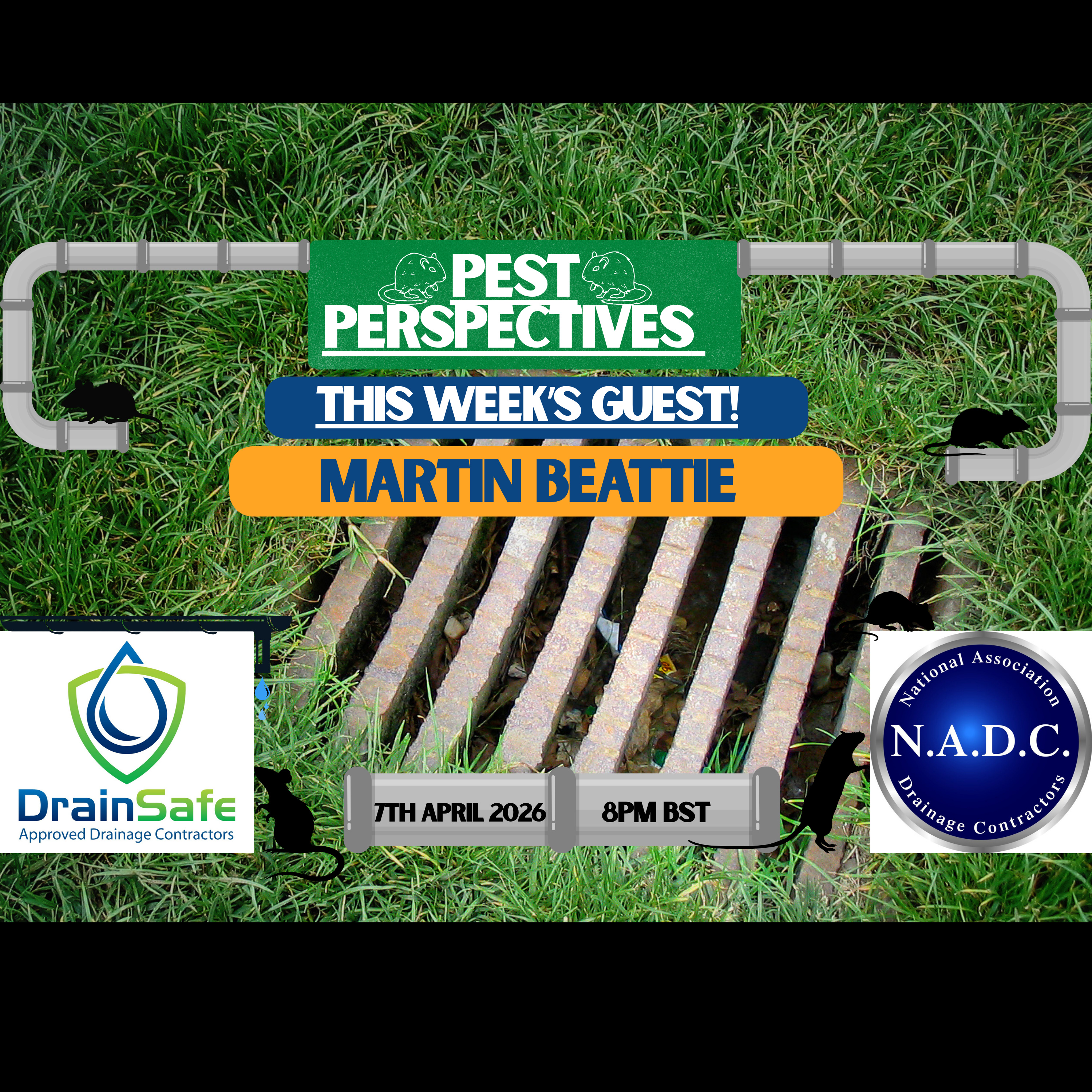
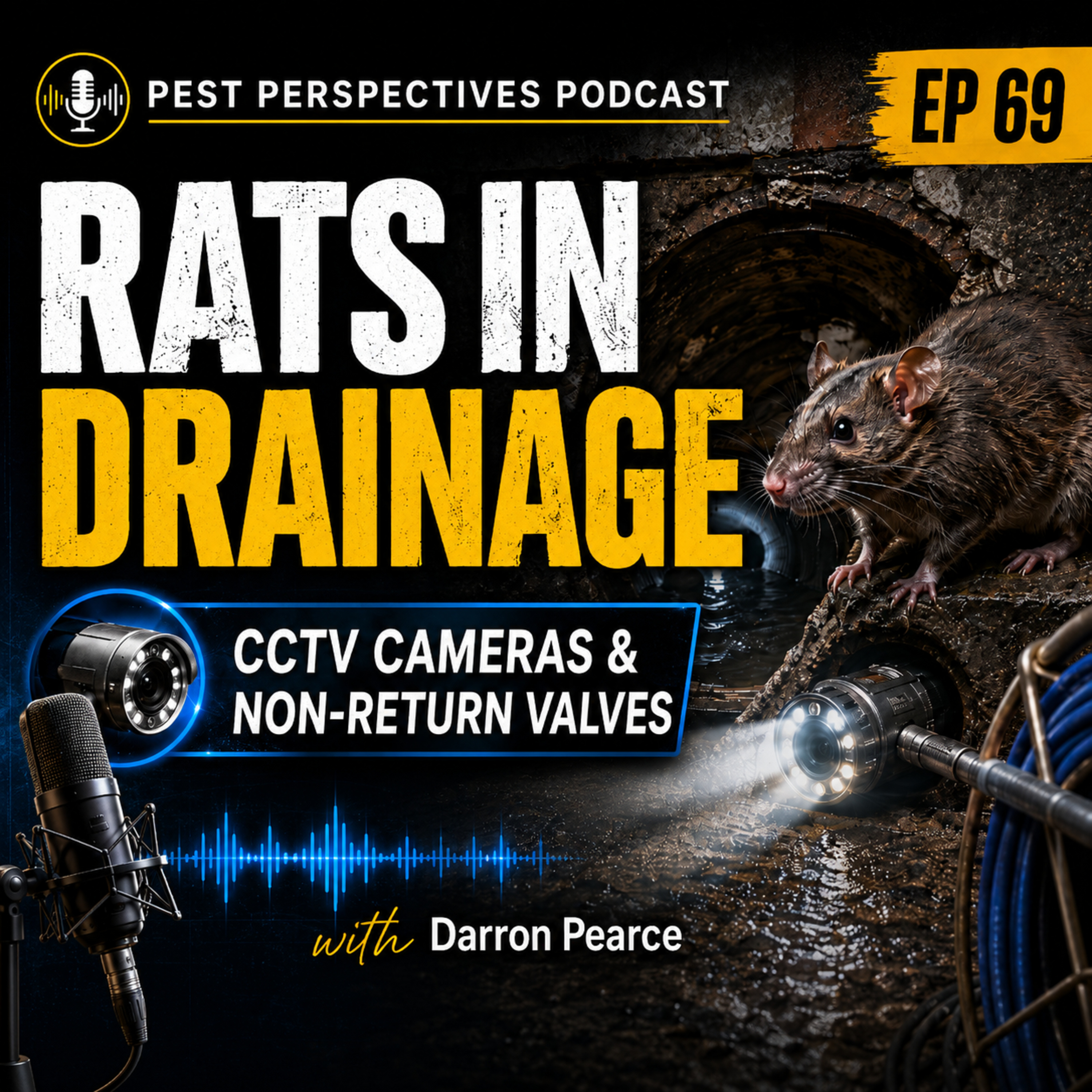
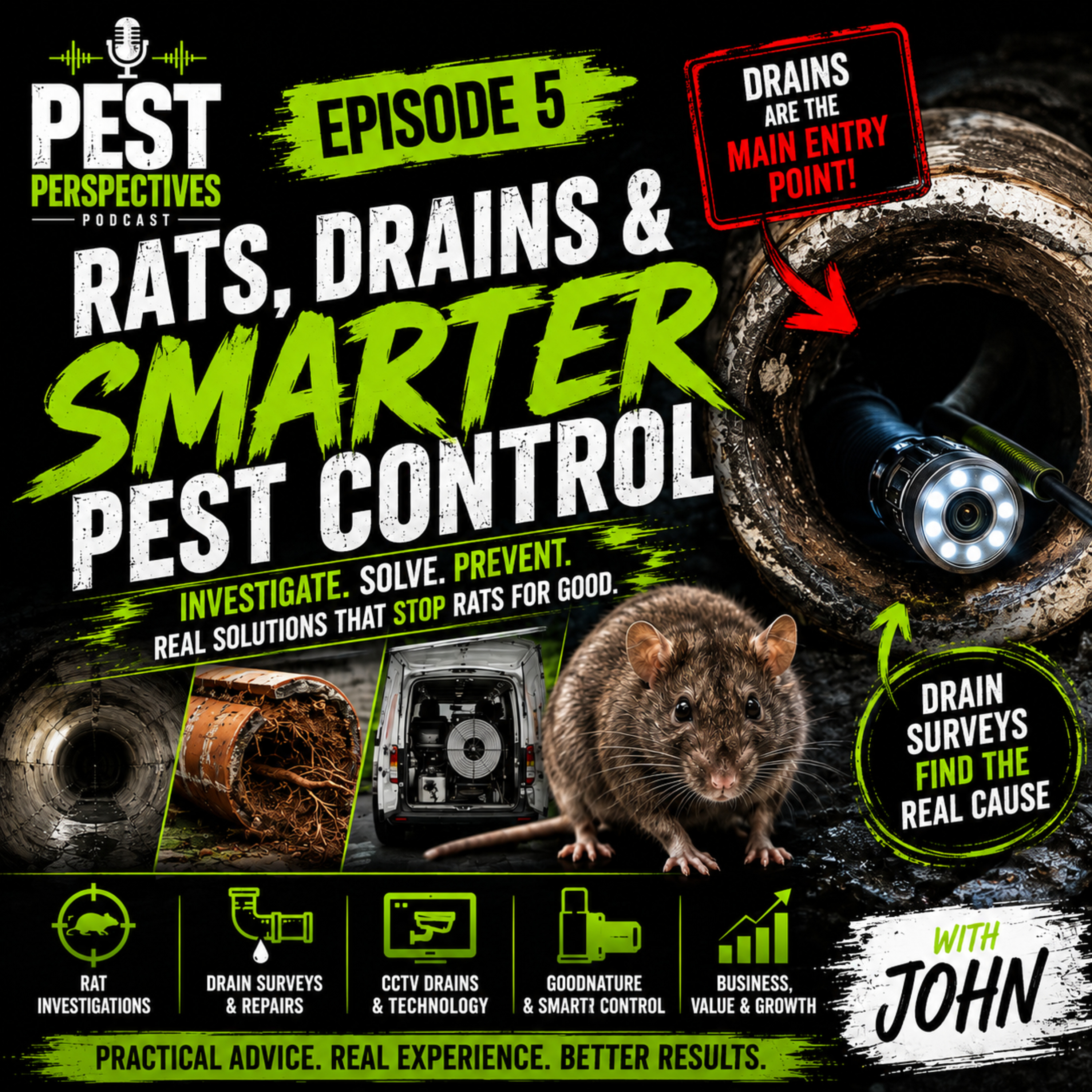
Rats in Drains: CCTV Surveys, Drainage & Pest Control Growth | Martin Beattie
Tonight's Episode
Rats in Drains: CCTV Surveys, Drainage & Pest Control Growth | Martin BeattieWelcome to Pest Perspectives Episode 59.
This week I’m joined by Martin Beattie, Co-Founder and Chairman of the NADC, for an insightful conversation on the connection between rats, drains, CCTV surveys, and pest control.
We talk about why recurring rat issues are often linked to drainage defects, why pest controllers need to understand underground drainage systems, and why proper CCTV survey training, reporting standards, and equipment matter.
We also cover:
- rat ingress and defective drains
- CCTV drain surveys
- training and certification
- drainage law and standards
- health and safety
- confined space risks
- business opportunities for pest controllers expanding into drain investigations
A really valuable episode for anyone in pest management looking to understand the drainage side of rodent control and where future opportunities may be.
Pest Perspectives Podcast is a UK pest control podcast hosted by Shaun Muller of Oakham Pest Control Ltd. The show features practical conversations with pest control technicians, business owners, suppliers and industry experts, covering rodent control, drainage investigations, bee removal, bed bugs, wasps, commercial pest management, compliance, business growth and wider pest industry topics.
Listen, watch and learn more at:
https://www.pestperspectivespodcast.co.uk
Hello and welcome to perspective #60 that's mental to believe that I've been. It's a 60th episode. Sorry about last week. There's a cancellation of guests, but it couldn't be helped. There's a family emergency. But I have now sorted out. I've got a list of backup people and I've got a list of backup content we can talk about. So that shouldn't happen anymore. I will. Rather than just not doing 1, I will, I will get a hold. I've got a few people I can ask and a banking content we could potentially talk about to fill in if it ever happens again.
But the diary is getting quite full. I'm getting, I'm starting to book it up. So if you've got any requests, people obviously be realistic in who you're going to ask me to get. You know, if you want people from chemical pest control, big chemical companies and even ask me because it's not going to happen. I don't seem too keen. But generally a lot of people are. I'm starting to book got that's my fault. I used to be 3-4 months ahead but yeah, getting booked up now. But this week I have Martin from a Co founder and chairman of the NADC.
How are you doing mate? I'm doing well, Sean. How are you? I'm OK, cheers. Good. Thanks for having us. No, it's good. I mean what? This is Martin Spurs live podcast. An actual podcast isn't it? It is indeed. Yeah, and lots of loads of CPD fence like this never live. There you go, you've got one down to you, someone live. So obviously this is a pest control industry podcast and obviously there is a massive link to rats and drains and a lot of people don't think there is obviously people within your own industry Rats need.
I was on that. I did Davies course with I'll Germ and that's one thing he kept saying that people keep people within it 30 years keep telling them rats don't come from the drains, Rats don't live in the sewers and they still say it, you know. Well, it's crazy though, because it's obviously he never mentioned the names of companies, etcetera. You don't want to for legal reasons, but but yeah, there's a lot out there. There is. But yeah. So would you like to tell people who, who you are, what you do and and your company and what you you've been around quite a long time within the drainage industry, haven't you?
I I have had a couple of silly jobs after I left school and about two weeks before my 8th birthday, I managed to get on to Donna Rod. I won't say when that was, it was a long time ago. I done, I think it was about two years, 2 1/2 years with Donna Rod and I left him and I went to work for John Murphy's Big Utilities, contracted doing the mainline servers. I can find a variety of roles there, one of which was sewer winching. Not many people have heard of that and even less have done it, enjoyed that, worked on their combi tankers there as well.
The Vector 82 fives. Some of the older lads that are around will remember them. They were the ones with the big gin. Yeah, combination units, tankers, but they they were unusual to look at because the jet rail was mounted on the front of the lorry, not on the back. Is this where you just blast the drains out of the blocks? Because obviously a lot of people listening won't know what you're talking about. They won't. High pressure jetting but for mainline schools. But the beauty of the beauty of the 825 was it was one of the first where you could jet and sack up at the same time.
So the jetting come off the PTO off the main lorry engine and the vacuum pump come off of a come off a slave or a donkey engine. Then I went to a company called William Titmus. They were boasting can. I'm not far from where I live. They were drainage consultants done about two years, just over 2 years with him back to Dinah Rod and then flipped between Dinah Rod and drain doctor. And then about 25 years ago, I opened up on my own and then it wasn't long into my own business, about eight or nine years when news come to both Peter Stacey and myself, my Co founder at the NADC about Johnson Silas transfer bill.
So we started bringing around contractors around the country and warning people about what was going to be happening. And as a result that that was the spark. That's where the the NADC was born. And from the NADC we found at the advice of death row, we found the National Drainage Academy developed a suite of training courses. So there's training for jetting, electromechanical, excavation, repair, CCTV, which I'll talk about in a little bit more detail at the minute. Patch lining. We've now got a vacuum sank course.
There's a new mapping course coming out very, very shortly and that has to come out. I can talk to you about that in a little bit more detail shortly as well. And then what happened sort of probably about eight or nine years down the line, we were talking to the stakeholders, a lot of stakeholders that we wanted them to engage with the NADC and they said, look, what you really need is an independent approved contractor scheme. So we went off and we've done our research. We spent a couple of years on that as it turned out and fair bit of money.
And that's, that's when Drones Safe was born. So the NADC, National Association of Drones Contractors, it's it's a trade association just like any other. Yeah. People are getting too confused. NADC is a trade association, but Drain Safe is an approved contractor scheme similar to similar to water safe or I suppose even Gas Safe to an extent. OK. So that's where the difference so sort of three fold the NADC, the NDA, the Academy and drain safe.
Why why is talking to pest controllers important? Well, I can tell you now from just the, the year before lockdown 2019, it, it was jibbs and drabs at 1st and then it really, really came on. But we started getting first the odd pest controller on a CCTV course, then there'd be two on the course, then there'd be 3. I banned one last summer. There was 12 on the course, but seven of them were pest controllers. That's interesting. Not one of them was from the same company and what what we're noticing is more and more and more pest controllers are going out.
They're buying cameras and they're attempting to do the CCTV surveys themselves because they can see the obviously the financial benefit of doing so. The problem that I think we're running into is a lot of them, if the truth be told, could really benefit from training, proper training. Now we know David Brown runs his course through Killjerm, which is brilliant. You've said it, I've said it. I learnt a lot from it. I definitely, I mean, you can always learn a lot from baby Brown. Let's be honest, he's, he's forgotten more than most people know, if the truth be told, a very, very good course.
But I think when it comes to drainage systems, understanding drainage systems, understanding components and design, understanding drainage law as well, very, very important. And the full CCTV course, our CCTV course, there's no other in the country like it because our course was written by two, two organisations. First of all, the WRC, the Water research Centre, they're the same people shown who write the book, the MSCC 5 manual, the sewer condition classification. Oh, I've got one of them books.
Yeah, right. The people that wrote that book are the same people that wrote our course that there's one, excuse me, one quite sizeable element within our course, which is about drainage misconnections. And that was written for us by the Environment Agency. So we didn't write that course ourselves. We had it professionally done. And there is no other course in the country where you can sit that course. Get your certification where it's got an NADC, it's got an EU Skills, it's got WRC, and it's got an Environment Agency certification behind it.
And what we're trying to do at the moment is we're trying to educate as much of the pest control industry, those that are buying cameras, if you're going to do these surveys, do them to a recognised professional standard. Yeah, I've had pest control guys in the classroom. I always go around the classroom and I'll ask people what brings you on the coast? Get the feedback. What sort of camera gear are you using? Get the feedback, what reporting software you're using, get the feedback. And what's, what's kind of surprising Sean, is a lot of these guys, they're coming on the courses to professionalise themselves and their own companies, which is a big, big plus, a very big positive.
But then what they're doing is they're going on to places like eBay and they're buying cameras for five, £600 and that just doesn't work. If you're going to be doing professional drain surveys and professional vermin investigation surveys, then you need to be using the proper kit. You should have the proper qualifications behind you. You know, you should be using proper recognised reporting software. And as much as that is lacking in the drainage industry to a degree, it is really sadly lacking in the pest control industry.
And that's something that we would like to change. We would like to see these guys professionalise themselves to the right standard. I can see why to start with why some of them are because they might. Some of them when you start a new service you might get NAF or work and they might just Jack it in because I can't see why they'd probably get a cheaper camera to start with. So in degree. Here's the thing. Pest control. Yeah, Now I know pest control covers a wide range of things. We're talking about insects.
We're talking about bugs. We're talking about Wasps. We're talking about probably stuff that some on you, you can probably barely see it freezing the like. I don't know. I can't imagine, but I would imagine the vast majority of pest control firms out there. I would say the majority can't be all of them, but I would say the majority of them are getting called about vermin rat infestations. And it stands to reason that if you've got a rat in your property, or if you're getting repeated right infestations, the first part of port of coal should be your underground drainage system.
Yeah, I. Mean that's no brainer, but there are pest control firms out there that are coming out and they're treating and they're treating, you know, baiting up and baiting up and baiting up and baiting up. As David Brown always says, prevention is better than the cure definitely is. You know, you need to find the source of how they're getting in. If you can cure that problem, you've you've killed the rat problem because they're confined to the underground drainage system or the local sewerage network, which is, I wouldn't say where they should be, but that's where they tend to reside.
Exactly. It's becoming more, I've noticed it more and more prevalent because obviously that is where they come from. It is not every case, obviously not every case, but sometimes it is 9. A stat that a stat that goes around is 80 to 90% of homes in the UK are drain related. They are routing for stations.
So it comes to it comes to reason why pest control is one that upscale and I totally believe you're right because we do say in the pest control industry everyone should have all the certificates etcetera. Absolutely within you should also. Then I want to do a few more in the future for drains but upskill more. But it's learning what I need to do etcetera. Because obviously when you go online there's loads of different websites. You need to know what information is correct and what called. You can ask people like yourself or Davey what's the best route you can.
Absolutely. I would say to any pest controller out there, if you're even considerate, get onto David Brown's course immediately. You know you will. You will learn so much and you will gain so much knowledge right off the bat. But then if you are going to take it that one step further, if you're going to go out, start spending money on camera gear and the like, then you really need to be sitting in the CCTV course and getting right up to speed with everything that you need to know about underground drainage.
You might not employ it all in the field, but at least you're around with that information. You can, you can talk as with with all the courage and conviction that you, you, you need to talk to any client. Remember in situations quite often you're going to be talking to probably building surveyors. You might be talking to building engineers, you could be talking to Ehos. They're going to want to know that if you've been called in and you're getting paid a fair amount of money to do this job, that you're properly qualified and certified to do the job that they're paying you to do.
Otherwise, what are you? You're you're an amateur with a camera. Nothing more than that.
Yeah, it it, it's a fairpoint because everyone talks about, we talk about an industry how every summer when the Wasps come out, all the window cleaners start doing Wasps nests and everyone moans about it's the same situation really, the Internet. It is. It is. It is so with with with that. Would you recommend if someone was to do full proper drain surveys, we'd recommend Davies course. You'd recommend the CCTV but would you recommend is it the sites of drain surveyors course? Would you recommend that as well?
It is a drain surveyors course. The course that we run is the CDs Certified Drainage Surveyor. I would say that is the same course. That is the course, right? 2 day course and it covers everything that you need to know. Starts off with drainage law, goes into misconnections, goes into components and design, talks a bit about drain cleaning, methods of drain cleaning and the like. And then it goes into actual coding, identifying defects properly, coding defects properly. And you know, there's 54 modules on there and then it goes on.
I mean to, to give you an example now I can't explain this even with my own company accelerating drone services, both down here in London. And maybe you can tell me. I don't know. I've asked about nobody else seems to know, but since lockdown 2020, vermin infestation seems to have skyrocketed. Yeah, it's still. Experiencing the same thing. I would, you know, I wouldn't say Skype where I am particularly, but I would what I would say is since 20, since 2020, well before 2020 rat infestations used to be not in the summer, right, Not in the warm times.
You can still have rat infestations all year round. Doesn't matter what the weather is massively. I'd say since then the populations have rocketed. Hey, look at Birmingham got the mess they're in. You know of all the, all the bidding collections, etcetera, all the rats building up. But you are right. Since since 2020, the, the, the rats have exploded. I have there's more of them and it's where we get them. Even in even in the heat of the wasp season, the rats are the rats are still about, they're still there.
They're not. It's not going down, it's going up. It is. I don't know, it's just my company. I've spoken to other guys that offer the similar service and they're they're in the same boat as I am. They're getting a lot more calls for it now, month by month by month. Yeah, because obviously I tell you the biggest thing we get is
customers. You obviously know what I'm about to say anyway. Yeah, a lot of customers say, we say there's something from the drains. We keep coming back. Obviously this was previous to us trying anything else and I said you need to get a full drain survey, not one off the water board. Oh no, no, I've got one off the water boy, all the drains are fine. I says no, what you that's their drains are fine, not under your house and a lot of them don't end up getting it done. They says, well, you'll just have us back.
I said, but I actually, I actually refused to go back. I said that until you get a full drain survey, I'm not coming back because you're just going to have them for the next 20 years. It's pointless to me coming back. Obviously a lot of people would just still take the bait to take the money. I mean, but the issue I was having was I couldn't get to them wherever they were. They I said to them, you've got to get a full drain survey and a lot of customers must, there must be something on Google that says, yeah, just just ring up your water company.
I'll do it for you for now. Everyone seems to do. Everyone seems to do it. They do. I think, to be honest with you, I'm here in the jungle, drums banging away in the distance. I think the way things are going, and don't quote me on any of this because none of this is official, but I think you'll find that over the course of the next year or two, the water companies will stop offering drain surveys on private drain systems. At the moment, they're still doing it, but I think in the very near future they're going to stop doing that.
And they will be looking, one would imagine, for contractors who are part of an accredited scheme to refer that word to. And I'm not mentioning any names. Yeah, Brainstein. Yeah, you never know. I. Think you might find if you ring your local water company and say I think I've got rats, they'll be saying OK, call in an accredited contractor, get your drain surveyed and once we're satisfied that you beg your drain surveyed and there's no problem on your part of the network, we'll come out and survey our part of the network.
I think that's fair. I think it's more than reasonable. More than reasonable. Can I tell you got us interest in in actually doing that to start with, even getting any interest in drains was we were a kill germ on the road day on the road, a workshop to call them. You know, we go through, you know, like a a load of training and talks, etcetera. And Davey was Davey was talking and it was fascinating. The course was and he mentioned about, I'm sure he mentioned something about what blew my mind was the bit where someone's someone's got a house and I've decided to build an extension.
And it was the bit about messing with it, the the extension and I didn't know there was a law they owned it and all that. And. Next thing and I'll message David saying, let us know when the nearest course is next year and I'll do it. It says, I think for you, it'll be the one that Burton on Trent, come to that one. I'll let you know when, when the dates are available. So I went on it, but that fascinated me and I, I love telling customers that that bit of the law. I was like, right, this is do you have permission?
Do you have this bit of paper? What's that? There's a situation, it's been going on for quite a while, Sean, where people are getting builders in. They're building over local authority, local water company silvers, but the builders that they're using aren't as common as they should be. And what they're doing is they're leaving old pint work in the ground, old manholes in the grand old pint work in the ground that's been broken off, hasn't been capped off properly. And within six months or a year of the extension being built, the next thing you know, they can hear rats in the walls and they're they're under the floor and they're here, they're there.
And it's all down to poor workmanship. Now. We've been talking to organisations like Reba, which is the Royal Institute of British Architects. We've been talking to CAC, which is the Charleston Institute of Architectural Technologists. We're talking to LABC, we're talking to a wide variety of stakeholders, including the water companies, and we're saying if you're applying to have an extension built, you should be having both a pre and a post conditional drain survey.
The preconditional survey is to establish what drainage you've got on your property, where is it, what conditions are in, who does it belong to, to see if you actually need consent from the water company or whether you don't. Some drainage contractors, myself and one of them will offer something called a planning meeting where you can liaise with the architect to help design the new system, the new drainage system layer. But what is absolutely imperative is that a post conditional drain survey is carried out and that's to make sure that that new drainage system has been laid in accordance with the part H of the building regs.
And there are things in the works at the moment where I think, when in fact I don't think I know for a fact that those types of surveys are going to be more stringently enforced. They know when new housing estates are built and they go up so fast. Do these new houses have to have when they put the drain drain systems in? Do they have to have loads of surveys done all the time? They are. They are supposed to have what's called a PC Practical Completion Drain Survey. That's all I'm saying. I'm dealing with a developer at the moment and they've got about four or five sites which are proving problematic.
I was on one of their sites today, I'm on another one of their sites tomorrow. And I can tell you now, PCs were never carried out because the draining systems on these sites are packed out with shingle and builders, rubble and bits of wood and bits of insulation and Christ knows what. And every time we go up to deal with a blockage, we're dragging this stuff out in the trains, we're putting it in buckets, we're photographing it and we're sending it back to them and saying this is what we're pulling out.
And it seems to be on every single shot we go to. Same thing. I just wondered because a lot, I'm not saying all had new housing estates, but a lot of them flood as they build them on floodplains, you know, just, I think the drainage as well as yeah, that. That doesn't help, does it? No, it doesn't. It's like, I'm not the biggest expert in obviously drains, but I've seen drains where I've told them you need to get your drains. My dad, my dad looked at it and he says, you know, when they pushed the toilet and the water goes that fast that the toilet paper is still left, that we've seen that.
And he said, well, it's a bit like now, you know, you can have to get it fixed. But I cost it that point, didn't it? You can get it all redone. We also have, I don't know about other places in the country, but this same organisation I'm talking to you about, same development, they're putting in economy flushes all over the place and economy flushes. If you push the economy flush like the smaller button, which a lot of people don't realise the difference between the two, it's only pushing solidified toilet waste around the track and about a metre or two down the line and it's literally just sitting there.
There's not enough power on the flush to, you know, disperse the waste that's just gone down the toilet. And that in itself is causing problems, too. So I always tell Pete, you've got an economy flush. Always use the full flush, you know. I've only got 1 flush on my toilets. That's fine. You know, I didn't know that. I didn't know these toilets had two different bushes. Yeah, three flush buttons. Yeah, one for wet waste and one for solid.
Getting more more better ways to sell toilets now, eh? It's. All about saving the environment. The reason it come to that we were doing something, we were looking at radish and we were looking at the drains and we rang him like the the the developer. I says we can't even look at his mate. He says he went why? He says, well there's about 6 to 8 foot of water which he made. He says it's full of, you know, everything's down there. Next thing you know, we got, I don't know who we got out, we got company and they cleared it.
But we think it will happen again in a while because we told him what what's happening? The water's going way too fast and leaving the toilet paper yard. So eventually it'll happen again. It will, it'll build up and build up. And that's, and that was a purpose. Load of houses were built and all the houses drains were lower down. But it's other one, it's weird how they've done the drains big time. No need to do it that way. When he sent us the plans, that was reading the plans. It's like these don't line up with what you actually got.
He told the guy and the problem is for a lot, a lot of developers and not, he said that's how you were a builder or anything. I'm just a Tyler mate. We put some money in. I was like, oh, you know. Yeah, playing joins and his builds are often very, very different pictures, Yeah. Yeah, I'm not an expert on it, but like, you know, maybe my dad said that you could have just joined it to the other one out. But he says all the houses are built now. So these issues are your problem. They are. You know they are.
Oh. They are ongoing. Yeah, they are seems to be ever changing landscape and drainage, but it's in it's in every industry. It is the pest control industry is getting more and more, we're getting more and more regulated on what we can do. Certain tools have been removed, whether that's licencing or just by law practises. They are. Is there a in the training industry? It's like is it deemed A regulated industry or is it, is it like regulated industry in a sense that it's not you regulate yourself, so you're supposed to on that.
There, there's no regulation as such. I mean you've got the purer regs under the Health and Safety Act that's provisional in use of work equipment regulations and what it states is and it's quite loose even though it's best the interpretation is, but the long and short of it is if you're using equipment in the workplace, you should be properly trained and certified on that piece of equipment. Now, to give you an example, if you went on to a building site to drive a bumper or a JCB or even the tower crane, you wouldn't get, you wouldn't get to set foot on that site unless you could prove that you had a whole host of competency to do that.
That said, there's people in training companies up and down the length and breadth for this country and probably I imagine around the world that are using what I've been to be very, very dangerous equipment, high pressure jet equipment with absolutely no formal training whatsoever. None. And for the life of me, I, I can't see that in this day and age. I can't see it. That said, when it comes to training, if you ask most Chinese contractors, have they ever done any training at all? Most of them will tell you that they've held a jetting certificate at one time or another.
See, with the with the National Drainage Academy, all of our training goes through energy and utility skills. Yeah. The idea behind that is if you do all of your training, so that's your, your basic health and safety, shear drains and sewers, your jetting, your electronic, your CCTV, your patch lining, your excavation and repair. If you do all of that through US, all of that certification goes on one card. So you don't have to go to 10 or 15 different training providers. You're not walking around with a wallet that thick full of certification cards.
Everything goes on one card and it's all online as well. So you can go on to the USR register, any engineer can put in his name and his 6 digit number, hit the button, his photograph will come up on the screen and all of his valid certification is listed beneath it. And that's one of the reasons why we have done it that way. It's been deliberately structured that way. So make maintaining your engineer's certification that much easier. Oh yeah, That's, that's that's stood that it's it's also crazy to believe that at the same time, if you were an actual drainage company that that you wouldn't have the because imagine if this is how I see it, not from your perspective on about health and safety, but say you haven't got in that training and you your employee dies or gets heavily injured and you look into it.
Where's his training that could get in seriously in trouble. I I had a. Chat with a guy, I'm going back a few years now. He was an assistant caretaker at a school not far from me, South End, and he was called to go to the school. There was a block drain and he was told to help the drainage engineer on the job and the drainage engineer had said to him can you put your foot on that pedal and run my machine and I'm going to go outside and see if I can hear it. Now what he didn't realise was as he had his foot on the machine, the cable was slowly but surely recoiling back into the machine.
Now he couldn't have known that he's never used the machine before but what happened was the cutting blade, which in this instance was an Oxbow U-shaped blade with leading edge teeth on it, slipped out the drain spinning whipped up and caught him in the face. Yeah, when I spoke to him, he had just finished his fifth surgery and he was told that he needed two more. And when the Health and Safety Executive started looking into the incident, it turned out that the guy that was using the machine, no certification at all across the board.
So we had lecture mechanical machines on the van. This is quite a reputable country. If I'd told you the name of this company, you'd know them. You'd know who it is, a national company. But the engineer had absolutely no certification. Not for jetting, not for electromechanical, not for his CCTV, no certification whatsoever. And when they dug deeper, the other 12 engineers on the company, same thing, none of them held any certification. Yet they were using all of this equipment on a day-to-day basis in the field and employing the help of people like this guy who had no clue about the machine.
We'd never seen it before. This is mentor. I imagine though, that he went to court and everything he I can't, can't work now, couldn't. It I did. I did actually ask him to keep me up to speed, but I didn't hear back from him. But I had to feel for him. Yeah, I had to feel. For him, he's lucky because he could have died. It could have got worse. It could have, you know, on his throat. You don't. You could have, you know, could. Have blinded him, could have just as easily blinded him, but he was he he, he was facially scarred, he told me the phone.
Facially scarred for life as a result, but bad enough that he was asked to use the machine, the engineer on site, no certification, so on. As sad as it is to say, it's the same story for an awful lot of drones contractors up and down the country. They're not adhering to the Health and Safety Act because none of them maintain certification on what they're doing day-to-day across the board. Jetting, CCTV, Electro, mechanical, all of these things are dangerous. They all come with their dangers. And you should by law, under the pure regs, have your certification in place, but they just don't.
It's that old, the old knowledge. It will never happen to me. Well, it doesn't happen to you until it happens to you. Yeah, it. Probably won't happen to you, but it happened to one of your employees. Then you're then you're in trouble. Well, I've been checking like that. I've been checking 17 years. When it did happen to me, I only lost the sight my left eye
rushing on a job. Basically, and foolishly, my my jet had been completely antifreeze. I know that because I'd done it two days before Christmas Eve went to so it it was a Trader jet in a Super Series 6, and in my haste to get the job done, I connected the supply hose. The bottom half of the supply hose had frozen water in it. Icy water connected that up to the tap, turned it on and pushed all of that icy water into the jet tanks because it was freezing cold. And I just wanted to get the job done and get back home and put me feet up because it was in the middle of the Christmas period.
Jet whipped up, caught me in the face, smashed all of these teeth. They're not real. Oh, OK. No, no, they're not real. I've got 6 stitches across the front of me lip, 6 stitches behind and I had to attend Moorfield's Eye Hospital every two weeks for about 6 months because they thought they were going to have to operate on the optic nerve at the back of this eye. Do you want to know the crazy thing? My visor was literally 10 feet away from me on the side loading, just behind the side loading door.
My van. The only reason I didn't put it on is because it was freezing wet, freezing cold and soaking wet, and because it was a cold day. I didn't want to put a cold wet riser over my face. If I hadn't had it on, all of that would have been avoided. So believe you me, I learnt my lesson that day. I'm still learning it every day as a result of. It good stories here but not good for you but learning points of people to do health and safety. I, I, I'd tell that story on every training course that I run, every single training course I'll run.
Always use your PPE because it just isn't worth it. It's it's not worth it not to. Someone in on the LinkedIn chat, Martin Wyatt, has said he's adding a membrane inside a drain and accept the acceptable fix if the if if the this damaged joints are found. And membrane if if by a membrane he means a patch or nothing yet. I think that's what he means. I must. He must mean patch line, Yeah? If you mean if if membrane means a patch liner or a thaw liner, then yes absolutely. It has been for 30 years.
That's the question that came up. But yeah, there's a few more. People listen to my podcasts after the fact. They can't catch up with it. They do. So what? So have you got any? Have you got any really, really bad jobs where you've, I hear all these jobs where people have had their cameras capped, caught and they've had to get them out? Have you got any stories on that? Are you? I'm actually saying by by your face. Every now and again, every now and again, your cameraman. Because I, I, I work the computer.
I'm looking at the computer, I'm typing into my laptop. I've got a cameraman feeding the camera for me. Yeah. And I don't know if it's him or me or a combination of two, but they'll get up to a bend, I'll go right, go easy round the bend. They'll go round the bend and everything's great. And then you're halfway through getting the camera around and all of a sudden, clunk, he's like, it's not coming out. And that is when your heart rate doubles and he's on a freezing cold day, beads of sweat are running down.
Because sometimes, I mean, it's only happened to me a couple of times when you've had to start breaking ground to get your camera out. The last time I was on the job at St. John's Wood, that was my fault. Aren't holding to push it round. I shouldn't have done. But it it went round a bend and then straight down the back of a gulley. So it had gone round a hard left and then dropped down and there was no way we were getting it out. And the only thing we could do was get the get the mini breaker out the van, break out the gulley, retrieve the camera and we had to go back the following day and fit a new galley for the gentleman at our own time and at our own expense.
But you know. You don't know a lot about this. You do need to be careful with your cameras and that's one of the reasons why I told Pest controllers as well. Be very careful about what camera gear you buy because if you're not used to camera and if you aren't used to CCTV, you can get yourself in an awful lot of trouble very quickly. You jam a camera in in a pipe underneath somebody's kitchen floor, for example, that's got under floor heating in it, and the only way to get that out is to start breaking that out.
It can work out a very expensive job. The other thing is as well, a lot of people don't realise this with pest controllers. If you're starting to survey drains, you need to be informing your insurance company that that's what you're doing and making sure you're properly covered. Yeah. I will say though, with the the company, Bradshaw and Bennett, if you have their pest control insurance, it does come as as a standard at us. But they've said, I asked them at Pestex and they said as long as you're justifying and using the camera.
But if you were to go in the drain, we have to know. We have to know everything. Give us a ring. I don't know if you ever would go in the drain. I don't know what they meant by if you go in the drain, don't. Get in the drain. Yeah, then you talk, then you're talking. What's it called that law, that rule? Confined space. That's it, confined spaces. But they said, yeah, just let us know. But they said generally if you're just using your camera, you're fine. So you are actually covered, they said. But anything more, they said what you need to ring us and tell us what you can do.
Years ago the policy was when I was young, did you get into a man or if it was up to waist height or or a chamber, you can only get into it if it was only up to waist height because the top half of your body was. At the chamber and you're in the ambient air. The problem with that is as soon as you bend down. The. Ambient air. And you get a. Blowback off the sewer that a lot of people don't realise it, but then gases down there take about 3 to 4 minutes to kill you. So if you're down a nano and you pass out by the time your mate at the top has picked up his phone, called the emergency services, explained where you are and what the problem is, while the time the fireman's coming down the greasy pole, chances are you're already dead.
Yeah, no, you're right. Yeah, that's never want to scare people every week. But it's a factor, isn't it? This is. This lengths do it all the time. We'll be down here 4 minutes. Just nip down here, you'll be all right. And some of these chambers are quite beep. Some of these chambers are quite beep, you know, 2-3 metres, you go down there and you get a blowback off that sewer. The thing is a lot of the gases that will kick catch you at there's no sense to them, there's no smell to them and some of them are more dense, which means you can be standing up and the air you're breathing is relatively OK.
Soon as you just Crouch down, your head goes down into it, you can't see it. All of a sudden you're breathing gas, you're dizzy, bang, you're out, you're unconscious, and the very worst thing anybody at the top can do is come down after you because that has happened on a few occasions and that's multiple fatalities. Really. Well, people have gone in to save them and they've ended up dead themselves. Happened to two brothers in Dublin a few years ago. One of them went down into a big chamber. His brother was sitting up in the van having seen sandwiches and he's calling him, will you come up and have your tea?
Come up and have your tea. And he wasn't responding. So he got out of van and climbed down to see what he was doing and the old fella watching the gate, the old the old bloke on security seen them both go down not come out and his wits about him called the fire service. The fire service showed up and pulled 2 bodies out. Both come.
Two brothers in their 30s. Two brothers in their 30s confined space all the way. That's full gear, that's gas detection, that's harness, that's breathing out the rates emergency BA kit, that's personal gas detection. That alarm will go off. It will go off. Now obviously, I'm guessing they knew they shouldn't be going down there, didn't they? Well, we all know we shouldn't be going down there. But you just pop down and don't. Just undo it. You can be, you can be you, you can be sure 500 or 1000 lads up and down this country today have jumped into a manhole chamber that they knew full well they shouldn't have been getting into, but they've done it anyway.
I know Woody. He's telling me it's common knowledge.
Yeah. You know, I'm just, I didn't know a lot of people died like that, Woody. That was all. I didn't know it was a common thing. I knew that you shouldn't be getting into drains, obviously. About 20 years ago if I'm not mistaken, somewhere in London, 3 legs, one after the other after the other, they all went down. Somebody called the fire service and a market somewhere in London and I think it was one of the market traders. Traders in that instance used to work for the council and see them going down one after the other after the other and he picks up the phone called the fire service fire service come out BA gear winning three fatalities it's.
Yeah, it's shows, doesn't it? It does health and safety, health and safety. Health and safety comes first. Look, nobody comes to work to get injured or killed. And they don't. It just isn't worth it, is it? Certainly don't count the work to get blinded. Don't come to work and lose your teeth. I certainly didn't that day, but my own negligence. That's how most of it happens, isn't it? It's just that moment you lapse and think, ah, OK, I'll do it. And that's split second, yeah. Split second. That's all it took.
A split second to to scar me and injure me the way it did, you know? No, it's, yeah, it's insightful stuff, mate. It really is. It's what's it called. Is there anything else you'd recommend for pest controllers? Any kind of cameras or it's only new cameras coming out of your feature that might help people? I know of pure. I know this for a fact because I'm I intend to buy one myself, but there's one company I'm not don't know if I'm supposed to actually name. 1. Company over another. OK, let me put it this way.
There's one company in particular. A lot of the lads are buying their cameras because they're reasonably priced and extremely reliable. And the locators that they come with, made out of the same company are hyper accurate. But they're bringing out a small. They've got a small camera about half of the size of our main lines. Yeah, came as about 3 1/2 grand, 4 grand I think at the moment, but they're bringing out one. I'm hoping it'd be out before the end of the year, but it's got pan and tilt on the end of it.
But this camera can go out about 30 odd metres and you can record everything to an app as well, which comes with it. And the second that's on the market, I'll be buying 31 for each of my veins. But I would say to the guys, look, don't buy a £500 camera off of eBay. It's all well, a good sound. Well, I'm just getting started. I only want a cheap camera. No, you don't. You want the best camera that you can afford. And when you consider what, what, what does a drain survey, a vermin investigation survey in London round about £350 on a on a domestic.
Yeah, well, you've only got to do 10 surveys and that camera unit has paid for itself. So it's worth the investment. It's worth the investment. And was as much as that equally having the proper training and certification across the board because you want to be able to say to your clients we're qualified, here's our certification, we're using proper equipment. Here is a copy of an example copy for example of one of our survey reports. And you should be using recognised reporting software as well in my view, you know.
But what I can tell you, and I have this one very, very good authority, demand for CCTV surveys is going to go up exponentially over the course of the next three or four years. Exponentially. But that work is only going to be going to companies that hold the correct qualification. It's not going to be going to Joe Bloggs training firm up the road because the bloke there has been doing it five years and he happens to have a camera. No, it will be going to work. That work will be going to companies that meet a specific criteria.
OK. So that's good. To know. If pest controllers up and down the country meet that criteria, they will be in you know they'll be in line for that work as much as the Droneys contractor down the road that's. Good to hear that's an area of growth people could potentially look up. To me that is growth company. That's one company that works there. There's one company here in London, Sean. I trained 2 of their lads in 2019, just just before COVID, and he had one drainage van, 1 camera. I've now trained all of them, that same pest control company.
At the last count they had nine drain, 9 drain cameras, 12 vans and nine of their vans had a drain camera. All of their lads, all fully certified, all of their reports to WRC standard and then making a fortune. An absolute fortune. It's good because it's a growth area that can potentially be tapped into. Martin. Martin White's saying he's going to get himself on the next course. Then Martin White's just put I'll get myself on the next course. Then I don't know which course he's referring to. It's CCTV.
I imagine CCTV and you know. Further to his early question, when he asked about the membrane, he did put, he had a recent job that he was on and he's saying that the membrane fix fixing the damaged joint didn't help with the flow. What was it Martin? I don't know if you can hear me. I imagine you can. Was it a WRC approved patch liner? Would like get a professional droneage contractor come out and fit a patch liner? Is that what you mean by membrane? Yeah. Because the patch liners, they're actually quite thin, but they're extremely strong, yeah.
No, he's, I'll, I'll see if he comes back to me on that. But no, there's been some great information on the podcast. I'm sure it's really helped people, and no, I'm sorry. I would hope so. Yeah, yeah, He wants to go on the Yeah, right.
CCTV. Yeah, well, look, give me a call. I'm easily found. Oh. And I'm on LinkedIn. He's, he's got, yeah, he's on LinkedIn. I'm on LinkedIn, the NADC logo is on my on my LinkedIn thing. So you you'll know it's me just and I would invite anybody that wants to connect with me on LinkedIn. Anybody that's watching now in the future, feel free to do so. I'll get people connecting with me. I've got 8 what, 8 1/2 thousand people following me there now.
Dream territory. I wish I could be. I'm nearly at 2000. I am. Well, it's just taking a while for that to build up, I can assure. You imagine it has, Yeah. Every time I logged in, there's four or five people that want to connect with me and I'm very choosy about who I let to connect. As well. I used to let everyone in. I used to, but now I don't anymore. A lot of people are just trying to connect because they want to sell you stuff. They want a lot of time, but they want they want a job offer me.
For some reason they do. I'm yeah, I'm a bit more choosier with connections. Not obviously followers follow you, but yeah, but they want inside your connections, don't they? But I have my connections set so you can't see them. I tell them I know I did. Yeah, but yeah, no. Thanks for coming on. And do you want to? I will. I will put your information in the description as well. Do you want to promote promote any courses or anything on on the? I would say, I would say to any pest controller, I would say this, if you're going to go into vermin surveys, there's never been a better time to do it.
But make sure A, you're using the right certification. Yeah, So C baby brand C me, B, make sure you're investing in the proper camera gear because you don't want to invest, you know, 500A grand, 52 grand in something that is not much use to you 3-4 months down the line. Buy the right gear from the start. Yeah, yeah. And make sure that you're reporting to a recognised standard. And if you tick all of them boxes, you should do well. There's no reason why you shouldn't do well. Well, you've said there's proof of that with this London pest control company.
It's now gone to 9. There is there is an area there for growth. OK, let's be fair, it's taken them seven years to get there. It's still good though for someone to expand to sector 9 when they probably do, you know, past other pest control services too. So there must be a fairly, fairly large company. I would say I would. Well they're, they're running 12 vans in the London area, so you know, 9 cameras, 9 cameras on 12 vans at the last camp. I would say it's working out very, very well for them. Proofs, yeah.
And there is. So there is room for growth there. But yeah, it's been an interesting chat. I'm sure you'll probably get a lot of interest from from the podcast because I'll, I'll put it up by Apple Podcasts and Spotify. It goes nearly everywhere. You can get a podcast, but now you can add on, tell everyone you're doing the seminars and courses online. You've now done a live podcast as well. Live. Podcast, yeah. There you go. You you've ticked ticked it off on your bucket there, so don't think it was on.
That very soon Yeah, you will. Well, listen, Sean, it's been a pleasure to be here. Pleasure to talk to you and the wider pest control network and thanks a lot for having me on. I appreciate. It Yeah, definitely. So thanks everyone. I'll see you all next week. You just stay on the line for a minute, Martin. I'll just end the stream. All right. Thanks everyone, and I'll see you next Tuesday.
Sponsored by



 Amazon Music
 Apple Podcasts
 Audible
 Castbox
 Castro
 Deezer
 Goodpods
 Moon FM
 Overcast
 Pocket Casts
 Podbean
 Podcast Addict
 Podcast Republic
 Spotify
 YouTube